
Clearing the Fog of ‘Unprovoked’ War
IN FOCUS, 4 Sep 2023
Edward Lozansky, Ph.D. | Antiwar - TRANSCEND Media Service
9 Aug 2023 – For the record: I was born in Ukraine, studied in Russia, and worked in the USA as a laser fusion researcher and Professor of Mathematics and Physics. I have relatives and friends in all three countries, and for the last 35 years, I have been trying to do my best to make them friends, partners, or even allies. Instead, all three are now at war, even if some call the U.S. war only a war “by proxy.”
This looks like a total failure of my efforts, but I hope this short summary clears a bit the fog of war, which might help in the search for avoiding a worst-case scenario.
I think I was the first one to recognize the independence of Ukraine from the Soviet Union back in December 1976, i.e., 15 years before Ukraine got its actual independence after the collapse of the USSR in 1991. This happened at the U.S. Embassy in Vienna, Austria during my application for an entrance visa. Vienna was my first stop after expulsion from the Soviet Union for dissident activities. My major “crime” was the distribution of the underground literary magazine “Kontinent,” which was a leading publication of Russian pro-democracy forces. It was founded by Nobel Laureate Alexander Solzhenitsyn, edited by writer Vladimir Maximov, and both had been expelled earlier. Magazine was printed by German publisher Axel Springer, and then smuggled into the USSR where at that time distribution of such literature could get you thrown in prison, mental institution or out of the country. In my case it was the latter, due to high-level family connections — but this is another story.
The visa application form included a question about my place of birth, to which I answered “Kiev, Ukraine.” Embassy officials didn’t object, and this information was later used in all subsequent documents, including my first U.S. passport after I got my citizenship.
The end of the Soviet Union also ended the Cold War, the smell of freedom could be felt all over the new Russia. But in my case, it happened even a few years earlier, when in October 1988 I got a call from Soviet President Gorbachev’s science advisor Yuri Ossipyan, who was also a Vice-President of the Soviet Academy of Sciences, and Member of the U.S. National Academy of Engineering. Yuri and I knew each other back in Moscow, where I was working as a nuclear physicist. He invited me to discuss various ideas for improving relations between the two countries. Taking into account my background, including TV interviews and publications in the U.S. media highly critical of the Soviet Union, this was quite unexpected. Nevertheless, I decided to accept, and in Moscow, I was introduced to many Soviet VIPs, and later to Gorbachev himself. The summary of these meetings can be expressed as follows: Moscow is constantly sending proposals to Washington asking to significantly expand the agenda for cooperation beyond arms control, but it doesn’t get an adequate response, only bureaucratic verbiage. Therefore, they made a decision to engage in what is called two-track diplomacy, sometimes called “people’s diplomacy” or “back channels.”
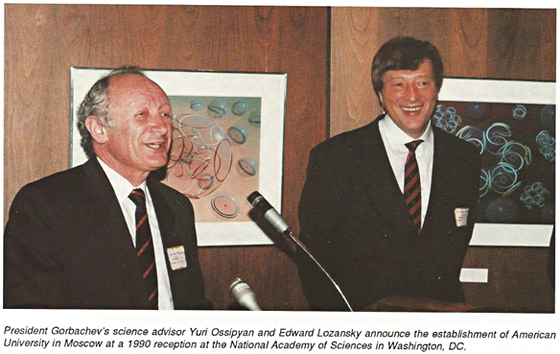
I liked the idea, and we agreed to exchange visits by Russian and American delegations to formulate concrete proposals. It was a huge effort that included many back and forth trips, exploring areas starting from business, science, education, culture, medicine, agriculture to space, security, military, etc.
The mayor of Moscow provided a downtown mansion for our office, while in Washington money was raised to buy a townhouse in Dupont Circle area for the same purpose. Both buildings placed American and Russian flags on their outside walls, and in Washington it was named “Russia House” where we installed on its front a bust of Andrei Sakharov, the famous Russian nuclear physicist, Nobel Peace Laureate who was praised in the West but persecuted by the Soviet authorities until pardoned by Gorbachev.
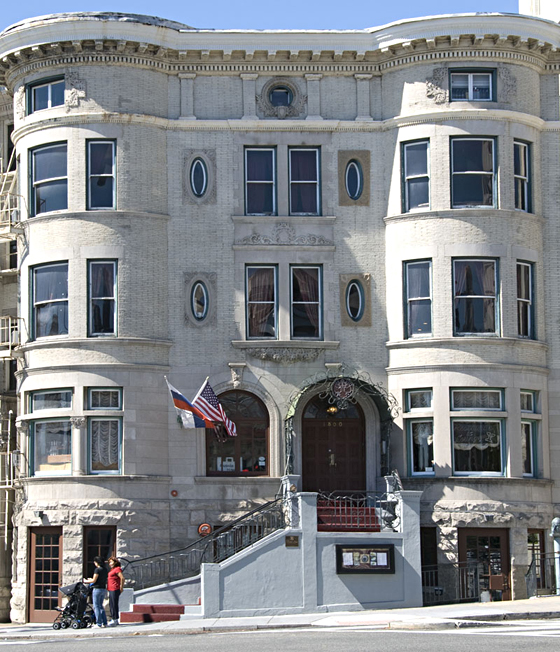
Drafts of our “Track Two” proposals were discussed during regular U.S.-Russia forums on Capitol Hill and at the Russian Academy of Sciences, with participation of Members of Congress and the Russian Duma deputies, as well as with government officials, and experts in particular fields of both countries.
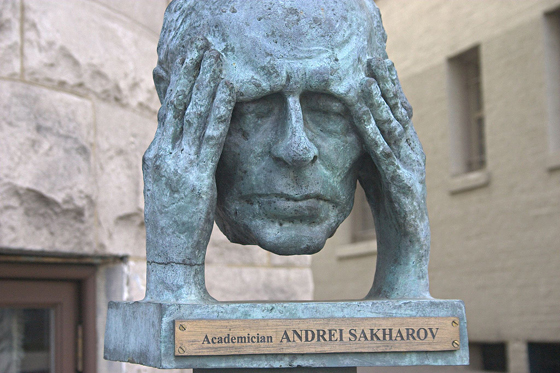
Some of us had direct talks in the White House with President George Bush, Sr., his Vice President, Dan Quayle, and in the Kremlin with Gorbachev and Yeltsin, who became Russian President after Gorby resigned on December 25, 1991. Even the U.S. mainstream media, including the New York Times and the Washington Post wrote laudatory articles about our activities at the time,
To celebrate 1992 New Year’s Eve, we brought about 300 American businessmen, some with their families, to the Kremlin where they were joined by the Russians Who’s Who and U.S. Ambassador James Collins. The following day the Americans were invited to different Russian homes to continue our celebrations and pledge friendship and cooperation. U.S. ratings among Russians at that time were well over 80%. In a symbolic gesture, Moscow State University transferred their Communist Party office to the recently registered American University in Moscow (AUM). Moreover, the mayor of Moscow transferred to AUM a downtown mansion which had previously housed the Communist Party’s young leaders’ school, plus a 200-acre estate that held previously country houses (dachas) of Members of Politburo, including Brezhnev’s, for our future campus.
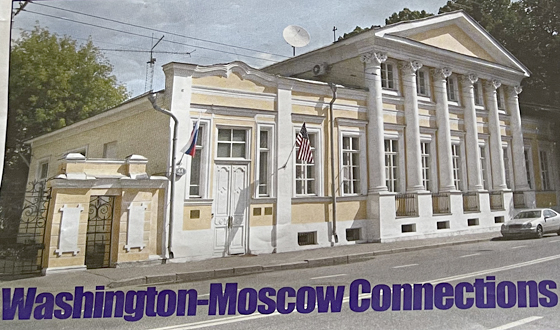
Vice-President Quayle sent me a personal congratulation letter on behalf of President Bush, and in Congress a large bipartisan coalition was working on a bill to fund this university. I didn’t forget my home country, and at the same time, was working on the establishment of American University in Ukraine as well.
The good times had arrived, the sky was the limit, and my dreams were coming true. Many exiles, including Solzhenitsyn and Maximov were returning to Russia, so did magazine “Kontinent”, where it got direct financial support from both, Moscow Citi government, and the U.S. Embassy. My wife and I were placed on the Embassy’s receptions guest list.
As it turned out – whoops, not so fast. While some Americans, whom I shall call the “good guys,” were ready to turn former foes into friends, partners, and allies, the “bad guys” from other powerful groups had different ideas, which had been described a few years earlier by a less naive and more realistic thinker, a distinguished American diplomat, and former U.S. Ambassador to Moscow George Kennan: “Were the Soviet Union to sink tomorrow under the waters of the ocean, the American military-industrial establishment would have to go on, substantially unchanged, until some other adversary could be invented. Anything else would be an unacceptable shock to the American economy,” – said Kennan.
Still, with George H.W. Bush in the White House the “good guys” had some leverage, but after Bill Clinton won the 1992 elections the Washington foreign policy establishment, sometimes called the “deep state,” was not interested in our work. The euphoria about winning the Cold War, and the dawning of what they saw as an era of a unipolar world under total American leadership, some called it hegemony, made them believe that Russia and her interests were no longer relevant. In their calculations, from now on, Moscow would have no choice but to obey orders from Washington since it had nowhere else to go. As Kennan predicted, our ideas of mutually beneficial business and security cooperation were largely ignored.
Worse than that, under the leadership of Clinton-Gore and their top Russian advisor, Strobe Talbott, the greatest robbery of the 20th Century under the “Bandit Capitalism” system had begun. There are many stories with the details of this robbery, including Congressional Report “Russia’s Road to corruption,” prepared by a group of Members of Congress. This is what one of the most outspoken critics of Russia, who can be hardly called a Putin apologist, said in his article titled “Who Robbed Russia?”: “What makes the Russian case so sad is that the Clinton administration may have squandered one of the most precious assets imaginable — which is the idealism and goodwill of the Russian people as they emerged from 70 years of Communist rule. The Russia debacle may haunt us for generations.”
Even worse than that, at the same time, Clinton and Talbott also started the push for NATO expansion, including Ukraine, to which many strategically thinking Americans strongly objected. Among them was the above-mentioned George Kennan, who called it a “fatal foreign policy mistake,” majority of members of the Arms Control Association, 19 U.S. Senators, and many others. New York Senator Daniel Patrick Moynihan said that “NATO expansion would open the door to future nuclear war.”
Our Ukrainian friends had a different agenda which we’ve been trying to publicize in Washington. The summary of this agenda is as follows: Free from the communist yoke, having strong industrial and agricultural sectors, a favorable climate and fertile land, Ukraine had great potential to become one of the most prosperous European countries. Effective anti-corruption reforms, a certain level of autonomy for the regions with large Russian ethnic population, and neutral status with no membership in any military blocs would have made Ukraine definitely a happy and prosperous state.
In May 1993 we organized a trilateral meeting on Capitol Hill with legislators from the U.S. Congress, Russia’s Duma, and Ukraine’s Rada to discuss what the U.S. were prepared to do to help Russia and Ukraine in their difficult transition from communism to democracy thus bringing them to our fold.
Congressman Tom Lantos of the House Foreign Affairs Committee, who chaired this meeting, said that had Gorbachev told us in 1989 that he was prepared to dissolve USSR and the Warsaw Pact – and requested a trillion dollars to do it – Congress would most likely have agreed, authorizing 100 billion annually for a period of 10 years. However, as it turned out, the Russians did it all by themselves. So why spend U.S. taxpayers’ money when the job is already being done? “You are on your own, guys,” said Lantos. CIA director James Woolsey and other Members of Congress who spoke afterward more or less repeated the same lines.
If that message sounded cynical, well, foreign politics always is. But it was also a bit misleading since the U.S. did not leave Russia and Ukraine alone, Yankees didn’t go home. Billions of American tax dollars were poured in Ukraine, not to boost its economy but to reformat public opinion that was predominantly in favor of neutral status and against joining NATO.
It was Assistant Secretary of State for European Affairs Victoria Nuland who admitted that “We have invested over $5 billion to assist Ukraine in these and other goals that will ensure a secure and prosperous and democratic Ukraine.” In reality the purpose of this money was to drive a wedge between the two Slavic nations, and push Ukraine into NATO.
This money, plus funding from George Soros, Canada, and other Western countries, helped to instigate the “Orange” color revolution in 2004 to bring a pro-NATO government into power. They succeeded but the anti-NATO mood in the country remained strong. Therefore, a second revolution was needed. This time its name was “Maidan,” and it was Victoria Nuland who coordinated it on location in Kiev while constantly reporting and getting input from then-Vice President Joe Biden, to whom Obama gave the Ukrainian portfolio.
All the media attention in her leaked phone call with the U.S. Ambassador Geoffrey Pyatt discussing the details of the coup two weeks before it actually happened on February 22, 2014, was concentrated on her expletive language insulting the EU. However, almost totally ignored is that a few seconds later she also mentioned that she is constantly discussing her work with Sullivan, and added that “Biden willing.”
Needless to say, that the new Ukrainian government that was selected by Washington immediately declared its intention to join NATO.
There is no doubt, that if not for this coup, there would be no war in Ukraine today but in line with the disgraced “Russiagate” narrative it’s no surprise that the White House, a bipartisan majority in Congress, and think tanks that are funded by the military-industrial complex are blaming it all on Russia.
One should note that the position of the U.S. mainstream media is especially disgraceful. Ashley Rindsberg in “The Spectator” called the anti-Russian hysteria the “media’s Vietnam.” She bitterly writes that the crusade against Russia has become “the raison d’etre of the mainstream, so important that it has forced some of the most famous publications in the country to openly renounce cherished journalistic values such as objectivity and neutrality.”
I think that what is happening now in Ukraine is worse than American wars in Vietnam and the Middle East, starting with Iraq and on. At that time, one at least could use a fight with communism or terror as a pretext. Here we see a policy of provoking, funding, and prolonging a war between two Christian nations that lived together for over three centuries and are bound together by close historical, religious, economic, cultural, and family ties.
If not for the Biden-Nuland coordinated coup to remove the democratically elected Ukrainian president in February 2014, that country would still retain its full territory, including Crimea.
Despite constant use of the word “unprovoked” the current war was indeed provoked by the U.S. and NATO. It denigrates not only the principles of a democratic country but contradicts the basic spirit and soul of America itself. There is no democracy in Ukraine, which Washington pledges to protect as long as it takes, and Russia is not planning to invade any other country. As any other nation, it does want to take its security interests seriously. In this particular case to insist that the pledge given to Gorbachev “not to expand NATO one inch East” is honored.
One phone call from Biden to Putin prior to February 24, 2022, with a pledge to guarantee Ukraine’s neutral status would have ensured there would be no war. Russia’s other security concerns could be then negotiated in a calm working atmosphere.
It is obvious, and no one is hiding the fact that collective West under current U.S. leadership wants to inflict a strategic defeat on Russia without going to war directly but rather by using Ukrainians as cannon fodder. How all this corresponds to Western, or in broader terms Judeo-Christian, values are hard to explain. Besides, according to Russian military doctrine, in case of the approaching of such a defeat Moscow would use nuclear weapons.
Frankly, being an optimist by nature, in this case I don’t feel too many glimpses of hope in avoiding what Senator Sam Nunn, former Secretary of Defense William Perry, along with many other leading American experts, the process of “sleepwalking into nuclear catastrophe”
All of the above might be viewed as “voice in the bewilderment” but I hope it will at least add a few new folks to the “good guys” list, and this subject will take precedent in the upcoming presidential campaign.
___________________________________________
 Edward Lozansky is president of the American University in Moscow. He is the author of the book Operation Elbe, which describes joint US-Russia anti-terrorist efforts.
Tags: Proxy War, Russia, USA, Ukraine, Warfare
DISCLAIMER: The statements, views and opinions expressed in pieces republished here are solely those of the authors and do not necessarily represent those of TMS. In accordance with title 17 U.S.C. section 107, this material is distributed without profit to those who have expressed a prior interest in receiving the included information for research and educational purposes. TMS has no affiliation whatsoever with the originator of this article nor is TMS endorsed or sponsored by the originator. “GO TO ORIGINAL” links are provided as a convenience to our readers and allow for verification of authenticity. However, as originating pages are often updated by their originating host sites, the versions posted may not match the versions our readers view when clicking the “GO TO ORIGINAL” links. This site contains copyrighted material the use of which has not always been specifically authorized by the copyright owner. We are making such material available in our efforts to advance understanding of environmental, political, human rights, economic, democracy, scientific, and social justice issues, etc. We believe this constitutes a ‘fair use’ of any such copyrighted material as provided for in section 107 of the US Copyright Law. In accordance with Title 17 U.S.C. Section 107, the material on this site is distributed without profit to those who have expressed a prior interest in receiving the included information for research and educational purposes. For more information go to: http://www.law.cornell.edu/uscode/17/107.shtml. If you wish to use copyrighted material from this site for purposes of your own that go beyond ‘fair use’, you must obtain permission from the copyright owner.