



Gaza Humanitarian Foundation Calls It Quits After Murdering Thousands Who Sought Its Aid
IN FOCUS, 1 Dec 2025
Jonah Valdez | The Intercept - TRANSCEND Media Service
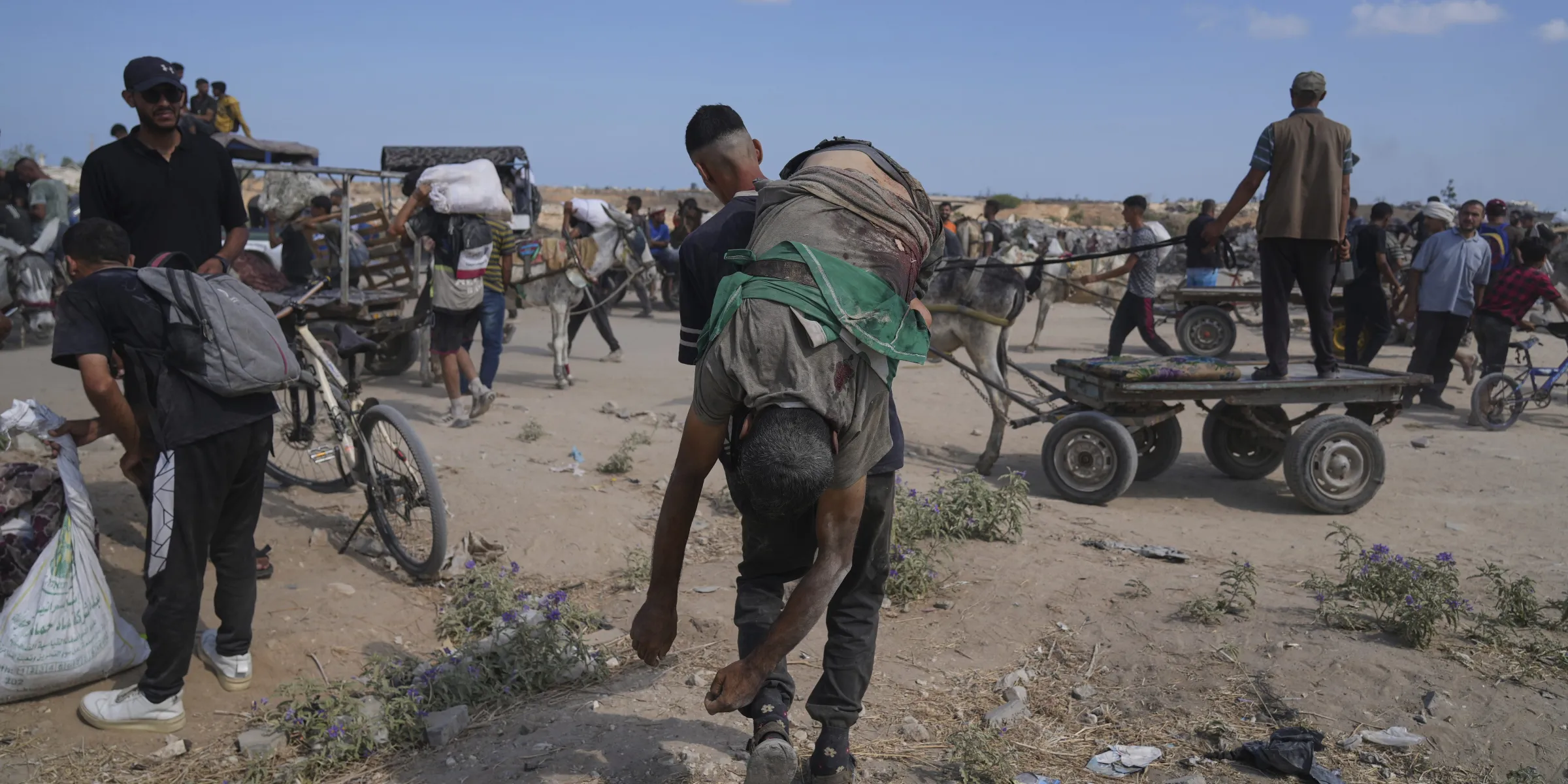
A Palestinian carries the body of a man killed while trying to receive aid near a distribution center operated by the U.S.-backed Gaza Humanitarian Foundation in Netzarim, in the Gaza Strip, on 4 Aug 2025.
Photo: Abdel Kareem Hana/AP
The aid group oversaw relief in Gaza during a period defined by sniper killings of Palestinians lured to receive food during famine–a criminal enterprise.
25 Nov 2025 – As the U.S. and Israel-backed Gaza Humanitarian Foundation announced its closure of operations in the territory yesterday, the organization tabulated its “success” by stating it delivered 3 million boxes of food “directly to civilians living in Gaza,” which, by the organization’s count, equals 187 million meals.
Another way of measuring GHF’s achievements is by counting the hundreds of Palestinians killed while trying to access such aid and the hundreds more who died of starvation-related conditions amid famine when GHF was the only organization allowed to deliver aid.
Since May, when Israel ousted long-standing aid providers and made GHF the lone distributor in Gaza, Israeli soldiers and American subcontractors have killed nearly 3,000 Palestinians seeking aid, according to a September tally by Gaza health officials. The vast majority were killed at GHF sites. Doctors Without Borders dubbed the GHF distribution points as “sites of orchestrated killing” after its medical teams cared for nearly 900 patients wounded at the four GHF hubs.
“On every dimension, on every indicator, I’d consider it a failure.”
In August, the Integrated Food Security Phase Classification declared a famine in Gaza City. GHF did not expand its operations beyond its four distribution sites. Within the famine’s first month, at least 175 Palestinians died of starvation, a likely undercount.
“The GHF model is one of the worst ‘aid’ — and I use ‘aid’ in quotes — models that’s been tried in the 21st century, if not longer than that,” said Anastasia Moran, advocacy director at MedGlobal, a Chicago-based medical aid organization that has teams inside Gaza. “On every dimension, on every indicator, I’d consider it a failure.”
Since March, Israel’s government has blockaded the entire Gaza strip in violation of international law, creating famine conditions across the territory. The Israeli government, with funding from the U.S. government, appointed the newly formed GHF to oversee all aid distribution in the territory in May. The Swiss-based organization was first run by Jake Wood, a former American sniper turned aid worker, who quit within two weeks after stating the foundation did not adhere to basic humanitarian principles of neutrality. GHF’s chair is Johnnie Moore, an evangelical minister and former religious adviser to the Trump administration.
Built on the Israeli misinformation campaign claiming Hamas was seizing and controlling most aid in Gaza, debunked by both U.S. and Israeli intelligence, the GHF model cut out the United Nations and all international NGOs, insisting it could deliver enough food to slow the worsening starvation conditions. The U.N. previously operated 400 aid sites throughout Gaza.
Rather than maintain the existing model of bringing food and supplies to individuals with most need by delivering goods directly to communities, GHF established four distribution sites. The foundation also hired two American logistics and security firms — UG Solutions and Safe Reach Solutions, led by a Green Beret veteran and former CIA officer, respectively — to oversee distribution. The result was the funneling of thousands of desperate people who traveled long distances into aid sites where long lines often devolved into stampedes. Gunfire from Israeli soldiers, or private American contractors, largely former U.S. special forces, was a near-daily reality. While some of those who survived the deadly queues managed to bring home boxes of food, the supplies failed to slow the famine conditions across Gaza which only worsened. The food provided by GHF was widely criticized by nutritional experts and aid groups as inadequate to prevent hunger and difficult to prepare (most items needed water to boil, itself a scarce resource in the territory).
The model amounted to simply another tool of war by the occupying Israeli forces.
“The GHF is a symptom, it’s not the problem,” said Scott Paul, Oxfam America’s director of peace and security. “The GHF is only relevant because people weren’t allowed access to food in ways that were safe and humane. In this way, the GHF is an entity occupying negative space, and the negative space is the deadly siege that the government of Israel has imposed for most of this year.”
“GHF is an entity occupying negative space, and the negative space is the deadly siege that the government of Israel has imposed for most of this year.”
The Israeli government continues to block aid into Gaza in violation of the recent ceasefire agreement. While the U.N. has been able to deliver some aid into the territory, Israel continues to restrict major NGOs from delivering aid, blocking more than 100 aid delivery requests in the first month after the ceasefire started on October 10, according to the U.N.
Oxfam, for instance, has $2.5 million worth of goods, including food and supplies to make water safe to drink, waiting inside a warehouse in Jordan, Paul said. Similarly, MedGlobal has said its shipments of medical goods are being prevented from entering Gaza.
While it wrapped its operations in Gaza, GHF said Monday it would not forgo its NGO status and pledged to “maintain readiness to reconstitute if new humanitarian needs are identified.” The foundation added that it is working to expand its model with the the Civil-Military Coordination Center, a base in southern Israel operated primarily by the U.S. military, meant to oversee aid distribution and the rebuilding of Gaza. The joint command base, or CMCC, is seen as the precursor to the eventual Trump-led Board of Peace that will govern Gaza’s rebuilding. The plan to form the Board of Peace, a key part of Donald Trump’s 20-point plan for Gaza, was codified into international law last week in a controversial U.N. Security Council vote and excludes Palestinian voices from the process. The plan ignored a previous U.N. resolution that called for the end of Israel’s occupation and creating a path to Palestinian statehood.
Aid groups are concerned that the GHF’s tactics would be replicated by the Board of Peace in Gaza and in other conflict zones across the world. They fear it normalizes private logistics and security firms managing humanitarian aid to turn a profit. In June, an American contractor group comprised of American military veterans airdropped supplies in South Sudan. And in Gaza, UG Solutions, an American contractor group that guarded GHF sites, inked a new deal with lobbyists tied to Trump. The group said it intends to remain in the region to continue its work. Among U.S. plans leaked in recent weeks includes the construction of Israeli-controlled, fenced “alternative safe communities” — essentially camps — within Gaza where displaced Palestinians would be moved into housing with access to aid.
“My biggest fear,” Moran said, “would be if anyone looked at GHF and thought this is a model that should be tried elsewhere.”
Update: 25 Nov 2025
The story was updated to include more information on the food supplies provided by the Gaza Humanitarian Foundation.
Go to Original – theintercept.com
Tags: Crimes against Humanity, Gaza, Gaza Humanitarian Foundation GHF, Genocide, Israel, Massacre, Palestine, USA, War crimes
DISCLAIMER: The statements, views and opinions expressed in pieces republished here are solely those of the authors and do not necessarily represent those of TMS. In accordance with title 17 U.S.C. section 107, this material is distributed without profit to those who have expressed a prior interest in receiving the included information for research and educational purposes. TMS has no affiliation whatsoever with the originator of this article nor is TMS endorsed or sponsored by the originator. “GO TO ORIGINAL” links are provided as a convenience to our readers and allow for verification of authenticity. However, as originating pages are often updated by their originating host sites, the versions posted may not match the versions our readers view when clicking the “GO TO ORIGINAL” links. This site contains copyrighted material the use of which has not always been specifically authorized by the copyright owner. We are making such material available in our efforts to advance understanding of environmental, political, human rights, economic, democracy, scientific, and social justice issues, etc. We believe this constitutes a ‘fair use’ of any such copyrighted material as provided for in section 107 of the US Copyright Law. In accordance with Title 17 U.S.C. Section 107, the material on this site is distributed without profit to those who have expressed a prior interest in receiving the included information for research and educational purposes. For more information go to: http://www.law.cornell.edu/uscode/17/107.shtml. If you wish to use copyrighted material from this site for purposes of your own that go beyond ‘fair use’, you must obtain permission from the copyright owner.
Join the discussion!
We welcome debate and dissent, but personal — ad hominem — attacks (on authors, other users or any individual), abuse and defamatory language will not be tolerated. Nor will we tolerate attempts to deliberately disrupt discussions. We aim to maintain an inviting space to focus on intelligent interactions and debates.