


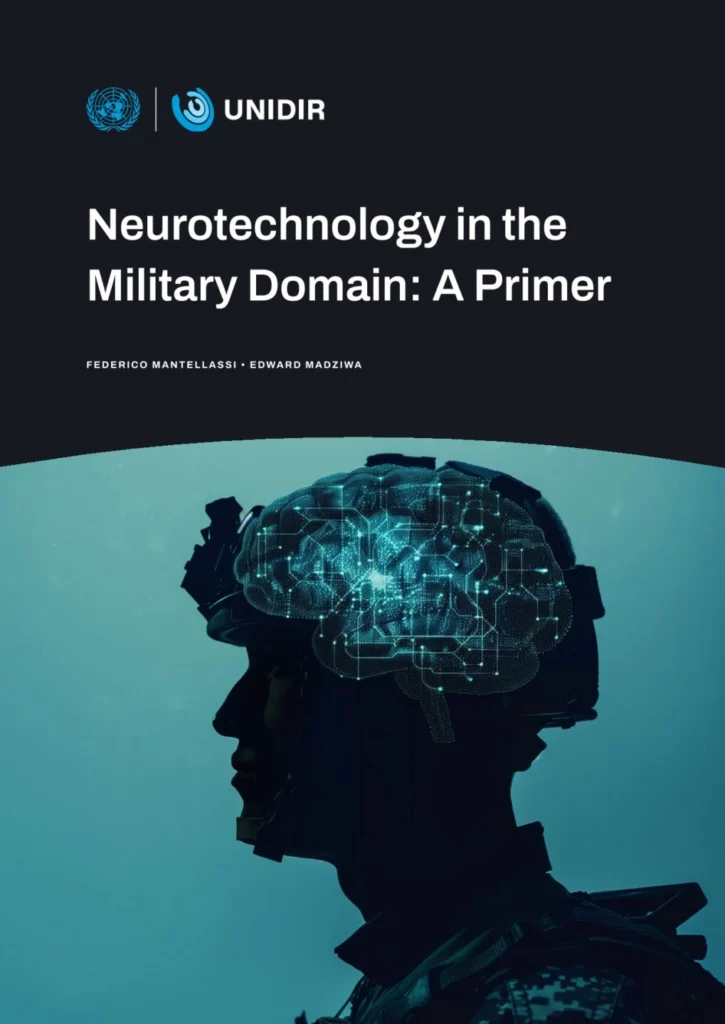
Neurotechnology in the Military Domain: A Primer
PAPER OF THE WEEK, 29 Dec 2025
UNIDIR - TRANSCEND Media Service
Introduction
Neurotechnology1 is an emerging but rapidly advancing field that offers significant promise across various domains, while also posing considerable risks. These risks have prompted an emerging discussion over the need for governance to ensure that the technology is developed in ways that are ethical, safe and secure.2 In particular, the dual-use nature of neurotechnologies raises the potential for them to become disruptive military technologies. Militaries worldwide have explored the integration of a wide suite of neurotechnologies into the military domain throughout the 21st century, with some initiatives dating back to the late 20th century.3 Recent advances in various scientific and technological fields have rendered the integration of neurotechnology into military contexts increasingly likely to become a reality in the near future. In contrast to civilian neurotechnology, this trend has received comparatively less attention, while carrying with it significant potential risks for international peace and security. A preliminary mapping of the potential risks, challenges and opportunities specifically associated with the militarization of neurotechnology is therefore both timely and necessary.
This primer has four sections. Section 1 briefly introduces neurotechnology, providing a description of what it does and how. Section 2 provides an overview of potential military applications of various neurotechnologies for various functions: battlefield applications, support functions (i.e., training, recruitment and personnel screening), military healthcare, intelligence, interrogation and counterintelligence. It also exposes the drivers behind the increasing desire to adopt neurotechnology in the military domain. Section 3 then provides a preliminary risk mapping linked to the militarization of neurotechnology. Due to the complexity of the technology, and its early stages of development and deployment in the military domain, an in-depth risk assessment is beyond the scope of this primer. Rather, it gives a general overview of the potential military uses of neurotechnology, highlighting possible categories of risk linked to its militarization. This may serve as a springboard for a future, more detailed analysis as the technology matures. Finally, Section 4 sets out an initial overview of ways in which neurotechnologies may intersect with disarmament and arms control, both due to their accelerating development and deployment in the military domain and due to their commercial proliferation.
TO READ FULL REPORT DOWNLOAD PDF FILE:
UNIDIR – Neurotechnology Military Domain A Primer
PAPER OF THE WEEK STAYS POSTED FOR 2 WEEKS BEFORE BEING ARCHIVED
Tags: Big tech, Military, Military Industrial Technological Complex, Neurotechnology, Science, Technocracy, Technology
DISCLAIMER: The statements, views and opinions expressed in pieces republished here are solely those of the authors and do not necessarily represent those of TMS. In accordance with title 17 U.S.C. section 107, this material is distributed without profit to those who have expressed a prior interest in receiving the included information for research and educational purposes. TMS has no affiliation whatsoever with the originator of this article nor is TMS endorsed or sponsored by the originator. “GO TO ORIGINAL” links are provided as a convenience to our readers and allow for verification of authenticity. However, as originating pages are often updated by their originating host sites, the versions posted may not match the versions our readers view when clicking the “GO TO ORIGINAL” links. This site contains copyrighted material the use of which has not always been specifically authorized by the copyright owner. We are making such material available in our efforts to advance understanding of environmental, political, human rights, economic, democracy, scientific, and social justice issues, etc. We believe this constitutes a ‘fair use’ of any such copyrighted material as provided for in section 107 of the US Copyright Law. In accordance with Title 17 U.S.C. Section 107, the material on this site is distributed without profit to those who have expressed a prior interest in receiving the included information for research and educational purposes. For more information go to: http://www.law.cornell.edu/uscode/17/107.shtml. If you wish to use copyrighted material from this site for purposes of your own that go beyond ‘fair use’, you must obtain permission from the copyright owner.
Join the discussion!
We welcome debate and dissent, but personal — ad hominem — attacks (on authors, other users or any individual), abuse and defamatory language will not be tolerated. Nor will we tolerate attempts to deliberately disrupt discussions. We aim to maintain an inviting space to focus on intelligent interactions and debates.