


The Law of Piracy
MILITARISM, 29 Dec 2025
Manlio Dinucci | Global Research – TRANSCEND Media Service
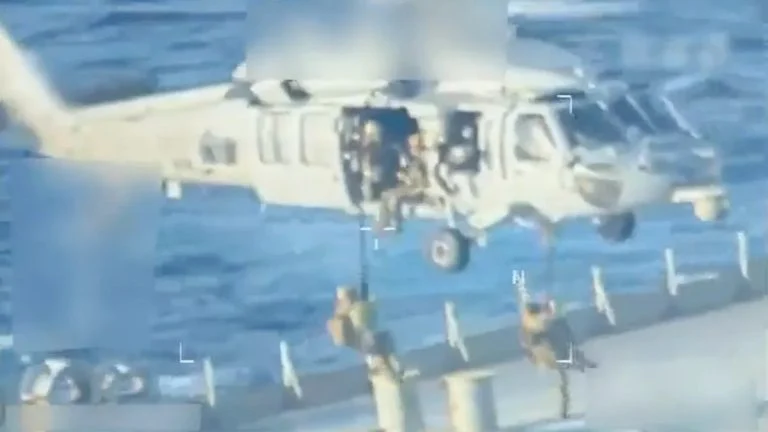 Featured image source
The “Law of Piracy” Is Back in the Spotlight
22 Dec 2025 – Attacks on Russian oil tankers, carried out with Ukrainian naval drones that are actually NATO property, are becoming increasingly frequent in the Black Sea and the Mediterranean. This is because military satellite networks are needed to guide the drones to their targets, and only NATO possesses these networks.
This law also applies in the Caribbean Sea, where US naval forces besieging Venezuela — a country with the world’s largest oil reserves, which the United States wants to take over — board and confiscate Venezuelan oil tankers. A similar situation exists in the Indian Ocean, where US naval forces have boarded and confiscated a ship carrying Chinese industrial products bound for Iran on the grounds that they could be used for both civilian and military purposes, enabling Iran to manufacture missiles capable of striking Israel. Meanwhile, the United States has announced its intention to supply Taiwan with $11 billion worth of modern weapons aimed at China.
Yet another revision of the “peace plan” for Ukraine was presented at a meeting of the European Council in Brussels, attended by representatives of the Trump administration. In summary, this is the final declaration: “The leaders appreciated the strong convergence between the United States, Ukraine, and Europe.” Both US and European leaders are committed to working together to provide:
1) continued support for the Ukrainian armed forces, which must remain at a peacetime strength of 800,000 in order to defend Ukrainian territory;
2) a “multinational force for Ukraine” provided by the European Coalition of the Willing and supported by the United States, including through operations inside Ukraine;
3) a legally binding commitment to take security measures in the event of a future armed attack, including the use of armed force;
4) the need for Russia to compensate Ukraine for the damage caused: to this end, Russian sovereign assets in the European Union have been frozen. (The plan to use these assets to finance Ukraine has not yet been approved. However, the EU will give Kiev another €90 billion over the next two years, drawing it from its budget, i.e. from the pockets of us European citizens – Ed.);
5) strong support for Ukraine’s accession to the European Union.
The leaders reiterated that international borders must not be changed by force and that decisions on territory are for the Ukrainian people, and agreed that some issues will need to be resolved in the final stages of negotiations. They also made clear that any agreement must protect the long-term security and unity of the Euro-Atlantic area and NATO’s role in providing a strong deterrent.
Moscow has made it clear that it will not accept the deployment of Western troops in Ukraine under any circumstances, let alone as part of NATO. The reason is clear: Moscow intervened militarily in Ukraine because NATO, under US command, has expanded further and further eastwards, close to Russian territory. With the 2014 coup d’état, NATO used Ukraine to attack Russia by targeting the Russian populations of Donbass and Crimea. Today, Russia is not only asking for these two territories back — Crimea has already returned to the Russian Federation through a referendum — but also for there to be no Western military forces equipped with nuclear weapons on its borders, whether directly or indirectly belonging to NATO.
The latest revision of the “peace plan” makes it impossible to end the war. But that is precisely what the powerful leaders of the warring forces want: the US leaders who want a divided Europe that is even more subject to US domination in the West; and the European leaders, starting with the military-industrial complex.
The European Union has given Germany the green light on defence spending. The European Commission has said that Germany will escape EU sanctions for violating budget rules thanks to an exemption on defence spending. A prime example of this is the German arms manufacturer Rheinmetall, which is producing more large-calibre artillery shells for the war in Ukraine than the entire US defence sector. Since 2022, Rheinmetall’s shares have risen about 15-fold, reaching a market value of around $80 billion — roughly on a par with major US arms manufacturers such as Lockheed Martin and General Dynamics. Meanwhile, Volkswagen has ceased car production at its Dresden plant for the first time in its history due to falling demand and high tariffs imposed by the United States. Significant wage cuts and layoffs are expected as a result.
In this situation of dismantling international law in this and other war scenarios, the “law of piracy” returns to the forefront: attacks on Russian oil tankers carried out with naval drones formally Ukrainian, but in fact NATO, are becoming increasingly frequent in the Black Sea and the Mediterranean, as military satellite networks, which only NATO possesses, are necessary to guide them to their targets. The “law of piracy” also applies in the Caribbean Sea, where US naval forces besieging Venezuela – the country with the largest oil reserves in the world, which the United States wants to take over – board and confiscate Venezuelan oil tankers. The same situation exists in the Indian Ocean, where US naval forces have boarded and confiscated a ship loaded with Chinese industrial products destined for Iran, on the grounds that they could have dual civilian and military use, allowing Iran to manufacture missiles to strike Israel. At the same time, the United States announced its decision to supply Taiwan with $11 billion worth of modern weapons, aimed at China.
______________________________________________
 Manlio Dinucci is a research associate of the Centre for Research on Globalization, a geographer, and geopolitical scientist. In the 1980s, he directed the magazine Lotta per la Pace (born from “Appeal against the installation of nuclear missiles in Italy”) and was Executive Director for Italy of the International Physicians for the Prevention of Nuclear War, winner of the 1985 Nobel Peace Prize. His latest books are L’arte della guerra/Annali della strategia USA/NATO 1990-2016, Zambon 2016; and Guerra Nucleare Il Giorno Prima, Zambon Editore; 2017.
Go to Original – globalresearch.ca
Tags: Big Oil, NATO, Piracy, Russia, USA, Ukraine, Venezuela
DISCLAIMER: The statements, views and opinions expressed in pieces republished here are solely those of the authors and do not necessarily represent those of TMS. In accordance with title 17 U.S.C. section 107, this material is distributed without profit to those who have expressed a prior interest in receiving the included information for research and educational purposes. TMS has no affiliation whatsoever with the originator of this article nor is TMS endorsed or sponsored by the originator. “GO TO ORIGINAL” links are provided as a convenience to our readers and allow for verification of authenticity. However, as originating pages are often updated by their originating host sites, the versions posted may not match the versions our readers view when clicking the “GO TO ORIGINAL” links. This site contains copyrighted material the use of which has not always been specifically authorized by the copyright owner. We are making such material available in our efforts to advance understanding of environmental, political, human rights, economic, democracy, scientific, and social justice issues, etc. We believe this constitutes a ‘fair use’ of any such copyrighted material as provided for in section 107 of the US Copyright Law. In accordance with Title 17 U.S.C. Section 107, the material on this site is distributed without profit to those who have expressed a prior interest in receiving the included information for research and educational purposes. For more information go to: http://www.law.cornell.edu/uscode/17/107.shtml. If you wish to use copyrighted material from this site for purposes of your own that go beyond ‘fair use’, you must obtain permission from the copyright owner.
Join the discussion!
We welcome debate and dissent, but personal — ad hominem — attacks (on authors, other users or any individual), abuse and defamatory language will not be tolerated. Nor will we tolerate attempts to deliberately disrupt discussions. We aim to maintain an inviting space to focus on intelligent interactions and debates.