


US War Crimes
ANGLO AMERICA, 15 Dec 2025
Peter Maguire | Sour Milk - TRANSCEND Media Service
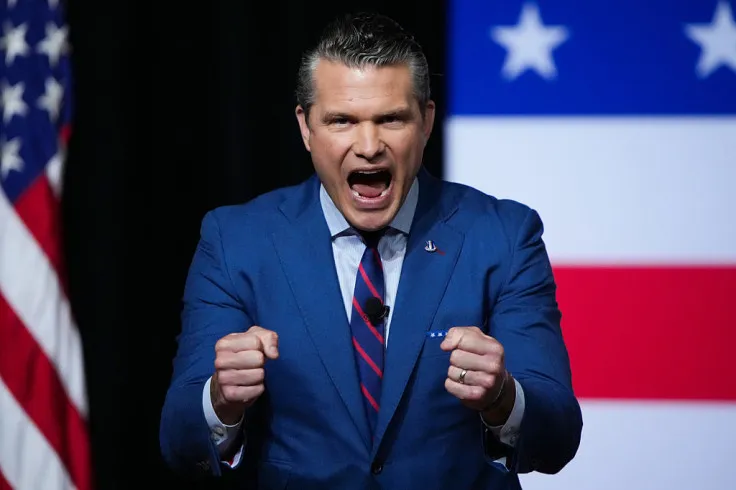
Pete Hegseth. Photo: Getty Images
Hegseth in the dock?
6 Dec 2025 – Recently, many people have asked me if the Trump administration’s decision to target and destroy the Venezuelan boats is a war crime? The simple answer is yes and Secretary of Defense Pete Hegseth ultimately bears responsibility. However, the legacy media’s sudden interest in these micro war crimes, while they continue to turn a blind eye to macro war crimes, reeks of what Joseph Conrad best described as “the self-righteous stench of the converted sinner.”
This week, in a passionate, but error studded essay, Andrew Sullivan, a prominent cheerleader for a macro war crime—the regime change war in Iraq—wrote, “This is America. We don’t murder; we don’t torture; we fight.” Not to be outdone, Rolling Stone’s Seth Hettena cited an obscure 1944 trial of German submariners (Peleus case) and concluded, “Eighty years later to the day, the law has not changed. The question is whether the United States is prepared to live by it.” Even Pulitzer Prize winner William Finnegan stepped down from his New Yorker pedestal, graced us with his presence on Substack and weighed in on boat attacks.
While it is convenient to blame the Trump administration for America’s moral decline, it is also intellectually dishonest. Our leaders—both republican and democrat—have flouted the laws of war since 9/11. One of the few constants in U.S. foreign policy is hypocrisy, the gap between our words and deeds. Since 9/11, that gap has widened into a yawning chasm. Let’s take a trip down memory lane. From my 2010 book Law and War: American History and International Law:
“Today, the Nuremberg trials and the principles that they spawned seem like quaint memories from a long-bygone era. The 9/11 attacks and the ensuing “Global War on Terror,” forced America’s international legal duality out into the open for all to see. Weeks after 9/11, senior Justice Department lawyers convinced President Bush that the “War on Terror” was a new kind of war requiring “a new paradigm” that would render the Geneva Convention’s strict limitations on the treatment of enemy prisoners “obsolete.”1
Unlike previous American presidents who claimed to support inter- national law when the outcome was favorable to the United States, President Bush explicitly rejected both long-standing, codified laws of war like the Geneva Conventions and older customary distinctions such as that be- tween soldier and civilian.2 The Bush administration pushed aside the military professionals and argued that there were no limits—constitutional or congressional — on presidential authority.3
Brazen disregard for the laws of war was soon elevated to a matter of principle as America began a sordid affair with what Vice President Cheney described as “the dark slide.” Even though the U.S. Second Court of Appeals compared torturers to slave traders in a 1980 opinion, by the summer of 2002 the United States had redefined torture to include only those acts that resulted in death or organ failure. According to the new American definition, not even John McCain’s treatment at the hands of the North Vietnamese met the new standard.4
President Bush officially declared war on international criminal law when he unsigned the Rome Statute establishing the International Criminal Court in July 2002. Conservatives viewed the ICC and the concept of “uni- versal jurisdiction” as a kind of inverse strategic legalism or “lawfare.” According to Brigadier General Charles Dunlap, lawfare used the law instead of military force “to achieve an operational objective.”
A new federal law called the American Service-Members’ Protection Act (better known as the Hague Invasion Act), passed in August 2002, authorized the President to use “all means necessary and appropriate to release US prisoners of the ICC.” The Bush administration also began suspending aid to countries that refused to give U.S. citizens immunity before the ICC. Initially the Bush administration took the position that neither the federal War Crimes Act nor the Geneva Conventions constrained U.S. forces in Af- ghanistan. Because the United States deemed that nation “a failed state,” they could define both Al Qaeda and the Taliban as “illegal enemy combat- ants” unprotected by common Article 3 of the Geneva Convention.5
It was one thing for American Special Forces teams to play fast and loose with the laws of war on hot battlefields in the Pashtu frontier, where the ir- regular nature of the foe merited such an approach. However, by the time the war shifted to Iraq, “torture’s perverse pathology” had taken root, and now army reservists were applying similar standards during the invasion of a sovereign nation. According to historian Alfred McCoy, not only does torture fail to provide reliable intelligence, it also “leads to both the uncontrolled proliferation of the practice and long-term damage to the perpetrator society.”6
Although the term “enemy combatant” was used as a strategic legal mechanism to get around international humanitarian law, when all else failed, the Bush administration invoked simple messianic unilateralism. “Good” and “Evil” became the new “metrics” for a vague new American foreign policy whose exponents claimed to be on a crusade to rid the world of “Evil” and to spread “Freedom.”7 Very suddenly, colonialism, crusades, nuclear weapons, and prayer breakfasts were all the rage for ambitious post–9/11 D.C. Republicans. Not only did America’s evangelical President describe the War on Terror as a “Crusade,” he claimed “God” had told him to strike at Al Qaeda and Saddam Hussein.8 However, this Judeo-Christian inspired, reflexively anti-Islam rhetoric and policy proved strategically unsound and worked as a force multiplier for America’s enemies. Soon the United States was fighting not only Al Qaeda but also “Islamofascism” and “IslamHitlerites.”9
After 9/11, human rights utopians were immediately replaced by proud neo-imperialists who called for a unipolar world, with America striking out preemptively against threats both real and imagined. Russian-born Wall Street Journal editor, Council on Foreign Relations fellow, and L.A. Times columnist Max Boot argued that “Afghanistan and other troubled lands to- day cry out for the sort of enlightened foreign administration once pro- vided by self-confident Englishmen in jodhpurs and pith helmets.” Heavily praised by the mainstream press, Boot’s 2002 book, Savage Wars for Peace, points to the 1898 U.S. war in the Philippines as a template for the “War on Terror.” “In deploying American power, decision makers should be less apologetic, less hesitant, less humble,” wrote Boot. “America should not be afraid to fight ‘the savage wars of peace’ if necessary to enlarge the ‘empire of liberty. ’”10 President Bush’s Canadian speechwriter, David Frum, and Iraq War architect, Richard Perle, went so far as to claim that the stakes for the United States in the War on Terror were “victory or holocaust.”11
The War on Terror’s cheerleaders and enablers were not limited to the right. Pro-war columns by liberal hawks like Judith Miller, Michael Gordon, Thomas Friedman, Michael Ignatieff, David Remnick, Jeffrey Goldberg, Peter Beinart, Paul Berman, and Kenneth Pollack helped to sell and justify U.S. policy and conduct. “The press played ball. After 9/11, they rolled over and played dead,” said the dean of the White House press correspondents, Helen Thomas. “Really, they asked no questions, they all had to be patriotic. . . . To ask a question was to be unpatriotic, un-American and so forth.”12 Even the onetime human rights advocates at Harvard’s Carr Center blew with the wind. Not only did Michael Ignatieff advocate the use of torture, his colleague Sara Sewall advised the U.S. military on counter- insurgency policy, and even Pulitzer Prize–winning journalist Samantha Power, who was quick to point out atrocities in Darfur, remained conspicuously silent about the new American paradigm.13 It is no coincidence that today all three are politicians or policy makers.
The most incisive criticism of the Bush administration’s POW policies came from professional soldiers who were growing increasingly uncomfortable with multiple combat tours ordered by civilian leaders who had never been in a fistfight, much less a firefight. Because the career military lawyers supported Geneva Convention protections for prisoners, they were simply cut out of the policy-planning process.14 One heavily decorated Vietnam war veteran wrote: “Never before in our country’s history has an administration charged with defending our nation been so lacking in hands-on combat experience and therefore so ignorant about the art and science of war.”15 Secretary of State Colin Powell, one of the few Vietnam veterans in the Bush administration, argued forcefully and prophetically that the new American paradigm would “reverse over a century of U.S. policy and prac- tice,” and predicted “a high cost in terms of negative international reaction, with immediate adverse consequences for our conduct of foreign policy.”16
Many American policy makers, pundits, and academics attempted to rationalize the use of torture based largely on the “ticking time bomb” scenarios of television supersleuth Jack Bauer. There was, however, one problem: torture does not provide a steady stream of reliable intelligence, as evidenced by testimony of superterrorist Khalid Sheikh Mohammed. After months of torture and isolation, “KSM” confessed to mastermind- ing thirty Al Qaeda operations and even wielding the knife that decapitated Daniel Pearl.17
“We are falling into the trap of imitating the ‘evil-doing’ which we accuse our enemies of initiating,” wrote Rich Arant. A contract interrogator who worked at Abu Ghraib and Afghanistan’s Bagram Air Force base in 2003–4, Arant had a revelation one night while questioning a former Afghan Mujahid who had fought against the Soviets and was now in jail be- cause a paid U.S. government informant and well-known Soviet collaborator had fingered him. When Arant told the old soldier he could trust an American to treat him with more respect than the Russians, “this dignified man completely collapsed in tears, unable to speak,” wrote Arant. “After my interpreter and I gave him a chance to gather himself, he said, ‘I fought Russians, our common enemy, and now you Americans have imprisoned me on the word of a son of the Russians. This is my reward. ’” Arant quit shortly thereafter and offered this observation:
Our leaders have taught us that taking a life on today’s battlefield can be a righteous and patriotic act, an act of bravery or self-defense, a “preemptive” necessity in the new age of the war on terror. “Precautionary murder” is the term once used by T. E. Lawrence, Lawrence of Arabia. Former conventions regarding the treatment of prisoners are now considered quaint, obsolete. But a prisoner is as defenseless as a passenger held hostage on an aircraft. There is little honor found in exploiting his fears, no matter how pressing the requirement.18
By the time the United States invaded Iraq in 2003, extraordinary rendition, secret prisons, indefinite detention of American citizens, domestic espionage, and watch lists were all accepted as facts of life by a stunned and submissive American population who viewed the havoc wrought in their name from afar. That arm’s-length relationship was shattered in 2004 when General Anthony Taguba’s report on prisoner abuse at Abu Ghraib was leaked to Seymor Hersh and photographs of American soldiers perversely torturing and humiliating common Iraqi criminals flashed around the world in seconds. Bin Laden himself could not have staged a more successful propaganda coup as smiling, fresh-faced American girls led naked Iraqi men on leashes. One senior policy maker described the perpetrators to me as “the seven soldiers who lost the war.”19
The Bush administration’s response to the Abu Ghraib affair was similar to President Theodore Roosevelt’s response to atrocities in the Philippines War or President Nixon’s response to the Mai Lai Massacre: the perpetrators were “a few bad apples” and these were “isolated” events.20 However, this buffoonery was limited to the Abu Ghraib Seven. This appendix from the Taguba Report speaks for itself: in a sworn statement, a U.S. soldier stationed at Abu Ghraib wrote, “I climbed a yellow ladder . . . to see a light skinned, black male . . . taunt the prisoners by flexing and shouting at them. Right after this, a Caucasian soldier . . . taunted the prisoners of compound ‘B’ and ‘C’ by similar means of flexing and shouting at them. This caused the prisoners to become extremely irate, and a short riot ensued that resulted in gunfire” (seven Iraqis were shot).21
It did not take long for American POW policy to be denounced by our British allies, the U.S. Supreme Court, federal judges, the International Red Cross, and the American Bar Association. Now there is irrefutable documentary evidence that even American doctors and psychiatrists violate the Geneva Conventions, the Nuremberg medical standards, and the Hippocratic oath. The New England Journal of Medicine called the complicity in the interrogation process “a matter of national shame.”22 Military professionals, like former Navy Judge Advocate General, Rear Admiral John Hutson, rejected the few bad apples argument: due to “the range of individuals and locations involved in these reports, it is simply no longer possible to view these allegations as a few instances of an isolated prison.”23
The Guantanamo Bay camp is in many ways a distraction, a set piece, or as defense attorney Clive Stafford Smith put it, a “lightning rod not only for criticism but also for global attention.” Largely ignored is the archipelago of secret prisons around the world where “high-value” detainees are tortured, interrogated, and sometimes killed. FBI agents who visited the Cuban prison were shocked by both the style and the substance of the interrogations. Stupidly brutal, proudly racist, and deeply perverse, the FBI agents witnessed scantily clad female interrogators sexually taunting Muslim captives (one even smeared fake menstrual blood on a suspect).24 FBI agents watched one “detainee sitting on the floor of the interview room with an Israeli flag draped around him, loud music being played and a strobe light flashing.” According to one FBI memo, the theatrics “produced no intelligence.”25
When it came to war crimes trials for the vanquished, the Bush adminis- tration employed traditional, primitive political justice. As a result, it could not even provide an easily convicted thug like Saddam Hussein with a de- cent show trial. The fallen Iraqi leader’s chaotic American-choreographed proceeding saw lawyers murdered, courtroom brawls between defendants and guards, and even an execution video on YouTube before it made the morning papers.26 The treatment meted out to American and Australian collaborators like Jose Padilla, John Walker Lindh, and David Hicks has been oddly unsystematic, as if the prosecutors were making up the rules as they went along.
The self-contained legal bubble of Guantanamo Bay has become a sort of Orwellian version of Alice’s Wonderland where even defendants found not guilty “can be held in perpetuity.”27 The Gitmo military commission was firmly under the control of Vice President Dick Cheney and his political appointee Susan Crawford. Navy Lieutenant Commander Brian Mizer filed a motion in 2008 that charged senior Pentagon appointees with “exercising unlawful command influence” by pressuring prosecutors to charge “high- value” detainees in order to gain “strategic political value” before the 2008 election.28 The tribunal’s top legal official, Brigadier General Thomas Hart- man, was removed from his position after judges in three separate cases barred him from participating in trials due to his pro-prosecution bias.29 Convinced that political interference made fair trials impossible, Colonel Morris Davis, Major Robert Preston, Captain John Carr, and Captain Carrie Wolf all resigned.
Australian David Hicks was the beneficiary of an eleventh-hour politi- cal deal that sent the prisoner home in a futile effort to aid Australian Prime Minister John Howard’s doomed reelection effort. Although Hicks signed a document claiming that he had not been mistreated by Americans, this statement was contradicted by his earlier affidavit.30 “The charade that took place at Guantanamo Bay would have done Stalin’s show trials proud,” said one of Australia’s most experienced criminal lawyers, Robert Richter. “First there was the indefinite detention without charge. Then there was the torture, however the Bush lawyers, including the attorney general, might choose to describe it. Then there was the extorted confession of guilt.”31
The Bush administration strained to make an analogy between the Nuremberg and Gitmo trials. In the lead-in to the first Gitmo trial, U.S. diplomats received a memo that instructed them to point to the execution of Nuremberg convicts to justify the death penalty at Guantanamo Bay.32 Brigadier General Hartmann went so far as to claim that the legal protections for Guantanamo Bay defendants “exceed those that were available at Nuremberg.”33 Colonel Morris Davis described one conversation with the Pentagon’s top lawyer and recently resigned torture advocate, William Haynes, who tried to describe the Gitmo trials as “the Nuremberg of our time.” When Davis reminded him that defendants at Nuremberg were acquitted, Haynes appeared shocked and replied: “Wait a minute, we can’t have acquittals. If we’ve been holding these guys for so long, how can we explain letting them get off? We can’t have acquittals, we’ve got to have convictions.”
Although the Bush administration and Guantanamo officials continue to compare the Guantanamo Bay military commission to the Nuremberg trials, nothing could be further from the truth. It took Nuremberg’s international court less than 13 months to indict, try, and sentence Nazi Germany’s top leaders in an imperfect but highly credible procedure. Between late 1946 and 1949, the United States tried another 177 German leaders in 12 more trials at Nuremberg.34 At no point did the United States monitor the work of the defense attorneys or authorize the use of torture to gain information. No Nuremberg defendants or their lawyers ever alleged that they were tortured. Former Nuremberg prosecutor Henry King found the analogies offensive: “To torture people and then you can bring evidence you obtained into court? Hearsay evidence is allowed? Some evidence is available to the prosecution and not to the defendants?”35
The Guantanamo Bay tribunals would have lived up to the worst star chamber expectations were it not for the verdict in the Hamdan case. In a split decision, a six-officer military commission convicted Osama Bin Laden’s driver, Salim Hamdan, of the lesser charge of providing material support for terrorism, but acquitted him of the more serious conspiracy charge. The Hamdan case proved once again that even primitive political justice cannot be stage-managed.36
Thankfully, not all Americans have given in to the fear. U.S. District Judge John Coughenour tried and convicted Algerian Ahmed Ressam for his plot to bomb Los Angeles Airport. Coughenour did not need a secret military tribunal, or indefinite detention, or to deny the defendant the right to counsel, or to deem him “an enemy combatant.” The judge explained, “The message to the world from today’s sentencing is that our courts have not abandoned our commitment to the ideals that set our nations apart.” According to Coughenour, if the prevailing American view becomes that terrorism renders the Constitution obsolete, “the terrorists will have won.”37
Former Navy General Counsel Alberto Mora was another who pushed back against the Bush administration: “When you put together the pieces, it’s all so sad. To preserve flexibility, they were willing to throw away our values.”38 With the establishment of a new, Democractic administration and a fresh set of international crises causing near-seismic shifts, Americans would be wise to consider the words of American Nuremberg prosecutor Robert Jackson’s now famous opening address: “We must never forget that the record on which we judge these defendants today is the record on which history will judge us tomorrow. To pass these defendants the poison chalice is to put it to our own lips as well.”39
The Bush/Cheney administration transformed Justice Jackson’s poisoned chalice into a poison keg. Not only did Bush, Rumsfeld, Wolfowitz, Rice, Chertoff, Feith, Perle, Gonzales, Ashcroft, Libby, Tenet and Black drink from it like frat boys during rush week, but so did their eager pledges—Yoo, Addington, Hadley, Miller, Rizzo, Sanchez, Bybee, Haynes, Goldsmith, Bellinger, Newstead, Frum, and others. I expected more from the Obama administration, especially his national security advisor, self-proclaimed “genocide chick,” Samantha Power. However, they too drank their fill from the poison keg as every American president since Bush—democrat or republican—has.
If the boat attacks end Hegseth’s career and reign in Trump’s idiotic foreign policy in Venezuela—good. However, accountability for these micro war crimes will not make up for our leaders’ macro war crimes, and the ongoing macro war crimes that we aid, abet, and finance in Gaza and the Middle East.
Today, more than 23 years, eight trillion dollars, and a million dead later, America has never been more insecure at home and had less power, credibility and moral authority abroad. “The U.S. is no longer the world’s policeman who will enforce the international rules based order,” one dispirited U.S. government official wrote me in 2023 after the Biden administration abandoned the 100 million dollar Airbase 201 in Niger. “We’ve instead turned into the fat middle aged crossing guard, standing there in a neon vest, flapping our arms and yelling at the side of the road for cars to slow down.”
End Notes Postscript: The New US Paradigm
1. Testimony of Cofer Black to the Joint Congressional Intelligence Committee, September 26, 2002; http://www.fas.org/irp/congress/2002_hr/092602black.html.
2. Jameel Jaffer and Amrit Singh, Administration of Torture (New York: Columbia University Press, 2007), A1–5. “But under this New Paradigm, the President gave terror suspects neither the rights of criminal defendants nor the rights of prisoners of war,” wrote Jane Mayer in her groundbreaking book, The Dark Side: The Inside Story of How the War on Terror Turned Into a War on American Ideals (New York: Doubleday, 2008), 51–52.
3. Bush also announced that the United States could use military force preemptively against terrorist organizations or the states that harbor or support them. Mayer, The Dark Side, 64–65. According to one of John Yoo’s 2001 memos, “These decisions, under our Constitution, are for the President alone to make.”
4. Alfred McCoy, A Question of Torture (New York: Metropolitan Books, 2006). “War means killing people,” the architect of the new American paradigm, John Yoo, explained in a 2007 interview. “If we are entitled to kill people, we must be entitled to injure them.”
5. Jaffer and Singh, Administration of Torture, A1–5.
6. McCoy, A Question of Torture, 112; Scott Shane, “Soviet-Style ‘Torture’ Becomes ‘Interrogation,’” The New York Times, June 3, 2007. “When you say something down the chain of command like, ‘The Geneva Conventions don’t apply,’ that sets the stage for the kind of chaos we have seen,” said retired Judge Advocate General Rear Admiral John Hutson.
7. Mayer, The Dark Side, 240 – 41.
8. Deputy Secretary for Defense Intelligence, Lieutenant William Boykin called the War on Terror a “holy war against Satan.” According to Boykin, “Our spiritual enemy will only be defeated if we come against them in the name of Jesus.” Richard Leiby, “Christian Soldier,” Washington Post, November 6, 2003.
9. “Was the USA unleashing pent-up rage, seeking vengeance for every military en- gagement it had lost or terrorist act that it had suffered?” asked former Guantanamo Bay prisoner Mossam Begg. “Well, almost. The common denominator was Islam.” David Horowitz, “Jimmy Carter: Jew-Hater, Genocide-Enabler, Liar,” Front Page Magazine, December 14, 2006; Moazzam Begg and Victoria Brittain, Enemy Combatant: My Imprisonment at Guantanamo Bay, Bagram, and Kandahar (New York: New Press, 2007), 111.
10. Max Boot, The Savage Wars of Peace (New York: Basic Books, 2002), 352.
11. David Frum and Richard Perle, An End to Evil (New York: Random House, 2003), 9. Disney/ABC radio host Paul Harvey did his best to stiffen the American spine and in the process demonstrated the insidious effects of “torture’s perverse pathology” in one 2005 radio address: “we didn’t come this far because we’re made of sugar candy. Once upon a time, we elbowed our way onto and into this continent by giving smallpox-infected blankets to Native Americans. Yes, that was biological warfare! And we used every other weapon we could get our hands on to grab this land from whomever. And we grew prosperous. And, yes, we greased the skids with the sweat of slaves” (Paul Harvey Show, ABC Radio, June 23, 2005). According to a Gallup poll, by 2005, more than one in four Americans approved of the use of nuclear weapons in the War on Terror. Another survey found that a majority of American high school students believed that newspapers “should not be allowed to publish without government approval,” and even more shocking, one in five said that “Americans should be prohibited from expressing unpopular opinions.”
12. Helen Thomas, Media Matters interview, May 12, 2006; http://vodpod.com/ watch /97344-helen-thomas-on-the-medias-failure.
13. Ron Steel blasted Ignatieff in a New York Times review of Ignatieff ’s book The Lesser Evil: “In concocting a formula for a little evil lite to combat the true evildoers, Michael Ignatieff has not provided, as his subtitle states, a code of ‘political ethics in an age of terror’ but rather an elegantly packaged manual of national self-justification.” Alfred McCoy was also extremely critical of Ignatieff. He described the American press and public’s “willful blindness” and “studied avoidance” of American con- duct in the War on Terror. The human rights advocate turned Canadian politician did a one-eighty after the Abu Ghraib debacle and subsequently wrote an embar- rassingly feeble mea culpa in which he blamed his lapse of judgment on too many years as a hothouse academic at Harvard. “The Lesser Evil,” The New York Times, July 25, 2004.
14. McCoy, A Question of Torture, 128. Major General Jack Rives, Air Force Judge Advocate General, argued that the more extreme interrogation techniques not only put “the interrogators and chain of command at risk of criminal accusations abroad,” they also damaged the military’s “culture and self image.”
15. David Hackworth, “Fry the big fish, too,” February 1, 2005, www.worldnetdaily .com.
16. Colin Powell, Memo to the Counsel to the President, January 26, 2002.
17. Robert Baer, “Why KSM’s Confession Rings False,” Time, March 15, 2007; Kath- erine Shrader, “Officials: Mohammed Exaggerated Claims,” AP, March 15, 2007; Josh Meyer, “Detainee Says He Confessed to Stop Torture,” Los Angeles Times, March 31, 2007.
18. Meng Try Ea, The Chain of Terror (Phnom Penh: The Documentation Center of Cambodia, 2002), 2: “Upper echelon wanted answers, and wanted them now. I soon left, ashamed at being unable to perform my duty.”
19. News.findlaw.com/hdocs/docs/iraq/tagubarpt.html.
20. Robert Jervis, The Logic of Impressions in International Relations (New York: Columbia University Press, 1989). “Unlike Nuremberg, which led with the trials of the top leadership of the Third Reich and only gradually worked its way down to the bottom of that evil ladder,” wrote Col. David Hackworth, “our leaders are, so far, successfully ducking any responsibility for the crimes perpetrated on their watch.”
21. Sworn statement taken at Baghdad Airport Confinement Facility, June 6, 2003. Another U.S. soldier wrote in a sworn statement: “X choked him until he passed out X stated that X was beating him because Y is a Muslim and X is a Christian.”
22. Jane Mayer, “The Experiment,” The New Yorker, July 11 and 18, 2005.
23. Hackworth, “Fry the big fish, too.”
24. www.cbsnews.com / htdocs /pdf / FBI_gitmo_detainees.pdf.
25. Ibid.
26. James Rosen, “Saddam Trial at Uncertain Juncture,” McClatchy Newspapers, Feb- ruary 13, 2006.
27. “Annan Backs UN Guantanamo Demand,” BBC, February 17, 2006; “Guantanamo Inmates Can Be Held in Perpetuity,” Reuters, June 15, 2005; “I think if you combine excessive arrogance and excessive ignorance, you wind up 78 months later where we are in this process,” said former Gitmo prosecutor Colonel Morris Davis, who resigned in protest. Josh White, “Prosecutor Alleges, Pentagon Played Politics,” Washington Post, October 20, 2007
28. White, “Prosecutor Alleges, Pentagon Played Politics”; Carol Williams, “Defender Says Advisor Exerts Illegal Sway,” Los Angeles Times, March 28, 2008; William Glaberson, “An Unlikely antagonist in the Detainees’ Corner,” New York Times, June 19, 2008.
29. “Guantanamo Bay Prosecutor Steps Down,” BBC, September 25, 2008; Mike Me- lia, “Former Gitmo Prosecutor Blasts Tribunals,” AP, September 26, 2008; Deputy Prison Camp Commander Brigadier General Gregory Zanetti called Hartmann’s conduct “abusive, bullying, and unprofessional.” Lieutenant Colonel Darrel Vandeveld resigned rather than prosecute a case against an Afghan teenager accused of throwing a grenade at U.S. soldiers. Vandeveld said that he could no longer serve due to the “slipshod” evidentiary procedures.
30. Carol Williams, “Detainee’s Plea Deal Angers Some Legal Experts,” Los Angeles Times, April 1, 2007; “Hicks Case Points up Problems Facing US ‘Terror’ Tribu- nals,” AFP, April 1, 2007; “Guantanamo Follies,” The New York Times, editorial, April 6, 2007.
31. “Trial Would Have Done Stalin Proud—Lawyer,” Sydney Morning Herald, April 1, 2007.
32. “U.S. Diplomats to Use Nuremberg Defense,” The Australian, February 14, 2008; Matthew Lee, “U.S Likens Death Penalty War Court to Nuremberg,” AP, February 12, 2008.
33. Dan Ephron, “Fair, Open, Just, Honest: A Chat with the Adviser to the Gitmo Military Commissions,” Newsweek, June 2, 2008.
34. Frank M. Buscher, The U.S. War Crimes Program in Germany, 1946–1955 (Westport, Conn.: Greenwood, 1989), appendix A.
35. Martha Neil, “Nuremberg Attorney: Gitmo Trials Unfair,” ABA Journal, June 11, 2007. To King, the United States “has always stood for fairness. We were the ones who started war crimes tribunals and we’re the architects. I don’t think we should turn our back on that architecture.”
36. www.hamdanvrumsfeld.com /.
37. Hal Bernton and Sara Jean Green, “Ressam Judge Decries U.S. Tactics,” The Seattle Times, July 28, 2005.
38. Mayer, The Dark Side, 228.
39. http://www.roberthjackson.org/Man/theman2–7-8–1/.
_______________________________________________
Peter Maguire is a writer at Sour Milk.
Go to Original – petermaguire.substack.com
Tags: Anglo America, Latin America Caribbean, Maduro, North America, Trump, USA, Venezuela, War crimes
DISCLAIMER: The statements, views and opinions expressed in pieces republished here are solely those of the authors and do not necessarily represent those of TMS. In accordance with title 17 U.S.C. section 107, this material is distributed without profit to those who have expressed a prior interest in receiving the included information for research and educational purposes. TMS has no affiliation whatsoever with the originator of this article nor is TMS endorsed or sponsored by the originator. “GO TO ORIGINAL” links are provided as a convenience to our readers and allow for verification of authenticity. However, as originating pages are often updated by their originating host sites, the versions posted may not match the versions our readers view when clicking the “GO TO ORIGINAL” links. This site contains copyrighted material the use of which has not always been specifically authorized by the copyright owner. We are making such material available in our efforts to advance understanding of environmental, political, human rights, economic, democracy, scientific, and social justice issues, etc. We believe this constitutes a ‘fair use’ of any such copyrighted material as provided for in section 107 of the US Copyright Law. In accordance with Title 17 U.S.C. Section 107, the material on this site is distributed without profit to those who have expressed a prior interest in receiving the included information for research and educational purposes. For more information go to: http://www.law.cornell.edu/uscode/17/107.shtml. If you wish to use copyrighted material from this site for purposes of your own that go beyond ‘fair use’, you must obtain permission from the copyright owner.
Join the discussion!
We welcome debate and dissent, but personal — ad hominem — attacks (on authors, other users or any individual), abuse and defamatory language will not be tolerated. Nor will we tolerate attempts to deliberately disrupt discussions. We aim to maintain an inviting space to focus on intelligent interactions and debates.