



Palestinian Historian and Academic Walid Al-Khalidi (16 Jul 1925 – 8 Mar 2026) Dies Aged 99
OBITUARIES, 9 Mar 2026
The New Arab - TRANSCEND Media Service
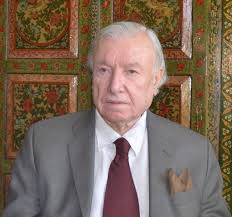
For more than seven decades, Walid Khalidi contributed important scholarship on the question of Palestine.
The Jerusalem-born scholar leaves behind a legacy spanning decades of research and writing on the question of Palestine.
8 Mar 2026 – Palestinian historian Walid Khalidi passed away today in Cambridge, Massachusetts.
Khalidi was one of the most prominent researchers of Palestinian history, documenting Israeli crimes since the Nakba, the ethnic cleansing of hundreds of thousands of Palestinians which accompanied the foundation of Israel in 1948.
Born in Jerusalem in 1925, Khalidi studied at the University of Oxford, earning a Master of Arts in 1951. He began his academic career there before resigning in 1956 to protest the Tripartite Aggression, in which Britain, France, and Israel launched an attack on Egypt under the pretext of securing access to the Suez Canal.
He then taught at the American University of Beirut as a professor of political studies until 1982, while also serving as a fellow at Harvard’s Center for International Affairs and lecturing at Princeton University.
He received numerous awards and titles, including an honorary doctorate from the American University of Beirut and election to the American Academy of Arts and Sciences.
In 1963, Khalidi founded the Institute for Palestine Studies (IPS) in Beirut, at a time when the Palestine Question was prominent in Arab politics and Palestinian identity was being revived.
Under his leadership, IPS’s library and archives grew into a world-leading collection with over 70,000 books, thousands of manuscripts, and key historical documents.
Khalidi authored or edited major works in Arabic and English, including Before Their Diaspora, documenting pre-1948 Palestinian life, and All That Remains, cataloguing depopulated Palestinian villages.
He also wrote extensively on the Arab-Israeli conflict, European history, and international relations theory.
Beyond scholarship, Khalidi shaped diplomacy: he drafted speeches for Palestinian leaders, including Yasser Arafat’s 1974 UN address, and joined the joint Jordanian-Palestinian delegation at the 1991 Madrid peace conference.
He consistently opposed Palestinian entanglement in intra-Arab conflicts, reportedly warning Yasser Arafat that the PLO had “no business” taking sides in Lebanon’s civil war.
A longtime advocate of the two-state solution, he argued in a 1988 Foreign Affairs article for a Palestinian state on 1967 borders alongside Israel as “the only conceptual candidate for a historical compromise of this century-old conflict”.
Tags: History, Obituary, Palestine, Walid Al-Khalidi
DISCLAIMER: The statements, views and opinions expressed in pieces republished here are solely those of the authors and do not necessarily represent those of TMS. In accordance with title 17 U.S.C. section 107, this material is distributed without profit to those who have expressed a prior interest in receiving the included information for research and educational purposes. TMS has no affiliation whatsoever with the originator of this article nor is TMS endorsed or sponsored by the originator. “GO TO ORIGINAL” links are provided as a convenience to our readers and allow for verification of authenticity. However, as originating pages are often updated by their originating host sites, the versions posted may not match the versions our readers view when clicking the “GO TO ORIGINAL” links. This site contains copyrighted material the use of which has not always been specifically authorized by the copyright owner. We are making such material available in our efforts to advance understanding of environmental, political, human rights, economic, democracy, scientific, and social justice issues, etc. We believe this constitutes a ‘fair use’ of any such copyrighted material as provided for in section 107 of the US Copyright Law. In accordance with Title 17 U.S.C. Section 107, the material on this site is distributed without profit to those who have expressed a prior interest in receiving the included information for research and educational purposes. For more information go to: http://www.law.cornell.edu/uscode/17/107.shtml. If you wish to use copyrighted material from this site for purposes of your own that go beyond ‘fair use’, you must obtain permission from the copyright owner.
Join the discussion!
We welcome debate and dissent, but personal — ad hominem — attacks (on authors, other users or any individual), abuse and defamatory language will not be tolerated. Nor will we tolerate attempts to deliberately disrupt discussions. We aim to maintain an inviting space to focus on intelligent interactions and debates.