
‘The Fire Devoured Everything’: Israeli Settlers Unleash Wave of Arson Attacks
PALESTINE ISRAEL GAZA GENOCIDE, 1 Dec 2025
Basel Adra | +972 Magazine - TRANSCEND Media Service
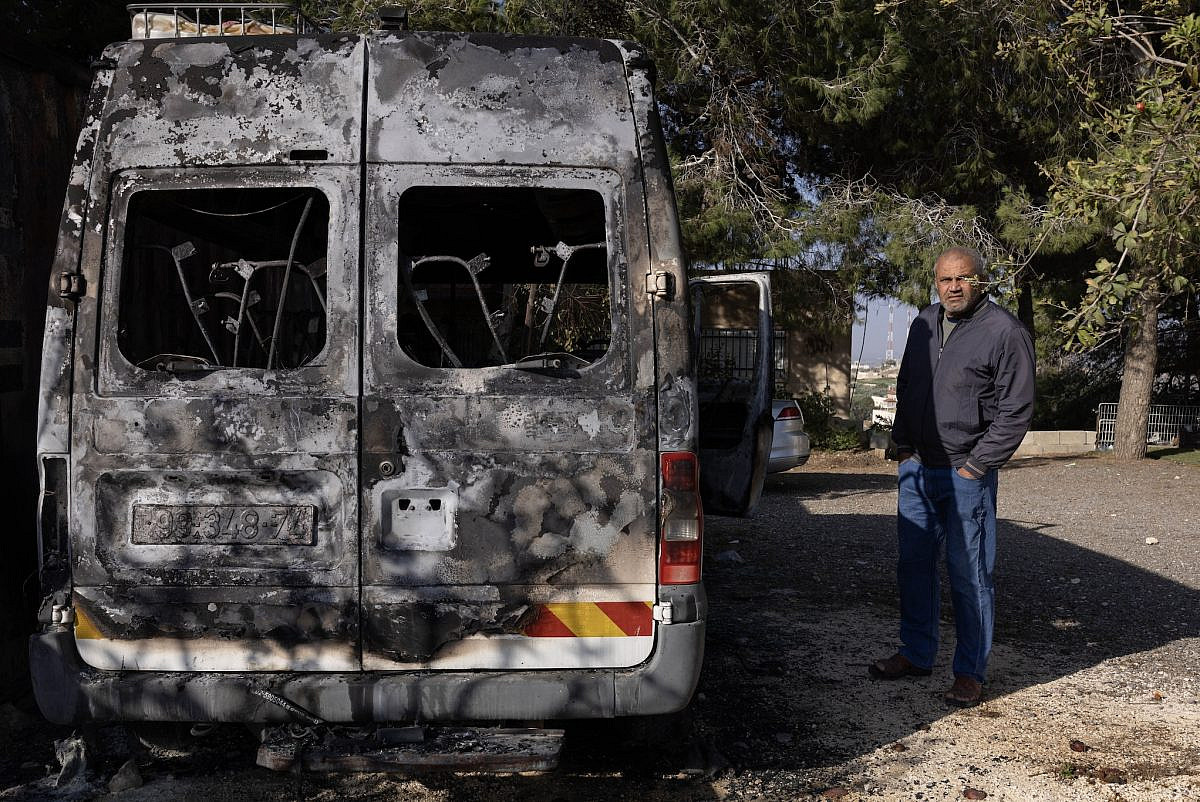
Ahmad Mousa Al-Mash’ala next to a van torched by Israeli settlers during an arson attack in the West Bank village of Jaba, 18 Nov 2025. (Oren Ziv)
At least five West Bank villages have been targeted as settlers lit Palestinian homes, cars, and a mosque ablaze, while the army delayed emergency vehicles.
18 Nov 2025 – Yesterday evening, shortly after Israeli authorities carried out a rare evacuation of an illegal settler outpost, dozens of settlers stormed the eastern edge of Jaba, a Palestinian village near Bethlehem in the occupied West Bank. They arrived by car, then fanned out on foot in coordinated groups, torching property and spraying graffiti reading, “Death to Arabs,” “Revenge,” and “A Jew doesn’t evict a Jew” — the latter likely in reference to the evacuation and recent police arrests of settlers.
The attack lasted only minutes, but the damage was severe: eight cars burned or smashed and seven homes vandalized, several of them set ablaze.
In the compound of 50-year-old Ahmad Mousa Al-Mash’ala, settlers torched three vehicles — including a work van belonging to a friend — and attempted to set two homes on fire. “We saw more than 50 settlers,” Al-Mash’ala said. “Two reached the balcony [of my home]. One sprayed a chemical, the other lit it. The fire caught instantly.”
He and his sons raced to pour water from inside, managing to stop the flames from reaching the house. In his son’s adjacent home, metal window bars prevented a burning object from landing inside.
Below, a settler shouted at them, “We’ll do to you what we did to the Dawabsheh family.” Palestinians have learned to interpret this threat literally: In July 2015, settlers firebombed two homes in the village of Duma, killing Sa’ad and Reham Dawabsheh and their 18-month-old son Ali.
Across the courtyard of the compound, Lila Al-Mash’ala, 28, sheltered with her mother and siblings as settlers hurled stones and Molotov cocktails at their windows. “They looked organized,” she told +972 Magazine. “Each group was doing something different. The army only came after they left.”
Fifty-year-old Ahlam Adawi described more than 20 settlers surrounding her home nearby, smashing windows and igniting fires. Her 15-year-old son, Mohammed Mash’ala, said one settler reached through a shattered windowpane and poured gasoline onto him. “If I hadn’t closed the door,” he said, “they would have burned all of us.”

Arson is not a new form of violence against Palestinians, as Hisham Sharabati of the Jerusalem Legal Aid and Human Rights Center explained. “Burning Palestinian property — and even burning Palestinians themselves — has been practiced for many years,” he said, pointing to incidents like the 1969 arson attack on Al-Aqsa Mosque by Christian Zionist Denis Michael Rohan, and the 2014 abduction and murder of 16-year-old Muhammad Abu Khdeir in East Jerusalem, whom Jewish-Israelis beat, covered in gasoline, and then burned alive.
For years, such attacks were carried out mostly in secret, or individually, Sharabati explained. But over the past two years, arson has become an overt and coordinated tactic deployed by mobs of settlers, as well as the army. During Israel’s ground invasion in Gaza, soldiers systematically set fire to residential buildings, farms, schools, and hospitals. In the days after the latest ceasefire announcement, troops launched another wave of burnings that destroyed a sanitation plant, food stores, and civilian housing.
In recent weeks, the same pattern of settler arson that occurred in Jaba has unfolded across the West Bank, with at least five documented attacks since late October. Last month also saw 260 incidents of settler violence, the highest monthly total since the UN Office for the Coordination of Humanitarian Affairs began tracking attacks in 2006. But despite the growing frequency of arson, Palestinians report that insurance companies routinely refuse to compensate them for cars burned or vandalized in such assaults.
According to Sharabati, these attacks “pose a direct threat to the lives of Palestinians,” and their escalation is driven by a policy of impunity: Settlers are rarely arrested, and despite the occasional condemnation by government officials, the state “benefits from these crimes” as they help push Palestinians off their land and clear space for expanding settlements.
In response to an inquiry about the attack in Jaba and whether any of the settlers had since been arrested, a spokesperson for the Israeli army told +972: “Before the security forces arrived, all those involved had fled the scene.”

‘The settlers want to terrorize us so we leave’
In Abu Falah, northeast of Ramallah, settlers erected a new outpost above the eastern edge of the village in 2023. Basel Mohammad Hamayel’s dwelling is the closest to the agricultural roads that connect Abu Falah to its neighbors — and the first that comes into view when settlers descend upon the village.
“Since they built the outpost two years ago, a settler can reach my house on an ATV in just three minutes,” Hamayel told +972.
The danger of this proximity made itself palpable in the early hours of Nov. 8. At 1:35 a.m., Hamayel was asleep alongside his wife and three children. “My 17-year-old son, Mohammad, had returned home around 1 a.m. after spending the evening with friends and had just settled into his room when he heard glass shatter on the balcony,” Hamayel said. Thinking at first that one of his siblings was awake in the kitchen, Mohammed dismissed the noise — until the smell of smoke reached him.
Realizing something was wrong, Mohammed ran to his parents’ room. “I woke up to a choking smell and flames rising in the guest room,” Hamayel recalled. “The fire had already caught the couches and was spreading quickly.”
He woke his wife and children and told them to head to the roof. But as his wife opened the backdoor to escape, she saw settlers jump over the wall around their home and flee into the darkness. “If my son had been asleep that night, we would’ve all burned inside the house — just like the Dawabsheh family,” Hamayel said, his voice shaking.

For years, he had watched news of settler attacks and prayed for the families affected. “But after the outpost was built, what I once heard in the news became the reality that my family and I are living,” he said.
The fire consumed the guest room and its bathroom, spreading to the kitchen and igniting the air conditioner gas tank. Despite limited equipment, the local volunteer Civil Defense team eventually managed to bring the fire under control.
When Israeli police and army forces eventually arrived, Hamayel said their questioning was dismissive. “They tried to claim the fire was caused by an electrical short circuit,” he recalled. “But we saw the settlers with our own eyes.” (In response to an inquiry, an Israeli army spokesperson said that upon the arrival of Israeli forces in the village, “no suspects were located in the area,” and the case has been transferred to the Israel Police and Shin Bet.)
Ten days after the attack, Hamayel is still clearing debris, repainting walls blackened by smoke, and repairing what he can. His wife and younger children remain with her family while she recovers from a broken leg sustained as she fled.
Across Abu Falah, residents are now installing security cameras, early-warning systems, and fences in hopes of preventing the next attack. But these measures offer little reassurance. “The settlers want to terrorize us so we leave,” Hamayel said. “But I believe there is no safe place. If we leave here, they will follow us anywhere else.”

‘The attack felt like an eternity’
Over the past two years, Khalet Al-Sidra, a small herding community north of Mukhmas in the central West Bank, has found itself at the center of a tightening ring of settler outposts.
The village is home to 40-year-old Mohammed Al-Kaabneh and roughly 15 other families. For decades, he says, the community existed in relative calm. But the landscape began to shift abruptly in the months after the October 7 attacks.
“Only two months before the war, settlers established an outpost about a kilometer and a half from our community,” he recalled. “It felt worrying, but not surprising. However, six months after the war began, three additional outposts were built in a way that completely surrounded the community. It was as if the land was closing in on us, little by little.”
The new outposts were quickly linked. “The settlers opened several roads between them,” Al-Kaabneh said, describing paths cut directly across the community’s grazing areas. The settlers’ movement has become “almost daily and constant,” he adds. “They never stop coming — causing problems, attacking us, provoking us. What’s most frightening is when they come at night, because we don’t know who is coming or what they are planning.”
The encroachment turned violent on Saturday, Oct. 25. Around 4 p.m., dozens of settlers launched an attack on the neighboring village of Mukhmas; when residents pushed them back, the group redirected toward Khalet Al-Sidra, less than a kilometer away.
“They came in cars, and some on foot,” Al-Kaabneh recalled. “I immediately called the police several times. As soon as the settlers reached the edge of the community, they began setting structures on fire.”

Within minutes, nine buildings were burning, including homes, animal shelters, tents, and small storage units. “The fire devoured everything that could burn,” he said. “The attack lasted about 20 minutes, long and heavy minutes that felt like an eternity.”
Police arrived only after most of the settlers had left, despite being stationed roughly 10 minutes away in Binyamina (the army told +972 in a statement that “a number of Israeli citizens” were arrested in relation to the attack). Civil Defense teams reached the area later still, by which time the flames had consumed nearly everything. Several Israeli activists present were also injured.
In communities like Khalet Al-Sidra in Area C of the West Bank, Israeli restrictions on local emergency services mean that arson attacks are especially destructive. As Al-Kaabneh put it, “Extinguishing the flames often fails because Civil Defense teams can only enter with coordination from the occupation army.”
‘They continue to burn mosques’
In Deir Istiya, a Palestinian town near Nablus in the northern West Bank, a recent arson attack reached one of the village’s most sacred spaces. In the morning of Nov. 13, worshippers arriving at the mosque in the eastern part of town found the door smashed and smoke billowing from inside: The mosque’s small library was on fire. Because the Palestinian Civil Defense station is located within the town itself, firefighters arrived quickly, preventing the building from burning down entirely.
It was immediately clear that the fire had been deliberate — an incendiary device had been thrown through a window, and racist Hebrew graffiti covered an exterior wall (the army told +972 that the incident was under investigation). Three settlement and grazing outposts have recently been established around Deir Istiya, and residents say attacks have grown more frequent.
Mohammed Al-Jamal, the mosque’s imam, told +972 that what happened in his village is consistent with a long pattern. “Those who call themselves ‘Hilltop Youth’ — I call them the youth of destruction — continue to burn mosques,” he said. “This is not the first time. They did the same in Marda, and their army did the same in Gaza. They continue showing hostility toward the places where God is worshipped.”

As in Abu Falah, Palestinians living close to settlements have tried to reinforce their homes and community buildings — installing heavy doors, placing metal gates over windows, constructing low walls, and buying handheld fire extinguishers through NGOs or local committees. But many families cannot afford these measures, and even those who can say they are no match for large, organized attacks. Windows and doors are often smashed easily, and small extinguishers cannot contain fast-spreading fires.
Two days before the arson attack in Deir Istiya, settlers torched vehicles, burned animal-feed warehouses, and stormed the Al-Junaidi dairy factory in Beit Lid, near Tulkarem. Three brothers were injured, one of them critically. Ziad Adais, 41, whose family has lived between Beit Lid and neighboring Deir Sharaf since the early 1970s, said the attackers moved rapidly, from one target to the next.
That afternoon, just after 3 p.m., Adais and his brothers were feeding their sheep when cousins called from a nearby hilltop to say settlers were attacking their homes and the dairy factory. The brothers rushed to help, but halfway there learned the attackers had already moved on, this time toward their own home.
When they arrived, they found dozens of masked settlers — several of them carrying clubs — outside, trying to break down the door while Adais’ wife and children sheltered inside. “As soon as they saw us,” Adais said, “they started throwing stones.”
His 70-year-old aunt was beaten, and he and his brothers Fouad, 26, and Mousa, 32, were knocked unconscious. Although the army arrived, residents say soldiers blocked the road to prevent Palestinians from reaching the area while doing nothing to stop the attackers.
The settlers then turned to the family’s livestock and tents, beating sheep and attempting to ignite flammable materials by pouring gasoline. They burned the schoolbag of Adais’ fifth-grade son, Ahmed, along with his books.
It took roughly an hour for ambulances to reach the family. By then, Fouad was bleeding heavily. He was admitted to the intensive care unit at Rafidia hospital in Nablus with a skull fracture and brain hemorrhage. Adais required 10 stitches to his head, and Mousa was hospitalized overnight in Nablus’ Al-Najah Hospital for a severe scalp injury.
In a statement to +972, an Israeli army spokesperson said: “The IDF strongly condemns any form of violence that diverts the attention of commanders and soldiers from their primary mission, defense and combating terrorism.” It went on: “In situations where soldiers do not strictly follow IDF orders, the incidents are thoroughly investigated, and appropriate measures are taken.”
__________________________________________________
Basel Adra is an activist, journalist, and photographer from the village of At-Tuwani in the South Hebron Hills.
Oren Ziv contributed to this report.
Tags: Genocide, Invasion, Israel, Israeli occupation, Jewish Settlers, Palestine, West Bank
JOIN THE BDS-BOYCOTT, DIVESTMENT, SANCTIONS CAMPAIGN TO PROTEST THE ISRAELI BARBARIC GENOCIDE OF PALESTINIANS IN GAZA.
DON'T BUY PRODUCTS WHOSE BARCODE STARTS WITH 729, WHICH INDICATES THAT IT IS PRODUCED IN ISRAEL. DO YOUR PART! MAKE A DIFFERENCE!
7 2 9: BOYCOTT FOR JUSTICE!
DISCLAIMER: The statements, views and opinions expressed in pieces republished here are solely those of the authors and do not necessarily represent those of TMS. In accordance with title 17 U.S.C. section 107, this material is distributed without profit to those who have expressed a prior interest in receiving the included information for research and educational purposes. TMS has no affiliation whatsoever with the originator of this article nor is TMS endorsed or sponsored by the originator. “GO TO ORIGINAL” links are provided as a convenience to our readers and allow for verification of authenticity. However, as originating pages are often updated by their originating host sites, the versions posted may not match the versions our readers view when clicking the “GO TO ORIGINAL” links. This site contains copyrighted material the use of which has not always been specifically authorized by the copyright owner. We are making such material available in our efforts to advance understanding of environmental, political, human rights, economic, democracy, scientific, and social justice issues, etc. We believe this constitutes a ‘fair use’ of any such copyrighted material as provided for in section 107 of the US Copyright Law. In accordance with Title 17 U.S.C. Section 107, the material on this site is distributed without profit to those who have expressed a prior interest in receiving the included information for research and educational purposes. For more information go to: http://www.law.cornell.edu/uscode/17/107.shtml. If you wish to use copyrighted material from this site for purposes of your own that go beyond ‘fair use’, you must obtain permission from the copyright owner.
Join the discussion!
We welcome debate and dissent, but personal — ad hominem — attacks (on authors, other users or any individual), abuse and defamatory language will not be tolerated. Nor will we tolerate attempts to deliberately disrupt discussions. We aim to maintain an inviting space to focus on intelligent interactions and debates.
Read more
Click here to go to the current weekly digest or pick another article:
PALESTINE ISRAEL GAZA GENOCIDE: