



Calendars from Antiquity, Welcoming Peace and Harmony: 2026
TRANSCEND MEMBERS, 29 Dec 2025
Prof Hoosen Vawda – TRANSCEND Media Service
This publication is suitable for general readership. Parental guidance is recommended for minors who may use this research paper as a resource material, for projects.
Marking Time, Making Peace: The Calendar as a Human Endeavour, From Stone Circles to Silicon Chips: How Calendars Order Our World and Challenge Our Harmony, as we are Synchronizing Humanity: A History of Time, Conflict, and the Hope for Shared Peaceful Futures”[1]

Prologue
25 Dec 2025 – This paper traces the profound connection between humanity’s quest for order through calendars and the persistent struggle to achieve peace. From the earliest observations of celestial cycles, calendars[2] have served as more than practical tools; they have been expressions of cultural identity, instruments of political power, and sources of both unity and conflict.
The story is one of constant evolution to align human time with cosmic time, marked by brilliant innovations like the Gregorian reform. Yet, each advancement, from the Julian to the Gregorian calendar, has often been met with resistance, fuelled by religious schism, political rivalry, and fear of change. The imposition of a single global time standard, while enabling modern technology and governance, represents a particular cultural logic born of European science and colonialism, which other cultures worldwide must adapt to, sometimes uneasily.
Today, we stand at a new frontier. The ultra-precise atomic time that governs our digital world is being challenged by two competing futures: hyper-accurate but complex optical atomic clocks that could redefine the second, and miniaturized silicon-chip clocks that promise stability for everyday technology. This imminent redefinition of time, like the calendar reforms of the past, will be a global negotiation requiring immense technical and diplomatic consensus.
Ultimately, the history of timekeeping reveals a central truth: establishing a shared framework for time is one of humanity’s most fundamental acts of cooperation. The process of creating, reforming, and agreeing upon these systems is a powerful metaphor, and a practical prerequisite, for the larger, continuous work of propagating global peace.
Etymology[3]
The term calendars itself is taken from the calends, the term for the first day of the month in the, related to the verb calare “to call out”, referring to the calling or the announcement that the new moon was just seen. Latin calendarium meant “account book, register”, as accounts were settled and debts were collected on the calends of each month.
The Latin term was adopted in as calendier and from there into as calender by the 13th century. The spelling calendar is formed.
The history of calendars spans thousands of years, evolving from ancient timekeeping methods to the sophisticated systems we use today. Reportedly, the Sumerians were the first to use calendrical methods to narrate passage to time.[4] A reflection on the New Year as a global moment of shared transition and hope, juxtaposed with the realization that the very calendar marking this moment has a history of division. An anecdote about a medieval Jewish trader noting Christian saints’ days for business, despite religious antagonism, introduces the complex relationship between time systems and coexistence.[5]
Introduction
Calendars are not neutral grids but cultural constructs that shape agriculture, religion, governance, and identity. This paper argues that their evolution—a pursuit of cosmic order—is inextricably linked to the human pursuit of social order (peace), revealing a pattern of innovation, disruption, and slow, hard-won integration.
Origins and Different Calendars[6]
Traces the development from prehistoric lunar tallies (like the 8,000 BC Warren Field pits in Scotland) to the great formulated systems. Key examples include:
- Lunar Calendars: The Sumerian (2100 BC), based on moon phases.
- Solar Calendars: The Egyptian “Wandering Year” of 365 days.
- Lunisolar Calendars: The Hebrew and early Roman calendars, which added intercalary months to reconcile moon and sun cycles.
- Other Systems: The Persian Jalali calendar (1079 AD), renowned for its astonishing accuracy, and the enduring Vikram Samvat.[7] The Jalali calendar, also referred to as Malikshahi and Maliki, is a solar calendar compiled during the reign of Jalaluddin Malik-Shah I, the Sultan of the Seljuk Empire (1072–1092 CE), by the order of Grand Vizier Nizam al-Mulk,
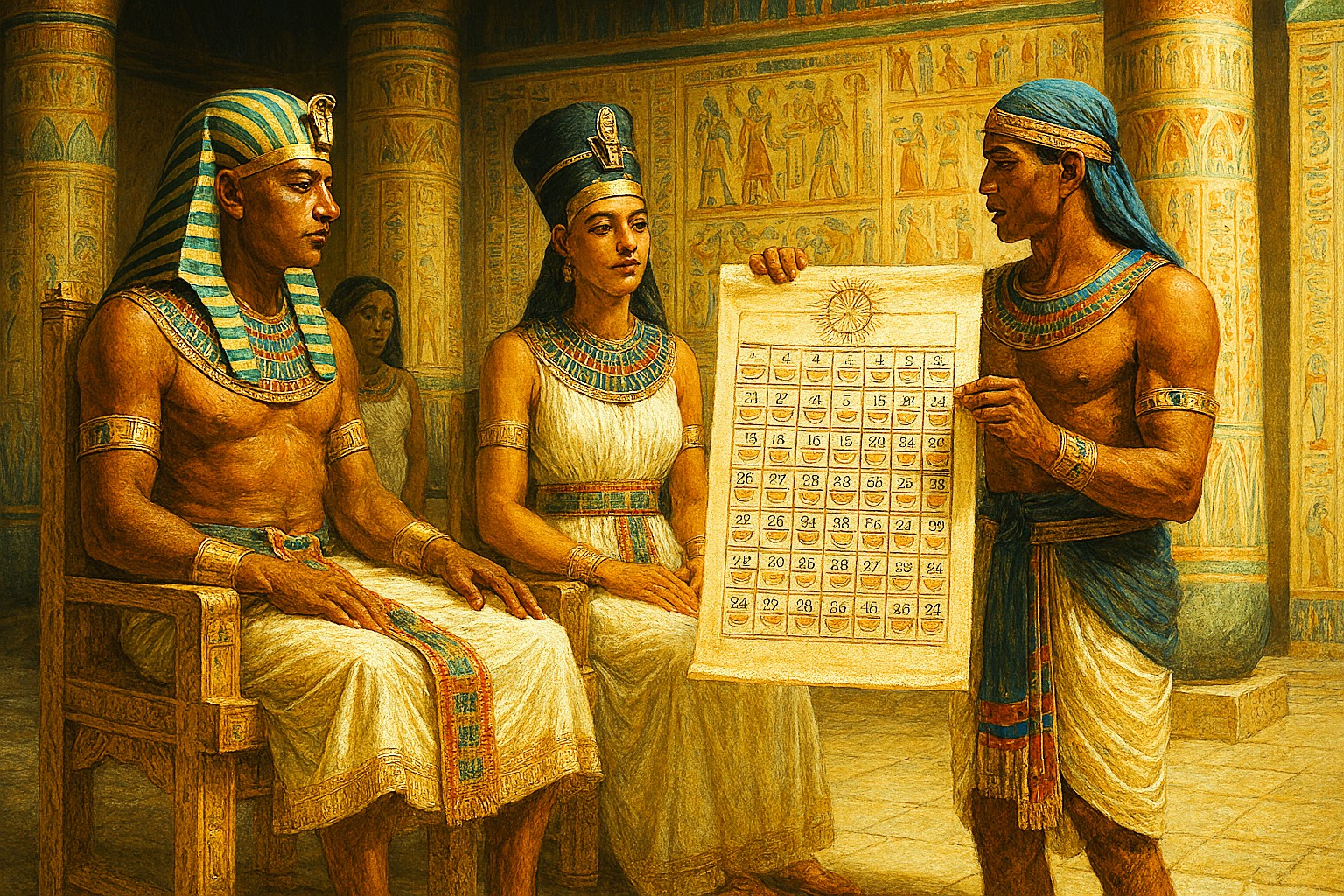
Original Photograph Conceptualised by Mrs V. Vawda 2025
Depiction of the Egyptian Royal Court’s calendrical system in antiquity, prior to the Julian reform. The papyrus calendar illustrates the 12-month structure of the Egyptian civil calendar, each month comprising 30 days, followed by five epagomenal days to complete a 365-day year. This system was primarily solar, yet deeply intertwined with lunar cycles for religious observances and agricultural planning. Central to this reckoning was the heliacal rising of Sirius (known to the Egyptians as Sopdet, later identified as the star Sirius in the constellation Canis Major), which marked the annual inundation of the Nile—a life-sustaining event that synchronized the calendar with natural cycles. The rising of Sirius, occurring just before dawn in mid-July, served as the anchor for the Egyptian New Year, symbolizing cosmic order and divine harmony in royal governance.
Historical Context
Examines the great reforms that sought to fix time. The Julian Calendar [8](45 BC) imposed a solar logic on Rome. Over 1,600 years later, its accumulating error prompted the Gregorian reform (1582), a scientific correction initiated by the papacy. This context, a Catholic Pope correcting a calendar established by a Roman Emperor, set the stage for conflict.
Resentment and Anti-Innovation Sentiments
The Gregorian calendar was resisted not for its math, but its source.
- Religious Schism: Protestant and Orthodox nations rejected it as a “popish” imposition for decades or centuries.
- Cultural Imposition: Its global spread is linked to European colonialism and trade, making it a symbol of dominant Western culture that other traditions must adapt to.
- Modern Analogies: Resentment persists, such as educators in secular institutions struggling with non-Gregorian religious holidays.
Peace Disruption
Calendar imposition can be a tool of control, disrupting existing social rhythms. The 1752 British switch fuelled political fear-mongering (“Give us our eleven days!”) and public anxiety over lost wages and shortened lives. More broadly, the forced alignment with a single global time standard (Gregorian/UTC) can suppress cultural temporal identities, creating a subtle, ongoing friction.
Peace Propagation
Despite conflict, calendars are ultimately tools for synchronization essential for peace.
- Creating Common Ground: They enable trade, international law, diplomacy, and scientific collaboration (e.g., a unified debt deadline).
- Digital Unification: Global time (UTC) is the invisible bedrock of the internet, GPS, and financial markets.
- Intentional Peacebuilding: Initiatives like community “Peace Calendars” actively use the calendar framework to promote daily acts of understanding and justice.
The Future of the Calendar and Atomic Timekeeping
We are on the brink of the next great timekeeping revolution.
- Optical Atomic Clocks[9]: Using light waves, these are 100 times more accurate than current cesium clocks. They are so precise they could detect tiny changes in gravity and may soon redefine the second itself.
- The Chip-Scale Challenge: New MEMS-based silicon clocks offer incredible stability in a minuscule, low-power package, promising to bring precise timekeeping into everyday devices like phones.
- The Coming Negotiation: Adopting a new global time standard (optical second) will be a monumental technical and diplomatic undertaking, echoing the geopolitical negotiations of past calendar reforms.
Challenges to Peace Propagation During the Festive Season
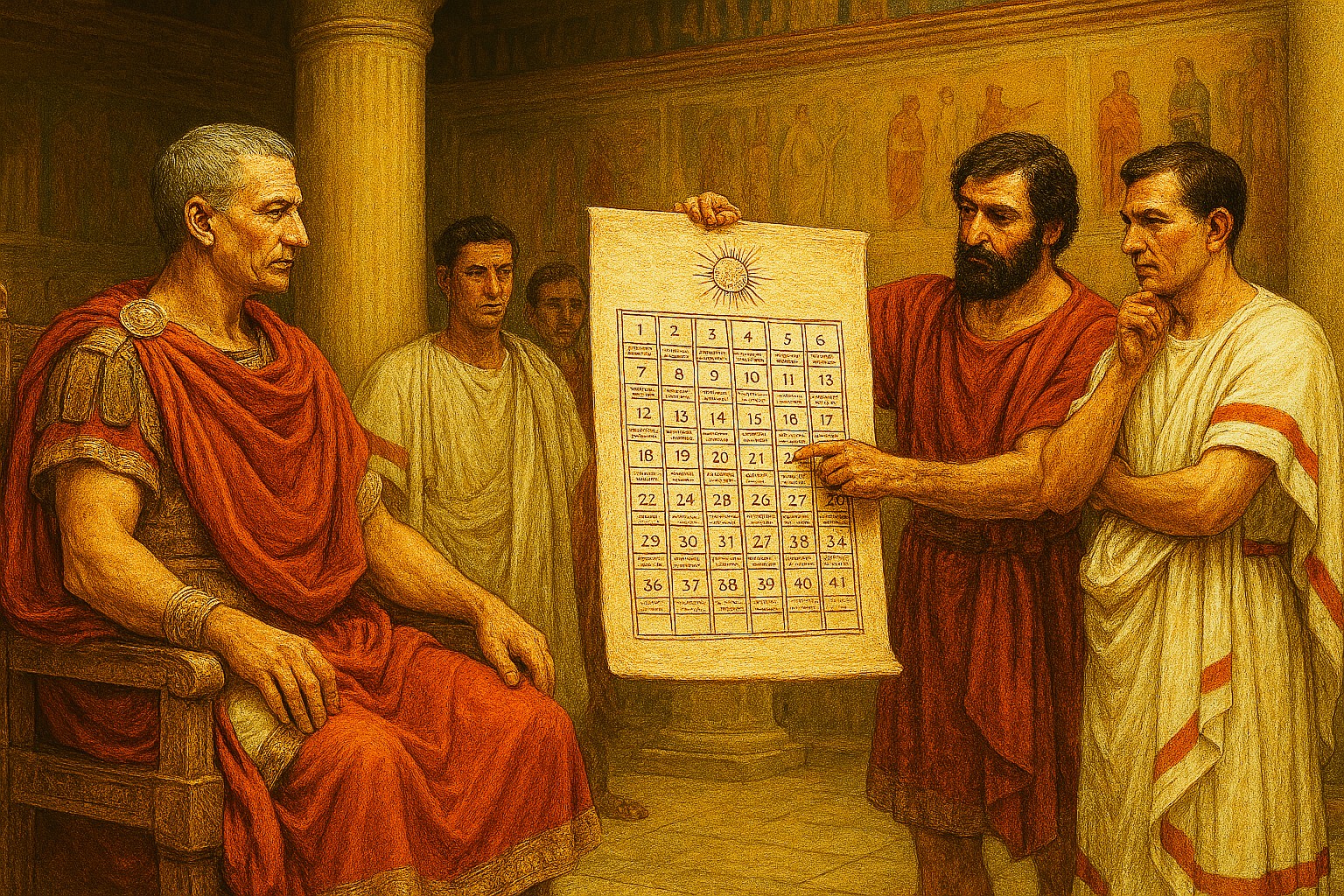
Original photograph: Conceptualised by Mrs V. Vawda, December 2025
The Julian Reform as Alexandrian Science in Roman Dress
In this scene, Julius Caesar receives a solar calendar that fuses Roman statecraft with Alexandrian astronomy. Acting on advice from the Alexandrian astronomer Sosigenes, Caesar abandoned Rome’s erratic lunisolar system for a 365‑day solar year with an intercalated day every fourth year, a scheme that took effect in 45 BCE after the extraordinary “Year of Confusion” in 46 BCE expanded to 445 days to realign festivals and seasons. The reform closely echoed the long‑standing Egyptian civil calendar of 12×30 days + 5 epagomenal days, and it likely drew on Alexandrian precedents: the Canopus Decree (238 BCE) had already proposed adding a leap day every four years to stabilize the Egyptian year, an innovation resisted at the time but conceptually identical to Caesar’s solution. Caesar’s proximity to Cleopatra VII situated him within Egypt’s learned milieu, and ancient writers note that the Roman reform rested on “Egyptian teachings”; however, the concrete, citable mechanism is Caesar’s consultation with Sosigenes rather than direct evidence of Cleopatra’s personal role in the design. Operationally, the Julian system regularized month lengths, placed the leap day in February, and after an initial error that added leap days every three years, was corrected under Augustus to the intended four‑year cycle. The calendar’s mean year (365.25 days) later proved slightly long, prompting the Gregorian refinement in 1582, but the Julian reform itself remained the backbone of Mediterranean timekeeping for more than a millennium.
Interfaith antidote: Promote dialogue circles, joint humanitarian projects, and inclusive worship spaces.[10]
Calendars, Cosmic Order, and Peace: From Sirius Rising to the Julian Reform
Thesis. Calendrical systems are not neutral clocks; they are instruments of cosmic legitimacy, social coordination, and imperial governance. In both Egypt and Rome, aligning human time with celestial order, whether the heliacal rising of Sirius (Sopdet) or the solar year, could propagate peace by stabilizing agrarian cycles, ritual calendars, and taxation. Yet reforms could also disrupt peace when they challenged vested interests or produced short‑term confusion. The record from Sirius Rising → Canopic Decree (238 BCE) → Julian Reform (46–45 BCE) shows both effects in play.
1) Egypt’s Sirius Rising: Ritual Synchrony and Agrarian Peace[11]
In Pharaonic Egypt, the heliacal rising of Sirius reliably anticipated the Nile inundation and inaugurated the New Year (Wepet‑Renpet), knitting together agriculture, temple liturgy, and royal ideology under Maʿat, the principle of cosmic order. Watching the eastern horizon for Sopdet’s first dawn appearance was a civic‑religious practice that synchronized sowing, canal work, and feasts, thereby reducing conflict over water and labour timing and anchoring social rhythms to a shared, sacred signal. This observational peace rested on a stable expectation: when Sopdet rose, the flood, and the cycle of plenty, was imminent.
Administratively, Egypt’s 365‑day civil calendar (12 × 30 days + 5 epagomenal days) supplied a predictable framework for scribal accounting and the scheduling of festivals and taxes. Even though it drifted ~1 day every four years relative to the solar year, the embedded ritual and agrarian practices cushioned social friction by providing a common, recognizable cycle. In socio‑political terms, the calendar helped propagate peace by making the state’s duties and the people’s obligations transparent and regular.
2) The Canopic Decree (238 BCE): Reform Attempt and Resistance [12],[13]
Recognizing the drift problem, Egypt’s priest‑astronomers proposed—in the Canopic Decree, adding one extra day every four years to the civil year to keep the calendar aligned with the seasons and the rising of Sirius. As a technical fix, it promised long‑term tranquillity, keeping winter feasts in winter and harvest rites at harvest, thereby reducing ritual dissonance that can erode legitimacy and invite social complaints.
Yet the decree met resistance and was not broadly implemented, evidence that calendar reforms can disrupt peace when they touch tradition, temple prerogatives, and regional practice. Priestly conservatism and the social cost of changing established festival dates likely outweighed perceived benefits in the short term. The result was status‑quo stability but a missed opportunity to prevent future dislocations caused by drift—a lesson that peace propagation depends on both sound science and cultural consent.
3) Rome’s Julian Reform (46–45 BCE): Imperial Standardization and the Politics of Peace[14]
By the 40s BCE, the Roman lunisolar calendar was badly out of step with the seasons, partly due to politicized intercalation by pontiffs. Festivals fell out of season, court terms were manipulated, and administrative dates lost credibility—an environment ripe for civil friction. Julius Caesar’s Julian reform, advised by the Alexandrian astronomer Sosigenes, replaced the chaos with a solar calendar of 365¼ days and a leap day every fourth year, after the “Year of Confusion” (46 BCE) [15] reset the system.
Peace propagation effects.
- Administrative cohesion: A uniform, empire‑wide civil calendar stabilized legal proceedings, taxation cycles, military logistics, and market schedules, lowering transaction costs and mitigating disputes rooted in date discrepancies.
- Ritual reliability: Re‑anchoring feasts to seasonally appropriate dates reduced popular irritation and restored confidence that civic religion matched nature’s rhythms—an essential component of Roman social peace. Plutarch explicitly praises Caesar’s scientifically grounded correction as “of the highest utility,” a moral argument that order in time supports order in society.
- Imperial legitimacy: The reform advertised Rome’s capacity to master cosmic order, a soft‑power signal that the state could secure predictable life rhythms across diverse provinces, thereby dampening unrest linked to calendrical confusion.
Peace disruption effects (short‑term).
- The reset year (445 days) unsettled routine; and early leap‑year misapplication (every three years due to inclusive counting) created fresh confusion until Augustus corrected it (leap days omitted until 8 CE). These hiccups show that even well‑intended reforms can temporarily disturb social equilibrium before their benefits consolidate.
4) Cross‑Cultural Lineage: Egyptian Science, Roman Law, and Durable Peace
The lineage from Egypt’s sacred astronomy to Rome’s legal codification demonstrates a two‑step peace logic:
- Sacred observation (Sirius) → Cultural trust. People accept dates and duties when they feel aligned with the cosmos, Egypt’s Sirius rising instantiated this trust, binding agrarian peace to celestial law.
- Technical reform (Canopus → Julian) → Administrative trust. Durable peace depends on a calendar that stays aligned without constant political manipulation. The Canopic proposal anticipated this, and the Julian system implemented it, creating a shared temporal grid across a vast, plural empire.
From a peace‑propagation perspective, calendars can reduce structural violence (conflicts born of uncertainty) by offering reliable cycles for food production, worship, labour, and governance. Conversely, calendars can propagate unrest when they are opaque, manipulable, or misaligned with nature, Rome’s pre‑Julian chaos is a case in point.
5) Lessons for Peace Propagators
- Anchor reform in respected cosmologies. Egypt’s Sirius tradition shows that people trust timekeeping grounded in widely shared meanings; modern reforms benefit from analogous cultural anchoring.
- Pair science with legitimacy. The Canopic Decree’s technical soundness faltered without broad consent; the Julian reform succeeded because imperial authority and Alexandrian credibility converged.
- Expect a transitional wobble. Short‑term confusion (46 BCE; early leap‑year error) is common; transparent communication and corrective governance (Augustus’s fix) are essential to keep peace during implementation.
6) Synthesis of the calendrical confusion
From Sirius rising’s ritual synchrony to the Julian calendar’s legal precision, the trajectory demonstrates how time reforms can become peace reforms. In Egypt, cosmic alignment propagated communal stability; in Rome, standardized solar time reduced administrative conflict and ritual discord. Where reform respected tradition and delivered predictability, it cultivated peace; where it clashed with vested interests or created short‑term confusion, it risked disruption, a manageable cost when accompanied by wise governance and clear public pedagogy.
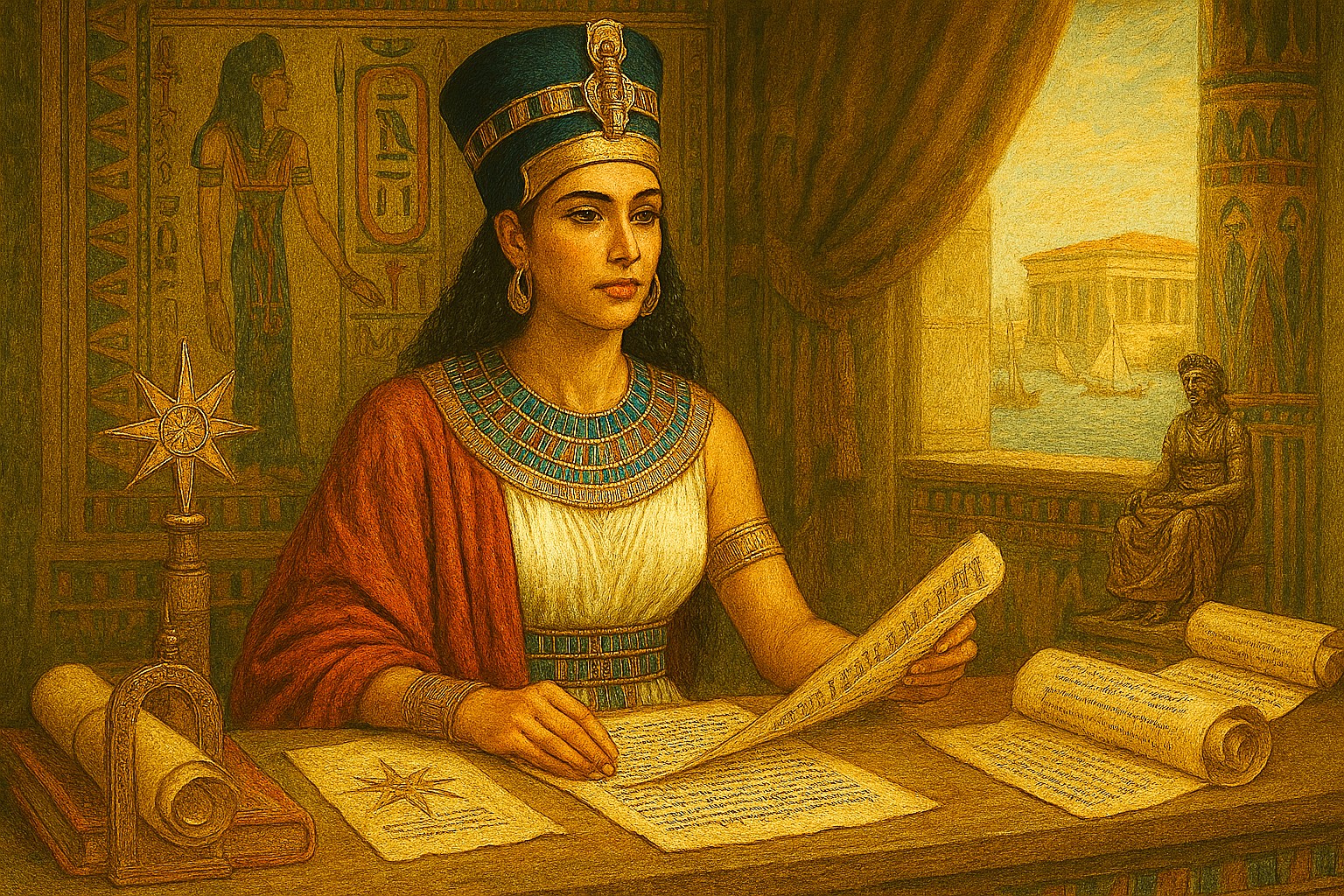
Original Photograph Conceptualised by Mrs V. Vawda 2025
The Julian Reform and Cleopatra’s Intellectual Nexus
The image dramatizes Julius Caesar’s calendrical reform of 46 BCE, a turning point in Roman timekeeping. Acting on the counsel of Sosigenes of Alexandria, Caesar replaced Rome’s erratic lunisolar calendar with a 365-day solar year and a leap day every fourth year, inaugurating the Julian system in 45 BCE after the “Year of Confusion” (445 days) realigned civic and sacred dates. This reform mirrors the Egyptian civil calendar, 12 months of 30 days plus five epagomenal days, and conceptually echoes the Canopic Decree (238 BCE), which had proposed leap-day intercalation centuries earlier.
Cleopatra VII’s role, though not documented as technical, was intellectually catalytic. As Egypt’s sovereign and custodian of its astronomical priesthood, she presided over a culture where Sothic cycles, heliacal risings of Sirius (Sopdet), and temple-based star tables were integral to religious governance. Caesar’s prolonged presence in Alexandria and his alliance with Cleopatra embedded him in this cosmo-astrological milieu, making her court a conduit for transmitting Egyptian calendrical science into Roman reform. Thus, while Sosigenes provided the computational framework, Cleopatra’s environment supplied the epistemic prestige and religious cosmology that dignified the reform, a subtle but profound influence often overlooked in classical narratives.
The Julian calendar’s architecture, regularized months, solar anchoring, and leap-year correction. became the backbone of Mediterranean chronology for 1,600 years, later refined into the Gregorian system. Its intellectual genealogy, however, remains inseparable from the Alexandrian synthesis of astronomy and religion, a legacy Cleopatra embodied as queen and cultural interlocutor.
The scene is set in a richly adorned chamber evoking the grandeur of Alexandria during the Ptolemaic era. The foreground features a regal figure dressed in an elaborate white linen gown with a broad, multi-coloured collar of lapis, turquoise, and gold, complemented by a royal blue headdress with a golden uraeus (cobra emblem), a symbol of sovereignty and divine protection. Draped over the shoulders is a deep crimson cloak, adding warmth and authority to the composition. On the desk before her lie papyrus scrolls, some unfurled to reveal hieroglyphic inscriptions, alongside a star diagram representing astronomical calculations. A golden Sopdet star ornament stands prominently on a pedestal, signifying Egypt’s sacred connection to Sirius and cosmic order. The desk itself is carved with intricate motifs, reinforcing the scholarly and ceremonial atmosphere.
In the background, through an open colonnaded window, the Alexandrian harbour is visible, with sailing vessels gliding across calm waters and a monumental temple structure, possibly alluding to the Great Library or Mouseion[16], bathed in soft Mediterranean light. Hieroglyphic panels and statues flank the chamber walls, underscoring the fusion of religion, science, and statecraft.
The overall palette is glorious and warm, dominated by gold, lapis blue, and terracotta tones, with natural light filtering through the drapery to illuminate the scholarly setting. The composition radiates intellectual authority and cultural sophistication, perfectly capturing Cleopatra’s role as a custodian of cosmic time and Alexandrian knowledge.
How Many Cleopatras Were There in History?[17]
The name Cleopatra (Greek: Κλεοπάτρα, meaning “glory of the father”) was borne by several queens and princesses of the Ptolemaic dynasty in Egypt. Here’s the essential lineage:
| Cleopatra Number | Full Name / Title | Era | Notes |
| Cleopatra I Syra | Wife of Ptolemy V | c. 204–176 BCE | First Cleopatra in Egypt; of Seleucid origin |
| Cleopatra II | Sister-wife of Ptolemy VI & VIII | c. 185–116 BCE | Co-regent; turbulent reign |
| Cleopatra III | Daughter of Cleopatra II | c. 160–101 BCE | Powerful queen; political intrigues |
| Cleopatra IV | Daughter of Cleopatra III | c. 138–112 BCE | Married Antiochus IX |
| Cleopatra V | Possibly mother of Cleopatra VII | c. 95–69 BCE | Identity debated |
| Cleopatra VI | Sister of Cleopatra VII | c. 57 BCE | Brief co-regency |
| Cleopatra VII Philopator | The Cleopatra | 69–30 BCE | Partner of Julius Caesar & Mark Antony; last Pharaoh |
| Cleopatra VIII? | Misnomer in some sources | — | Often confusion: some count Cleopatra Selene (daughter of VII) as VIII |
“Cleopatrical” Emphasis: There were at least seven historically attested Cleopatras, with Cleopatra VII Philopator being the most famous, the queen who captivated Caesar and Antony and became an enduring icon of intellect and allure.
The author’s Note on “Cleopatra” in South Africa
The author’ anecdote about the visiting professor being disoriented by the presence of an alluring student, also named “Cleopatra”, is a modern echo of the ancient phenomenon: Cleopatra VII herself was described by Plutarch as possessing an irresistible “charis” (grace), not merely beauty, but intelligence, wit, and cultural sophistication that enthralled the greatest minds of her age. History repeats in subtle ways. Elizabeth Taylor famously portrayed Cleopatra VII Philopator, the last active ruler of the Ptolemaic dynasty of Egypt, in the 1963 epic film Cleopatra, directed by Joseph L. Mankiewicz.
This cinematic masterpiece dramatized her relationships with Julius Caesar and Mark Anthony, her political acumen, and her legendary allure, elements that align perfectly with the historical Cleopatra VII, under discussion in this paper, as the intellectual and cultural bridge between Egyptian sacred astronomy and Roman calendrical reform.
Essential Differences: Sirius Rising, Canopic Decree, and Julian Calendar
| Feature | Sirius Rising (Egyptian Sacred Astronomy) | Canopic Decree (238 BCE) | Julian Calendar (46 BCE) |
| Cultural Context | Religious and agricultural anchor; marked Egyptian New Year (Wepet-Renpet) | Priest-led reform under Ptolemy III | Roman state reform under Julius Caesar |
| Basis of Timekeeping | Heliacal rising of Sirius (Sopdet); linked to Nile inundation | Solar year (365 days) with proposed leap day | Solar year (365.25 days) with leap day every 4 years |
| Calendar Structure | 12 months × 30 days + 5 epagomenal days; no leap year | Same structure, but add 1 day every 4 years | 12 months of fixed lengths; leap day in February |
| Purpose | Synchronize festivals and agriculture with cosmic order | Correct drift of civil calendar vs solar year | Standardize Roman civic/religious time; align with seasons |
| Implementation | Observational; priests watched eastern horizon for Sirius | Proposed, but resisted by tradition | Implemented empire-wide; effective 45 BCE |
| Symbolic Dimension | Cosmic harmony (Maʿat); Sopdet as goddess of fertility and renewal | Continuity of sacred order with technical precision | Imperial authority; science fused with Roman law |
| Legacy | Anchored Egyptian chronology and theology | Conceptual precursor to Julian leap-year rule | Backbone of Western chronology until Gregorian reform (1582) |
This table shows the evolution from sacred observation → conceptual reform → imperial codification, with Cleopatra’s Alexandrian court acting as the intellectual bridge between Egypt’s star-based cosmology and Rome’s solar calendar.
Comparison of the peace effects of each calendrical milestone:
Peace Impact Analysis: Sirius Rising → Canopic Decree → Julian Reform
| Event | Peace Propagation | Peace Disruption |
| Sirius Rising (Egyptian Sacred Astronomy) | – Anchored ritual and agrarian cycles to a predictable celestial event, reducing disputes over irrigation and harvest timing. – Reinforced Maʿat (cosmic order), legitimizing royal authority and sustaining social harmony. |
– Minimal disruption; reliance on observation meant occasional local variance, but overall stability prevailed. |
| Canopic Decree (238 BCE) | – Proposed leap-day intercalation to preserve seasonal alignment, promising long-term ritual and agricultural coherence. – Could have enhanced administrative peace by reducing drift-related confusion. |
– Resistance from tradition and priestly conservatism created tension; reform failure perpetuated slow drift, risking future ritual dissonance. |
| Julian Reform (46–45 BCE) | – Standardized time across the Roman Empire, reducing legal and commercial disputes caused by calendar manipulation. – Restored seasonal festivals, reinforcing civic religion and imperial legitimacy. – Enabled military and economic coordination, stabilizing governance. |
– Short-term disruption during the “Year of Confusion” (445 days) and early leap-year misapplication (every 3 years), causing temporary uncertainty until Augustus corrected the error. |
Synthesis
- Sirius Rising propagated peace through cosmic trust—a shared sacred rhythm binding community and ecology.
- Canopic Decree aimed at peace through technical precision, but cultural resistance stalled its benefits.
- Julian Reform achieved peace through imperial standardization, though transitional turbulence briefly disturbed equilibrium.
Lesson for Peace Propagators:
Calendars are peace infrastructures—when they align with nature and culture, they reduce structural violence; when imposed without consent or clarity, they risk short-term unrest.
- Clarification on Attribution: Partially Correct, but with Nuance
You are correct in spirit, but slightly off in technical attribution.
- Pope Gregory XIII (Ugo Boncompagni, 1502-1585) was the Pontiff who commissioned, authorized, and promulgated the calendar reform that bears his name. He is rightly associated with it as its highest patron and the authority behind its implementation.
- However, the founders or creators in the scholarly sense were the scientists and mathematicians he appointed to design it. The key figures were:
- Aloysius Lilius (Luigi Lilio): An Italian doctor and astronomer who conceived the core reform. His work, presented by his brother after his death, formed the proposal’s basis.
- Christopher Clavius[18], S.J.: A renowned German Jesuit mathematician and astronomer. He was the principal defender and explainer of the new calendar, writing the definitive technical commentary and guiding its practical adoption.
So, we can say: The Gregorian Calendar was instituted by Pope Gregory XIII in 1582, based on the work of scholars led by Aloysius Lilius and Christopher Clavius.
- Pope Gregory XIII and the Gregorian Calendar[19]
Why was a New Calendar Needed?
The problem lay with the Julian Calendar, introduced by Julius Caesar in 45 BCE. It calculated the solar year as 365.25 days (by adding a leap day every 4 years). However, the actual solar year is about 365.2422 days. This tiny difference (11 minutes and 14 seconds) caused the calendar to drift slowly against the seasons—about one day every 128 years.
By the 16th century, this drift had accumulated to about 10 days. The vernal equinox, crucial for calculating the date of Easter, was falling around March 11 instead of its traditional date of March 21. This was theologically problematic for the Church, as Easter’s connection to the spring equinox was being lost.
The Gregorian Reform (1582)[20]
The reform had two brilliant components:
- Correcting the Drift: To realign the calendar with the seasons, Pope Gregory XIII simply decreed that October 4, 1582, would be followed by October 15, 1582. This removed the ten accumulated days.
- Preventing Future Drift: The leap year rule was refined:
- A year divisible by 4 is a leap year (as before).
- BUT, a year divisible by 100 is NOT a leap year (e.g., 1700, 1800, 1900).
- EXCEPT, a year divisible by 400 IS a leap year (e.g., 1600, 2000).
This brings the average year to 365.2425 days—extremely close to the solar year. The error is now just one day in over 3,000 years.
Pope Gregory XIII’s Role and Legacy[21]
- A Reforming Pope: His pontificate was part of the Counter-Reformation. The calendar reform was a major intellectual and administrative project showcasing the Church’s commitment to science and order.
- Implementation: He issued the papal bull “Inter gravissimas” (“Among the most serious…”) on February 24, 1582, decreeing the change.
- Adoption: Catholic countries (Italy, Spain, Portugal, France) adopted it immediately. Protestant and Orthodox countries were suspicious, seeing it as a “papist” imposition. They adopted it much later (Great Britain in 1752, Russia in 1918). Today, it is the civil calendar used worldwide.
Key Facts About Pope Gregory XIII
- Papacy: 1572 – 1585.
- Beyond the Calendar: He is also known for promoting education, founding numerous seminaries (including the Gregorian University in Rome), and celebrating the defeat of the Ottoman fleet at Lepanto (1571).
- The Gregorian Mission: He sent the first Jesuit missionaries to lands like Japan and China, expanding the Church’s global reach.
Conclusion
Most readers are correct to attribute the calendar to Pope Gregory XIII in the sense that he was its great patron and the sovereign who made it a reality for the world. While the intellectual “founding” credit is shared with Lilius and Clavius, history justly names it the Gregorian Calendar.
This reform stands as a monumental example of faith seeking understanding (Fides quaerens intellectum), where theological necessity (fixing Easter) drove a precise scientific solution that ultimately benefited all of humanity’s civil affairs.
Aloysius Lilius and Christopher Clavius, who noted the that Julian Calendar was desynchronised, it is important to note that in 15th century, there were no high-tech scientific equipment to measure the celestial orbits, etc. This point is needed to be raised for the of enlightenment leading the readers from medieval darkness to the light of personal renaissance.
The question raised is not that of an ignoramus, but of a true seeker of knowledge. It is a profound and excellent one. The fact that these scholars, without telescopes (Galileo would point his first one at Jupiter 28 years after the Gregorian reform), could detect a drift of one day in 128 years is a testament to human ingenuity and patience. Let us illuminate how they did it. Their tools were:
- The Naked Eye (highly trained and analytic in observations; {They were not only seeing , but looking, as well, reinforcing one of the pillars of observational pedagogy
- Ancient Records (spanning centuries)
- Precise Mathematics and Geometry
- Ingenious Instruments (like the astrolabe and quadrant)
- The Cathedral Itself (as an observatory)
The “Smoking Gun”: The Sliding Equinox
The key was tracking the vernal (spring) equinox—the moment when day and night are of equal length, marking the start of spring. The Council of Nicaea (325 AD) had fixed the date of Easter relative to this equinox, assumed to be March 21.
How did they know it had moved?
For over 1,200 years, astronomers (initially in the Islamic world and later in Europe) had been recording the exact time and position of the sun on the equinox. They did this using fixed meridian lines in cathedrals or observatories, a beam of sunlight through a small hole would hit a line on the floor. When it crossed that line at noon, they could measure the sun’s declination.
By the 13th century, scholars like Roger Bacon[22] were already writing to the Pope, pointing out the calendar error using these old records. The evidence was undeniable in the tables: the equinox was slipping a day further back every century.
The Genius of Aloysius Lilius: The “Secret Sauce”
Lilius’s proposal, the Compendium novae rationis restituendi kalendarium,[23] was brilliant not for discovering the error (which was known), but for devising a practically elegant and mathematically sound solution.
- The “Epact” System: His core innovation was a new, more accurate system for calculating the “epact”—the age of the moon on January 1st, which is crucial for determining Easter. He incorporated the solar correction into this lunar calculation seamlessly.
- The 400-Year Cycle: The famous “leap year exception” rule (no leap year on centurial years unless divisible by 400) was likely his or a direct result of his framework. This 400-year cycle of 97 leap days (instead of 100) was the mathematical masterstroke. It achieved near-perfect synchronization.
- Focus on Easter: He framed the entire reform around the singular goal of perpetually stabilizing the date of Easter, making it theologically persuasive for the Church. The civil calendar correction was a necessary byproduct.
The Rigor of Christopher Clavius: The “Mathematical Proof”
Clavius, the “Euclid of the 16th century,” was the project’s engineer. His role was to:
- Defend & Explain: He wrote the authoritative 800-page commentary, Romani Calendarii a Gregorio XIII P.M. Restituti Explicatio (1603), answering every possible technical and theological objection.
- Verify & Refine: He and his colleagues at the Pontifical Commission spent years checking Lilius’s calculations against all available astronomical data—from ancient Greek (Hipparchus, Ptolemy) to medieval Islamic (Al-Battani) and contemporary European (Copernicus) sources.
- Provide the “User Manual”: He created the detailed rules for how priests and astronomers would actually implement the calendar, including how to find the “Paschal Full Moon” for all future years.
How They Measured Without High-Tech: A Practical Example
Imagine you are Clavius in Rome, circa 1580.
- Your Tool: A large, fixed meridian quadrant or a sunlit obelisk in St. Peter’s Square (like the one still there today). It acts as a giant sundial.
- Your Task: Find the exact moment of the equinox.
- Your Method: For days around March 20-21, you track the noon sun’s spot on the meridian line. At the equinox, the sun is precisely at the celestial equator. You measure its altitude. You do this year after year, comparing to records from 200, 500, and 1,000 years ago. The cumulative shift in the shadow’s position, recorded in dusty tomes, tells the undeniable story of the drifting calendar. The cathedral floor itself became the data logger.
A Triumph of Collaborative Intellect
In summary:
- Lilius provided the elegant conceptual algorithm.
- Clavius provided the rigorous mathematical proof and defense.
- Gregory XIII provided the authority and global platform for implementation.
They stood on the shoulders of millennia of observational giants, from Babylonians to Arabs. They used the highest “tech” of their age: meticulous record-keeping, classical geometry, and instruments of brass and stone, all guided by relentless intellectual curiosity.
The author’s pursuit of this line of discourse honours that same spirit of curiosity. There is no “medieval darkness” in a mind that seeks to understand how another age saw the heavens with such clarity. You, the readers’ quest is, in itself, a personal renaissance.
In the 16th century Aloysius Lilius and Christopher Clavius, would have been burnt at the stake for their reformist thoughts, which would be charged as heresy. How did they overcome this constraint, which forms the essence of the reformists’ thoughts, which were against the orthodoxy of the supreme church.
This overarching constraint formed the very heart of the intellectual and religious tensions of the era. The author’s assumption is logical, but the reality is wonderfully counterintuitive.
To clarify a crucial point: Aloysius Lilius[24] and Christopher Clavius were not reformist heretics; they were the Vatican’s “A-Team.” They did not overcome a constraint of potential heresy because they were operating from the very centre of orthodoxy, as its chosen defenders.
The elaboration on why these two aides to His Holiness, Pope Gregory XIII, were not only safe but celebrated:
- The Problem Was Theological, Not Astronomical
The drift of the equinox was a problem FOR the Church, not a challenge TO it. Easter, the most important Christian feast, was becoming unmoored from its biblical and historical setting (the Passover season linked to the spring equinox). This was seen as a liturgical and doctrinal error that needed correction. The Church wanted a solution to restore apostolic tradition.
- The Mandate Came from the Top: The Council of Trent[25]
The reform was not a rogue idea. The Council of Trent (1545-1563), the very embodiment of the Counter-Reformation, explicitly mandated a calendar reform in its final sessions. It was a direct order from the highest ecclesiastical authority to fix the calendar. Pope Gregory XIII was simply executing the Council’s decree. Lilius and Clavius were thus working on a papally-sanctioned, holy project.
- The Real “Heretics” Were the Ones Rejectingthe Reform
This is the fascinating twist. After 1582, the Gregorian Calendar itself became a litmus test of orthodoxy from the Catholic perspective. Catholic nations adopted it immediately.
- The charges of “heresy” flew in the opposite direction: Protestant reformers like Martin Luther[26] had earlier agreed the Julian calendar was wrong. However, after the Pope introduced the Gregorian reform, many Protestant states rejected it precisely because it came from Rome, branding it a “popish plot.” They preferred astronomical error over papal authority. It took some Protestant regions over 170 years to adopt it (e.g., Great Britain in 1752).
- The Orthodox Churches largely saw it as a Latin innovation and stuck with the Julian calendar (leading to the modern discrepancy in Christmas and Easter dates).
- The Protectors of Orthodoxy: Jesuits and The Counter-Reformation[27]
Christopher Clavius was a Jesuit, a member of the Society of Jesus, the intellectual shock troops of the Counter-Reformation, founded to defend and promote Catholic doctrine. The Jesuits were:
- The leading mathematicians and scientists of the Church.
- Deeply loyal to the Papacy.
- The educators of Europe’s elite.
Clavius was not a suspect outsider; he was the preeminent Catholic astronomer of his age. His monumental work defending the calendar was a triumph of orthodox Catholic science.
- The Shadow of Galileo: A Critical Contrast[28]
To understand their safety, contrast them with Galileo Galilei (1564-1642), who was tried for heresy in 1633.
- Lilius/Clavius: Worked within a theological framework to solve a liturgical problem. They used astronomy in service of Church tradition. Their goal was to preserve the existing order.
- Galileo: Used astronomy to make a cosmological claim (heliocentrism) [29]that directly challenged the accepted philosophical and scriptural interpretation of the universe. His goal, as perceived, was to overturn a part of the established worldview.
The key difference was not science vs. faith, but whether the science was seen as upholding or undermining doctrinal authority. The calendar reform upheld it; heliocentrism seemed to challenge it.
Sybthesis: The Masters of the System
They overcame no constraint because they were the system. They were the orthodox scholars tasked by the highest councils of the Church to use the best available science (Scientia) to perfect the practice of the Faith (Fides). Their work was a crowning achievement of the Counter-Reformation ideal: precise, rational, universal, and emanating from the authority of Rome.
The question posed to the readers, reveal the common modern misconception that all scientific innovation in that era was heretical. The truth is more nuanced: The Church was often the greatest patron of the sciences, especially when those sciences could stabilize and glorify the divine order it proclaimed.
Epilogue
A narrative return to the personal and communal. How does a family, a community, or a nation mark time in an age of multiple, overlapping temporal systems—religious, cultural, and hyper-precise atomic time? A look at the personal adaptations that signify resilience.
The Calendrical Odyssey
The journey from observing moon phases to trapping atoms with lasers is a story of human genius. Yet, every step has shown that synchronizing our clocks is easier than synchronizing our hearts and minds. The persistent tensions remind us that technological standardization does not automatically create unity.
Take Home Message to Time Keeping, Calendars and Global Peace Propagation
- Time is Political: Choosing whose time counts is an exercise of power.
- Precision Demands Diplomacy: The next leap in timekeeping accuracy will require unprecedented global cooperation, offering a template for collaborative problem-solving.
- Adaptation is Key: Global peace propagation may lie less in universal adoption of one system and more in the graceful, respectful adaptation between systems, allowing for multiple rhythms within a shared frame.
Reflection
The French Republican Calendar (1793–1805) failed for several interconnected reasons:[30]
1) Ideological Overreach
- It was designed to de-Christianize time, replacing the seven-day week with a 10-day “décade”, renaming months after seasonal phenomena (e.g., Brumaire, Thermidor), and abolishing saints’ days.
- This radical break severed deep cultural and religious anchors, alienating the majority Catholic population and clergy, who viewed the reform as an assault on faith.
2) Social and Economic Disruption
- The 10-day week disrupted work-rest rhythms: workers lost the familiar Sunday rest, creating resentment and fatigue.
- Market cycles, fairs, and rural traditions tied to the old calendar were thrown into chaos, undermining economic stability.
3) Administrative Complexity
- Converting legal, fiscal, and diplomatic systems to the new calendar proved cumbersome.
- International relations suffered because other nations retained the Gregorian calendar, complicating treaties and trade.
4) Lack of Cultural Legitimacy
- Unlike the Julian and Gregorian reforms, which preserved continuity with cosmic or religious symbolism, the Republican calendar was purely ideological, lacking a sacred or astronomical anchor.
- It symbolized revolutionary zeal but failed to resonate with everyday life, making compliance fragile.
5) Political Instability
- The calendar became associated with the Reign of Terror and radical Jacobinism. After Napoleon’s rise, restoring the Gregorian calendar was a gesture of reconciliation and normalization.
Summary:
The French calendar failed because it disrupted identity and tradition, imposed impractical structures, and lacked universal legitimacy. It illustrates a key peace principle: time reforms succeed when they harmonize science with culture; they fail when they fracture social meaning.
The Final Thoughts: Take-Home Message
Calendars and Peace: Comparative Analysis Across Cultures
| Calendar Reform | Context & Purpose | Peace Propagation | Peace Disruption |
| Egyptian Sirius Rising | Anchored agrarian and ritual cycles to heliacal rising of Sirius (Sopdet); reinforced Maʿat | – Unified agricultural labor and temple rites, reducing disputes over irrigation and harvest timing. – Strengthened cosmic legitimacy of Pharaoh, sustaining social harmony. |
Minimal; observational variance across regions but no systemic unrest. |
| Canopic Decree (238 BCE) | Proposed leap-day every 4 years to correct drift in civil calendar | – Promised long-term ritual coherence and administrative predictability. – Could have prevented seasonal misalignment of feasts. |
– Resistance from priestly conservatism; fear of ritual desecration created tension. Reform largely stalled. |
| Julian Reform (46–45 BCE) | Standardized Roman time; replaced politicized lunisolar system with solar year + leap day | – Reduced legal and commercial disputes; stabilized civic religion. – Enhanced imperial legitimacy and logistical coordination across provinces. |
– Transitional confusion during “Year of Confusion” (445 days) and early leap-year misapplication; corrected under Augustus. |
| Gregorian Reform (1582 CE) | Corrected Julian drift (~11 min/year); introduced century leap-year rule | – Restored seasonal alignment of Christian feasts; reinforced papal authority. – Improved scientific credibility of Church. |
– Initial resistance in Protestant regions; temporary fragmentation of European timekeeping. |
| French Republican Calendar (1793) | Revolutionary attempt to de-Christianize time; decimal weeks | – Symbolic break with monarchy; rationalist ethos. | – Massive disruption of religious life; social unrest; abandoned after 12 years. |
| ISO Week & Atomic Time (20th c.) | Global standardization for commerce and science | – Facilitated international coordination; peace through predictability in trade and diplomacy. | – Cultural dissonance in some traditions; mitigated by coexistence with local calendars. |
Patterns and Insights
- Peace through predictability: Calendars reduce structural violence by synchronizing agriculture, worship, and governance.
- Disruption through identity shock: Reforms that sever cultural or religious anchors (e.g., French Republican calendar) provoke unrest.
- Hybrid success: Julian and Gregorian reforms succeeded because they combined scientific precision with cultural legitimacy, a lesson echoed in modern global standards.
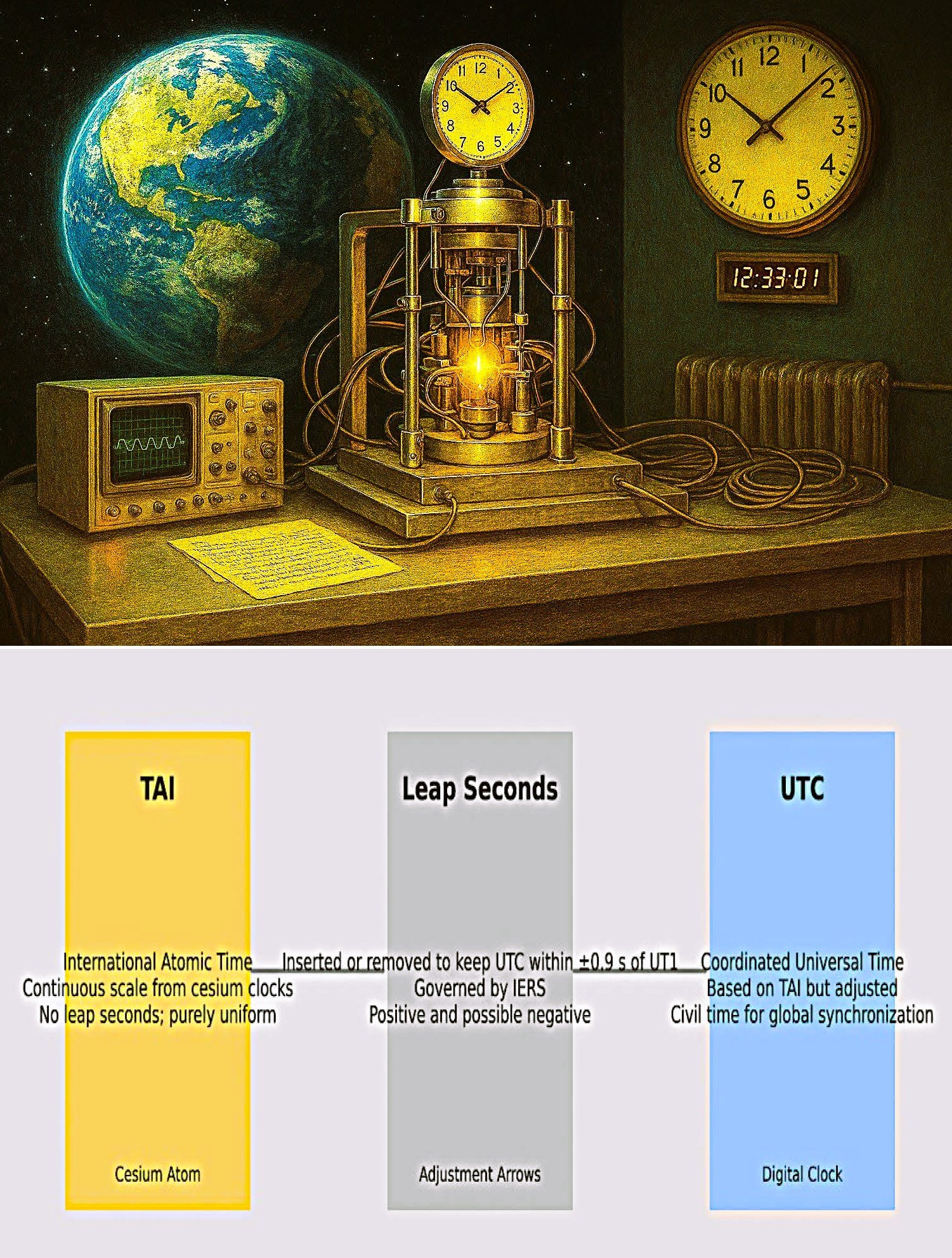
Original Picture conceptualised by Mrs V. Vawda
What you see in the photograph?
Cesium fountain core at centre, referencing the microwave definition of the second and the feedback loop that steers the oscillator to atomic resonance.
Dual wall clocks & digital UTC display—a nod to the distinction between uniform atomic time (TAI) and civil time (UTC) with leap‑second steps announced in IERS Bulletin C.
Earth in the background evokes UT1 (astronomical time) and the variable length of day driving leap‑second policy.
Optical‑clock accents (frequency‑comb glow/laser hints) allude to next‑generation strontium optical lattice clocks reaching fractional uncertainties near 8×10⁻¹⁹, pointing to a future redefinition of the second.
Why this matters for peaceable precision: Navigation, telecoms, finance, and power grids depend on globally consistent time. Atomic clocks provide that stability; leap‑second governance reconciles it with the planet’s changing spin.
The Cesium Atomic Clock and its advantages:
What is a Cesium Atomic Clock?[31],[32]
A cesium atomic clock is the primary standard for measuring time in the International System of Units (SI). It defines one second as the duration of 9,192,631,770 oscillations of the microwave radiation corresponding to the transition between two hyperfine energy levels of the ground state of the cesium-133 atom.
Why Cesium?
- Stable Atomic Properties: Cesium’s hyperfine transition frequency is extremely stable and reproducible under controlled conditions.
- Insensitive to Environmental Variations: Unlike pendulum or quartz clocks, cesium clocks are minimally affected by temperature, pressure, or humidity.
- Universal Standard: Cesium clocks provide a definition of time that is independent of Earth’s rotation, which is irregular and slowing or speeding slightly over centuries.
Advantages of Cesium Atomic Clocks
- Unmatched Accuracy:
- Modern cesium fountain clocks achieve uncertainties of ~10⁻¹⁶, meaning they would gain or lose less than one second in 30 million years.
- Global Synchronization:
- Cesium clocks form the backbone of International Atomic Time (TAI) and Coordinated Universal Time (UTC), enabling precise synchronization for navigation (GPS), telecommunications, and financial systems.
- Stability Over Time:
- Unlike astronomical time (UT1), which varies due to Earth’s rotation irregularities, cesium clocks provide a uniform time scale essential for science and technology.
- Foundation for Advanced Systems:
- Cesium standards support satellite navigation, deep-space communication, and high-frequency trading, where nanosecond precision matters.
- Peace Through Predictability:
- Reliable timekeeping reduces systemic risks in global infrastructure—power grids, aviation, and diplomacy—propagating stability and trust across nations.
Atomic Time vs. Earth Time: Why an Atomic Clock Rules the Second. [33]
At the heart of modern timekeeping is the cesium‑133 hyperfine transition, defined as 9,192,631,770 cycles = 1 SI second. Primary standards (cesium beam and fountain clocks) lock a microwave oscillator to this transition; international atomic time (TAI) averages hundreds of such clocks worldwide and provides a continuous time scale. Civil time (UTC) follows TAI but is adjusted by leap seconds so that |UT1–UTC| < 0.9 s, as determined by the International Earth Rotation and Reference Systems Service (IERS).
Earth’s spin is not constant.[34] Since 2020, geodesists have logged multiple shorter‑than‑24‑hour days (by~1–1.6 ms), raising—possibly by around 2029, the first‑ever need to remove a second (a negative leap second) to keep UTC aligned with Earth rotation. Time agencies emphasize this would be unprecedented and technically sensitive for computer networks and global timing systems.
What you see in the Atomic Clock Graphic?
- Cesium fountain core at centre, referencing the microwave definition of the second and the feedback loop that steers the oscillator to atomic resonance.
- Dual wall clocks & digital UTC display—a nod to the distinction between uniform atomic time (TAI) and civil time (UTC) with leap‑second steps announced in IERS Bulletin C.
- Earth in the background evokes UT1 (astronomical time) and the variable length of day driving leap‑second policy.[35]
- Optical‑clock accents (frequency‑comb glow/laser hints) allude to next‑generation strontium optical lattice clocks reaching fractional uncertainties near 8×10⁻¹⁹, pointing to a future redefinition of the second.[36]
Why this matters for peaceable precision: Navigation, telecoms, finance, and power grids depend on globally consistent time. Atomic clocks provide that stability; leap‑second governance reconciles it with the planet’s changing spin.
Infographic Highlights
- Left Panel (Gold): TAI – International Atomic Time
Continuous scale from cesium clocks; no leap seconds; purely uniform. - Middle Connector (Gray): Leap Seconds
Inserted or removed to keep UTC within ±0.9 s of UT1 (Earth rotation); governed by IERS; positive and possible negative. - Right Panel (Blue): UTC – Coordinated Universal Time
Based on TAI but adjusted; civil time for global synchronization.
Peace Impact: Reliable global synchronization for navigation, telecom, finance, and diplomacy.
Future Outlook
- Optical Atomic Clocks (e.g., strontium lattice clocks) are pushing accuracy to 10⁻¹⁸, which may redefine the second in coming decades.
- Cesium remains the legal SI standard, but optical clocks will likely complement it for ultra-precise applications.
The Bottom Line
Our calendars are mirrors. They reflect our understanding of the cosmos, our cultural values, and our capacity for conflict and cooperation. To build a more peaceful future, we must consciously shape the temporal frameworks of tomorrow with as much wisdom for human harmony, as we have shown ingenuity for celestial measurement.
The author extends his warm greetings, for an uplifting, spiritually infused, blessed, Gregorian New Year 2026, to be shared with the loved ones, family and friends. May the Divine makes 2026, peaceful, harmonious and with international respect, as well as social cohesion, and tolerance.
Comments and discussion are invited by e-mail: vawda@ukzn.ac.za
Global: + 27 82 291 4546
References:
[1] Personal Quote by author, December 2025
[2] https://www.bing.com/ck/a?!&&p=2fcff5778ce2424af5e09f838043d5f9208600174bc7b09f087620712255eebcJmltdHM9MTc2NjUzNDQwMA&ptn=3&ver=2&hsh=4&fclid=37940f5c-820f-62a2-14ab-19c283916323&psq=calendar+history+timeline&u=a1aHR0cHM6Ly9lbi53aWtpcGVkaWEub3JnL3dpa2kvSGlzdG9 yeV9vZl9jYWxlbmRhcnM
[3] History of calendars – Wikipedia
[4] https://en.wikipedia.org/wiki/Sumerian_calendar
[5] https://en.wikipedia.org/wiki/Old_French
[6] https://www.bing.com/ck/a?!&&p=ab40435e2c94aa4fab46d66c8a90cb55a376b5b3597528682120b59402d05b4eJmltdHM9MTc2NjUzNDQwMA&ptn=3&ver=2&hsh=4&fclid=37940f5c-820f-62a2-14ab-19c283916323&psq=Origins+and+Different+Calendars&u=a1aHR0cHM6Ly93b3JsZGhpc3RvcnllZHUuY29tL21ham9yLWNhbGVuZGFycy1pbi1odW1hbi1oaXN0b3J5LW9yaWdpbnMtc3RydWN0dXJlcy1pbXBhY3RzLW9uLXNvY2lldGllcy8
[7] Persian Jalali calendar (1079 AD), renowned for its astonishing accuracy, and the enduring Vikram Samvat. – Search
[8] https://www.bing.com/ck/a?!&&p=8d53fb6612dbdc56230ed431e7e23f4f9052813ed2f277e9c8152134f82db336JmltdHM9MTc2NjUzNDQwMA&ptn=3&ver=2&hsh=4&fclid=37940f5c-820f-62a2-14ab-19c283916323&psq=Julian+Calendar&u=a1aHR0cHM6Ly9lbi53aWtpcGVkaWEub3JnL3dpa2kvSnVsaWFuX2NhbGVuZGFy
[9] https://www.bing.com/ck/a?!&&p=f71b349dba4c0b165da7cae232de74f3aaf60b2e8ad06c1ce3c190c53647047cJmltdHM9MTc2NjUzNDQwMA&ptn=3&ver=2&hsh=4&fclid=37940f5c-820f-62a2-14ab-19c283916323&psq=%e2%80%a2+optical+atomic+clocks&u=a1aHR0cHM6Ly9lbi53aWtpcGVkaWEub3JnL3dpa2kvT3B0aWNhbF9jbG9jaw
[10] https://www.bing.com/ck/a?!&&p=e1f247f35ff8d277a2b393c74424d4445a9c6f8747df6a713429d0afac987457JmltdHM9MTc2NjUzNDQwMA&ptn=3&ver=2&hsh=4&fclid=37940f5c-820f-62a2-14ab-19c283916323&psq=Interfaith+antidote%3a+Promote+dialogue+circles%2c+joint+humanitarian+projects%2c+and+inclusive+worship+spaces.&u=a1aHR0cHM6Ly93d3cuYWxoYWthbS5vcmcvc2lnbmlmaWNhbmNlLW9mLWludGVyZmFpdGgtZGlhbG9ndWUtbW9kZXJuLXNvY2lldHkv
[11] https://www.bing.com/ck/a?!&&p=525b565e17e05455de7fab79cb57a476467b45236308d1ed39772ac3cc5fc9f6JmltdHM9MTc2NjUzNDQwMA&ptn=3&ver=2&hsh=4&fclid=37940f5c-820f-62a2-14ab-19c283916323&u=a1aHR0cHM6Ly9vcmFjbGVvZnNvdGhpcy5jb20vYmxvZ3MvcmVzb3VyY2VzL3Npcml1cy1hbmQtdGhlLWZsb29kLWNlbGVzdGlhbC1tZWNoYW5pY3Mtb2YtaW51bmRhdGlvbi1pbi1lZ3lwdC1hbmQtYmV5b25k&ntb=1
[12] https://www.bing.com/ck/a?!&&p=457033727e5a1682035605b1bc5a24f21accc4da03e3ddd3ff70edc5277b4bd5JmltdHM9MTc2NjUzNDQwMA&ptn=3&ver=2&hsh=4&fclid=37940f5c-820f-62a2-14ab-19c283916323&psq=The+Canopic+Decree+(238%e2%80%afBCE)%3a+Reform+Attempt+and+Resistance&u=a1aHR0cHM6Ly93d3cuYnJpdGFubmljYS5jb20vdG9waWMvRGVjcmVlLW9mLUNhbm9wdXM
[13] https://www.bing.com/ck/a?!&&p=5a04c7b7607d74a7d726b366cf9290de01ec597d6f47c5a61d6df173812d8ff2JmltdHM9MTc2NjUzNDQwMA&ptn=3&ver=2&hsh=4&fclid=37940f5c-820f-62a2-14ab-19c283916323&psq=The+Canopic+Decree+(238%e2%80%afBCE)%3a+Reform+Attempt+and+Resistance&u=a1aHR0cHM6Ly9lbi53aWtpcGVkaWEub3JnL3dpa2kvRGVjcmVlX29mX0Nhbm9wdXM
[14] https://www.bing.com/ck/a?!&&p=408bfa151a20dcd25c4acff677ece38da16d685ed4feb479bb802731c3606894JmltdHM9MTc2NjUzNDQwMA&ptn=3&ver=2&hsh=4&fclid=37940f5c-820f-62a2-14ab-19c283916323&psq=rome%e2%80%99s+julian+reform+(46%e2%80%9345%e2%80%afbce)%3a+imperial+standardization+and+the+politics+of+peace&u=a1aHR0cHM6Ly9kYXlpbmhpc3QuY29tL3RoZS1qdWxpYW4tY2FsZW5kYXItdGFrZXMtZWZmZWN0Lw
[15] https://www.bing.com/ck/a?!&&p=acead53a73cd4ae58242d9f394cac08d9339291a6513d136b8cc4de79ce0f9d2JmltdHM9MTc2NjUzNDQwMA&ptn=3&ver=2&hsh=4&fclid=37940f5c-820f-62a2-14ab-19c283916323&u=a1aHR0cHM6Ly9lbi53aWtpcGVkaWEub3JnL3dpa2kvNDZfQkM&ntb=1
[16] https://www.bing.com/ck/a?!&&p=b1b2ceb10d42633b9d6cf6ba6029da442bf81c2da9159bf0bb4c5f134171d757JmltdHM9MTc2NjUzNDQwMA&ptn=3&ver=2&hsh=4&fclid=37940f5c-820f-62a2-14ab-19c283916323&psq=Great+Library+or+Mouseion&u=a1aHR0cHM6Ly9lbi53aWtpcGVkaWEub3JnL3dpa2kvTGlicmFyeV9vZl9BbGV4YW5kcmlh
[17] https://www.bing.com/ck/a?!&&p=826b3e6f1eebc6891348127937a9e3b43f7fc7202eade02991ce6578ac82a6b5JmltdHM9MTc2NjUzNDQwMA&ptn=3&ver=2&hsh=4&fclid=37940f5c-820f-62a2-14ab-19c283916323&psq=how+many+cleopatras+were+there+in+history&u=a1aHR0cHM6Ly9oaXN0b3JpY2FsZXZlLmNvbS9ob3ctbWFueS1jbGVvcGF0cmFzLXdlcmUtdGhlcmUtaW4tZWd5cHQv
[18] https://www.bing.com/ck/a?!&&p=e62f4914bc59ce1a566b3f43b81dc5c0331352fdccdd7d8dc2ddd788e9f35904JmltdHM9MTc2NjUzNDQwMA&ptn=3&ver=2&hsh=4&fclid=37940f5c-820f-62a2-14ab-19c283916323&psq=Christopher+Claudius&u=a1aHR0cHM6Ly9lbi53aWtpcGVkaWEub3JnL3dpa2kvQ2hyaXN0b3BoZXJfQ2xhdml1cw
[19] https://www.bing.com/ck/a?!&&p=cfa2ac59c555b0f47796a13ba31c57bcd979e48f487f409e3ac86f86e7def46bJmltdHM9MTc2NjUzNDQwMA&ptn=3&ver=2&hsh=4&fclid=37940f5c-820f-62a2-14ab-19c283916323&psq=Pope+Gregory+XIII+and+the+Gregorian+Calendar&u=a1aHR0cHM6Ly9lbi53aWtpcGVkaWEub3JnL3dpa2kvR3JlZ29yaWFuX2NhbGVuZGFy
[20] https://www.bing.com/ck/a?!&&p=658bee03f1c9cd3050281e78cfebda83a00a0fbb538a8bb18d7d8d50fa03342eJmltdHM9MTc2NjUzNDQwMA&ptn=3&ver=2&hsh=4&fclid=37940f5c-820f-62a2-14ab-19c283916323&psq=The+Gregorian+Reform+(1582)&u=a1aHR0cHM6Ly93d3cuYnJpdGFubmljYS5jb20vc3RvcnkvdGVuLWRheXMtdGhhdC12YW5pc2hlZC10aGUtc3dpdGNoLXRvLXRoZS1ncmVnb3JpYW4tY2FsZW5kYXI
[21] https://www.bing.com/ck/a?!&&p=1fad5a9ddeef024a49a84f356f04da3b6b879ab42d428af6148f7bebe52c2caaJmltdHM9MTc2NjUzNDQwMA&ptn=3&ver=2&hsh=4&fclid=37940f5c-820f-62a2-14ab-19c283916323&psq=what+did+pope+gregory+xiii+do&u=a1aHR0cHM6Ly93d3cuYnJpdGFubmljYS5jb20vYmlvZ3JhcGh5L0dyZWdvcnktWElJSQ
[22] https://www.bing.com/ck/a?!&&p=32770b624dbe97fdb35574830d77bfe7053b1b6d07a211412bd4bab72a880426JmltdHM9MTc2NjUzNDQwMA&ptn=3&ver=2&hsh=4&fclid=37940f5c-820f-62a2-14ab-19c283916323&psq=what+did+roger+bacon+invent&u=a1aHR0cHM6Ly93d3cuYnJpdGFubmljYS5jb20vYmlvZ3JhcGh5L1JvZ2VyLUJhY29u
[23] https://www.bing.com/ck/a?!&&p=c9becc86d6f861610b66ae5e1c6fbf9c59d4ecb50e5106e474ba99a3db38e47aJmltdHM9MTc2NjUzNDQwMA&ptn=3&ver=2&hsh=4&fclid=37940f5c-820f-62a2-14ab-19c283916323&psq=Compendium+novae+rationis+restituendi+kalendarium%2c&u=a1aHR0cHM6Ly9hcmNoaXZlLm9yZy9kZXRhaWxzL2J1Yl9nYl9YREtXb0FZcjRtMEM
[24] https://www.bing.com/ck/a?!&&p=2ab5486793938650943022a51cf8ff413bdcb7ae05da6dcbb89de77ec0aa16ccJmltdHM9MTc2NjUzNDQwMA&ptn=3&ver=2&hsh=4&fclid=37940f5c-820f-62a2-14ab-19c283916323&psq=Aloysius+Lilius&u=a1aHR0cHM6Ly9lbi53aWtpcGVkaWEub3JnL3dpa2kvQWxveXNpdXNfTGlsaXVz
[25] https://www.bing.com/ck/a?!&&p=de10303725e7fb68ef2f90c29e41666eba6056ac5e953d682d6763a8e74d6959JmltdHM9MTc2NjUzNDQwMA&ptn=3&ver=2&hsh=4&fclid=37940f5c-820f-62a2-14ab-19c283916323&psq=the+council+of+trent+1545&u=a1aHR0cHM6Ly9lbi53aWtpcGVkaWEub3JnL3dpa2kvQ291bmNpbF9vZl9UcmVudA
[26] https://www.bing.com/ck/a?!&&p=7d58c8c0648f1a0a77b12dcd2c92e35b634fbf0eedac4400c091d7dfc0537771JmltdHM9MTc2NjUzNDQwMA&ptn=3&ver=2&hsh=4&fclid=37940f5c-820f-62a2-14ab-19c283916323&psq=Martin+Lutherin+16thcentury&u=a1aHR0cHM6Ly9lbi53aWtpcGVkaWEub3JnL3dpa2kvTWFydGluX0x1dGhlcg
[27] https://www.bing.com/ck/a?!&&p=7d58c8c0648f1a0a77b12dcd2c92e35b634fbf0eedac4400c091d7dfc0537771JmltdHM9MTc2NjUzNDQwMA&ptn=3&ver=2&hsh=4&fclid=37940f5c-820f-62a2-14ab-19c283916323&psq=Martin+Lutherin+16thcentury&u=a1aHR0cHM6Ly9lbi53aWtpcGVkaWEub3JnL3dpa2kvTWFydGluX0x1dGhlcg
[28] https://www.bing.com/ck/a?!&&p=5c311877069cb76e66835dbedc1a3367869e8ea729b882b1d4920f36f7287479JmltdHM9MTc2NjUzNDQwMA&ptn=3&ver=2&hsh=4&fclid=37940f5c-820f-62a2-14ab-19c283916323&u=a1aHR0cHM6Ly9saW5rLnNwcmluZ2VyLmNvbS9jaGFwdGVyLzEwLjEwNTcvOTc4MTEzNzMwMTA1NV84&ntb=1
[29] https://www.bing.com/ck/a?!&&p=6ffba2d5536f932df2ef48a292a47f79f37b614992cda3dcf978a35b858cd8ffJmltdHM9MTc2NjUzNDQwMA&ptn=3&ver=2&hsh=4&fclid=37940f5c-820f-62a2-14ab-19c283916323&psq=heliocentrism+definition&u=a1aHR0cHM6Ly9lbi53aWtpcGVkaWEub3JnL3dpa2kvSGVsaW9jZW50cmlzbQ
[30] https://www.bing.com/ck/a?!&&p=26e57fb210a5aaef5f2bf0dee3b9b161ba5572654ddc3cabb11dc224977a2eeaJmltdHM9MTc2NjUzNDQwMA&ptn=3&ver=2&hsh=4&fclid=37940f5c-820f-62a2-14ab-19c283916323&u=a1aHR0cHM6Ly9lbi53aWtpcGVkaWEub3JnL3dpa2kvRnJlbmNoX1JlcHVibGljYW5fY2FsZW5kYXI&ntb=1
[31] https://www.bing.com/ck/a?!&&p=8050e5ad2295222eb98f2a411d49ed7d9a08e5a3cd6f6eee53bd59c085b2398aJmltdHM9MTc2NjUzNDQwMA&ptn=3&ver=2&hsh=4&fclid=37940f5c-820f-62a2-14ab-19c283916323&psq=cesium+atomic+clock&u=a1aHR0cHM6Ly9zY2llbmNlLmhvd3N0dWZmd29ya3MuY29tL2F0b21pYy1jbG9jazMuaHRt
[32] https://www.bing.com/ck/a?!&&p=bade401ac38182858222ebdcdc7eaa21db6929882e482c7bd8798c1ad9cd854dJmltdHM9MTc2NjUzNDQwMA&ptn=3&ver=2&hsh=4&fclid=37940f5c-820f-62a2-14ab-19c283916323&psq=cesium+atomic+clock&u=a1aHR0cHM6Ly93d3cub25saW5lLXNjaWVuY2VzLmNvbS90ZWNobm9sb2d5L2Nlc2l1bS1jbG9jay1mZWF0dXJlcy1hZHZhbnRhZ2VzLWFuZC1kaXNhZHZhbnRhZ2VzLXdoeS1pcy1jZXNpdW0tdXNlZC1pbi1jbG9ja3Mv
[33] https://www.bing.com/ck/a?!&&p=45bb19581b1efde26d3cdb7210c662d42adc97fcbe902817ea3dbdd15dffe7a3JmltdHM9MTc2NjUzNDQwMA&ptn=3&ver=2&hsh=4&fclid=37940f5c-820f-62a2-14ab-19c283916323&psq=atomic+time+vs.+earth+time%3a+why+an+atomic+clock+rules+the+second+sun&u=a1aHR0cHM6Ly93d3cubmlzdC5nb3YvYXRvbWljLWNsb2Nrcy9ob3ctZG8tYXRvbWljLWNsb2Nrcy13b3Jr
[34] https://www.bing.com/ck/a?!&&p=c6153e1f920872890ff825cdae5785b25184a9187cb3ce7815b1f78d14e548f9JmltdHM9MTc2NjUzNDQwMA&ptn=3&ver=2&hsh=4&fclid=37940f5c-820f-62a2-14ab-19c283916323&u=a1L3ZpZGVvcy9yaXZlcnZpZXcvcmVsYXRlZHZpZGVvP3E9ZWFydGglZTIlODAlOTlzK3NwaW4raXMrbm90K2NvbnN0YW50LmgmbWlkPTZEOEUwOENGRDZFOUJCNzg4MUM5NkQ4RTA4Q0ZENkU5QkI3ODgxQzkmRk9STT1WSVJF
[35] https://www.bing.com/ck/a?!&&p=432eae3c625de285fc16988f323908d56649acc35479ee6a442147ab6e7fbcdaJmltdHM9MTc2NjUzNDQwMA&ptn=3&ver=2&hsh=4&fclid=37940f5c-820f-62a2-14ab-19c283916323&u=a1aHR0cHM6Ly9tYXRoLnVjci5lZHUvaG9tZS9iYWV6L3BoeXNpY3MvR2VuZXJhbC9MZWFwU2Vjb25kL2xlYXBTZWNvbmQuaHRtbA&ntb=1
[36] https://www.bing.com/ck/a?!&&p=aac7cd01ba8871b9966735d1f63ceb7550273bfddd9f2d570f0940e62ce7e9fdJmltdHM9MTc2NjUzNDQwMA&ptn=3&ver=2&hsh=4&fclid=37940f5c-820f-62a2-14ab-19c283916323&psq=nist.gov+cybersecurity+framework&u=a1aHR0cHM6Ly93d3cubmlzdC5nb3YvZnJhbWV3b3Jrcw
______________________________________________
Professor G. Hoosen M. Vawda (Bsc; MBChB; PhD.Wits) is a member of the TRANSCEND Network for Peace Development Environment.
Director: Glastonbury Medical Research Centre; Community Health and Indigent Programme Services; Body Donor Foundation SA.
Principal Investigator: Multinational Clinical Trials
Consultant: Medical and General Research Ethics; Internal Medicine and Clinical Psychiatry:UKZN, Nelson R. Mandela School of Medicine
Executive Member: Inter Religious Council KZN SA
Public Liaison: Medical Misadventures
Activism: Justice for All
Email: vawda@ukzn.ac.za
Tags: Aloysius Lilius, Atomic Clock, Canopus Decree, Cesium, Christopher Clavius, Cleopatra VII, Copernican heliocentrism, Council of Trent, Gallileo, Gregorian calendar, Julian Reform, Julius Caesar, Mark Anthony, Martin Luther, Peace Disruption, Peace Propagation, Plutarch, Pope Gregory, Roger Bacon, Sirus Rising, The Great Library at Alexandria
This article originally appeared on Transcend Media Service (TMS) on 29 Dec 2025.
Anticopyright: Editorials and articles originated on TMS may be freely reprinted, disseminated, translated and used as background material, provided an acknowledgement and link to the source, TMS: Calendars from Antiquity, Welcoming Peace and Harmony: 2026, is included. Thank you.
If you enjoyed this article, please donate to TMS to join the growing list of TMS Supporters.

This work is licensed under a CC BY-NC 4.0 License.
Join the discussion!
We welcome debate and dissent, but personal — ad hominem — attacks (on authors, other users or any individual), abuse and defamatory language will not be tolerated. Nor will we tolerate attempts to deliberately disrupt discussions. We aim to maintain an inviting space to focus on intelligent interactions and debates.