



Global Mine Ban Treaty Meeting Ends with Withdrawals by Five States
MILITARISM, 8 Dec 2025
Beyza Binnur Donmez | Anadolu Ajansı - TRANSCEND Media Service
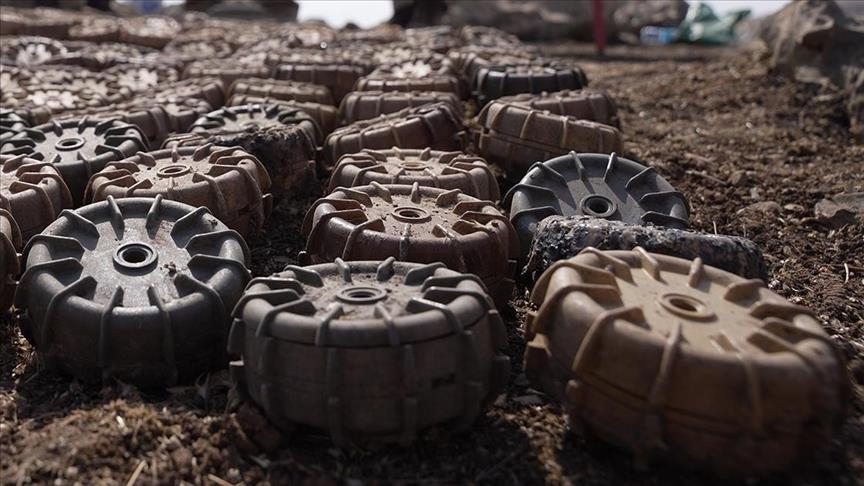
Record-high military spending to have ‘profound potential implications for global peace, stability, sustainable development,’ warns UN high representative.
5 Dec 2025 – The 22nd meeting of states parties to the Anti-Personnel Mine Ban Convention concluded in Geneva today with widespread expressions of “regret” over the impending withdrawals of five countries, a shift delegates warned risks weakening one of the world’s strongest humanitarian disarmament norms.
More than 700 delegates from 126 states and over 20 international and civil society organizations attended the meeting, chaired by Japan’s ambassador to the Conference on Disarmament, Ichikawa Tomiko.
Delegations raised alarm as five countries’ withdrawals take effect from December to February. Withdrawal of Estonia, Latvia, and Lithuania will take effect on Dec. 27, while Finland’s on Jan. 10 and Poland’s on Feb. 20.
A total of 93 States Parties aligned themselves with statements warning that the departures undermine the integrity of the global ban on anti-personnel mines and could erode broader humanitarian protections.
The meeting also took note of mounting concerns about a wider global shift toward militarized responses.
Izumi Nakamitsu, the UN high representative for disarmament affairs, warned during the meetings that “global military spending is surging across all regions, reaching a record $2.7 trillion in 2024,” describing it as a “systemic shift” with “profound potential implications for global peace, stability and sustainable development.”
She cautioned that approaches “premised on the dangerous notion that military necessity can override humanitarian considerations … strike at the heart of what this Convention stands for,” adding that the legal framework protecting civilians “risks further erosion” if the trend continues.
– Ukraine has been urged to re-engage within convention’s framework
The meeting also addressed concerns surrounding Ukraine’s status in the treaty. Delegates noted Ukraine’s July 18 communication to the UN stating it had “decided, as of July 17, 2025, to suspend the operation” of the convention; however, states parties stressed that the treaty does “not allow” for suspension of obligations and urged Ukraine to re-engage within the convention’s framework.
Ukraine, which did not attend the session, was invited to maintain a cooperative dialogue with the convention’s presidency and office holders.
Additionally, the meeting noted that Greece and Ukraine remain in non-compliance for missing stockpile destruction deadlines.
Greece reiterated its commitment, noting it has destroyed over 81,000 mines in the past five months and transferred more than 260,000 to Croatia for safe destruction, with further destruction phases planned for 2026 and 2027.
Adopted in 1997, the convention bans the use, production, stockpiling and transfer of anti-personnel mines and is regarded as a landmark instrument for reducing civilian harm in conflict.
Tags: Anti-Personnel Mine Ban, Arms Industry, Arms Trade, Landmines, Military, United Nations
DISCLAIMER: The statements, views and opinions expressed in pieces republished here are solely those of the authors and do not necessarily represent those of TMS. In accordance with title 17 U.S.C. section 107, this material is distributed without profit to those who have expressed a prior interest in receiving the included information for research and educational purposes. TMS has no affiliation whatsoever with the originator of this article nor is TMS endorsed or sponsored by the originator. “GO TO ORIGINAL” links are provided as a convenience to our readers and allow for verification of authenticity. However, as originating pages are often updated by their originating host sites, the versions posted may not match the versions our readers view when clicking the “GO TO ORIGINAL” links. This site contains copyrighted material the use of which has not always been specifically authorized by the copyright owner. We are making such material available in our efforts to advance understanding of environmental, political, human rights, economic, democracy, scientific, and social justice issues, etc. We believe this constitutes a ‘fair use’ of any such copyrighted material as provided for in section 107 of the US Copyright Law. In accordance with Title 17 U.S.C. Section 107, the material on this site is distributed without profit to those who have expressed a prior interest in receiving the included information for research and educational purposes. For more information go to: http://www.law.cornell.edu/uscode/17/107.shtml. If you wish to use copyrighted material from this site for purposes of your own that go beyond ‘fair use’, you must obtain permission from the copyright owner.
Join the discussion!
We welcome debate and dissent, but personal — ad hominem — attacks (on authors, other users or any individual), abuse and defamatory language will not be tolerated. Nor will we tolerate attempts to deliberately disrupt discussions. We aim to maintain an inviting space to focus on intelligent interactions and debates.