


Trump, Kagame, Tshisekedi & the Donald J. Trump Institute for Peace: A Peace Deal Short on Peace
TRANSCEND MEMBERS, 15 Dec 2025
Raïs Neza Boneza – TRANSCEND Media Service
7 Dec 2025 – Let’s start with the basics.
We are told this is “one of the deadliest and longest-running wars on the planet.” Millions dead, villages erased, women raped on an industrial scale, more than seven million displaced. In human terms, it’s a catastrophe. In geopolitical terms, it’s a resource hub with a body count.
Enter Washington.
Paul Kagame and Félix Tshisekedi are summoned to the United States to co-sign a “historic peace agreement” for eastern Congo—while, at that very moment, artillery fire continues in South Kivu. Think of it as a ceasefire that forgot to tell the guns.
The scene unfolds not in Goma, Bukavu, or Kinshasa, but in a building in Washington that has been christened, with all the modesty we expect, the Donald J. Trump Institute of Peace. Because nothing says “peace” like stamping your own name on the façade.
The Photo, Not the Peace
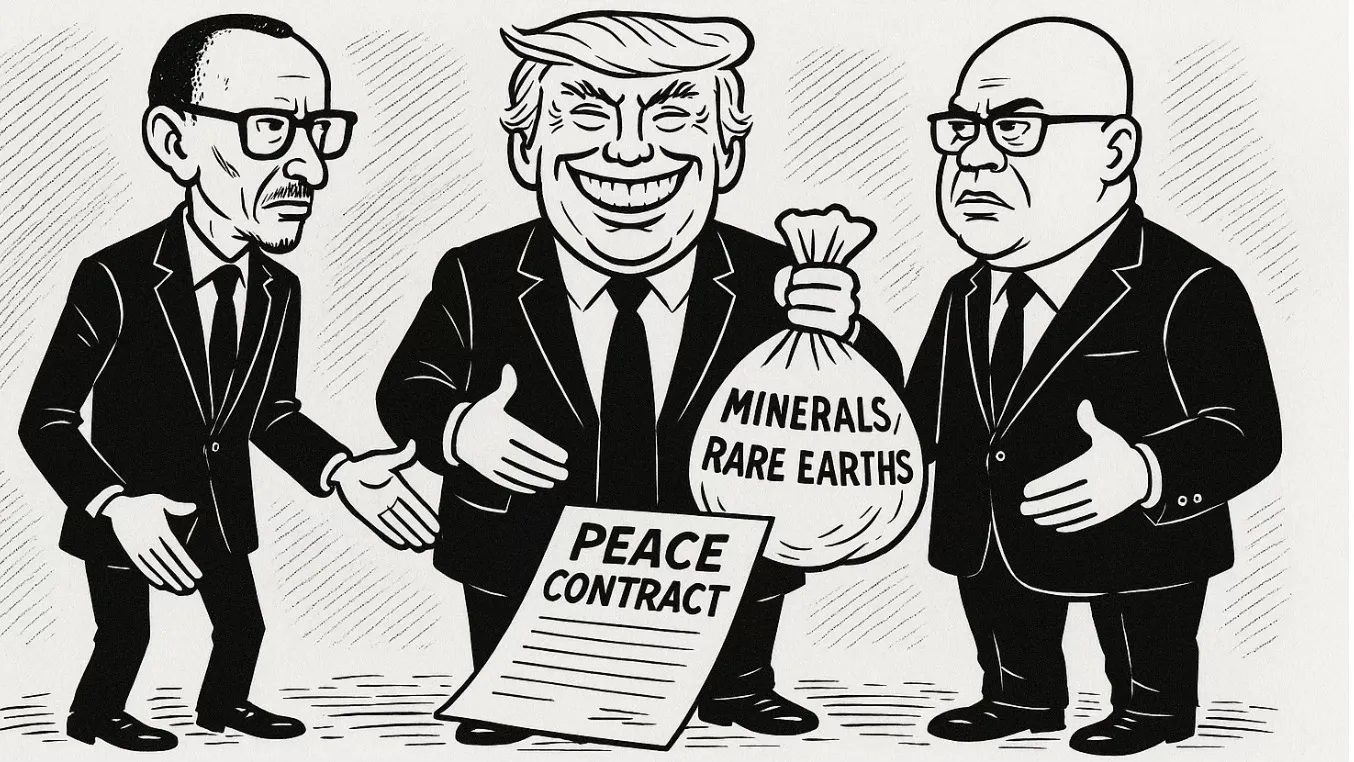
The choreography is simple: Trump in the middle, beaming, Kagame on one side, icy. Tshisekedi on the other, frozen. Two pens, two signatures, zero handshake.
No handshakes, no warmth, not even a forced grin. Just body language so stiff it could have been carved in granite. The only hand both men eagerly shake is Trump’s.
If you watched it on TV, you saw what you were meant to see: “Historic agreement ends decades of violence.” If you looked beyond the camera angle, you saw what it really was:
A photo-op dressed up as a peace process, staged to present Trump as the man who can “bring enemies together” and, coincidentally, secure access to critical minerals.
The war on the ground? Still burning. But the optics? Perfect.
A Peace Agreement That Forgot the War
Let’s review the absurdity. The main armed group tearing up eastern Congo right now — M23 and its latest avatars — is not even a signatory to this peace accord.
They don’t recognize it. They don’t feel bound by it. They are busy advancing, shelling, and entrenching themselves.
Imagine signing a “historic agreement” to end World War II without involving Germany or Japan. That’s roughly the intellectual level we’re dealing with here.
On paper, Congo commits to neutralizing the FDLR, an old Rwandan Hutu militia, some of whose founders were linked to the 1994 genocide. Rwanda, in return, promises to withdraw troops from Congolese territory. Beautiful symmetry. Except:
The FDLR has been hunted, scattered and weakened for decades. Even Western and UN reports admit they are no longer a strategic threat to Rwanda. Meanwhile, Rwandan troops and Rwanda-backed rebels have been documented by the UN as operating inside Congo, exploiting mines and terrorizing civilians.
So the agreement dedicates pages to a decaying, politically convenient enemy, while glossing over the very real, very current occupation and pillage. This isn’t a peace plan.
It’s a laundering machine: Laundering Rwanda’s role.
Laundering decades of foreign complicity. Laundering access to Congo’s minerals.
“More Than 10,000 Dead”: When Arithmetic Becomes Propaganda
Trump proudly announces this war has killed “more than 10,000” people.
Ten thousand.
In a conflict where estimates of the dead run into the millions, where entire regions have been turned into graveyards, the American president casually downsizes the horror to something numerically manageable. A rounding error in the global ledger.
It’s not a mistake. It’s a narrative.
If you admit there are millions of victims, you might have to talk about: Responsibility, International complicity, The role of American policy since the 1990s. The price of cheap electronics and “green” technologies.
But if it’s “just” 10,000?
That’s tragic, of course, but manageable.
It becomes a solvable crisis with a neat ceremony, a flag backdrop, and a commemorative plaque at the Donald J. Trump Institute of Peace.
The Real Text Is Written in the Periodic Table
Let’s be blunt:
This “peace agreement” is not primarily about peace. It’s about cobalt, coltan, copper, gold, niobium, beryllium, and other rare minerals buried under Congolese soil.
The same minerals that: Power smartphones and laptops. Feed the AI industry. Run electric cars and “clean energy” fantasies. Sustain aerospace and military technologies.
China already holds dominant positions in many of Congo’s mining projects, processing or owning a vast share of the cobalt and copper chain. That’s the backdrop. Trump’s urgency to “solve” Congo is not driven by tears over Congolese suffering. It is driven by the fear of losing the resource race.
So what does this deal actually do? It formalizes what was long informal: external control over Congo’s wealth. It offers the United States a clearer, more open, more direct stake in extracting those minerals. It gives Rwanda de facto recognition as a key player and logistical hub—even as it is never named as an aggressor.
In other words, what Clinton did in the shadows through proxies, Trump seeks to do legally, on paper, with signatures. Congratulations, Congo:
your destruction just acquired a legal framework.
Congo: Rich Enough to Be Pillaged, Not Enough to Be Respected
Here’s the cruel paradox at the heart of this story: If Congo were poor, nobody would care. Because Congo is rich, everyone cares—but not about Congolese lives.
Congo is treated as a geological supermarket with 120 million human inconveniences walking on top of it. The state is infiltrated.
The army is sabotaged.
The political class is divided between those who collaborate directly or indirectly with foreign interests, and those patriots who have ideas, reports, intelligence, strategies… but can’t get within shouting distance of the president.
Meanwhile, both Rwandan proxies and foreign mining lobbies push for “manageable chaos”: Not open apocalypse — that scares investors.
But just enough violence to keep the state weak, the population terrorized, and the territories negotiable.
You don’t need Congo stable. You just need it open and disarmed.
Trump the “Peacemaker”: A Role Written in Dollar Signs
Is Trump “sincere” about peace? In a way, yes — as long as you understand what he means by peace: Peace is when American interests are secured, peace is when China doesn’t have a monopoly and peace is when the war is low-intensity enough not to hit the headlines.
He doesn’t hide it. He literally says: “We’re going to make a lot of money.”
He’s not a hypocrite. He’s a salesman.
He has simply rebranded resource capture as peace diplomacy: Stage a ceremony, bring two African presidents who can barely look at each other. Surround them with other African leaders and sponsors (Qatar, Emirates, etc.) to act as “witnesses” and “guarantors”. Call it “historic”and lock in economic arrangements in parallel.
Job done. If some committee in Oslo decides this performance deserves a Nobel Peace Prize, that’s a bonus feature.
The Great Absentees: Europe and the African Union
Two actors are spectacularly missing from the scene. The EU, France, Belgium — all historically involved in Congo — are essentially sidelined. The same Europe that: pumps aid money into the region, lectures the world on human rights, and outsources its raw materials vulnerability…
…now watches from a distance while the US and China carve up access to Congo’s resources. Europe’s Congo “policy” has been reduced to: funding peacekeeping missions that never keep the peace, signing off on traceability schemes that manage to make Rwandan blood minerals look clean, and pretending this is all very complicated.
On the other hand, the African Union, that glorious defender of sovereignty, is conspicuously toothless: Silent while one African state occupies and bleeds another;absent while non-African powers run the negotiations; more comfortable with platitudes about “African solutions” than with facing a member state that blatantly violates borders.
The message to Congo is simple: You are on your own.
Unless, of course, someone needs your minerals. Then you are very popular.
And the Congolese?
Amid all this, what about the Congolese themselves?
They are not in the room when the real deals are made, not named as victims in any meaningful way, not offered justice — no tribunal for the millions killed, no compensated, not protected, not prioritized.
There is no serious plan for: demilitarizing the region in a way that actually dislodges foreign-backed forces; holding Rwanda (and its accomplices) accountable; rebuilding communities destroyed by decades of war and displacement; giving Congolese people power over their own resources.
Instead, they get: a ceremony, a few speeches, a promise of “visible results very soon”, and continued bombardments in South Kivu the next morning.
So What Was Really Signed in Washington?
Not a peace accord. A framework for managed chaos. A chaos low enough not to disturb markets. A chaos high enough to keep the Congolese state weak. A chaos flexible enough to be dialed up or down like the volume on a TV remote, depending on who needs leverage.
Trump didn’t end a war. Kagame didn’t renounce expansion. Tshisekedi didn’t regain control over his territory.
What they all did — each à sa manière — was participate in a spectacle: Trump gets to play the peacemaker. Kagame gets continued room to maneuver. Tshisekedi gets to say he’s not a warmonger. The mining lobbies get what they want.
And the Congolese? They get an upgraded version of what they already had: Pillage with paperwork.
In the end, this is the real logic at work: The dead in Congo are negotiable. The minerals are not. The world has decided that some wars must be stopped at all costs, and others can be moderated as long as the ore keeps flowing. This “peace deal” is not the end of a tragedy.
It is a change of set design.
The stage is the same. The actors are the same.
The script — proxy war, extraction, denial, silence — is the same.
Only the branding has improved: Now, exploitation comes with a ribbon on it, signed at the Donald J. Trump Institute of Peace
 ____________________________________________
 Raïs Neza Boneza is the author of fiction as well as non-fiction, poetry books and articles. He was born in the Katanga province of the Democratic Republic of Congo (Former Zaïre). He is also an activist and peace practitioner. Raïs is a member of the TRANSCEND Media Service Editorial Committee and a convener of the TRANSCEND Network for Peace Development Environment for Central and African Great Lakes. He uses his work to promote artistic expressions as a means to deal with conflicts and maintaining mental wellbeing, spiritual growth and healing. Raïs has travelled extensively in Africa and around the world as a lecturer, educator and consultant for various NGOs and institutions. His work is premised on art, healing, solidarity, peace, conflict transformation and human dignity issues and works also as freelance journalist. You can reach him at rais.boneza@gmail.com – http://www.raisnezaboneza.no
Tags: Peace
DISCLAIMER: The statements, views and opinions expressed in pieces republished here are solely those of the authors and do not necessarily represent those of TMS. In accordance with title 17 U.S.C. section 107, this material is distributed without profit to those who have expressed a prior interest in receiving the included information for research and educational purposes. TMS has no affiliation whatsoever with the originator of this article nor is TMS endorsed or sponsored by the originator. “GO TO ORIGINAL” links are provided as a convenience to our readers and allow for verification of authenticity. However, as originating pages are often updated by their originating host sites, the versions posted may not match the versions our readers view when clicking the “GO TO ORIGINAL” links. This site contains copyrighted material the use of which has not always been specifically authorized by the copyright owner. We are making such material available in our efforts to advance understanding of environmental, political, human rights, economic, democracy, scientific, and social justice issues, etc. We believe this constitutes a ‘fair use’ of any such copyrighted material as provided for in section 107 of the US Copyright Law. In accordance with Title 17 U.S.C. Section 107, the material on this site is distributed without profit to those who have expressed a prior interest in receiving the included information for research and educational purposes. For more information go to: http://www.law.cornell.edu/uscode/17/107.shtml. If you wish to use copyrighted material from this site for purposes of your own that go beyond ‘fair use’, you must obtain permission from the copyright owner.
Join the discussion!
We welcome debate and dissent, but personal — ad hominem — attacks (on authors, other users or any individual), abuse and defamatory language will not be tolerated. Nor will we tolerate attempts to deliberately disrupt discussions. We aim to maintain an inviting space to focus on intelligent interactions and debates.