



A New Year’s Thought: A Farewell to Warriors!
ASIA--PACIFIC, 12 Jan 2026
Editorial | The Tokyo Shimbun – TRANSCEND Media Service
I carefully read an article in The Chunichi Shimbun newspaper on 8 December of last year (2025). It was a memoir, the first time it had been spoken to a journalist, by a former military nurse who was deployed to the fierce battlefields of Burma (now Myanmar) in 1944, during the Asia-Pacific War (i.e. the Asia-Pacific theater of WWII).
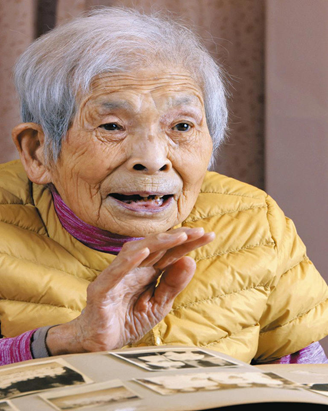
Michi Nakamura
Source of the image above: https://img-s-msn-com.akamaized.net/tenant/amp/entityid/AA1Tw9fQ.img?w=768&h=1168&m=6&x=182&y=272&s=350&d=350
The nurse in question was 102-year-old Michi Nakamura (pictured above), a resident of Gifu City, Japan. She was a Japanese Red Cross nurse who treated wounded soldiers during the Battle of Imphal, considered the Japanese military’s most reckless battle during WWII.
- [Battle of Imphal 1944: The Turning Point of the Burma Campaign – World War 2 Planes]
- [The ENTIRE History of the Battle of Imphal–Kohima (1944) | WWII | Full Documentary]
- [Battle of Imphal-Kohima | World War II Database]
The operation was poorly planned, neglecting ammunition and food supplies, and more than 30,000 of the approximately 100,000 soldiers mobilized lost their lives. Nakamura, too, was on the brink of death due to an infectious disease.
Eventually, the operation was canceled. Nakamura and her companions were ordered to retreat on foot. They risked their lives to escape through mountainous areas and rainy-season jungles, where soldiers collapsed.
◆ A One Hundred Two -Year-Old War Survivor Speaks About “War”
This bitter experience was recorded by reporter Kyoka Inoue, a young reporter who joined the company in 2019. Since 1941, she has met Nakamura many times, carefully covering his deeply moving recollections: “I wanted to keep it in my heart and die because it was so tragic.”
Even so, she was in her 20s, born in a peaceful era. There were many points in Nakamura’s recollections that I didn’t understand during each of their two-hour meetings.
So, in addition to her daily work, Inoue diligently searched for and read the notes and articles of the nurses and medics who were in Nakamura’s unit. “As the result, I learned a lot of things. It really brought home to me how important it is to leave records,” says Inoue.
This former military nurse reveals the true nature of war after a long silence, and now a journalist over 70 years younger than her tells future generations. This article, which deserves attention in today’s world where “historical revisionism,” which seeks to whitewash historical facts inconvenient for one’s own country, is rampant, is a four-part series. Some regions have different publication dates, and some regions have not published articles, so we have introduced them here.
- [Japan during World War II]
- [Japanese history textbook controversies]
- [Unveil political manipulation behind Japan’s historical revisionism]
- [How Japanese Wikipedia is Spreading Historical Revisionism – Yumiko Sato]
Now, there is one quote from Nakamura that particularly made an impression on me.
“It was good for Japan that this country lost the war. If we had won the war, we would have been heading for another war.”
“And yet another war” is a very serious observation. But there is a passage that makes sense.
Ango Sakaguchi‘s “Mushaburui-ron” [Note: See the English translation of “Mushaburui-ron” following this article below.], published in 1951, is a short but important essay by this author, who has a keen insight into post-war Japan. Let me quote from the Iwanami Bunko edition: “I’m not very smart, so I just can’t understand why so many countries are so invested in something as fruitless as war. Surely it would be better to redirect counterproductive efforts like armaments toward production, and instead of building pillboxes and warships, build apartment buildings and hospitals.”
◆ Ango Sakaguchi’s View of the “State of the World”
I couldn’t agree more. The author’s pen goes even further: “However, I’m amazed at the number of Japanese people, young and old, men and women, eagerly waiting for war to come. I’m not talking about militarists or right-wing ronins… I’m talking about the common people in general.”
- [Note: It is deemed that “right-wing ronins” refer to those people, devoting to extreme right-wing chauvinism, and expecting to get military-related jobs or any other similar relevant jobs. There were quite a few such Japanese during the Asia-Pacific War.]
- [Rewriting Japan’s postwar pacifism]
It is not necessarily that all Japanese people hate war, regret it, or vow to never do it again. “If war breaks out again, we’ll make as much money as we want.” Sakaguchi had observed closely how such thoughts had begun to take hold in just six years after that devastating defeat. “Those politicians at the Diet, both men and women, young and old, were eagerly anticipating war and trembling with excitement.”
This is not a story from long ago. The November 8th issue of the economic magazine “Weekly Toyo Keizai“ ran a special feature titled “Defense Industry Heatwave.” Under the headline “Industry Frenzy Under the Takaichi Administration!“, the article reported on the current state of domestic defense contractors, who are excited by the significant increase in the defense budget.
- [New PM Takaichi moves to unleash Japan’s long-restrained defence industry]
- [Japan gov’t greenlights record $58bn defence budget amid regional tension]
- [Japanese cabinet earmarks record 8.7 trillion yen ($US55.3 billion) for war]
Not only Japan, but countries around the world are now strengthening their military capabilities for the sake of “defense.” Many of you may have read the report released by the Stockholm International Peace Research Institute in Sweden last December, which stated that in 2024, sales of the world’s top 100 defense contractors would reach an all-time high.
- [The Business of War: Who Profits and Who Pays]
- [Japan Kept Its War Economy Alive With Fake Money]
- [Why “war or any other kinds of military conflict” brings more economic prosperity than “peace” do?]
In short, it seems that many countries and companies are “driving the fight” in the name of “defense.” But isn’t it time to say goodbye to this “counterproductive” arms race?
- [How do countries profit from war? (2026)]
- [Global powers boost military budgets by record percent]
- [The True Cost of Peace: Rebalancing world military spending for a sustainable and peaceful future | United Nations]
On 8 December 2025 [Note: The Pearl Harbor attack was conducted on “8” December 1941 Japan Standard Time; on “7” December 1941 in the United States], the day I read Nakamura’s article, was the anniversary of the commencement of the Asia-Pacific War. Now, at the beginning of the new year, 2026, I pray that the military expansion that is like playing with fire by those in power will not lead to any unforeseen incidents, and that the words “war!” will never appear in the newspapers this year, next year, or in the future.
- [Farewell to pacifism: Japan is rearming – YouTube]
- [Why Is Japan Planning for War? – YouTube]
- [Pacifist Japan moving from exclusive self-defense to military buildup]
——————————————————————————————————-
Notes:
- Hyperlinks in the text were added by the translator for the convenience of the reader.
- Relevant web links were added in [ ] under some paragraphs by the translator for the convenience of the reader.
- Several square parentheses [Note: ] were added by the translator for the convenience of the reader.
- The views and/or opinions expressed in these hyperlinks and/or web links do not necessarily reflect those of the translator or those of the Transcend Media Service (TMS).
——————————————————————————————————-
Original author: An Editorial Writer of The Tokyo Shimbun
—————————————————————————————————-
Translation: Satoshi Ashikaga — Google Translate
——————————————————————————————————-
Original in Japanese: https://www.msn.com/ja-jp/news/opinion/%E7%A4%BE%E8%AA%AC-%E5%B9%B4%E3%81%AE%E3%81%AF%E3%81%98%E3%82%81%E3%81%AB%E8%80%83%E3%81%88%E3%82%8B- %E3%81%95%E3%82%88%E3%81%AA%E3%82%89-%E6%AD%A6%E8%80%85%E3%81%B6%E3%82%8B%E3%81%84/ar-AA1Tw7nF?ocid=msedgntp&pc=U531&cvid=6959e1818ce1474aab7b951b0aa9eb1e&ei=18
——————————————————————————————————-
A Warrior’s Spirit (Mushaburi-ron)
By Ango Sakaguchi
Ominous clouds hang over the heavens and earth, disks fly through the sky, and astronomers everywhere seem to be predicting the impending war. However, as for me, I’m not particularly troubled by war. I have a chronic tendency to believe that whatever happens is fate and there’s nothing we can do about it. However, I’m not the type of person who enjoys being chased by fires, earthquakes, and war, even if I just accept it as fate and there’s nothing we can do about it.
The mindset of not wanting to fight and simply dealing with fate might be the pinnacle of calm and gentleness, an exceptional pacifist. That’s why people like me enjoy ridiculous ideas.
The Yellow River [in China] is usually empty, but when heavy rains come, loess mud flows overflow, depositing meters of mud on the riverbed every year. To make matters worse, the riverbed becomes higher than the plains, resulting in a major flood every 20 to 30 years. When this river floods, the Yellow River, which yesterday flowed as the Tone River, suddenly overflows from the upper reaches of the Tenryu River today and flows into the sea at Nagoya, causing a cataclysmic event in which hundreds of square miles in between become lake water. Despite the tireless efforts of scholars and politicians specializing in flood control over the Yellow River over the past 5,000 years, periodic floods have continued for the past 5,000 years.
So, about 2,000 years ago, a Yellow River scholar came up with the famous theory that water and land should not be fought over. In other words, it’s impossible to survive against floods. Since there’s no way to prevent them, the only option is to let them happen. Instead, if the residents of flood-prone areas were relocated to flood-free regions, the floods would essentially disappear. Such is the argument. More decadent scholars see the Yellow River’s floods as a divine command, arguing that China is a country where peasants are overproducing. They argue that the deaths of around 500,000 people each time a flood occurs are a divine command to regulate the population, and that it’s better not to go against divine command. The proponents may be happy, but since we’re one of those 500,000 people controlled by divine command, we won’t survive. Even if we share the same view of fate, the more peaceful approach is to not fight over water and land, to let floods take their course, and for people to quickly flee and settle elsewhere. However, sages call this a “smooth speech.” The indigenous people who fled to these lands are greatly inconvenienced, and leaving the fertile plains to flood is a huge loss of practical value. Scholars may say clever things, but the local people inevitably return, knowing the floods will bring them more practical benefits.
There is no middle ground when it comes to dealing with such a monster. You either leave it to fate, or completely suppress it. Completely suppressing it will be difficult. It will be nothing compared to the Great Wall of China. It would require the best of modern science and tens of millions of times more concrete than the Maginot Line. Without such large capital and scientific teams, there is no choice but to leave it to fate. Five thousand years of struggle have made it clear that flight is better than a half-hearted escape.
When I think of war, I can’t help but think of the Yellow River. It’s just as monstrous. And the wise teachings and teachings of Yellow River scholars are extremely useful. “Don’t fight over water and earth.” In the case of war, this simply translates to “fire.” It’s impossible to prevent this fire, so run away quickly. Otherwise, raise your hands. Resistance is futile.
The decadent school of thought that sees population control as a divine mandate is the ideology of the Shogun, the Tojo school. Condoms are a more appropriate form of population control than war. However, even if contraceptives are banned nationally, the common people will not be saved because many politicians and military personnel are unwilling to ban war. The Tojo school was considered as a peaceful one for the Shogun himself, because he himself is not considered a designated member of the divine mandate for population control. He intends not to submit to population control until the MP comes for him and he knows his inescapable fate. If people understood the pain of being subject to population control, they would never wage war. The words of the sages say, “Do not give to others what you do not want for yourself.”
However, saying that it’s okay because some people want to become soldiers is the opposite of “do not fight between water and earth. “If there is practical benefit, people will settle in even if it means flooding. People who cannot afford to eat become soldiers. Those who love floods are eels or catfish, not humans. Those special races who become soldiers because they love killing or boasting are beasts who are completely unrelated to the words of the sages. It would be best if they migrated to the jungle and did as they pleased, but this is not the case. This explains the brilliant idea behind “do not fight between fire and earth,” which means that if war breaks out, we should raise our hands, run away, or never resist.
However, fatalists do not simply avoid defying fate. They do not resist once they have come to understand that resisting is futile; they resist if they can calculate that resisting will lead to better results. There is no formula that says that if you encounter a mad dog, you must not resist and be bitten. If you marshal big capital and the latest advances in modern science, you might be able to stave off the Yellow River, but it would be impossible to do if you were poor. That’s why they simply do not resist.
The same goes for war. Obviously, it would be better if there was no such thing as war, but there is no immediate way to eliminate it, and especially since people from a country like Japan, where none of their opinions are accepted, have no desire to plot anything grand. All they need to do is submit to fate, throw up their hands, and run away.
- I’m not very smart, so I just can’t understand why so many countries put their efforts into something as fruitless as war. It seems to me that it would be better to redirect counterproductive things like armaments toward production, and instead of building pillboxes and warships, build apartment buildings and hospitals, but perhaps that’s not the case.
However, I’m amazed at the number of Japanese people, young and old, men and women, who are eagerly waiting for war to come. I’m not talking about militarists or right-wing ronins, but peasants, elementary school teachers, monks, waitresses, prostitutes, merchants, and other common people in general.
- [Note: A “ronin” literately means a jobless samurai because his does not have his master. As such, in the contemporary context, a “ronin” means a person who is not working for the authorities, autocratic organization or the like. Sometimes a “ronin” also means a person who failed in the entrance examination of a university or any examination for a certain qualification in the previous year and who is currently preparing for the examination to take in the next year again. During that time, in most cases, he or she is not hired by any organization/anyone/any master.]
But their logic is innocent. In the last war [i.e WWII], we were overtaken by cunning people and suffered losses, but this time we’ve got the hang of it, so try the next war: hoarding, withholding, black market trading, running off with the stuff and picking it up for free (there’s no such thing as theft in war. Running off with the stuff and picking it up first. There’s no such thing as ownership. Understand that well). We’ll take as much as you want, so learn that. And so they say, stroking the arms of monks, teachers, waitresses, and concubines.
When it comes to peasants, it’s even more ferocious. City merchants, office workers, and factory workers are all defeated, having their homes burned down and struggling to survive with only the clothes on their backs, but the peasants can only watch from the sidelines. What’s a blackout? What, a plane is coming? It’s coming, but what’s the problem? It flew over my head once, but it’s nothing. It’s nothing at all. You’re just a scarecrow.
When a war begins, the usually arrogant city guys come crying, bowing and stripping off all their kimonos, and gradually the women become like dirty maids, so naturally the number of kimonos around here increases. They even had morning coats. The only thing missing was a top hat. There were so many suits and ties, I had to learn how to wear a dress shirt. War is a civilized thing. When a war begins, people like Ginza [i.e. one of the very main commercial centers of Tokyo] flock to Adachigahara, Hebitani Village, Oshu. It’s been two or three years since the war ended, but we’re still civilized. There’s nothing more civilized and peaceful than war. It seems like the world gets worse and worse about the fourth year after a war. Nothing good ever comes from city folk learning about luxury. Unless a war starts to fix the world, Japan will be ruined. Just wait until the next war starts. I’ll rip you off as much as I want. Remember that, if you have a set of three gabardine suits, it’s rare to sell you even a sho of rice.
- [Note: “A or one sho of rice” is equivalent to approximately 1.5kg of rice.]
There are countless men and women, young and old, eager to fight, eager for war. But it seems no good. Even if one has mastered the tricks of war, a genius is called a new tactic, while a novice is the source of serious injury, as the saying goes. It seems the learned tricks won’t be of any use in the chaos of the next war.
When I try to admonish them like this, they just snort and think, “This guy has no confidence in war. He is one of those people in the next generation of decline.”
Dreams are important in life. But the eagerness of those who have acquired a taste of war is far too sad to be called a dream. The current that now lurches heavily under Japan is the dream and spirit of a ronin.
Even with B-36s in the sky and atomic bombs exploding somewhere, living humans are nothing more than bandits. They are nothing more than bandits from hundreds, no, even thousands of years ago. Whether it’s 1960 or 2000 years from now, this will always be the nature of war. Primitive as the muddy rivers of the Yellow River, they are nothing more than the simple forms of primitive humans.
- [Note: It was “B29s” that conducted the air raids to many cities in Japan during WWII. Besides, it was the B29 whose name was “Enola Gay”, which attacked Hiroshima and Nagasaki with atomic bombs. The “B36”, operated after WWII, from 1948 to 1959, was primarily produced as the nuclear weapons delivery vehicle. Ironically or paradoxically, the unofficial name of this nuclear weapons bomber was “Peacemaker”.]
Such is the true nature of war. Whether there is this war, or the next one, the lives of ordinary people are ruined, and whether they submit to population control and die, or become bandits, their true nature will remain unchanged. I would like to see war with some variety, but I have come to understand that it is not, so I don’t bravely call for war. But I simply won’t be foolish enough to fight on the ground against the flames of war.
——————————————————————————————————-
Translation: Satoshi Ashikaga — Google Translate
——————————————————————————————————-
Source the original Japanese: https://www.aozora.gr.jp/cards/001095/files/56817_58911.html
Tags: Japan, WWII, Warfare
This article originally appeared on Transcend Media Service (TMS) on 12 Jan 2026.
Anticopyright: Editorials and articles originated on TMS may be freely reprinted, disseminated, translated and used as background material, provided an acknowledgement and link to the source, TMS: A New Year’s Thought: A Farewell to Warriors!, is included. Thank you.
If you enjoyed this article, please donate to TMS to join the growing list of TMS Supporters.

This work is licensed under a CC BY-NC 4.0 License.
Join the discussion!
We welcome debate and dissent, but personal — ad hominem — attacks (on authors, other users or any individual), abuse and defamatory language will not be tolerated. Nor will we tolerate attempts to deliberately disrupt discussions. We aim to maintain an inviting space to focus on intelligent interactions and debates.