


Calendars of Faith: Sacred Time, Shared Humanity as Catalysts for Peace and Conflict
TRANSCEND MEMBERS, 5 Jan 2026
Prof Hoosen Vawda – TRANSCEND Media Service
A Comparative Study of Abrahamic and Dharmic Timekeeping Systems from Antiquity to Modernity
“From Anno Mundi to Martian Sols: A Universal History of Sacred Calendrics in Peace Propagation”[1]
This publication is suitable for general readership. Parental guidance is recommended for minors who may use this research paper as a resource material, for projects.
The author unconditionally apologises for any offence caused to readers, on his personal hermeneutics of respected different religious traditions and beliefs. The author invites and welcomes any comments and discussions, by the readership.
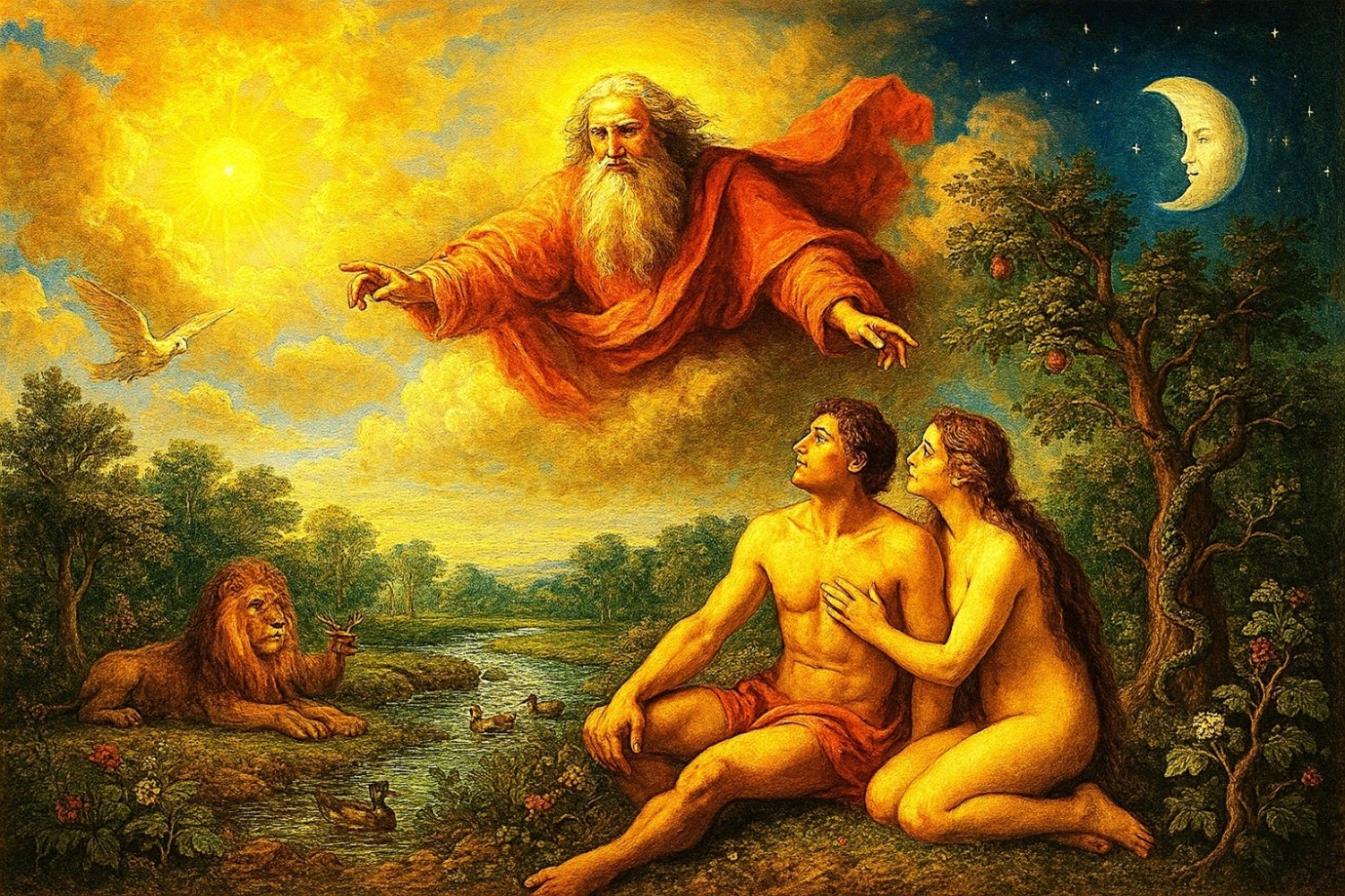
Original Photograph Conceptualised by Mrs V. Vawda 2025
The Traditional Symbols, encapsulating Anno mundi: The Narrative of Creation in Judaism
Prologue: The Human Quest to Measure Eternity
This paper elaborates the stages, as from the earliest moments of human consciousness, our ancestors gazed skyward, seeking patterns in the celestial dance of sun, moon, and stars, to establish some system of passage of days and night. This primal observation birthed humanity’s first calendars, not merely as practical tools for agriculture and societal coordination but as profound theological statements about humanity’s place in the cosmos. Across civilizations, the measurement of time evolved into sacred science, with each major religious tradition developing sophisticated systems that reflected their unique understanding of divinity, creation, and human destiny. These calendrical systems[2] became embedded cultural frameworks that ordered religious observance, marked historical memory, and encoded philosophical truths about the nature of existence itself. In this exploration, we trace the parallel and divergent paths of Abrahamic[3] and Dharmic calendar systems,[4] examining how each tradition conceptualized and organized the mysterious flow of time within their distinctive theological universes.
Introduction: Calendars as Theological Constructs[5]
The calendars of the world’s great religious traditions represent far more than neutral timekeeping devices; they are living theological documents that express fundamental beliefs about creation, history, and eschatology. Where secular timekeeping aims for universal standardization, religious calendars serve as sacred maps of meaning, orienting communities toward transcendental realities through seasonal rhythms and commemorative cycles. This paper examines how Judaism, Christianity, Islam, Hinduism, and Buddhism have each developed sophisticated calendrical systems that embody their distinct worldviews while addressing the practical challenge of reconciling celestial cycles with earthly existence.
At the heart of the Abrahamic traditions lies a linear conception of time flowing from creation through prophetic history toward an eschatological culmination, a conception profoundly shaped by the figure of Abraham as the patriarchal archetype of faith. The Dharmic traditions, by contrast, often embrace more cyclical understandings of time, reflecting philosophical orientations toward rebirth and cosmic recurrence. Yet both families of traditions have demonstrated remarkable astronomical sophistication and have faced similar mathematical challenges in harmonizing lunar and solar cycles. Through comparative analysis of their origins, structures, historical developments, and societal impacts, we uncover both the distinctive theological commitments and surprising convergences in how these great faith traditions have answered humanity’s perennial question: How shall we mark our days?
Origins from Patriarchal Archetypes and Vedic Antiquity
The calendrical systems of both Abrahamic and Dharmic traditions trace their origins to foundational religious figures and ancient revelations. For Judaism, Christianity, and Islam, Abraham serves as the pivotal patriarchal figure[6] whose covenant with God established the theological framework within which their timekeeping systems developed. Though not directly credited with creating calendars, Abraham’s journey of faith—from Ur to Canaan to Egypt—established a paradigm of sacred history moving through divinely appointed seasons and cycles. This linear understanding of time flowing from creation through prophetic history profoundly shaped how these traditions would later structure their calendars around key moments in salvation history.
In the Dharmic traditions, calendrical origins reach back to the ancient Vedic period[7] of India, where sophisticated astronomical observations were already being made. The Hindu calendar finds its earliest roots in Vedic texts that demonstrate remarkable astronomical knowledge, with some traditions suggesting origins as early as 6676 BCE according to Greek accounts of Mauryan kings referencing the Saptarsi calendar .[8] The Buddhist calendar, while emerging later, consciously positioned itself in relation to these earlier systems, with its epoch based on the Buddha’s Parinirvana[9] (generally calculated as 543 BCE) . Unlike the Abrahamic focus on a single patriarchal figure, Dharmic calendars often reflect more diffuse philosophical origins tied to cosmic principles and enlightened beings rather than historical covenants.
Etymology[10]
“Anno Mundi”[11] (often abbreviated as A.M.) is a Latin phrase meaning “In the Year of the World.” It is the epoch, or starting point, for the Hebrew calendar’s year count and represents one of the most profound concepts in religious timekeeping.
The Meaning and Calculation of Anno Mundi
Unlike the Islamic calendar, which begins with a historical migration (the Hijra), or the Gregorian calendar, which begins with the birth of Jesus (Anno Domini), Anno Mundi dates time from the moment of Divine Creation itself.
- Theological Significance: This epoch establishes time as a framework of divine providence. Every year numbered in this system represents another year since God created the universe, making the calendar a continuous, sacred chronology from Genesis to the present day.
- The Calculated Date: Based on a meticulous rabbinic interpretation of chronological data in the Hebrew Bible (the Tanakh), the creation of the world is calculated to have occurred in what the Gregorian calendar would label as 3761 BCE. Therefore, as of the Gregorian year 2025, we are in the Hebrew year 5785 A.M. (2025 + 3761 = 5786; the year changes in the autumn during Rosh Hashanah).
How It Differs from Other Major Epochs
It is helpful to see Anno Mundi in contrast with other systems we’ve discussed:
| Calendar System | Epoch (Starting Point) | Guiding Principle | Sample Year (Gregorian 2025) |
| Hebrew Calendar | Anno Mundi (“Year of the World”) – 3761 BCE | Theological Origin: Time begins with Divine Creation. | 5785 A.M. |
| Islamic Calendar | Anno Hegirae (“Year of the Hijra”) – 622 CE | Historical Community: Time begins with the foundation of the Muslim community (Ummah). | 1446 A.H. |
| Gregorian Calendar | Anno Domini (“Year of Our Lord”) – 1 CE | Salvific Event: Time is centered on the incarnation of Jesus Christ. | 2025 A.D. |
| Buddhist Calendar | Parinirvana of the Buddha – 543/544 BCE | Enlightenment Event: Time is marked from the Buddha’s final liberation from the cycle of rebirth. | 2568 B.E. |
Broader Concept: “Dating from Creation”[12]
The term Anno Mundi is specifically Latin/Judeo-Christian, but the concept of dating from creation is a wider theological phenomenon.
- Byzantine Empire[13]: Used a different Anno Mundi calculation, placing Creation in 5509 BCE.
- Other Traditions: While not using the Latin term, other faiths have their own “years since creation” calculations based on their scriptures.
In the paper’s title, “From Anno Mundi to Martian Sols” elegantly captures the incredible journey of human timekeeping, from dating our years from the theological origin of everything to designing a pragmatic calendar for a new, barren world. It perfectly symbolizes the span of your research from ancient spiritual foundations to future scientific adaptation.
Anno Mundi – The Creation in Judaic Tradition
This visual representation captures the essence of the Creation narrative as described in the Hebrew Scriptures, integrating key symbolic elements:
- Celestial Division
The image portrays the sun on the left and the moon on the right, signifying the establishment of day and night, a foundational act in the Genesis account.
- Divine Presence
Positioned in the heavens, the radiant figure symbolizes the Creator’s omnipotence and authority over all creation, extending hands in an act of blessing and formation.
- Adam and Eve
In the foreground, the first humans are depicted in harmony with nature, representing the origin of humanity and the covenantal relationship with the Creator.
- Garden of Eden
Lush greenery, flowing river, and vibrant flora evoke the paradisiacal setting described in Genesis, emphasizing abundance and life.
- Tree with Fruit
The tree bearing fruit on the right alludes to the Tree of Knowledge, central to the narrative of free will and moral responsibility.
- Living Creatures
- Lion: Symbol of strength and dominion, reflecting the harmony between humans and animals before the Fall.
- Birds and Aquatic Life: Representing the diversity of creation and the fulfilment of the command to “let the waters teem with living creatures.”
- Atmospheric Duality
The transition from bright daylight to starry night across the canvas signifies the cosmic order established during the six days of creation.
The author clarifies the term. It is a key concept that beautifully illustrates how a calendar’s starting point is never neutral; it is always a statement of faith about what event gives time its ultimate meaning.
Calendar Commencements: Epochs and Reference Points
Each religious calendar establishes its unique starting point—an epoch that serves as both historical reference and theological statement about what constitutes the beginning of meaningful time.
Abrahamic Traditions:
- Hebrew Calendar: Commences with Anno Mundi (Year of Creation), calculated as 3761 BCE based on rabbinic interpretation of biblical chronology. This date was systematized by Maimonides in the 12th century, though earlier calculations varied.
- Islamic Calendar: Begins with the Hijra (Migration) of Prophet Muhammad from Mecca to Medina in 622 CE. This epoch represents a deliberate theological choice, prioritizing the establishment of the Muslim community over either creation or prophetic birth .
- Christian/Julian/Gregorian Calendars:[14] Originally used Anno Domini (Year of Our Lord) dating from the supposed birth of Jesus, calculated by Dionysius Exiguus in 525 CE. This system gradually replaced various regional systems, becoming standardized in Europe by the 8th century .
Dharmic Traditions:
- Hindu Calendars: Multiple systems exist, with the two most prominent being the Vikram Samvat[15] (beginning 57 BCE, associated with King Vikramaditya) and the Shaka era (beginning 78 CE) .
- Buddhist Calendars: Most commonly date from the Buddha’s Parinirvana in 543 BCE, though regional variations exist (Thai tradition uses 544 BCE) .
Table: Major Calendar Epochs and Their Significance
| Calendar System | Epoch Year | Epoch Event | Theological Significance |
| Hebrew | 3761 BCE | Creation of World | Time as framework of divine providence |
| Islamic | 622 CE | Hijra (Migration) | Foundation of Muslim community |
| Gregorian | 1 CE | Birth of Jesus | Incarnation as cosmic pivot |
| Hindu (Vikram) | 57 BCE | Vikramaditya’s reign | Royal patronage of dharma |
| Buddhist | 543 BCE | Buddha’s Parinirvana | Liberation from temporal existence |
- Systems of Time Measurement: Lunisolar, Lunar, and Sidereal Approaches[16]
Religious calendars employ diverse astronomical approaches to reconcile the challenges of time measurement, each reflecting distinct philosophical orientations toward celestial phenomena.
Abrahamic Systems:
- Hebrew Calendar: A sophisticated lunisolar system that harmonizes lunar months (29 or 30 days) with solar years through intercalation. The 19-year Metonic cycle adds seven leap months to maintain seasonal alignment . Days begin at sunset, reflecting the Genesis creation narrative (“there was evening and there was morning”) .
- Islamic Calendar: A purely lunar system of 12 synodic months (approximately 354 days) with no intercalary months. This results in an annual drift of about 11 days relative to solar years, causing festivals to cycle through seasons .
- Gregorian Calendar:[17] A refined solar system descended from the Julian calendar, with 365 days plus leap year adjustments (excluding centurial years not divisible by 400). This system prioritizes alignment with equinoxes for calculating Easter .
Dharmic Systems:
- Hindu Calendars: Complex lunisolar systems that incorporate both synodic months and sidereal years. The system adds an intercalary month (Adhik Maas) approximately every 32-33 months to maintain seasonal correspondence . The calendar recognizes multiple simultaneous time measurements including synodic, sidereal, and tropical elements .
- Buddhist Calendars: Lunisolar systems derived from Hindu precedents but with regional adaptations. They employ variations of the Metonic cycle (adding months seven times in 19 years) to reconcile lunar months with solar years . The calendar divides months into waxing and waning halves, reflecting Buddhist emphasis on impermanence and cyclical change .
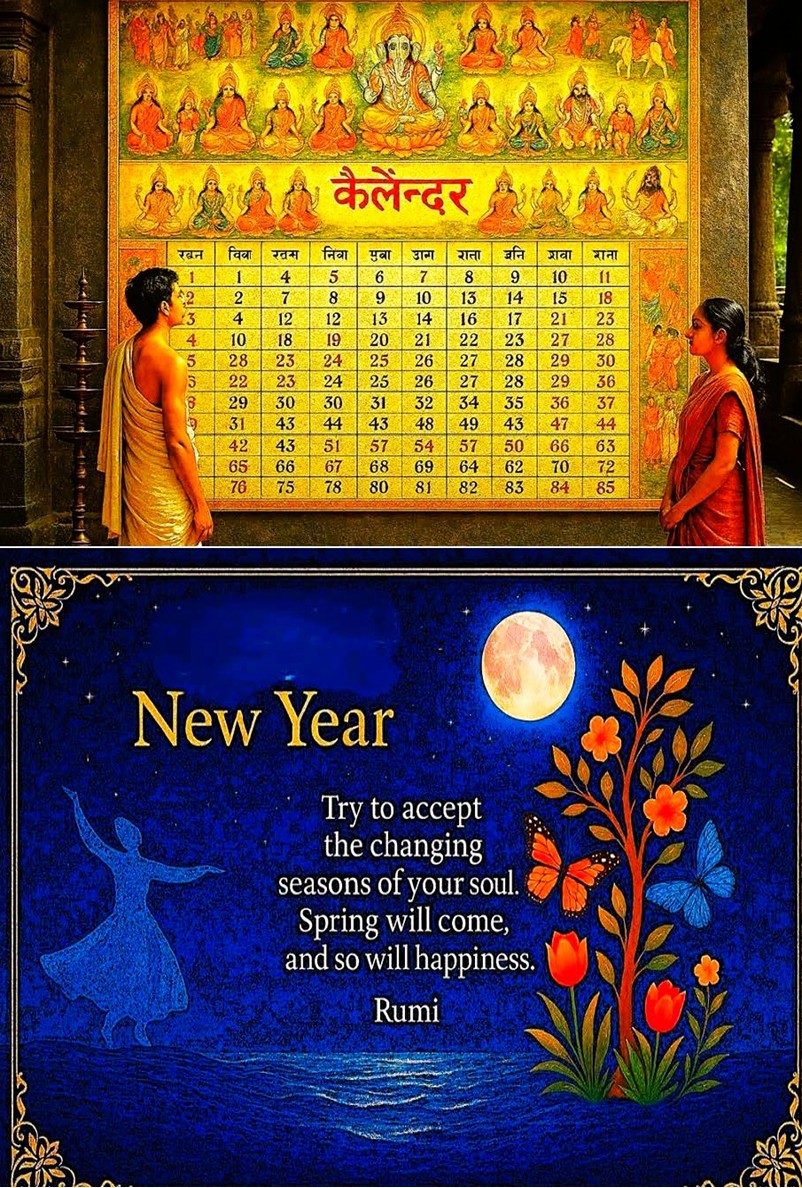
Original Photographs Conceptualised by Mrs V. Vawda 2025
Top Photo: An artistic reconstruction of an ancient Hindu calendar (Panchang), integrating sacred iconography and numerical grids. The upper panel depicts deities symbolizing cosmic order and time cycles, while the lower grid represents sequential tithis (lunar days) and nakshatras (constellations) used in Vedic timekeeping. Such calendars were central to determining auspicious timings for rituals, festivals, and life events, reflecting the synthesis of astronomy, spirituality, and cultural tradition in Hindu civilization.”
Bottom Photo: Rumi’s famous quotation related to relationship between calendrical systems, the seasons of the year and ageing.
How Were the Dates of Various Hindu Festivals Decided?
Hindu festival dates are traditionally determined using the Panchang,[18] which is based on lunisolar calculations. The key factors include:
- Lunar Phases (Tithi)
- The Hindu calendar divides the lunar month into 30 tithis (phases), each corresponding to a specific angle between the Sun and Moon.
- Festivals like Diwali occur on Amavasya (new moon), while Raksha Bandhan falls on Purnima (full moon).
- Solar and Lunar Months
- Months are named after the nakshatra (constellation) in which the full moon occurs.
- Some festivals follow solar transitions (e.g., Makar Sankranti on Sun’s entry into Capricorn).
- Nakshatras (Constellations)
- Certain rituals require alignment with specific stars, e.g., Janmashtami when Rohini nakshatra coincides with Krishna’s birth tithi.
- Planetary Positions and Yogas
- Auspicious combinations of planetary positions (yogas) influence timing for major observances.
- Seasonal Cycles (Ritus)
- Festivals are aligned with agricultural and seasonal changes, ensuring harmony with nature.
- Regional Variations
- Different regions may follow Amanta (month ends on new moon) or Purnimanta (month ends on full moon) systems, causing date variations.
Role of Nakshatras in the Hindu Calendar and Festival Determination[19]
Nakshatras are 27 (sometimes 28) lunar constellations that divide the ecliptic into segments of approximately 13°20′ each. They play a crucial role in Hindu timekeeping and astrology, forming the backbone of the Panchang (Hindu almanac). Here’s how they influence festival dates:
- Astronomical Basis
- The Moon travels through one Nakshatra roughly every day, completing the cycle in about 27.3 days.
- Each Nakshatra is associated with specific stars and mythological deities, symbolizing cosmic forces.
- Determining Auspicious Timings
- Festivals and rituals are often scheduled when the Moon occupies a particular Nakshatra.
- Janmashtami: Celebrated when Rohini Nakshatra coincides with Krishna’s birth tithi.
- Maha Shivaratri: Linked to Nakshatras favourable for Lord Shiva worship.
- Influence on Muhurta (Sacred Time)
- Nakshatras, combined with Tithi (lunar day) and Yoga, define auspicious periods for ceremonies like weddings, housewarming, and temple consecrations.
- Cultural and Spiritual Significance
- Each Nakshatra has symbolic attributes (e.g., Rohini signifies fertility and beauty; Ashwini represents healing and vitality).
- Ancient texts like the Vedanga Jyotisha and Brihat Samhita detail their role in predicting seasonal changes and agricultural cycles.
- Integration with Zodiac Signs
- Nakshatras are subdivisions of the 12 zodiac signs, adding granularity to astrological calculations.
- They influence personal horoscopes, which in turn affect festival observances for individuals and communities.
Elaboration on Holi Festival in Hinduism[20]
Holi, often called the Festival of Colours, is one of the most vibrant and widely celebrated festivals in Hinduism. It marks the arrival of spring, the victory of good over evil, and the joy of renewal. Here are its essential aspects:
- Mythological Significance
- Victory of Devotion: Holi commemorates the triumph of Prahlada, a devotee of Lord Vishnu, over his tyrannical father Hiranyakashipu, symbolizing the power of faith.
- Holika Dahan: The night before Holi, bonfires are lit to signify the burning of Holika (evil), representing purification and the destruction of negativity.
- Seasonal and Agricultural Roots
- Celebrated at the full moon (Purnima) in the month of Phalguna (February–March).
- Marks the end of winter and the beginning of the harvest season, bringing communities together in joy and abundance.
- Cultural Practices
- Throwing Colours (Gulal): People smear each other with colored powders and splash water, symbolizing unity and equality.
- Music and Dance: Traditional songs and rhythmic drumming create a festive atmosphere.
- Sweets and Drinks: Special treats like gujiya and drinks like thandai are shared.
- Spiritual Symbolism
- Colours represent divine energy, love, and harmony.
- The act of playing Holi dissolves social barriers, promoting inclusivity and joy.
Theological Foundations:
- Quranic Mandate: The prohibition of intercalation (nasi) is explicitly stated in Surah At-Tawbah (9:36-37), criticizing pre-Islamic Arabs for manipulating months to suit worldly interests.
- Universal Applicability: By decoupling from seasonal cycles, Islamic observance maintains consistency across global climates—Ramadan fasting occurs under similar conditions whether in tropical or temperate regions over a 33-year cycle.
- Anti-idolatrous Stance: The rejection of intercalation represents a break from nature worship, emphasizing instead submission to divine command independent of natural cycles.
Advantages:
- Simplicity and Predictability: The consistent 12-month lunar cycle (alternating 29 and 30 days) creates a transparent, easily calculated system without complex intercalation rules.
- Theological Independence: The calendar’s liberation from seasonal associations reinforces Islamic monotheism’s transcendence of natural phenomena.
- Global Unity: Muslims worldwide observe rituals simultaneously according to the same calendar, fostering transnational religious solidarity.
Disadvantages:
- Seasonal Drift: The annual 11-day discrepancy with solar years means religious observances lack fixed seasonal associations, which can complicate agricultural planning in Muslim-majority societies.
- Coordination Challenges: The need for monthly moon sighting (or calculations) creates potential for disagreement about month beginnings, particularly between different theological schools and regions.
- Civil Administration Difficulties: Most Muslim-majority countries maintain the Islamic calendar for religious purposes while using the Gregorian calendar for civil affairs, creating a dual calendrical system.
Calendars as Instruments of Peace and Conflict
Historically, calendrical systems have served as both unifying forces within religious communities and sources of conflict between them, particularly when intertwined with political power.
Unifying Functions:
- Intra-communal Coordination: Calendars establish shared ritual rhythms that reinforce group identity. The Hebrew calendar’s fixed holiday schedule unites global Jewry ; the Islamic calendar synchronizes global Muslim observance .
- Historical Continuity: Calendars preserve collective memory through commemorative cycles. The Hindu calendar maintains connection to ancient Vedic traditions ; the Buddhist calendar links contemporary practice to the Buddha’s life .
- Cosmic Orientation: By aligning human activity with celestial phenomena, calendars foster a sense of participating in cosmic order—what the Hebrew tradition calls “divine providence” .
Conflict Generation:
- Schismatic Divides: Calendar differences have historically marked and reinforced religious schisms. The Eastern Orthodox rejection of Gregorian reforms (1582) exemplifies how calendrical divergence can cement theological separation.
- Imperial Imposition: Calendars have served as tools of cultural domination, as when colonial powers imposed Gregorian systems on subject populations.
- Interfaith Tensions: The global dominance of the Gregorian calendar creates implicit pressure on non-Christian communities to adopt Christian temporal frameworks, potentially eroding religious distinctiveness .
The peace-disruption paradox of religious calendars stems from their dual nature as both internal organizing principles and external boundary markers. While creating internal cohesion, they simultaneously differentiate communities from one another, sometimes exacerbating interfaith tensions.
Historical Conflicts: Calendar Disputes and Their Consequences
Throughout history, calendrical differences have precipitated significant conflicts, reflecting how timekeeping intersects with power, identity, and theological authority.
Early Christian Controversies:
- Easter Dating: The Quartodeciman controversy (2nd century) over whether Easter should align with Passover highlighted tensions between Jewish and Gentile Christian traditions.
- Calendar Reform Conflicts: The Gregorian reform (1582) was rejected by Protestant states for centuries and remains unaccepted by Eastern Orthodox churches, creating lasting ecclesiastical divisions.
The Galileo Affair (1616-1633):[21]
This seminal conflict demonstrates how calendar reform intersected with cosmological debates. While often framed as simple science-versus-religion conflict, the Galileo affair involved complex considerations including:
- Doctrinal Implications: Heliocentrism challenged literal interpretations of biblical passages describing celestial motion .
- Institutional Authority: The Catholic Church’s monopoly on calendar determination was intertwined with broader claims to interpretative authority.
- Scientific Method: Galileo’s observational approach challenged Aristotelian natural philosophy underpinning existing calendrical calculations .
Ironically, Copernican theories had been used in the 1582 Gregorian reform, demonstrating the complex relationship between astronomy and religious authority. The affair ultimately hindered Catholic astronomical research while Protestant regions advanced in these sciences .
Jewish Calendar Standardization:
The fixation of the Hebrew calendar by Hillel II (4th century) or later authorities (traditionally 359 CE) represented a significant transition from observational to calculated methods, centralizing calendrical authority and ensuring diaspora uniformity .
Charges of Heresy: The Galileo Case as Watershed Moment
The trial of Galileo Galilei represents the most famous collision between religious calendrical authority and emergent scientific cosmology, with ramifications extending far beyond the 17th century.
The Core Conflict:
- Scriptural Interpretation: Opponents cited passages like Joshua 10:13 (“Sun, stand still”) as evidence for geocentrism, while Galileo argued for non-literal interpretation of biblical descriptions of natural phenomena .
- Philosophical Foundations: The Aristotelian-Ptolemaic cosmology underlying the liturgical calendar was increasingly challenged by telescopic observations of Jupiter’s moons and Venus’ phases .
- Institutional Politics: The dispute involved complex papal politics, with Urban VIII initially supporting Galileo before turning against him following perceived insults in the “Dialogue” .
Broader Implications:
The Galileo affair established a problematic paradigm of science-religion conflict that continues to influence contemporary debates. The eventual Catholic rehabilitation of Galileo (1757, 1822, 1992) illustrates the gradual accommodation between religious tradition and scientific advance, though the episode created lasting cultural wounds.
Dharmic Contrasts:
Notably, comparable heresy trials are largely absent from Dharmic traditions regarding calendrical astronomy. Hindu and Buddhist traditions generally embraced astronomical refinement as compatible with spiritual insight, as evidenced by the sophisticated mathematical astronomy in texts like the Surya Siddhanta .
Societal Impact: Calendars in the Lives of Believers
Religious calendars exert profound influence on the daily lives, seasonal rhythms, and communal identities of believers, shaping everything from agriculture to astronomy.
Agricultural and Economic Life:
- Seasonal Rituals: Lunisolar calendars like the Hebrew and Hindu systems maintain agricultural connections through harvest festivals and planting-related observances .
- Market Cycles: Traditional markets often follow calendar-based schedules, with particular days designated for trading based on religious significance.
- Fiscal Timing: Some religious communities maintain fiscal years aligned with religious calendars, though most modern states use Gregorian systems for official purposes.
Era Terminology: AD, BCE, AH, AM and Their Meanings
The terminology used to mark years reveals much about the theological assumptions and historical contexts of different calendrical systems.
Christian-Based Terminology:
- AD (Anno Domini): “In the Year of Our Lord,” popularized by Bede in the 8th century based on Dionysius Exiguus’ 6th-century calculations. This terminology explicitly centres Christian theology in timekeeping.
- BC (Before Christ): The complementary designation for years preceding Jesus’ birth, though notably without a year zero.
- CE/BCE (Common Era/Before Common Era): Secular alternatives that emerged in the 17th century (initially as “Vulgar Era”) and gained popularity in academic and interfaith contexts during the 20th century. These terms preserve the Gregorian structure while removing explicit Christian references .
Other Religious Terminology:
- AH (Anno Hegirae): “In the Year of the Hijra,” the Islamic system beginning in 622 CE. Some confusion can arise with the similar abbreviation for the Hebrew Anno Hebraico .
- AM (Anno Mundi): “In the Year of the World,” used in the Hebrew calendar. Different calculations exist, with the Byzantine tradition using 5509 BCE versus the Hebrew 3761 BCE .
- BE (Buddhist Era): Used in Theravada Buddhist countries, generally adding 543-544 years to Common Era dates .
- VS (Vikram Samvat): The Hindu era beginning in 57 BCE, widely used in Nepal and parts of India .
The controversy over terminology reflects deeper tensions between religious particularity and universal secular frameworks. While BCE/CE notation attempts religious neutrality, critics note it maintains the same Christian-derived epoch .
Seasonal Synchronization: Agricultural and Ritual Alignments
Religious calendars employ various intercalation methods to maintain alignment between ritual cycles and seasonal realities, with significant implications for agricultural and communal life.
Intercalation Methods:
- Hebrew System: Adds an entire month (Adar II) seven times in a 19-year Metonic cycle. This ensures that Passover consistently occurs in spring (“the month of Aviv”) as biblically mandated.
- Jewish Calendar Standardization: The fixation of the Hebrew calendar by Hillel II (4th century) or later authorities (traditionally 359 CE) represented a significant transition from observational to calculated methods, centralizing calendrical authority and ensuring diaspora uniformity .
- Hindu System: Inserts an intercalary month (Adhik Maas) approximately every 32-33 months based on sidereal calculations. This maintains the relationship between festivals and seasons, explaining why Diwali consistently falls in October-November .
- Buddhist System: Uses similar intercalation principles to Hindu calendars but with regional variations. This ensures that festivals like Vesak (commemorating the Buddha’s birth, enlightenment, and death) maintain seasonal associations .
- Islamic System: Conspicuously avoids intercalation despite pre-Islamic Arabian knowledge of the practice (nasi), following Quranic injunction (9:36-37). This results in festivals like Ramadan cycling through all seasons over a 33-year period .
Agricultural Implications:
The lunisolar calendars of Judaism and Hinduism maintain close ties between religious observance and agricultural cycles. Jewish festivals like Sukkot (harvest festival) and Shavuot (first fruits) retain their seasonal character through intercalation . Hindu festivals are similarly tied to seasonal transitions and agricultural milestones . In contrast, the Islamic calendar’s purely lunar nature severs this agricultural connection, emphasizing instead the universal applicability of religious observance across geographical and climatic variations.
The Islamic Lunar Calendar: Theological Rationale and Practical Implications
The Islamic calendar’s steadfast adherence to a purely lunar system represents a deliberate theological choice with both symbolic significance and practical consequences.
Theological Foundations:
- Quranic Mandate: The prohibition of intercalation (nasi) is explicitly stated in Surah At-Tawbah (9:36-37), criticizing pre-Islamic Arabs for manipulating months to suit worldly interests.
- Universal Applicability: By decoupling from seasonal cycles, Islamic observance maintains consistency across global climates—Ramadan fasting occurs under similar conditions whether in tropical or temperate regions over a 33-year cycle.
- Anti-idolatrous Stance: The rejection of intercalation represents a break from nature worship, emphasizing instead submission to divine command independent of natural cycles.
Advantages:
- Simplicity and Predictability: The consistent 12-month lunar cycle (alternating 29 and 30 days) creates a transparent, easily calculated system without complex intercalation rules.
- Theological Independence: The calendar’s liberation from seasonal associations reinforces Islamic monotheism’s transcendence of natural phenomena.
- Global Unity: Muslims worldwide observe rituals simultaneously according to the same calendar, fostering transnational religious solidarity.
Disadvantages:
- Seasonal Drift: The annual 11-day discrepancy with solar years means religious observances lack fixed seasonal associations, which can complicate agricultural planning in Muslim-majority societies.
- Coordination Challenges: The need for monthly moon sighting (or calculations) creates potential for disagreement about month beginnings, particularly between different theological schools and regions.
- Civil Administration Difficulties: Most Muslim-majority countries maintain the Islamic calendar for religious purposes while using the Gregorian calendar for civil affairs, creating a dual calendrical system.
Calendars as Instruments of Peace and Conflict
Historically, calendrical systems have served as both unifying forces within religious communities and sources of conflict between them, particularly when intertwined with political power.
Unifying Functions:
- Intra-communal Coordination: Calendars establish shared ritual rhythms that reinforce group identity. The Hebrew calendar’s fixed holiday schedule unites global Jewry ; the Islamic calendar synchronizes global Muslim observance .
- Historical Continuity: Calendars preserve collective memory through commemorative cycles. The Hindu calendar maintains connection to ancient Vedic traditions ; the Buddhist calendar links contemporary practice to the Buddha’s life .
- Cosmic Orientation: By aligning human activity with celestial phenomena, calendars foster a sense of participating in cosmic order—what the Hebrew tradition calls “divine providence” .
Conflict Generation:
- Schismatic Divides: Calendar differences have historically marked and reinforced religious schisms. The Eastern Orthodox rejection of Gregorian reforms (1582) exemplifies how calendrical divergence can cement theological separation.
- Imperial Imposition: Calendars have served as tools of cultural domination, as when colonial powers imposed Gregorian systems on subject populations.
- Interfaith Tensions: The global dominance of the Gregorian calendar creates implicit pressure on non-Christian communities to adopt Christian temporal frameworks, potentially eroding religious distinctiveness .
The peace-disruption paradox of religious calendars stems from their dual nature as both internal organizing principles and external boundary markers. While creating internal cohesion, they simultaneously differentiate communities from one another, sometimes exacerbating interfaith tensions.
Historical Conflicts: Calendar Disputes and Their Consequences
Throughout history, calendrical differences have precipitated significant conflicts, reflecting how timekeeping intersects with power, identity, and theological authority.
Early Christian Controversies:
- Easter Dating: The Quartodeciman controversy (2nd century) over whether Easter should align with Passover highlighted tensions between Jewish and Gentile Christian traditions.
- Calendar Reform Conflicts: The Gregorian reform (1582) was rejected by Protestant states for centuries and remains unaccepted by Eastern Orthodox churches, creating lasting ecclesiastical divisions.
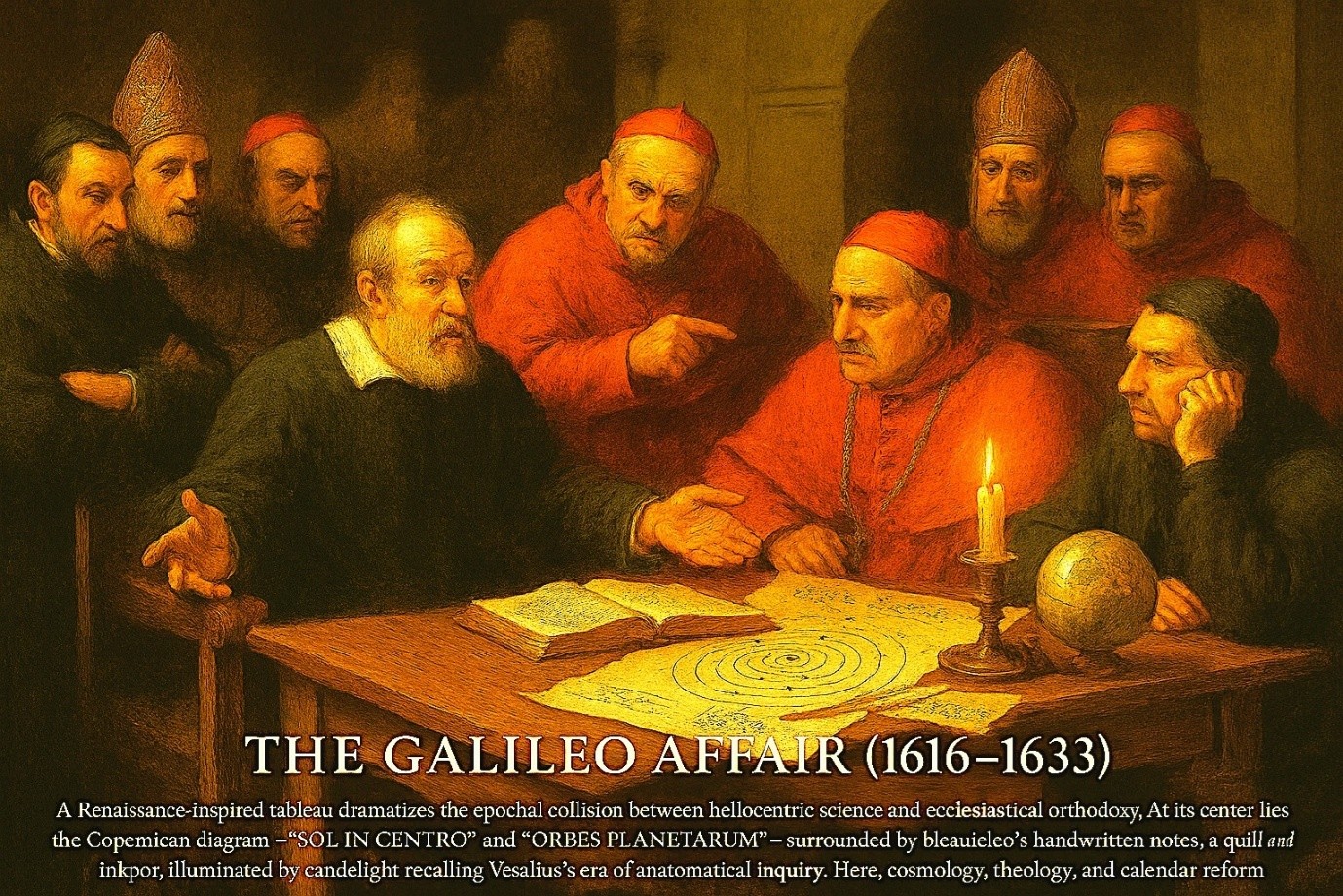
Original photograph: Conceptualised by Mrs V. Vawda, January 2025
The Galileo Conflict with religious Hegemony. The image captures the essence of the Galileo Affair (1616–1633), depicting Galileo presenting heliocentric evidence with an open book and a globe, while church officials in cardinal robes and mitres confront him, symbolizing the clash between scientific truth and ecclesiastical authority. The composition reflects the tension of cosmological debates intertwined with calendar reform, highlighting the profound disruption of peace during this seminal conflict.
The Galileo Affair (1616-1633): Charges of Heresy, The Galileo Case as Watershed Moment
This seminal conflict demonstrates how calendar reform intersected with cosmological debates. While often framed as simple science-versus-religion conflict, the Galileo affair involved complex considerations including:
- Doctrinal Implications: Heliocentrism challenged literal interpretations of biblical passages describing celestial motion .
- Institutional Authority: The Catholic Church’s monopoly on calendar determination was intertwined with broader claims to interpretative authority.
- Scientific Method: Galileo’s observational approach challenged Aristotelian natural philosophy underpinning existing calendrical calculations.
Ironically, Copernican theories had been used in the 1582 Gregorian reform, demonstrating the complex relationship between astronomy and religious authority. The affair ultimately hindered Catholic astronomical research while Protestant regions advanced in these sciences Galileo was not executed for heresy. Historically in:
- 1616: Galileo was warned by the Roman Catholic Church not to teach or defend the heliocentric theory (Copernican model), which placed the Sun at the centre of the universe. The Church considered this idea “formally heretical” because it contradicted Scripture as interpreted at the time.
- 1633: After publishing Dialogue Concerning the Two Chief World Systems, Galileo was tried by the Inquisition. He was found “vehemently suspect of heresy”, but not guilty of outright heresy.
- His punishment:
- Forced to recant his heliocentric views publicly.
- Sentenced to house arrest for life, which he served in his villa near Florence.
- His book was banned, and he was forbidden to publish further works on cosmology.
- His punishment:
- Death: Galileo died peacefully in 1642 at age 77, still under house arrest, but continuing scientific work (including studies on motion and mechanics).
So, Galileo was never executed, his case is often misunderstood because of its dramatic nature, but it was intellectual suppression rather than physical execution..
The trial of Galileo Galilei represents the most famous collision between religious calendrical authority and emergent scientific cosmology, with ramifications extending far beyond the 17th century.
The Core Conflict:
- Scriptural Interpretation: Opponents cited passages like Joshua 10:13 (“Sun, stand still”) as evidence for geocentrism, while Galileo argued for non-literal interpretation of biblical descriptions of natural phenomena .
- Philosophical Foundations: The Aristotelian-Ptolemaic cosmology underlying the liturgical calendar was increasingly challenged by telescopic observations of Jupiter’s moons and Venus’ phases .
- Institutional Politics: The dispute involved complex papal politics, with Urban VIII initially supporting Galileo before turning against him following perceived insults in the “Dialogue”.
Broader Implications:
The Galileo affair established a problematic paradigm of religio-scientific conflict, that continues to influence contemporary debates. The eventual Catholic rehabilitation of Galileo (1757, 1822, 1992) illustrates the gradual accommodation between religious tradition and scientific advance, though the episode created lasting cultural wounds.
Festival Cycles and Communal Identity:
- Annual Rhythms: The repetitive cycle of festivals creates predictable communal rhythms that reinforce religious identity across generations.
- Lifecycle Integration: Calendars map individual lifespans onto sacred history through birthdays, anniversaries of death (yahrzeits in Judaism), and other commemorations.
- Cosmological Participation: Observance of calendar-based rituals fosters a sense of participating in cosmic order—what Jewish thought calls “divine providence” .
Astronomical Engagement:
- Observational Traditions: Many religious communities maintain sky-watching practices tied to calendar determination—moon sighting in Islam, equinox observations in Hinduism .
- Mathematical Refinement: The need for accurate calendar calculation spurred mathematical advances in various traditions, from the Metonic cycle to Hindu trigonometry.
The dual-calendar reality of most modern religious communities—using religious calendars for ritual life while participating in the Gregorian-dominated civil sphere—creates complex navigational challenges but also opportunities for cultural bilingualism in temporal understanding.
The Martian Day (Sol)[22]
A “sol” is the fundamental unit of timekeeping on Mars, defined as one full rotation of the planet (a solar day).
- Length: One sol is 24 hours, 39 minutes, and 35.244 seconds long, making it about 2.75% longer than an Earth day.
- Practical Use: NASA missions have used sols to schedule rover activities since the 1970s, with a simple count starting from the day of landing (Sol 0 or Sol 1). Future human missions would also operate on “Mars time,” with workdays shifting about 40 minutes later each Earth day.
Living on “Mars Time”
Adapting to this new system presents unique challenges and potential solutions:
- Body Clock: The longer day and lack of Earth’s 24-hour light/dark cycle can disrupt human circadian rhythms. Artificial lighting simulating a 24.65-hour day would be essential.
- Technology: Watches and software would need to be recalibrated for the longer sol. Special Mars-time watches have already been created for mission teams.
- Scheduling: Work, rest, and communication with Earth (which has a ~40-minute daily drift) would need to be carefully planned.
- Social Rhythms: New terms like “yestersol” (yesterday) and “solmorrow” (tomorrow) have already been coined, and new holidays would naturally emerge, marking events in Martian history or seasonal changes.
In summary, future Martians would live by the rhythm of the sol, using a calendar and time system fundamentally designed for their new world, while developing the social and technological tools to make it feel like home.

Original photograph: Conceptualised by Mrs V. Vawda, December 2025
Human Habitat on Mars: Sol-Based Timekeeping and Environmental Context
This photorealistic scene envisions a human outpost operating on Martian solar time (“sol”), the standard day-length used by NASA since Viking (1976). A sol is the mean interval between successive noons at a location on Mars and lasts 24 h 39 m 35.244 s, about 2.75% longer than an Earth Day. Mission operations therefore adopt a 24‑“Mars‑hour” clock in which hours, minutes, and seconds are proportionally stretched to fit the sol, preserving familiar 24‑hour scheduling while aligning activities to Martian daylight. [giss.nasa.gov]
Timekeeping Systems Depicted.
- LMST/LTST (Local Mean/True Solar Time): Outposts typically track local solar time tied to site longitude for planning EVA, power, and science; several lander missions have used LMST or LTST at their landing sites. [an.rsl.wustl.edu], [en.wikipedia.org]
- MTC (Mars Coordinated Time) & MSD (Mars Sol Date): For planet‑wide coordination, teams reference Mars Coordinated Time (analogous to UTC) derived from Mars Sol Date, a continuous sol count calculated from Earth‑based Julian Date via the Mars24 algorithms. These conventions support synchronized operations across different sites and orbits. [giss.nasa.gov], [giss.nasa.gov], [en.wikipedia.org]
Environmental Cues in the Scene.
- The butterscotch sky and muted sun disk reflect light scattering in Mars’ dusty, thin atmosphere; at twilight, blue‑tinted sunsets can occur due to forward scattering by fine dust. [science.nasa.gov]
- Pressure and Composition: Near‑surface atmospheric pressure averages ~6 mbar and is ~95% CO₂, shaping habitat design (pressurization, airlocks) and ISRU concepts. [en.wikipedia.org]
- Gravity: Human posture and movement adapt to ~0.38 g surface gravity, influencing locomotion, load‑carrying, and long‑term physiology countermeasures. [en.wikipedia.org]
Astronomical Markers.
- Colonists often track the visibility and rapid west‑to‑east motion of Phobos (~7 h 39 m orbit) and the slower Deimos (~30 h orbit) as practical sky references; both are observable from the surface and exhibit phases. [astronomy.com]
Operational Rationale.
Sol‑aligned scheduling maximizes solar power, thermal management, and crew circadian health, while dual displays of local time (LMST/LTST) and planetary time (MTC/MSD) enable seamless coordination among habitats, rovers, and orbiters using the NASA GISS Mars24 framework.[23]
Brief History of Holi in Hinduism
In the context of this paper, it is necessary to refer to the Hindu Festival of Holi, both as a calendrical event and as a festival of social cohesion, especially in India. Holi is an ancient Hindu festival with roots in Vedic traditions, originally celebrated as a seasonal and agricultural ritual marking the arrival of spring and the harvest season. Its earliest references appear in Puranic texts such as the Bhavishya Purana [24] and Narad Purana[25], and in classical Sanskrit literature like Ratnavali[26] (7th century CE), which describes Holi as a joyous celebration with colours and music.
Mythological Origins
- Prahlada and Hiranyakashipu:[27] Holi commemorates the victory of devotion over tyranny. Prahlada, a devotee of Vishnu, was saved from the fire meant to kill him, while Holika (his evil aunt) perished, symbolizing the triumph of good over evil.
- Krishna and Radha[28]: In Braj (Mathura and Vrindavan),[29] Holi is linked to Krishna’s playful colouring of Radha and the Gopis, giving the festival its romantic and joyous character.
Evolution Over Time
- Initially a ritualistic bonfire (Holika Dahan)[30] to purify and ward off evil spirits.
- Later evolved into a social festival of colours, music, and dance, breaking caste and social barriers.
- Today, Holi is celebrated across India and globally, blending spiritual symbolism with cultural exuberance.
How Holi Propagates Peace Over the Centuries
Holi has served as a cultural and spiritual instrument of peace since its inception, transcending barriers and fostering harmony in multiple ways:
- Dissolution of Social Divisions
- Traditionally, Holi encourages people of all backgrounds—irrespective of caste, class, or status—to come together and celebrate.
- The act of smearing colors symbolizes erasing distinctions, promoting equality and fraternity.
- Celebration of Forgiveness and Renewal
- Holi is associated with letting go of past grievances and starting anew.
- Communities use this occasion to reconcile differences, strengthening social bonds and reducing conflict.
- Mythological Message of Peace
- The story of Prahlada and Holika emphasizes the triumph of devotion and righteousness over tyranny and ego.
- This narrative reinforces the principle that peace and virtue ultimately prevail over aggression and injustice.
- Joy as a Unifying Force
- Music, dance, and shared meals during Holi create an atmosphere of collective happiness, which reduces hostility and fosters goodwill.
- The communal nature of the festival promotes dialogue and interaction, essential for peaceful coexistence.
- Global Cultural Diplomacy
- In modern times, Holi has become a symbol of cultural exchange, celebrated worldwide by diverse communities.
- Its universal themes of joy, equality, and renewal resonate across cultures, making it a soft power tool for peacebuilding.
“Holi as a Catalyst for Peace: From Vedic Times to Global Celebrations”, showing its historical evolution and peacebuilding aspects? Or prepare a timeline graphic illustrating Holi’s role in promoting social harmony across eras?
Holi’s Impact on Social Harmony
Holi has historically functioned as a powerful social equalizer, and the image vividly illustrates this through its symbolic elements:
- Breaking Social Barriers
- The act of throwing colors, as seen in the image, represents erasing distinctions of caste, class, and status. Everyone becomes visually equal when covered in vibrant gulal.[31]
- This tradition fosters inclusivity, encouraging interaction among diverse groups.
- Collective Participation
- The image shows multiple individuals engaging together in the celebration, surrounded by bowls of coloured powders and festive sweets. This communal activity strengthens social bonds and promotes unity.
- Shared Resources and Hospitality
- The presence of traditional sweets (gulab jamun) and thandai drink signifies sharing and generosity, which are essential for harmony.
- Food and drink during Holi are offered without discrimination, reinforcing the idea of universal fellowship.
- Symbolism of Holika Dahan
- The bonfire in the background represents purification and the destruction of negativity, a metaphor for burning away social discord and fostering peace.
- Cultural Continuity
- The traditional setting and attire in the image reflect heritage and collective identity, which help maintain harmony across generations by connecting people to shared values.
“Holi and Social Harmony: A Cultural Blueprint for Peace”, combining these points with visual symbolism? Or prepare a poster with this explanation integrated for academic or cultural presentations?
Holi’s Role in Community Bonding
The image vividly illustrates how Holi fosters collective joy and social cohesion, making it a cornerstone of community bonding in Hindu culture. Here’s how:
- Shared Participation in Rituals
- The Holika Dahan bonfire in the background represents a communal act of purification and renewal. Lighting the bonfire together strengthens a sense of unity and shared purpose.
- Collective Celebration Through Colors
- Bowls of gulal powders in bright hues (red, yellow, green) symbolize equality and inclusivity. When colors are thrown, individual distinctions disappear, creating a visual metaphor for harmony.
- Exchange of Food and Hospitality
- Plates of traditional sweets (gulab jamun) and a brass vessel of thandai highlight the importance of sharing meals. Food exchange during Holi is a cultural gesture of goodwill and friendship.
- Breaking Social Barriers
- The image shows people engaging together in playful activities, regardless of attire or status. This interaction dissolves hierarchical boundaries, promoting social integration.
- Cultural Continuity
- The traditional courtyard setting and attire reflect heritage, reinforcing a collective identity that binds generations together.
In essence, Holi transforms public spaces into zones of joy, equality, and togetherness, making it a festival that actively nurtures community bonding and social harmony.
The photorealistic depiction of Holi, below, captures the essence of one of Hinduism’s most exuberant festivals. The scene illustrates the symbolic interplay of elements: vibrant gulal powders in red, yellow, and green representing joy, vitality, and renewal; traditional sweets such as gulab jamun[32] and the festive drink thandai signifying hospitality and abundance; and the Holika Dahan bonfire in the background, commemorating the triumph of devotion and righteousness over arrogance and evil. The architectural backdrop evokes cultural continuity, while the dynamic dispersion of colours reflects Holi’s core philosophy, dissolving social barriers and celebrating unity through shared festivity.”

The Holi: A Hindu festival of vibrant colours, social cohesion and endogenous, as well as community Peace. An important calendrical event in Hinduism, widely observed in India and the diaspora. Original photograph: Conceptualised by Mrs V. Vawda, December 2025
Epilogue: The Calendar’s Enduring Power
As humanity progresses through the 21st century, religious calendars continue to exert remarkable influence despite the global dominance of standardized secular timekeeping. These ancient systems persist not merely as historical curiosities but as living frameworks of meaning that connect contemporary believers to ancestral wisdom and cosmic rhythms. The endurance of multiple calendrical systems in an increasingly interconnected world testifies to the profound human need for temporality infused with transcendence, for ways of marking time that acknowledge our place within larger stories of creation, revelation, and redemption.
The ongoing negotiations between religious particularity and global standardization reflect broader tensions between cultural diversity and universal coordination. As religious communities navigate these tensions, their calendars evolve, incorporating technological advances in calculation while preserving theological essentials. This dynamic interplay between preservation and adaptation ensures that religious calendars remain vital organs of living traditions rather than mere relics of bygone eras.
Conclusion: Synthetic Insights from Comparative Analysis
This comparative examination reveals that religious calendars, despite their diversity, address common human needs: to orient ourselves within cosmic order, to commemorate transformative sacred events, to synchronize communal ritual life, and to infuse mundane temporality with transcendental significance. The Abrahamic traditions, with their linear historical consciousness, tend to structure time around unique, non-repeatable divine interventions, creation, covenant, incarnation, revelation. The Dharmic traditions, with their more cyclical orientations, often emphasize repeating cosmic patterns and the possibility of liberation from temporal bondage itself.
Yet significant convergences emerge: the nearly universal adoption of lunisolar compromise systems (excepting Islam), the sophisticated mathematical astronomy developed across traditions, and the shared recognition that how we mark time fundamentally shapes how we understand reality. All major religious calendars ultimately serve as pedagogies of temporality, teaching adherents particular understandings of history, eternity, and human purpose through the rhythmic repetition of sacred commemorations.
Bottom Line:
- Theological Embodiment: Calendars are not neutral timekeeping tools but concrete expressions of theological worldviews, encoding beliefs about creation, history, and eschatology in their structures and epochs.
- Abrahamic-Dharmic Contrast: While Abrahamic calendars generally reflect linear salvation historyanchored in unique divine acts, Dharmic systems more often embrace cyclical understandings of time, though with significant complexity within each tradition.
- Mathematical Sophistication: All major religious traditions developed advanced astronomical knowledgeto address the challenge of harmonizing lunar and solar cycles, with intercalation systems representing remarkable pre-modern scientific achievements.
- Conflict and Coexistence: Calendars have historically served as both sources of communal unityand catalysts for conflict, particularly when intertwined with political power and claims to exclusive truth.
- Contemporary Resilience: Despite globalization pressures, religious calendars demonstrate remarkable persistenceas markers of identity and frameworks for sacred time, often existing in creative tension with secular systems.
The author extends his warm greetings, for an uplifting, spiritually infused, blessed, Gregorian New Year 2026, to be shared with the loved ones, family and friends. May the Divine makes 2026, peaceful, harmonious and with international respect, as well as social cohesion, and tolerance.
Comments and discussion are invited by e-mail: vawda@ukzn.ac.za
Global: + 27 82 291 4546
References:
[1] Personal Quote by author, December 2025
[2] calendrical systems – Search
[3] https://www.bing.com/ck/a?!&&p=5fe43f9492a60dbc8a553770f475ed8d7a9c99759ac3a4a75179ce2b3d0e993bJmltdHM9MTc2NzMxMjAwMA&ptn=3&ver=2&hsh=4&fclid=37940f5c-820f-62a2-14ab-19c283916323&u=a1aHR0cHM6Ly93d3cuYmlibGVvZHlzc2V5Lm9yZy9hcnRpY2xlcy90aGUtY2FsZW5kYXItaW4tdGhlLWhlYnJldy1iaWJsZS8&ntb=1
[4] https://www.bing.com/ck/a?!&&p=a10b22f5e49b4e645beef04f1e0ce15c9c974babe9d8484108e0fd50e0e025e0JmltdHM9MTc2NzMxMjAwMA&ptn=3&ver=2&hsh=4&fclid=37940f5c-820f-62a2-14ab-19c283916323&u=a1aHR0cHM6Ly93d3cuaGluZHVhbWVyaWNhbi5vcmcvaGluZHUtaG9saWRheXMtZ3VpZGU&ntb=1
[5] https://www.bing.com/ck/a?!&&p=fd9f24f11d509fa3fe5c23739e1e7269f47ef7929082676e8230a38c4cdeb37fJmltdHM9MTc2NzMxMjAwMA&ptn=3&ver=2&hsh=4&fclid=37940f5c-820f-62a2-14ab-19c283916323&psq=calendars+as+theological+constructs+meaning&u=a1aHR0cHM6Ly9kaWdpdGFsYmlibGUuY2EvYXJ0aWNsZS1wYWdlL21vZGVybi10b3BpY3Mtd2hhdC1kb2VzLXRoZS1iaWJsZS1zYXktYWJvdXQtY2FsZW5kYXI
[6] https://www.bing.com/ck/a?!&&p=14d118e767b3e50dcaa85e512eaca5b230fc23a08ab55ccc92fe9585f8fe49e8JmltdHM9MTc2NzMxMjAwMA&ptn=3&ver=2&hsh=4&fclid=37940f5c-820f-62a2-14ab-19c283916323&u=a1aHR0cHM6Ly93d3cud29ybGRoaXN0b3J5Lm9yZy9BYnJhaGFtLF90aGVfUGF0cmlhcmNoLw&ntb=1
[7] https://www.bing.com/ck/a?!&&p=f3b07eb14da1be7d4f4da8549fe8fe7a66187bbccb23f1f72e54d1bedf28ab6dJmltdHM9MTc2NzMxMjAwMA&ptn=3&ver=2&hsh=4&fclid=37940f5c-820f-62a2-14ab-19c283916323&psq=ancient+Vedic+period&u=a1aHR0cHM6Ly9lbi53aWtpcGVkaWEub3JnL3dpa2kvVmVkaWNfcGVyaW9k
[8]https://www.bing.com/ck/a?!&&p=75202aa69c09d46013af7bc5a26672c3a8e3cb91af9ea89b22832cb676d0d701JmltdHM9MTc2NzMxMjAwMA&ptn=3&ver=2&hsh=4&fclid=37940f5c-820f-62a2-14ab-19c283916323&u=a1L2ltYWdlcy9zZWFyY2g_cT1tYXVyeWFuK2tpbmdzK3JlZmVyZW5jaW5nK3RoZStzYXB0YXJzaStjYWxlbmRhcisuJmlkPUU3RUJCQ0M0RkFGQUJBMTI4QkY1RkNDQkU3QzA0NDcwQjI1NDdGMjUmRk9STT1JUUZSQkE
[9] https://www.bing.com/ck/a?!&&p=5c4e454be0b350981a45435c9030d6b7085e8ab6c0ddae272fd3157b21c6542cJmltdHM9MTc2NzMxMjAwMA&ptn=3&ver=2&hsh=4&fclid=37940f5c-820f-62a2-14ab-19c283916323&psq=lord+buddha%27s+parinirvana&u=a1aHR0cHM6Ly9lbi53aWtpcGVkaWEub3JnL3dpa2kvUGFyaW5pcnZhbmE
[10] History of calendars – Wikipedia
[11] https://www.bing.com/ck/a?!&&p=77bb44b838408108d16a0887116e9046a6db2516294240e8433ca1944d533fabJmltdHM9MTc2NzMxMjAwMA&ptn=3&ver=2&hsh=4&fclid=37940f5c-820f-62a2-14ab-19c283916323&psq=Anno+Mundi%22&u=a1aHR0cHM6Ly9lbi53aWtpcGVkaWEub3JnL3dpa2kvQW5ub19NdW5kaQ
[12] https://www.bing.com/ck/a?!&&p=293a247da0958e0249fadae22cd673a184f3ac0ad83d1b6dbc0c09b28b2996abJmltdHM9MTc2NzMxMjAwMA&ptn=3&ver=2&hsh=4&fclid=37940f5c-820f-62a2-14ab-19c283916323&psq=%22Dating+from+Creation%22&u=a1aHR0cHM6Ly90aGVvcG9saXNpbnN0aXR1dGUuY29tL3dwLWNvbnRlbnQvdXBsb2Fkcy9lZGQvMjAxNi8wMS9Gcm9tLUNyZWF0aW9uLXRvLVNvbG9tb24uLVN0dWRpZXMtaW4tQmlibGljYWwtQ2hyb25vbG9neS1QYXJ0LTIuLUphbWVzLUpvcmRhbi5wZGY
[13] https://www.bing.com/ck/a?!&&p=75bbf4b14b3cd7af20af6394533daccf8eb1aea75a09d5f438f4a11d2027df5fJmltdHM9MTc2NzMxMjAwMA&ptn=3&ver=2&hsh=4&fclid=37940f5c-820f-62a2-14ab-19c283916323&u=a1aHR0cHM6Ly93d3cuYnJpdGFubmljYS5jb20vcGxhY2UvQnl6YW50aW5lLUVtcGlyZQ&ntb=1
[14] https://www.transcend.org/tms/2025/12/calendars-from-antiquity-welcoming-peace-and-harmony-2026/
[15] https://www.bing.com/ck/a?!&&p=252cac1279ebac5d9364508244bfab2da9c253919a37450695f37365773a2dc2JmltdHM9MTc2NzMxMjAwMA&ptn=3&ver=2&hsh=4&fclid=37940f5c-820f-62a2-14ab-19c283916323&psq=vikram+samvat+calendar&u=a1aHR0cHM6Ly9lbi53aWtpcGVkaWEub3JnL3dpa2kvVmlrcmFtX1NhbXZhdA
[16] https://www.bing.com/ck/a?!&&p=33ec122ea3dedc5deb05731b5b1c6e4b9117f568af0862d4952324471d300b6bJmltdHM9MTc2NzMxMjAwMA&ptn=3&ver=2&hsh=4&fclid=37940f5c-820f-62a2-14ab-19c283916323&psq=Systems+of+Time+Measurement%3a+Lunisolar%2c+Lunar%2c+and+Sidereal+Approaches&u=a1aHR0cHM6Ly9lcmFvZmludmVudGlvbi5jb20vbHVuYXItYW5kLXNvbGFyLXllYXItYWxpZ25tZW50Lw
[17] https://www.transcend.org/tms/2025/12/calendars-from-antiquity-welcoming-peace-and-harmony-2026/
[18] https://www.bing.com/ck/a?!&&p=a71c8e450b699afd7e58b4e6286cd162fdb7db1eea06aff122600e9a9131d39fJmltdHM9MTc2NzMxMjAwMA&ptn=3&ver=2&hsh=4&fclid=37940f5c-820f-62a2-14ab-19c283916323&psq=panchang+today&u=a1aHR0cHM6Ly93d3cuZHJpa3BhbmNoYW5nLmNvbS8
[19] https://www.bing.com/ck/a?!&&p=eab4e89252200158fecdafc694cc4e1a6cadaaad182b7458bb2defeaa3677cf5JmltdHM9MTc2NzMxMjAwMA&ptn=3&ver=2&hsh=4&fclid=37940f5c-820f-62a2-14ab-19c283916323&psq=Role+of+Nakshatras+in+the+Hindu+Calendar+and+Festival+Determination&u=a1aHR0cHM6Ly9kaGFybWtzaGV0cmEuY29tL2Jsb2dzL3N0b3JpZXMvaGluZHUtY2FsZW5kYXItZ3VpZGUtcGFuY2hhbmctdGl0aGlz
[20] https://www.bing.com/ck/a?!&&p=49172de34baee90b35679113d54a6e34a6e2c0afbc5b80da22ca101d40e6c722JmltdHM9MTc2NzMxMjAwMA&ptn=3&ver=2&hsh=4&fclid=37940f5c-820f-62a2-14ab-19c283916323&u=a1aHR0cHM6Ly9mZXN0aXZhbHNvZmhpbmR1LmNvbS9zaWduaWZpY2FuY2UtYW5kLWhpc3Rvcnktb2YtaG9saS8&ntb=1
[21] https://www.bing.com/ck/a?!&&p=67670014d27143fa0e800125be3d45102474e994111fe1f5ab4461fe702465adJmltdHM9MTc2NzMxMjAwMA&ptn=3&ver=2&hsh=4&fclid=37940f5c-820f-62a2-14ab-19c283916323&psq=The+Galileo+Affair+(1616-1633)%3a&u=a1aHR0cHM6Ly9lbi53aWtpcGVkaWEub3JnL3dpa2kvR2FsaWxlb19hZmZhaXI
[22] https://www.bing.com/ck/a?!&&p=bab7578cf1c1d76e08c51c89ae0fe0553ea071b706fa8de7f893729863d690e7JmltdHM9MTc2NzMxMjAwMA&ptn=3&ver=2&hsh=4&fclid=37940f5c-820f-62a2-14ab-19c283916323&psq=The+Martian+Day+(Sol)&u=a1aHR0cHM6Ly9lbi53aWtpcGVkaWEub3JnL3dpa2kvTWFyc19zb2w
[23] https://www.bing.com/ck/a?!&&p=a21a0b8b695c92077904ebc2446ac8cb77b855979d5b7fb1f418675c607f75bfJmltdHM9MTc2NzMxMjAwMA&ptn=3&ver=2&hsh=4&fclid=37940f5c-820f-62a2-14ab-19c283916323&psq=Mars24+framework.&u=a1aHR0cHM6Ly9zZXdhcmRsZWUuY29tL2Jsb2cvYXN0cm9ub215LzIwMjAvMDkvMjgvdGltZWtlZXBpbmctb24tbWFycy13aXRoLXIv
[24] https://www.bing.com/ck/a?!&&p=a8e97c8751a8e8fc1ff1e3d877cf6deb286fd8ca6b58b5b4f5ed633f436a8f53JmltdHM9MTc2NzMxMjAwMA&ptn=3&ver=2&hsh=4&fclid=37940f5c-820f-62a2-14ab-19c283916323&psq=Bhavishya+Purana&u=a1aHR0cHM6Ly9lbi53aWtpcGVkaWEub3JnL3dpa2kvQmhhdmlzaHlhX1B1cmFuYQ
[25] https://www.bing.com/ck/a?!&&p=bdb96fd62589349d2d75e58050d8c88157a5398ad77a6e341d6936989b63f16dJmltdHM9MTc2NzMxMjAwMA&ptn=3&ver=2&hsh=4&fclid=37940f5c-820f-62a2-14ab-19c283916323&psq=Narad+Purana&u=a1aHR0cHM6Ly9lbi53aWtpcGVkaWEub3JnL3dpa2kvTmFyYWRpeWFfUHVyYW5
[26] https://www.bing.com/ck/a?!&&p=13525f1a8f5dab54867e096ea8ab923e502944122070282ad4df4d2d4da8d116JmltdHM9MTc2NzMxMjAwMA&ptn=3&ver=2&hsh=4&fclid=37940f5c-820f-62a2-14ab-19c283916323&psq=ratnavali&u=a1aHR0cHM6Ly9lbi53aWtpcGVkaWEub3JnL3dpa2kvUmF0bmF2YWxp
[27] https://www.bing.com/ck/a?!&&p=d0c9da7ca7abd95b6ef96716776717884cd23bbc2fb57b718302ceff1dfbf778JmltdHM9MTc2NzMxMjAwMA&ptn=3&ver=2&hsh=4&fclid=37940f5c-820f-62a2-14ab-19c283916323&psq=%e2%80%a2%09Prahlada+and+Hiranyakashipu&u=a1aHR0cHM6Ly93d3cuaGluZHUtYmxvZy5jb20vMjAyNC8wNS9sZXNzb25zLWZyb20tcmVsYXRpb25zaGlwLWJldHdlZW4tcHJhaGxhZGEtaGlyYW55YWthc2hpcHUuaHRtbA
[28] https://www.bing.com/ck/a?!&&p=5622576c7ccbb67d354ffdbc8d3050bdc1f13ff40f3d8843d8f50ac8ad4d11faJmltdHM9MTc2NzMxMjAwMA&ptn=3&ver=2&hsh=4&fclid=37940f5c-820f-62a2-14ab-19c283916323&psq=holika+dahan+story&u=a1aHR0cHM6Ly9pbmRpYW5mZXN0aXZhbDEwMS5jb20vaG9saWthLWRhaGFuLXN0b3J5LXNpZ25pZmljYW5jZS8
[29] https://www.bing.com/ck/a?!&&p=3e5b37b8bf97e5fc4c424c2300c1e324b6d1059eecbdfa3497ec3c49ae2389e3JmltdHM9MTc2NzMxMjAwMA&ptn=3&ver=2&hsh=4&fclid=37940f5c-820f-62a2-14ab-19c283916323&psq=Mathura+and+Vrindavan)%2c&u=a1aHR0cHM6Ly9lbi53aWtpcGVkaWEub3JnL3dpa2kvVnJpbmRhdmFu
[30] https://www.bing.com/ck/a?!&&p=c50c543b424717b7f07179542f4aaecb971cbf1cf9b3d69558f57f826ece93d2JmltdHM9MTc2NzMxMjAwMA&ptn=3&ver=2&hsh=4&fclid=37940f5c-820f-62a2-14ab-19c283916323&psq=holika+dahan&u=a1aHR0cHM6Ly9lbi53aWtpcGVkaWEub3JnL3dpa2kvSG9saWthX0RhaGFu
[31] https://www.bing.com/ck/a?!&&p=6a881465816a0cb586cdd4f99b77cc51e180bfc643682c1f5e7cf1f8841b9755JmltdHM9MTc2NzMxMjAwMA&ptn=3&ver=2&hsh=4&fclid=37940f5c-820f-62a2-14ab-19c283916323&psq=gulal.&u=a1aHR0cHM6Ly9lbi53aWtpcGVkaWEub3JnL3dpa2kvR3VsYWw
[32] https://www.bing.com/ck/a?!&&p=d47c6d9511064eaec62fb7bafa4f6b23ce7a5eeda69f6817e696e339843262c3JmltdHM9MTc2NzMxMjAwMA&ptn=3&ver=2&hsh=4&fclid=37940f5c-820f-62a2-14ab-19c283916323&psq=NASA+GISS+Mars24+framework.&u=a1aHR0cHM6Ly93d3cuZ2lzcy5uYXNhLmdvdi90b29scy9tYXJzMjQv
_____________________________________________
Professor G. Hoosen M. Vawda (Bsc; MBChB; PhD.Wits) is a member of the TRANSCEND Network for Peace Development Environment.
Director: Glastonbury Medical Research Centre; Community Health and Indigent Programme Services; Body Donor Foundation SA.
Principal Investigator: Multinational Clinical Trials
Consultant: Medical and General Research Ethics; Internal Medicine and Clinical Psychiatry:UKZN, Nelson R. Mandela School of Medicine
Executive Member: Inter Religious Council KZN SA
Public Liaison: Medical Misadventures
Activism: Justice for All
Email: vawda@ukzn.ac.za
Tags: Abrahamic, Dharmic, Holi, Mars Sol, Martian Time Keeping, Mathura and Vrindavan, NASA GISS Mars24, Narad Purana, Peace Disruption, Peace Propagation, Prahlada and Hiranyakashipu, gulab jamun
This article originally appeared on Transcend Media Service (TMS) on 5 Jan 2026.
Anticopyright: Editorials and articles originated on TMS may be freely reprinted, disseminated, translated and used as background material, provided an acknowledgement and link to the source, TMS: Calendars of Faith: Sacred Time, Shared Humanity as Catalysts for Peace and Conflict, is included. Thank you.
If you enjoyed this article, please donate to TMS to join the growing list of TMS Supporters.

This work is licensed under a CC BY-NC 4.0 License.
Join the discussion!
We welcome debate and dissent, but personal — ad hominem — attacks (on authors, other users or any individual), abuse and defamatory language will not be tolerated. Nor will we tolerate attempts to deliberately disrupt discussions. We aim to maintain an inviting space to focus on intelligent interactions and debates.