


The War for the Elusive Word of Peace: A Search for Common Ground in Abrahamic and Dharmic Hermeneutics (Part 1)
TRANSCEND MEMBERS, 12 Jan 2026
Prof Hoosen Vawda – TRANSCEND Media Service
“Hermeneutics: Confronting the Bimodal Interpretive Crisis in Global Religions” [1]
“The Unholy Triad of Tradition, Interpretation and Modernity: The Triple Challenge Facing World Religions in the 21st Century”[2]
This publication is suitable for general readership. Parental guidance is recommended for minors who may use this research paper as a resource material, for projects.
The author unconditionally apologises for any offence caused to readers, on his personal hermeneutics of respected different religious traditions and beliefs. The author invites and welcomes any comments and discussions, by the readership.

“Hermeneutics – Bridging the Divine and the Human”
Original Photograph Conceptualised by Mrs V. Vawda January 2026
Prologue: The Living Word
This paper, the first in a two-part series on hermeneutics, lays down the origins, principles and comprehension of the topic, while Part 2 will elaborate on practical case studies, quoting examples, enunciated as scriptural doctrines, in both Abrahamic and Dharmic traditions, as foundational, religious belief, over the millennia. These two papers expand the processes that occur in receiving the divine messages, interpreting them and effectively incorporating these doctrines, into daily religious lives of the adherents of each religion.
At the heart of Judaism, Christianity, and Islam, the Abrahamic faiths, lies a sacred, foundational text: the Torah, Bible, or Quran. Yet, these are not static artifacts. They are living conversations across centuries. The Dharmic traditions, with their vast scriptural canons and emphasis on experiential wisdom, engage in a parallel, dynamic dialogue. This paper is an exploration of that dialogue, the art and science of interpretation, or hermeneutics. It investigates how ancient words are continually made new, navigating the profound tensions between eternal truth and temporal reality, between unwavering tradition and relentless modernity. In a world of polarized religious landscapes, understanding this interpretive struggle is not merely academic; it is essential for grasping how faith shapes and is shaped by the contemporary human condition. The term “Abrahamic religions,” while a modern construct useful for interfaith dialogue, groups together faiths with deep, shared roots but also irreducible differences. All three are fundamentally “religions of the book,” where hermeneutics, the method of interpretation, is central to religious authority and identity. Historically, new religious movements often arise in “rapid bursts” of interpretive divergence, as seen in the Protestant Reformation. Today, this dynamic is accelerated by globalization and digital media, forcing a confrontation between long-held interpretations and modern ethical frameworks.
This paper posits that a bimodal distribution, a polarization between “Ultra-Orthodox” and “modern thought” adherents, with a diminishing middle, characterizes many religious communities today. We will analyze this phenomenon through a comparative hermeneutical lens, examining how each tradition’s interpretative principles are applied to contemporary issues. Using a structured framework, we will explore the promises and perils of this polarization for the future of religious life and social cohesion.
Introduction: Hermeneutics: Bridging the Divine and the Human Scriptural Interaction.
Hermeneutics, traditionally defined as the art and science of interpretation, stands at the threshold where human finitude meets the intimation of transcendence. It asks how mortals may responsibly receive, construe, and act upon messages that are not immediately clear or familiar, whether the voice of sacred scripture, the rigor of ancient law, the idiom of a foreign language, or the labyrinth of philosophical discourse. The accompanying Renaissance-style artwork stages this inquiry as a dialogue across realms: the Divine, the messenger, and the scholar. Its composition, classical in line, Technicolour in palette, presents a visual grammar of interpretation and a symbolic map of the hermeneutic journey from obscurity to intelligibility.
Hermes, the Messenger God [3],[4]
At the centre stands Hermes, the messenger god, whose winged helmet and caduceus signify velocity, mediation, and eloquence. In mythic imagination, Hermes traverses boundaries, celestial, terrestrial, and subterranean, embodying the interpreter’s vocation to move between horizons without dissolving their difference. His presence underscores the indispensability of mediation in any interpretive act: meaning does not leap unassisted from source to recipient; it is carried, translated, and tactfully reframed. The drapery’s crimson and gold harmonize authority with illumination, suggesting that genuine understanding is both a gift bestowed and a discipline cultivated, never merely a passive reception.
The Divine Presence
Above, the Divine presence enveloped in cloud intimates the abyssal depth from which authoritative texts and traditions speak. The cloud motif, simultaneously concealing and revealing, captures the paradox that animates hermeneutics: what most compels interpretation is precisely what resists reduction to immediate clarity. The play of light and shadow (chiaroscuro)[5] mirrors the interpretive movement: from the half-light of initial encounter through progressively articulated understanding, always retaining reverent humility before what exceeds conceptual capture.
Friedrich Schleiermacher[6] – Father of Modern Hermeneutics
Seated below at the scholar’s desk is Friedrich Daniel Ernst Schleiermacher, often honoured as the Father of Modern Hermeneutics. His studied posture amidst open tomes and unfurled scrolls signals the methodological transformation he inaugurated. Schleiermacher reframed hermeneutics from a set of rules for particular genres (e.g., legal or biblical exegesis) into a general theory of understanding, applicable to any text. He united two complementary modes: the grammatical (attending to linguistic structures, historical usage, and textual coherence) and the technical or psychological (entering the author’s communicative intention and living context). In this dual approach, the interpreter oscillates between parts and whole—the so-called hermeneutic circle, where comprehension of each element enriches the grasp of the totality, and vice versa. The desk’s sturdy wood, the weight of the folios, and the disciplined arrangement of materials evoke the ethical posture Schleiermacher demanded: patience, rigor, and sympathetic imagination.
Books and Scrolls
The books and scrolls serve not merely as props but as metaphors for the layered nature of understanding. The open book invites close reading—syntax, semantics, and structure—while the scroll suggests tradition’s continuity, the long conversation across generations in which each act of interpretation both inherits and renews meaning. Inscribed titles and marginalia signal the discipline’s commitment to transparency and interlocution: interpretation is public, accountable, and corrigible, not an esoteric privatism.
Together these classical elements form a visual prologue to the inquiry this paper undertakes. They remind us that hermeneutics is neither a free-for-all subjectivism nor a mechanistic decoding. It is a dialogical craft: disciplined by language and history, animated by empathy and prudence, and oriented toward responsible action in the world. When applied to sacred scripture, it seeks to hear faithfully before speaking boldly; when brought to ancient law, it balances original meaning with contemporary justice; when deployed in foreign language learning, it moves from literal equivalence to pragmatic understanding; and when engaged with complex philosophy, it traces concepts back to their formative lifeworld’s, testing them for coherence, adequacy, and fruitfulness.
Chiaroscuro and Technicolor Palette[7]
The artwork’s technicolour vibrancy and Renaissance chiaroscuro finally underscore a perennial truth: interpretation is illumination without erasure. It clarifies while preserving depth, translates while honouring otherness, and mediates without collapsing distance. The dramatic interplay of light and shadow, combined with rich hues of gold, crimson, and deep blue, reflects Renaissance ideals of divine illumination and human inquiry. This visual tension mirrors the interpretive challenge: moving from obscurity to clarity.
Thesis Statement
This paper argues that hermeneutics is not merely a technical exercise but a transformative dialogue between text, tradition, and interpreter, a disciplined yet creative process that mediates meaning across historical, linguistic, and existential horizons, enabling humanity to act responsibly upon directives that originate in realms beyond immediate comprehension.
Hinduism, Peace Rituals and Hermeneutics
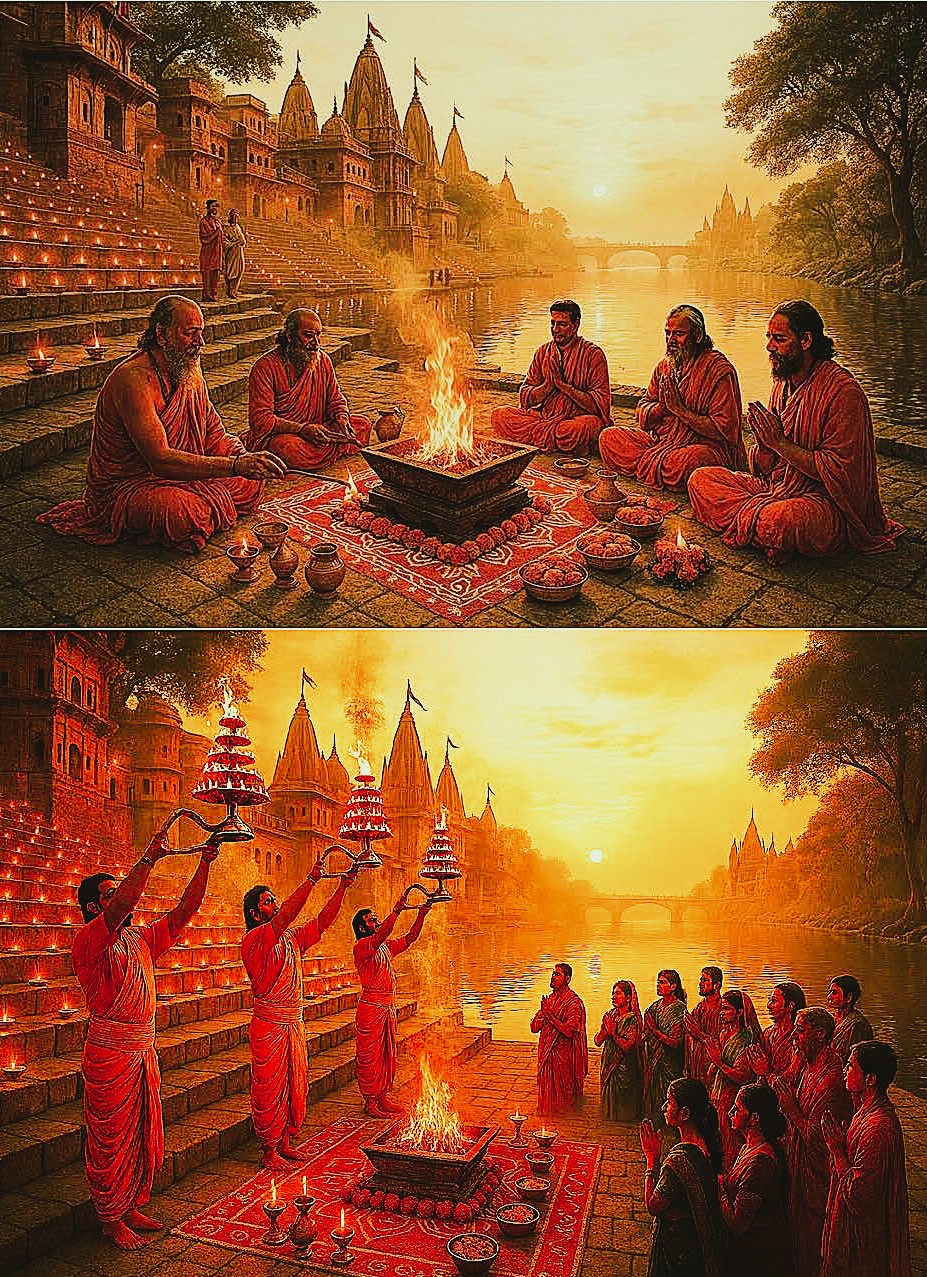
Top Photo: Varanasi Havan Ritual by the Ganges
“On the sacred ghats of Varanasi, the havan ritual unfolds at dawn—a timeless invocation of divine energy through fire. Flames rise from the kund, encircled by marigold garlands and brass vessels filled with ghee and herbs, symbolizing purity and cosmic offering. Maharishis chant Vedic mantras, their oblations sanctifying the space where earth, water, fire, air, and ether converge. The River Ganges, shimmering under the golden light, reflects the eternal dialogue between humanity and the divine.”
Photo Bottom: Varanasi Ganga Aarti Ceremony
“As the sun ascends over the Ganges, the ghats of Varanasi glow with rows of oil lamps, heralding the grandeur of the Ganga Aarti. Priests elevate multi-tiered lamps ablaze with sacred fire, their synchronized movements embodying devotion and cosmic rhythm. Incense smoke mingles with the morning mist, while devotees stand in reverent silence, hands folded in prayer. This ritual, steeped in symbolism, venerates the river as a living goddess, source of life, liberation, and spiritual transcendence.”
Original Photographs Conceptualised by Mrs V. Vawda January 2026
Hermeneutics: A Comprehensive Yet Simple Definition
At its core, hermeneutics is the theory and practice of interpretation. It answers the question: “How do we derive meaning from something that is not immediately clear?”
To make this concrete for the readers, one can break it down using a simple, powerful analogy:
“Hermeneutics is to texts what a translator is to languages.”
A translator does more than swap words; they bridge cultures, convey tone, and make meaning accessible. Similarly, hermeneutics is not just reading words on a page. It is the disciplined process of bridging the gap between a text (or any meaningful object) created in one context and a reader living in another.
The Three Essential Gaps Hermeneutics Seeks to Bridge[8]
To be comprehensive, we can explain that this “gap” has three key dimensions, which are especially critical for religious scripture:
| Gap | Explanation | Example in Religious Scripture |
| 1. The Linguistic and Historical Gap | The words, idioms, and worldviews of an ancient text are foreign to a modern reader. | Understanding what “an eye for an eye” meant in a Bronze Age legal code versus how it is understood today. |
| 2. The Cultural and Experiential Gap | The text addresses realities (e.g., agrarian life, monarchy) and assumptions its original audience took for granted. | Interpreting parables about sowing seeds or shepherding in an urban, digital society. |
| 3.The Existential and Applicative Gap | The deepest question: “What does this text mean for me, for us, today?” | Determining how a scriptural command or teaching applies to modern issues like artificial intelligence, gender equality, or ecological ethics. |
Putting It All Together: A Complete Definition
These points could be synthesized into a formal definition to introduce the topic.
“Hermeneutics is the structured discipline of interpretation. It provides the principles and methods for understanding texts, especially those considered authoritative or sacred. Its primary task is to mediate between the world of the text, shaped by its ancient language, history, and culture, and the world of the reader, who seeks relevance, guidance, and meaning in a contemporary context. In religious traditions, hermeneutics is the vital, often contested, process that keeps ancient scripture a living voice rather than a historical artifact.”
This definition establishes hermeneutics as necessary (the gaps exist), structured (it’s a discipline, not just opinion), and consequential (it determines how faith engages with modern life).
By framing it accordingly, the author, immediately show the readers why hermeneutics is the critical, and often contentious, heart of religious life in the modern world, perfectly setting the stage for your analysis of the “bimodal distribution” between traditional and modern interpretations.
The individual widely considered the “Father of Modern Hermeneutics” is Friedrich Daniel Ernst Schleiermacher, a German theologian and philosopher of the late 18th and early 19th centuries.
The Founder: Schleiermacher
Schleiermacher (1768–1834) transformed hermeneutics from a set of technical rules for interpreting specific texts (especially the Bible) into a universal philosophical discipline concerned with the very nature of understanding.
His key motivations and innovations were:
- Universal Scope: He argued that hermeneutics was not just for sacred or legal texts but applied to all forms of linguistic communication. Its goal was to systematically avoid misunderstanding in any discourse.
- The Hermeneutic Circle: He formalized the idea that understanding a text involves a circular movement between its parts and the whole. You understand the whole from the parts, and the parts from the whole.
- Psychological Interpretation: Beyond analyzing grammar and history, Schleiermacher introduced the task of understanding the author’s unique thoughts and inner world. This shifted focus toward the creative act behind the text.
Origins Before Schleiermacher
The practice and term existed long before Schleiermacher gave it a systematic theory.
| Period | Key Development |
| Ancient Greece | The term originates from the Greek hermēneuein (to interpret). It was philosophically engaged by Aristotle in his work Peri Hermeneias (On Interpretation). |
| Medieval to Reformation | The primary focus was biblical exegesis. Interpreters like Augustine established multi-layered methods (literal, moral, allegorical, anagogical). The Protestant Reformation emphasized the text’s “plain meaning” and personal interpretation. |
| The Enlightenment (17th-18th C.) | Thinkers sought to develop hermeneutics into a general science of interpretation based on universal rules of reason, applying it to legal and historical texts. |
Etymology and Rationale
The motivation for developing hermeneutics stems from a fundamental human problem: bridging a gap in understanding.
- Etymology: The word derives from the Greek hermēneuein(to interpret, translate, or explain). It is folk-etymologically linked to Hermes, the messenger god who mediated between gods and humans, translating divine messages into a form mortals could grasp. This perfectly symbolizes the hermeneutic task.
- Core Rationale: Hermeneutics arose from the need to interpret things that are not immediately clear or familiar, whether sacred scripture, ancient law, a foreign language, or a complex philosophical work. Its purpose is to translate the unfamiliar, the distant, or the ambiguous into something comprehensible.
Key Takeaway Concepts
The trusts that integrating this historical context will certainly strengthen the readers’ understanding and practical application.
- Schleiermacher as a Pivot Point: He is positioned as the key figure who universalized hermeneutics, making the comparative study between Abrahamic and Dharmic traditions philosophically possible.
- Pre-Modern Foundations: Acknowledge that sophisticated interpretive systems (like Talmudic Midrash[9]or Vedic Mīmāṃsā)[10] existed for millennia. Schleiermacher provided a meta-framework to analyze them all, comprehensively
- The Central Problem: The author has framed the entire paper around the enduring hermeneutic problem Schleiermacher identified: How do we faithfully understand meaning across gaps of time, culture, language, and experience, to effectively put into practice the religious doctrines in our socio-religious lives, in the current era? This is indeed the greatest dilemma of humans, trying on one hand to subscribe to religious edicts and fatwas, and blend it into traditions and lifestyle of modernity. This conflict leads to tremendous Peace Disruption in the community, fracturing the fragile relationships, between cleric and plebians, even further,
The specific case studies, highlighted, are intended to analyze how different traditions navigate the “hermeneutic circle” or balance “grammatical” (textual) and “psychological” (authorial/contextual) interpretation that Schleiermacher outlined. It is relevant to note that how specific Dharmic or Abrahamic hermeneutic principles (like Mīmāṃsā rules or Reformed sola scriptura) can be analysed through this framework. Hermes, a winged messenger in Greek tradition, was a central figure in Greek mythology, and his role is intrinsically linked to the meaning of hermeneutics. The connection goes far beyond a simple name origin; it provides a powerful metaphor for the entire discipline.
Hermes: The Divine Interpreter[11]
Hermes was indeed the winged messenger of the gods, but his functions were multifaceted and precisely why his name lends itself to interpretation theory:
- Messenger and Herald: He carried divine messages and decrees from Mount Olympus to gods, mortals, and even the underworld.
- Translator and Interpreter: This is the most crucial function. Hermes did not just deliver messages verbatim; he had to translate, explain, and mediatethe often-obscure will of the gods into a form that humans could begin to understand.
- God of Boundaries and Transitions: He moved freely between realms (divine/mortal, living/dead), making him the patron of thresholds, commerce, and, intellectually, of crossing from confusion to understanding.
- Trickster and Ambiguity: Hermes was also known for his cunning and for messages that could be deceptive or multilayered. This acknowledges that interpretation is not always straightforward and meaning can be elusive.
From God to Theory: The Metaphorical Bridge[12]
The etymology of “hermeneutics” from hermēneuein (to interpret) is thus folk-etymologically linked to Hermes. This is not a strict linguistic origin but a profound conceptual one that ancient philosophers recognized. The link establishes interpretation as a divine, yet perilous, act.
| Hermes’ Function | Parallel in Hermeneutics |
| Carries a message from a distant, superior source (the gods). | Interprets a text from a distant context (ancient, sacred, or authoritative). |
| Translates and explains the divine will to make it comprehensible. | Bridges the gap in language, culture, and time between the text and the modern reader. |
| Moves between different realms and boundaries. | Mediates between the world of the text and the world of the reader. |
| Deals with messages that can be ambiguous or polysemic. | Acknowledges that texts, especially sacred ones, contain multiple, contested layers of meaning. |
This mythological foundation is not just trivia; it enriches your argument:
- Universalizes the Hermeneutic Task: It shows that the core problem of interpretation—mediating meaning from one sphere to another—was recognized as a fundamental, almost sacred, human challenge from the very beginning of Western thought.
- Highlights the Interpreter’s Responsibility: Just as Hermes had a weighty responsibility to convey messages faithfully, the hermeneutic act carries ethical weight. Misinterpretation is not just an academic error; it can be a form of betrayal of the text’s intended meaning (or divine will).
- Connects to Dharmic Traditions: You can draw a fascinating parallel. In the Dharmic traditions, one could see the role of the guruor the commentator (like Shankara or Ramanuja) as fulfilling a similar “Hermetic” function: mediating the meaning of the revealed śruti (the “heard” scriptures like the Vedas) to the disciple. This creates a beautiful cross-cultural point of connection for your comparative study.
In short, Hermes symbolizes that interpretation is an act of mediation, translation, and crossing boundaries. Your entire paper explores how the Abrahamic and Dharmic traditions have developed their own sophisticated systems to perform this “Hermetic” task in the modern world.
However, the author has alluded to, but not fully explored, how specific figures in Dharmic exegetical traditions (like the ṛṣis or medieval commentators) embody a similar mediating role. Hermeneutics is therefore, a branch of study formulated by antagonists of various religious edits and doctrines, in antiquity, for the elusive freedom that Homo sapiens, sapiens, eternally are in pursuit of and endeavour to seek? This leads to oppression and “fencing” the power of orthodoxy, which religious leaders are hesitant to cede to intellectuals, regarding their theories and proposals as unacceptable and heretical innovations, over historical eras, extending across millennia.
Based on historical evidence, the author cannot conclude that hermeneutics was primarily created by antagonists of religious doctrines for personal freedom. Instead, it was developed to solve the inherent problem of understanding texts considered sacred or authoritative. These texts often existed across gaps of time, culture, and language, necessitating rules for interpretation.
The author has raised another point, however, is insightful: the application of hermeneutics has often led to the conflicts, describe between orthodox authority and innovative intellectuals. The core dynamics can be summarized as follows:
| Dimension | Core Tension |
| Primary Origin | A technical discipline for preserving and accessing the intended meaning of difficult or sacred texts. |
| Inherent Outcome | A site of power struggle, as control over interpretation grants authority over a community’s beliefs, laws, and identity. |
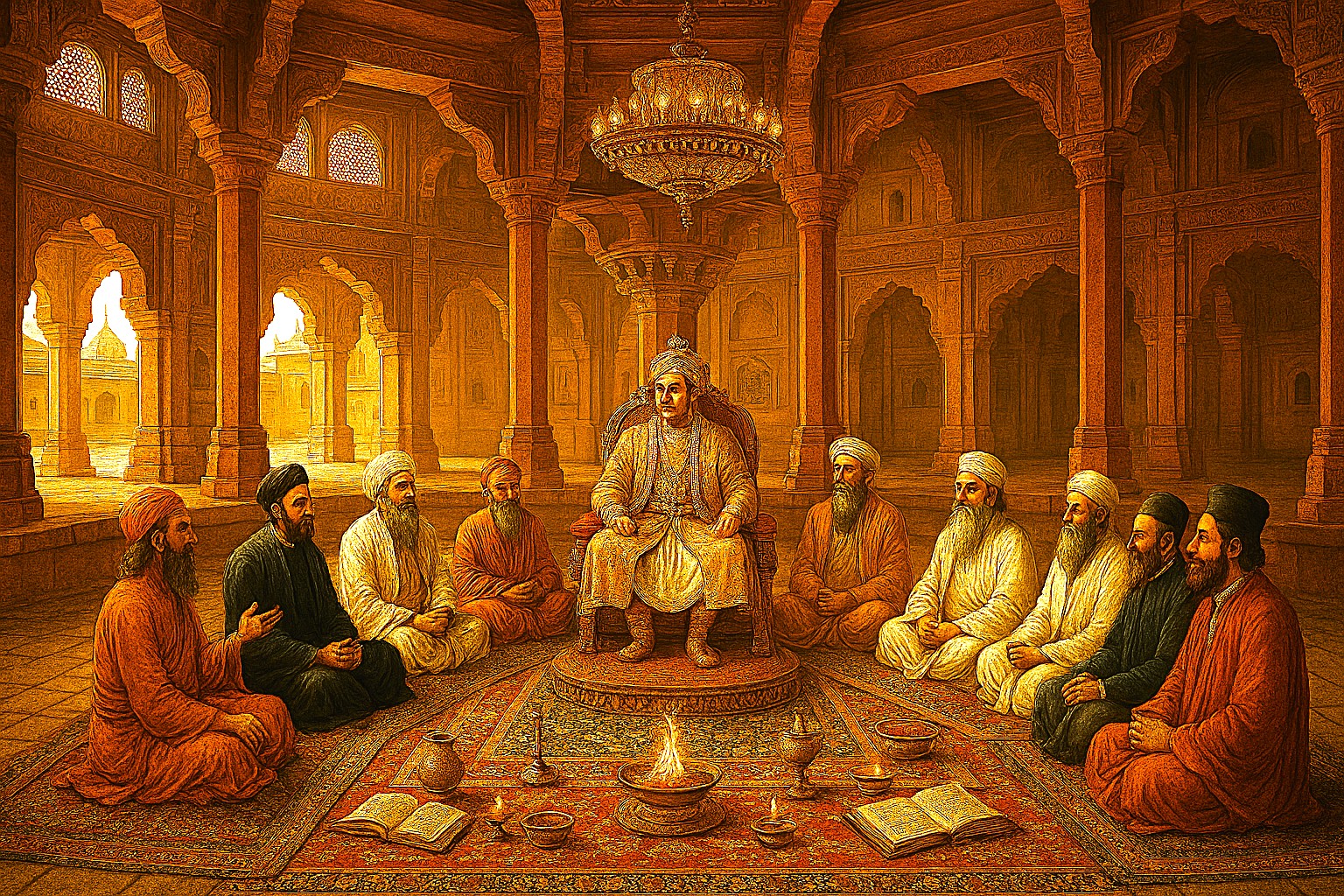
“Akbar’s Ibadat Khana: A Vision of Universal Dialogue, an exemplar of hermeneutics, officially using ministers of different religions in his court”
Original photograph: Conceptualised by Mrs V. Vawda, January 2026
“Within the opulent hall of Fatehpur Sikri, the Mughal Emperor Akbar presides over a gathering that transcends the boundaries of creed and culture. This architectural marvel, adorned with red sandstone arches, intricate jali screens, and a resplendent chandelier,becomes the sanctum of intellectual and spiritual exchange. At its center, Akbar occupies an elevated seat, symbolizing impartial authority and the axis of a wheel whose spokes radiate toward the diverse spiritual luminaries encircling him.
Here, leaders of Dharmic and Abrahamic traditions convene in their distinctive robes, bearing sacred texts and ritual objects emblematic of their faiths. The circular arrangement reflects Akbar’s profound metaphor: all paths converge at the hub of truth, where dialogue supplants dogma. Persian carpets, geometric motifs, and ceremonial flames evoke the synthesis of aesthetics and metaphysics, while manuscripts and scrolls signify the primacy of reasoned discourse over sectarian rigidity.
This tableau embodies Akbar’s doctrine of Sulh-i-Kul, ‘Peace with All’, a revolutionary ideal that sought harmony through pluralism and hermeneutics. In an age shadowed by orthodoxy, the Ibadat Khana emerged as a beacon of inclusivity, where the emperor’s court became a crucible for comparative theology, ethical inquiry, and the pursuit of universal wisdom. It stands as a timeless precedent for interfaith dialogue, reminding posterity that the grandeur of empire is magnified not by conquest, but by the courage to convene minds in the service of peace.”
The Origins: Necessity, Not Rebellion
Hermeneutics arose as a supportive, not antagonistic, discipline within religious traditions, though many hermeneutics have paid the ultimate penalty of being burnt at the stake, for their views, which were considered heretical at the time. In some religions there is absolutely no manoeuvrability, nor any flexibility in interpreting religious edits and scriptural doctrines, more so in the 21st century.
- Foundational Purpose: The goal was to “discover the truths and values expressed” in scriptures. Rules like the Talmudic middotof Rabbi Ishmael in Judaism or the principles of Vedic Mīmāṃsā were created to faithfully understand and apply divine law (Dharma), not to subvert it.
- Solving a Problem: The need for hermeneutics was recognized within the traditions themselves. The sacred nature of the text introduced an “implicit uncertainty regarding its truth,” a form of “ambiguity” or “irrationality” that required a “rational method of interpretation” to resolve. Its purpose was to bring clarity, harmony and socio-religious cohesion in ant tradition or community, not chaos.
Schleiermacher’s Revolutionary Contribution to Hermeneutics[13]
Religious and Academic Background
Friedrich Daniel Ernst Schleiermacher (1768–1834) was born into a devout Protestant family in Breslau, Prussia. His father was a chaplain in the Reformed Church, and this early environment steeped him in the traditions of Pietism[14], a movement emphasizing personal faith and heartfelt devotion over rigid dogma. Schleiermacher’s formative years were marked by tension between inherited orthodoxy and the emerging rationalist currents of the Enlightenment. Initially educated in Moravian schools, he later enrolled at the University of Halle[15], where he studied theology and philosophy, encountering the works of Kant and the German Idealists.[16] This dual exposure, to religious piety and critical philosophy, shaped his lifelong quest to reconcile faith with reason, devotion with intellectual rigor.
Motivation and Catalyst for Innovation
Schleiermacher’s motivation arose from a profound cultural and intellectual crisis: the fragmentation of meaning in a rapidly modernizing world. The Enlightenment had elevated reason and autonomy, often at the expense of tradition and revelation, while Romanticism sought to recover individuality and inwardness. Schleiermacher perceived that interpretation was no longer a marginal skill for theologians or jurists but a universal necessity in an age of pluralism and historical consciousness. Texts, whether sacred, literary, or philosophical—could no longer be approached with naïve immediacy; they demanded a method capable of bridging temporal, linguistic, and cultural distances.
The catalyst for his hermeneutic revolution was twofold:
- Theological Challenge– Biblical interpretation had become contested terrain, oscillating between rigid literalism and reductive rationalism. Schleiermacher sought a mediating approach that honoured the integrity of scripture while acknowledging historical and linguistic complexity.
- Romantic Philosophy– Immersed in the Romantic movement, Schleiermacher embraced its emphasis on individuality, creativity, and the uniqueness of expression. This inspired his conviction that understanding a text requires entering the author’s inner world, not merely parsing grammatical structures.
Rationale and Core Innovations
Schleiermacher’s rationale was clear: interpretation is not a mechanical application of rules but a dynamic, dialogical process. He advanced several groundbreaking principles:
- Universal Scope of Hermeneutics[17]
Schleiermacher elevated hermeneutics from a specialized technique (e.g., biblical or legal exegesis) to a general theory of understanding, applicable to all forms of discourse. This move globalized hermeneutics as an academic field, influencing theology, philology, law, and eventually philosophy.
- Dual Method: Grammatical and Psychological
He proposed two complementary dimensions:
- Grammatical Interpretation– Analyzing linguistic structures, historical usage, and syntactic coherence.
- Psychological Interpretation– Reconstructing the author’s communicative intention and inner life through empathetic imagination.
- The Hermeneutic Circle
Schleiermacher articulated the principle that understanding oscillates between part and whole: each word gains meaning from the text’s totality, while the whole is grasped through its parts. This circularity is not a flaw but the very logic of interpretation.
- Fusion of Horizons
Though later elaborated by Gadamer, Schleiermacher anticipated the idea that interpretation involves a meeting of perspectives, the historical horizon of the text and the contemporary horizon of the reader.
Global Impact
By systematizing these insights, Schleiermacher laid the foundation for hermeneutics as a discipline of universal relevance, influencing theology, literary criticism, jurisprudence, and eventually continental philosophy. His work catalyzed a lineage that runs through Dilthey, Heidegger, Gadamer, and Ricoeur, ensuring that hermeneutics remains central to the humanities and social sciences worldwide.
Explaining the Hermeneutic Circle in Detail[18]
The hermeneutic circle is a foundational concept in hermeneutics that describes the dynamic and reciprocal relationship between the parts of a text and its whole during interpretation. It is not a literal circle but a metaphor for the iterative process of understanding.
Core Principle
To understand any text (or discourse), one must grasp:
- The Whole: The overall meaning, purpose, and context of the text.
- The Parts: Individual words, sentences, and sections that constitute the text.
However, these two dimensions are interdependent:
- The meaning of each partcan only be fully understood in light of the whole.
- The meaning of the wholeemerges through the interpretation of its parts.
This creates a circular movement:
From parts → to whole → back to parts, refining understanding at each step.
Why Is It Important?
The hermeneutic circle emphasizes that interpretation is not linear. You cannot simply read a text from start to finish and claim complete understanding. Instead, comprehension deepens through repeated engagement:
- Initial reading gives a provisional sense of the whole.
- Detailed analysis of parts (words, syntax, historical context) modifies that sense.
- Revised understanding of the whole reshapes interpretation of parts.
This iterative process continues until the interpreter achieves a coherent and plausible understanding.
Schleiermacher’s Contribution
Schleiermacher formalized this principle as central to hermeneutics:
- He argued that interpretation involves two dimensions:
- Grammatical: Understanding linguistic structures and historical usage.
- Psychological: Reconstructing the author’s intention and inner world.
- Both dimensions operate within the hermeneutic circle, requiring oscillation between micro-level details and macro-level meaning.
Modern Extensions
Later thinkers like Heidegger and Gadamer expanded the concept:
- Heidegger: Applied the circle to existential understanding—our preconceptions shape interpretation, and interpretation reshapes preconceptions.
- Gadamer: Introduced the idea of fusion of horizons, where the interpreter’s historical horizon meets that of the text.
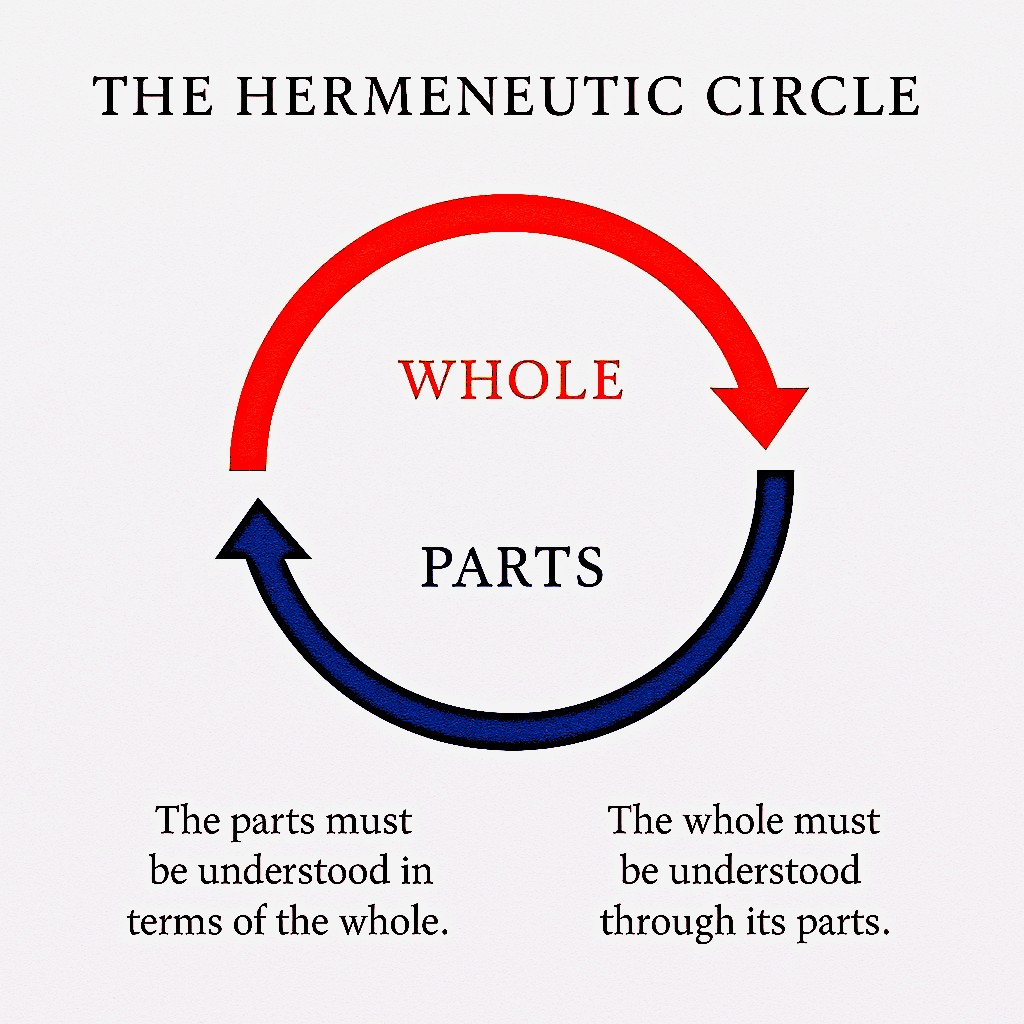
A Diagrammatic Representation of the Hermeneutic Circle, visually representing the reciprocal relationship between the whole and parts.
Original Diagram Conceptualised by Mrs V. Vawda, January 2026
Top Arrow (Whole → Parts): The whole provides context for interpreting individual elements.
Bottom Arrow (Parts → Whole): The parts collectively shape and refine our understanding of the whole.
Explanatory Labels:
“The parts must be understood in terms of the whole.”
“The whole must be understood through its parts.”
This diagram captures the iterative, non-linear nature of interpretation central to hermeneutics.
The Hermeneutic Circle
This diagram illustrates the reciprocal relationship between parts and whole in the interpretive process. The orange arc represents the movement from the whole, the overarching context or meaning, toward the parts, emphasizing that individual elements gain significance within the totality. The blue arc signifies the reverse movement, where the whole is progressively understood through detailed engagement with its parts. The accompanying statements underscore this iterative dynamic:
- “The parts must be understood in terms of the whole.”
- “The whole must be understood through its parts.”
This circularity is not a flaw but the very logic of interpretation, ensuring that understanding deepens through continuous oscillation between detail and totality.
The Evolution of Hermeneutics After Schleiermacher – Dilthey and Heidegger
Wilhelm Dilthey (1833–1911)[19]: Hermeneutics as the Foundation of the Human Sciences
Building on Schleiermacher’s universalization of hermeneutics, Wilhelm Dilthey extended its scope beyond theology and philology to the entire domain of the Geisteswissenschaften (human sciences). Dilthey’s central motivation was methodological: he sought to distinguish the interpretive approach of the humanities from the explanatory model of the natural sciences. Whereas the latter aimed at causal explanation (Erklären), the former pursued understanding (Verstehen), which required entering into the lived experience and historical context of human expressions.
- Catalyst for Dilthey’s Thought
The rise of positivism in the 19th century threatened to reduce all knowledge to empirical observation and causal laws. Dilthey resisted this reduction, arguing that human life is historically situated and cannot be grasped through mechanistic models. Hermeneutics, therefore, became the epistemological foundation for disciplines like history, literature, and philosophy.
- Key Contributions
- Historical Consciousness: Dilthey emphasized that texts and cultural artifacts are embedded in historical life-worlds. Understanding them requires reconstructing these contexts.
- Life-Expression Theory: Every text is an expression of lived experience (Erlebnis), and interpretation involves re-experiencing that life through empathetic imagination.
- Systematization of Hermeneutics: He envisioned hermeneutics as a general methodology for all human sciences, anticipating later debates on historicity and meaning.
Dilthey thus transformed hermeneutics into a historical-philosophical discipline, preparing the ground for existential and phenomenological developments in the 20th century.
Martin Heidegger (1889–1976): Hermeneutics as Ontology[20]
With Martin Heidegger, hermeneutics underwent a radical shift, from a methodological tool for interpreting texts to an ontological inquiry into the nature of understanding itself. In his seminal work Being and Time (1927), Heidegger argued that interpretation is not an optional scholarly technique but a fundamental structure of human existence (Dasein).
- Catalyst for Heidegger’s Innovation
- Heidegger was responding to the limitations of neo-Kantian epistemology and the crisis of meaning in modernity. Influenced by phenomenology (Husserl) and existential philosophy, he reconceived hermeneutics as the way in which being is disclosed through understanding.
- Key Contributions
- Pre-understanding and Fore-structures: Heidegger asserted that all interpretation begins with prior assumptions and anticipations. We never approach a text or phenomenon as a blank slate; our historical and existential situation shapes understanding.
- Hermeneutic Circle Reinterpreted:[21] For Heidegger, the circle is not merely methodological but ontological: it reflects the structure of human existence, which always interprets from within a horizon of meaning.
- Language as the House of Being: Interpretation is grounded in language, which is not a neutral medium but the very space where being is articulated.
- Impact
Heidegger’s transformation of hermeneutics into philosophical hermeneuticspaved the way for Hans-Georg Gadamer’s dialogical theory[22] and Ricoeur’s hermeneutics of suspicion. [23]It also influenced theology, literary theory, and social philosophy, making hermeneutics central to 20th-century thought.
Table: Comparative Overview of Three Foundational Thinkers in Hermeneutics
| Thinker | Historical Context | Motivation and Catalyst | Core Contribution | Key Concepts | Impact |
| Friedrich Schleiermacher (1768–1834) | Post-Enlightenment, Romantic Era | Crisis of meaning between rationalism and faith; need for universal interpretive method | Elevated hermeneutics from specialized technique to general theory of understanding | – Grammatical & Psychological interpretation – Hermeneutic Circle (parts ↔ whole) – Empathetic reconstruction of author’s intention |
Foundation for modern hermeneutics; influenced theology, philology, and literary studies |
| Wilhelm Dilthey (1833–1911) | 19th-century historicism; rise of positivism | Defend humanities against positivist reduction; establish distinct methodology | Positioned hermeneutics as basis of human sciences (Geisteswissenschaften) | – Historical consciousness – Life-expression theory (Erlebnis) – Understanding (Verstehen) vs Explanation (Erklären) |
Systematized hermeneutics for history, literature, and cultural studies |
| Martin Heidegger (1889–1976) | 20th-century existentialism & phenomenology | Overcome epistemological limits; address crisis of meaning in modernity | Transformed hermeneutics into ontology of understanding | – Pre-understanding & fore-structures – Hermeneutic Circle as ontological – Language as “House of Being” |
Paved way for Gadamer, Ricoeur; central to continental philosophy and existential thought |
The Consequence: The Inevitable Hermeneutic Conflict[24]
While created for stability, the act of interpretation inevitably becomes a battleground. The author’s observation about “fencing” power is central to Western religious history.
- Orthodox Control: For centuries, institutions like the medieval Catholic Church maintained authority by controlling the “exclusive and dogmatic interpretation” of scripture. This is a classic example of “fencing” interpretive power and religious orthodoxy.
- The Protestant Challenge: The Reformation was a monumental hermeneutic revolution. Figures like Martin Luther insisted on sola scriptura(scripture alone), arguing that the Bible’s meaning could be derived directly from the text, liberating it from traditional authorities. This directly challenged the orthodox “fence.”
- The Enlightenment Shift: This conflict evolved further when Enlightenment thinkers applied reason to scripture, viewing it partly through historical and social forces rather than purely through divine revelation. This was often seen by religious authorities as an unacceptable, “heretical innovation.”
A Modern Example: Young Earth Creationism
A contemporary example perfectly illustrates this enduring tension:
- The “Plain Reading” (Literalist) Hermeneutic[25]: Asserts that a “plain reading” of Genesis yields a literal, scientific account of creation in six days. This view often equates any deviation with a compromise of biblical authority.
- The “Historical-Cultural” Hermeneutic: Argues that respect for the text requires understanding its ancient Near Eastern context, genre, and authorial intent, which may not be primarily scientific. Proponents see the literalist approach as a modern imposition on an ancient text.
- The Conflict: Each side views its method as the true protector of scriptural authority, while often regarding the other’s conclusions as unacceptable innovations. This creates the exact “bimodal distribution” of followers you previously identified.
In essence, hermeneutics is the inherent and necessary engine of doctrinal development and conflict. It was not born from a desire for freedom from doctrine but from the need to understand it. However, because understanding is never neutral, hermeneutics inevitably becomes the field where the struggle for authoritative meaning, and thus for power within a religious community, is fought. This dynamic of orthodox control versus innovative interpretation manifests in specific Dharmic traditions, such as debates within schools of Vedanta or Buddhism?

Buddhist Riverside Meditation Scene
“A serene riverside courtyard becomes a sanctum of contemplation, where saffron-robed monks gather around a ceremonial altar adorned with flowers, incense, and sacred objects. The calm river mirrors the golden hues of sunrise and the arch of a stone bridge, while drifting cherry blossoms evoke impermanence—a central tenet of Buddhist philosophy. This tranquil tableau embodies the harmony between nature and spiritual practice, inviting the observer into a meditative state of inner stillness.”
Original photograph: Conceptualised by Mrs V. Vawda, January 2026
Epilogue: The Personal Toll of Interpretive War[26]
Beyond the social and theological, the hermeneutical crisis exacts a deep personal cost. Individuals often feel torn between the secure, all-encompassing world of traditional interpretation and the intellectually honest, but sometimes lonely, path of modern inquiry. Families can fracture over these differences. The seeker is left in a precarious position: to choose the comfort of definitive answers or embrace the uncertainty of a faith that must be continually interpreted and owned. This is the human reality behind the academic debate.
Conclusion: The Indispensable Struggle
This analysis demonstrates that the current bimodal distribution in religious hermeneutics is not an aberration but a feature of faith in the modern age. The tension between immutable text and changing context is intrinsic to scriptural religions. While polarizing, this struggle is a sign of vitality, it shows that these traditions are still considered worth fighting over. The critical insight is that no interpretation is neutral; every reading serves a community, an ideology, or a vision of the future. The task for scholars and believers alike is to recognize this, to map the hermeneutical choices being made, and to understand their profound consequences.
Take-Home Message for the General Community
- For Religious Leaders and Educators: Acknowledge the spectrum of belief within your communities. Foster safe spaces for questioning and discussion that honor tradition while engaging modernity seriously. Teach hermeneutical principles—not just doctrinal conclusions.
- For Policymakers and Civil Society: Recognize that “religion” is not a monolith. Engage with both traditional and reformist voices within communities. Policies must navigate carefully between respecting religious freedom and upholding universal human rights, especially where traditional interpretations may conflict with them.
- For Individuals in Faith Communities: Cultivate hermeneutical humility. Recognize that your reading is one among many. Engage with the “other” within your own tradition. Seek understanding before condemnation, whether you lean toward traditional or modern interpretations.
Bottom Line
The future of Abrahamic and Dharmic religions will be determined not by the discovery of new scriptures, but by the reinterpretation of old ones. Hermeneutics is the battlefield where the soul of these traditions is being contested.
The Future: Doctrine and Hermeneutics in the 21st Century
The relationship between doctrinal edicts and hermeneutics in this century will be defined by three key dynamics:
- The Rise of the Non-Affiliated Hermeneutic:[27] Growing numbers, disillusioned by institutional polarization, will practice “unbundled” religion—cherry-picking interpretations and practices across traditions based on personal spirituality and ethics, further challenging centralized authority.
- Technology as a New Interpretative Layer:[28] Artificial intelligence will be used to mine scriptures for new patterns, while social media will create global, decentralized interpretative communities that bypass traditional religious authorities, accelerating both reform and fundamentalism.
- The Ecological Imperative:[29] Climate change and ecological crisis will become a major, perhaps the major, driver of new hermeneutics. Scriptures will be systematically re-read through a “green” lens, generating new eco-theologies that could become a rare point of convergence between traditional and modern interpreters, based on shared concepts of stewardship (khalifah in Islam[30], tikun olam in Judaism[31]) and reverence for creation.
In short, the 21st century will not see the end of hermeneutics but its democratization, diversification, and intensification. The task for the faithful and the scholar is to navigate this complex landscape with both critical insight and compassionate understanding, highlighting contextual Hermeneutics for the 21st century. In an era defined by rapid social transformation and global interconnectedness, the interpretation of sacred texts must remain anchored in their divine essence while embracing the tools of hermeneutics to illuminate their relevance for contemporary life. Scriptural edits, scholarly fatwas, and doctrinal clarifications are not intended to dilute or distort the sanctity of revelation; rather, they serve as interpretive bridges, ensuring that eternal truths resonate within the ethical, cultural, and technological realities of the present age.
The purpose of these interpretive efforts is to complement, not compete with, the original scriptures. By contextualizing principles of justice, compassion, and human dignity, hermeneutics enables faith traditions to speak with clarity and wisdom to modern challenges, whether in governance, social equity, or interfaith coexistence. Such dynamic engagement safeguards against rigid literalism and fosters a spirit of dialogue, tolerance, and mutual respect.
When guided by scholarship and sincerity, these processes uphold the integrity of sacred texts while nurturing a cohesive society where diversity is not a threat but a testament to divine plurality. In this way, the 21st century can witness a renaissance of spiritual thought, rooted in tradition, not dogmatism, nor belligerism, but fully cognizant and responsive to the moral imperatives of peace and universal harmony.[32]
Comments and discussion are invited by e-mail: vawda@ukzn.ac.za
Global: + 27 82 291 4546
References:
[1] Personal Quote by author, January 2026
[2] Personal Quote by author, January 2026
[3] https://www.bing.com/ck/a?!&&p=bd34354a51f3058c88652181f89365f068912af3e0b6c66f3a93d082ca5956caJmltdHM9MTc2NzkxNjgwMA&ptn=3&ver=2&hsh=4&fclid=37940f5c-820f-62a2-14ab-19c283916323&psq=Hermes%2c+the+Messenger+God&u=a1aHR0cHM6Ly9lbi53aWtpcGVkaWEub3JnL3dpa2kvSGVybWVz
[4] https://www.bing.com/ck/a?!&&p=c86b7a4235bbeb3a226f4d7531a9211ecaab0cb3a12529818a0199fbc533800cJmltdHM9MTc2NzkxNjgwMA&ptn=3&ver=2&hsh=4&fclid=37940f5c-820f-62a2-14ab-19c283916323&psq=Hermes%2c+the+Messenger+God&u=a1aHR0cHM6Ly93d3cuZ3JlZWtteXRob2xvZ3kuY29tL09seW1waWFucy9IZXJtZXMvaGVybWVzLmh0bWw
[5] https://www.bing.com/ck/a?!&&p=68fdf8e1eeb1de2f29ad58340de4aec94e673d6ca460a74ffdc4fd1f1f5cefadJmltdHM9MTc2NzkxNjgwMA&ptn=3&ver=2&hsh=4&fclid=37940f5c-820f-62a2-14ab-19c283916323&psq=chiaroscuro+definition&u=a1aHR0cHM6Ly9lbi53aWtpcGVkaWEub3JnL3dpa2kvQ2hpYXJvc2N1cm8
[6] https://www.bing.com/ck/a?!&&p=774d02c4a27947f8d27306258d49712d49cecd38c3c99cbbbbea26ee233257bbJmltdHM9MTc2NzkxNjgwMA&ptn=3&ver=2&hsh=4&fclid=37940f5c-820f-62a2-14ab-19c283916323&psq=friedrich+schleiermacher+hermeneutics&u=a1aHR0cHM6Ly9lbi53aWtpcGVkaWEub3JnL3dpa2kvRnJpZWRyaWNoX1NjaGxlaWVybWFjaGVy
[7] https://www.bing.com/ck/a?!&&p=e930818dfae3449a45cfe3dfb1007300e03019baa4732ac28883a8e113769fb2JmltdHM9MTc2NzkxNjgwMA&ptn=3&ver=2&hsh=4&fclid=37940f5c-820f-62a2-14ab-19c283916323&u=a1L3ZpZGVvcy9zZWFyY2g_cT1DaGlhcm9zY3VybythbmQrVGVjaG5pY29sb3IrUGFsZXR0ZSZxcHZ0PUNoaWFyb3NjdXJvK2FuZCtUZWNobmljb2xvcitQYWxldHRlJkZPUk09VkRSRQ
[8] https://www.bing.com/ck/a?!&&p=fe42ebbe5a3883c22566ecbf3ed1ba44c00c5b8a7192cee2067a3d66fb6822d8JmltdHM9MTc2NzkxNjgwMA&ptn=3&ver=2&hsh=4&fclid=37940f5c-820f-62a2-14ab-19c283916323&psq=the+three+essential+gaps+hermeneutics+seeks+to+bridge&u=a1aHR0cHM6Ly9waGlsb3NvcGh5Lmluc3RpdHV0ZS9lcGlzdGVtb2xvZ3kvaGVybWVuZXV0aWNhbC1hbmFseXNpcy1jb3JlLWNvbXBvbmVudHMv
[9] https://www.bing.com/ck/a?!&&p=e183b4f13d4b41e3aaddeb080985c908f3e40607e1e97a9d445bc719eca2022eJmltdHM9MTc2NzkxNjgwMA&ptn=3&ver=2&hsh=4&fclid=37940f5c-820f-62a2-14ab-19c283916323&u=a1aHR0cHM6Ly9lbi53aWtpcGVkaWEub3JnL3dpa2kvTWlkcmFzaA&ntb=1
[10] https://www.bing.com/ck/a?!&&p=1738df2737b452c88b5a690aa4e533eeb16ac6173a81032ec8eaf1a1919af2a0JmltdHM9MTc2NzkxNjgwMA&ptn=3&ver=2&hsh=4&fclid=37940f5c-820f-62a2-14ab-19c283916323&u=a1aHR0cHM6Ly9lbi53aWtpcGVkaWEub3JnL3dpa2kvTSVDNCVBQm0lQzQlODElRTElQjklODNzJUM0JTgx&ntb=1
[11] https://www.bing.com/ck/a?!&&p=69b58c83dbc816efaceb151ebdcb066578bcdc9ba77650dabd8c1b0ab5aa549aJmltdHM9MTc2NzkxNjgwMA&ptn=3&ver=2&hsh=4&fclid=37940f5c-820f-62a2-14ab-19c283916323&psq=hermes%3a+the+divine+interpreter&u=a1aHR0cHM6Ly93d3cuZ3JlZWt0dXRvcmluZ2h1Yi5jb20vaGVybWVzLXRoZS1tZXNzZW5nZXItb2YtZ3JlZWstZ29kcw
[12] https://www.bing.com/ck/a?!&&p=d69d2e5071135b62a1ae725bbde081b50b31cdc3ec479557e46acf6e948e9e45JmltdHM9MTc2NzkxNjgwMA&ptn=3&ver=2&hsh=4&fclid=37940f5c-820f-62a2-14ab-19c283916323&u=a1aHR0cHM6Ly9zY2llbG8ub3JnLnphL3NjaWVsby5waHA_c2NyaXB0PXNjaV9hcnR0ZXh0JnBpZD1TMDI1OS05NDIyMjAwOTAwMDEwMDAzOQ&ntb=1
[13] https://www.bing.com/ck/a?!&&p=7760ade8e52a11cd90a5cebac289afc87525d3926ed0380a07df8934755dc9daJmltdHM9MTc2NzkxNjgwMA&ptn=3&ver=2&hsh=4&fclid=37940f5c-820f-62a2-14ab-19c283916323&psq=schleiermacher%e2%80%99s+revolutionary+contribution+to+hermeneutics&u=a1aHR0cHM6Ly93d3cuanN0b3Iub3JnL3N0YWJsZS8yNzkwMjQ3MQ
[14] https://www.bing.com/ck/a?!&&p=4687a266fa837802d3dbc9e3fa846604aebcc8e95ba7956d13601b1e04923144JmltdHM9MTc2NzkxNjgwMA&ptn=3&ver=2&hsh=4&fclid=37940f5c-820f-62a2-14ab-19c283916323&psq=pietism+definition&u=a1aHR0cHM6Ly9lbi53aWtpcGVkaWEub3JnL3dpa2kvUGlldGlzbQ
[15] https://www.bing.com/ck/a?!&&p=b879eb18b849a873160fda21dfd4344bee0ad7609e388a6cc2ab432dc55f9439JmltdHM9MTc2NzkxNjgwMA&ptn=3&ver=2&hsh=4&fclid=37940f5c-820f-62a2-14ab-19c283916323&u=a1aHR0cHM6Ly93d3cuYmluZy5jb20vYWxpbmsvbGluaz91cmw9aHR0cHMlM2ElMmYlMmZ3d3cudW5pLWhhbGxlLmRlJTJmJnNvdXJjZT1zZXJwLWxvY2FsJmg9WHo3TmJLU3FmNUpiMnRoUDhaRnJPN1VhRXVyTnloSnZRTVdhR1FCbDg3MCUzZCZwPWx3X21hZ3NtbHQmaWc9REJDODQwNkQyNDM5NEMzMEEyQTkyRjdFRjBBNTc2NDUmeXBpZD1ZTjY3NDB4MjQzOTc1ODk5
[16] https://www.bing.com/ck/a?!&&p=3c5690999ac30561761b060f7187346962405525a75c1ad44b464d650d5fc931JmltdHM9MTc2NzkxNjgwMA&ptn=3&ver=2&hsh=4&fclid=37940f5c-820f-62a2-14ab-19c283916323&u=a1aHR0cHM6Ly9lbi53aWtpcGVkaWEub3JnL3dpa2kvR2VybWFuX2lkZWFsaXNt&ntb=1
[17] https://www.bing.com/ck/a?!&&p=bfbbaec6773f47d2f3a08852b45f125f683787ce8f8d218a9caabf0198d7e97eJmltdHM9MTc2NzkxNjgwMA&ptn=3&ver=2&hsh=4&fclid=37940f5c-820f-62a2-14ab-19c283916323&psq=Universal+Scope+of+Hermeneutics&u=a1aHR0cHM6Ly9wbGF0by5zdGFuZm9yZC5lZHUvZW50cmllcy9oZXJtZW5ldXRpY3Mv
[18] https://www.bing.com/ck/a?!&&p=184d8f41d7cb2a9f575288d593cdc95df2a8115506f83d9d7d0fdbace55b19acJmltdHM9MTc2NzkxNjgwMA&ptn=3&ver=2&hsh=4&fclid=37940f5c-820f-62a2-14ab-19c283916323&u=a1aHR0cHM6Ly9lbi53aWtpcGVkaWEub3JnL3dpa2kvSGVybWVuZXV0aWNfY2lyY2xl&ntb=1
[19] https://www.bing.com/ck/a?!&&p=a9a209f9b0f9cfaad872d2c39c78a5cd0e4481ba41a676cfbc6caa7fd1c50dcaJmltdHM9MTc2NzkxNjgwMA&ptn=3&ver=2&hsh=4&fclid=37940f5c-820f-62a2-14ab-19c283916323&u=a1aHR0cHM6Ly9lbi53aWtpcGVkaWEub3JnL3dpa2kvV2lsaGVsbV9EaWx0aGV5&ntb=1
[20] https://www.bing.com/ck/a?!&&p=d7a2d91b48454c552a8f186c03174e5589be99bbcdaaf08c44089b235afdf20cJmltdHM9MTc2NzkxNjgwMA&ptn=3&ver=2&hsh=4&fclid=37940f5c-820f-62a2-14ab-19c283916323&psq=Martin+Heidegger+(1889%e2%80%931976)%3a+Hermeneutics+as+Ontology&u=a1aHR0cHM6Ly9ib29rcy5nb29nbGUuY29tL2Jvb2tzL2Fib3V0L09udG9sb2d5Lmh0bWw_aWQ9YmNPalRpU05GWm9D
[21] https://www.bing.com/ck/a?!&&p=f447ee65fd255d315db99a934e87293730657927f66bd8160e310ae793eab866JmltdHM9MTc2NzkxNjgwMA&ptn=3&ver=2&hsh=4&fclid=37940f5c-820f-62a2-14ab-19c283916323&u=a1aHR0cHM6Ly93d3cubnVtYmVyYW5hbHl0aWNzLmNvbS9ibG9nL2hlcm1lbmV1dGljLWNpcmNsZS1ndWlkZQ&ntb=1
[22] https://www.bing.com/ck/a?!&&p=0a17968a2c4fa76672856c00ff9c61632d2697e20e61e48bd9d5a31489f40487JmltdHM9MTc2NzkxNjgwMA&ptn=3&ver=2&hsh=4&fclid=37940f5c-820f-62a2-14ab-19c283916323&psq=hans-georg+gadamer%e2%80%99s+dialogical+theory+pdf&u=a1aHR0cHM6Ly93d3cuZGlhbG9ndWVzdHVkaWVzLm9yZy93cC1jb250ZW50L3VwbG9hZHMvMjAxNS8wNS9Kb3VybmFsX29mX0RpYWxvZ3VlX1N0dWRpZXNfVm9sXzNfTm9fMV9Ib2xkaW5nX09uZXNlbGZfT3Blbl9pbl9hX0NvbnZlcnNhdGlvbl9HYWRhbWVyLXNfUGhpbG9zb3BoaWNhbF9IZXJtZW5ldXRpY3NfYW5kX3RoZV9FdGhpY3Nfb2ZfRGlhbG9ndWUucGRm
[23] https://www.bing.com/ck/a?!&&p=d07b384c40b2cf47e76da37c6aa7f0d6845d20b1ecd0083a3ae3e4327b1a42e7JmltdHM9MTc2NzkxNjgwMA&ptn=3&ver=2&hsh=4&fclid=37940f5c-820f-62a2-14ab-19c283916323&psq=paul+ricoeur+hermeneutics+of+suspicion&u=a1aHR0cHM6Ly9lbi53aWtpcGVkaWEub3JnL3dpa2kvSGVybWVuZXV0aWNzX29mX3N1c3BpY2lvbg
[24] https://www.bing.com/ck/a?!&&p=9bdcd305528f20972f15617cb0254a365a94f2037dafbbc858fa581153c72405JmltdHM9MTc2NzkxNjgwMA&ptn=3&ver=2&hsh=4&fclid=37940f5c-820f-62a2-14ab-19c283916323&u=a1aHR0cHM6Ly9wYS5tb2guZ292LnptL1Jlc291cmNlcy9qZW8zSjkvMjcyMDE1L1RoZUNvbmZsaWN0T2ZJbnRlcnByZXRhdGlvbnNFc3NheXNJbkhlcm1lbmV1dGljcy5wZGY&ntb=1
[25] https://www.bing.com/ck/a?!&&p=15d17a11b8e8e6711b37056f9b3ba2956004bbd5a3757b9256921e6e7967a4e0JmltdHM9MTc2NzkxNjgwMA&ptn=3&ver=2&hsh=4&fclid=37940f5c-820f-62a2-14ab-19c283916323&psq=%22plain+reading%22+(literalist)+hermeneutics&u=a1aHR0cHM6Ly93d3cuYnJpdGFubmljYS5jb20vdG9waWMvbGl0ZXJhbC1pbnRlcnByZXRhdGlvbg
[26] https://www.bing.com/ck/a?!&&p=19074a23b2d3cd21e6152616f8a9c9efd701ff0bd080f712e9fd96e94d2b2210JmltdHM9MTc2NzkxNjgwMA&ptn=3&ver=2&hsh=4&fclid=37940f5c-820f-62a2-14ab-19c283916323&psq=he+Personal+Toll+of+Interpretive+War+in+hermeneutics&u=a1aHR0cHM6Ly9waGlsYXJjaGl2ZS5vcmcvYXJjaGl2ZS9PTUVIVkEtMg
[27] https://www.bing.com/ck/a?!&&p=aa4c1eb07d5faaf8a988a9f510dd89d51f66e37968651180dd15198ca18be3c7JmltdHM9MTc2NzkxNjgwMA&ptn=3&ver=2&hsh=4&fclid=37940f5c-820f-62a2-14ab-19c283916323&psq=hermeneutics+and+criticism+and+other+writings&u=a1aHR0cHM6Ly9ib29rcy5nb29nbGUuY29tL2Jvb2tzL2Fib3V0L1NjaGxlaWVybWFjaGVyX0hlcm1lbmV1dGljc19hbmRfQ3JpdGljaXMuaHRtbD9pZD1sZkR0eHh1NFMxc0M
[28] https://www.bing.com/ck/a?!&&p=ad04717f11c57003e1ad8021701c92ff4f038ae2d66756c415eaa4f9d45cb237JmltdHM9MTc2NzkxNjgwMA&ptn=3&ver=2&hsh=4&fclid=37940f5c-820f-62a2-14ab-19c283916323&psq=Technology+as+a+New+Interpretative+Layer+in+hermeneutics&u=a1aHR0cHM6Ly93d3cub3BlbmJvb2twdWJsaXNoZXJzLmNvbS9ib29rcy8xMC4xMTY0Ny9vYnAuMDQyMy9jaGFwdGVycy8xMC4xMTY0Ny9vYnAuMDQyMy4wNg
[29] https://www.bing.com/ck/a?!&&p=8a44f9290fc9358abfa524edab61b9b37f455d2c86c4a8a969d98c364886b2c3JmltdHM9MTc2NzkxNjgwMA&ptn=3&ver=2&hsh=4&fclid=37940f5c-820f-62a2-14ab-19c283916323&u=a1aHR0cHM6Ly93d3cuc2NpZWxvLm9yZy56YS9wZGYvb3RlL3YzMm4xLzEyLnBkZg&ntb=1
[30] https://www.bing.com/ck/a?!&&p=95f900f2bc0b8daa0557cac0346a9c9b478fba3a2cff24928ed7c8a0c41d81f2JmltdHM9MTc2NzkxNjgwMA&ptn=3&ver=2&hsh=4&fclid=37940f5c-820f-62a2-14ab-19c283916323&psq=khalifah+in+islam&u=a1aHR0cHM6Ly9lbi53aWtpcGVkaWEub3JnL3dpa2kvTGlzdF9vZl9jYWxpcGhz
[31] https://www.bing.com/ck/a?!&&p=c5397e8990087e3cdb1a58ff096e3f01ced5277effb74e6031fba8d01eb46df7JmltdHM9MTc2NzkxNjgwMA&ptn=3&ver=2&hsh=4&fclid=37940f5c-820f-62a2-14ab-19c283916323&psq=tikkun+olam+judaism&u=a1aHR0cHM6Ly93d3cuY2hhYmFkLm9yZy9saWJyYXJ5L2FydGljbGVfY2RvL2FpZC8zNzAwMjc1L2pld2lzaC9XaGF0LUlzLVRpa2t1bi1PbGFtLmh0bQ
[32] https://www.bing.com/ck/a?!&&p=40bb57fb6e7daf66191046f7befe372f0c471cb6e044f17d8062f8b90bf3ed99JmltdHM9MTc2NzkxNjgwMA&ptn=3&ver=2&hsh=4&fclid=37940f5c-820f-62a2-14ab-19c283916323&psq=moral+imperatives+of+peace+and+universal+harmony.&u=a1aHR0cHM6Ly9yanBuLm9yZy9pam50aS9wYXBlcnMvSUpOVEkyNTExMDE5LnBkZg
______________________________________________
Professor G. Hoosen M. Vawda (Bsc; MBChB; PhD.Wits) is a member of the TRANSCEND Network for Peace Development Environment.
Director: Glastonbury Medical Research Centre; Community Health and Indigent Programme Services; Body Donor Foundation SA.
Principal Investigator: Multinational Clinical Trials
Consultant: Medical and General Research Ethics; Internal Medicine and Clinical Psychiatry:UKZN, Nelson R. Mandela School of Medicine
Executive Member: Inter Religious Council KZN SA
Public Liaison: Medical Misadventures
Activism: Justice for All
Email: vawda@ukzn.ac.za
Tags: Abrahamic Religions, Bimodal, Dharmic, Hermeneutics, Peaceful
This article originally appeared on Transcend Media Service (TMS) on 12 Jan 2026.
Anticopyright: Editorials and articles originated on TMS may be freely reprinted, disseminated, translated and used as background material, provided an acknowledgement and link to the source, TMS: The War for the Elusive Word of Peace: A Search for Common Ground in Abrahamic and Dharmic Hermeneutics (Part 1), is included. Thank you.
If you enjoyed this article, please donate to TMS to join the growing list of TMS Supporters.

This work is licensed under a CC BY-NC 4.0 License.
Join the discussion!
We welcome debate and dissent, but personal — ad hominem — attacks (on authors, other users or any individual), abuse and defamatory language will not be tolerated. Nor will we tolerate attempts to deliberately disrupt discussions. We aim to maintain an inviting space to focus on intelligent interactions and debates.