


From Possession to Presence, From Posture to Pilgrimage: A Trans Tradition Framework for Endogenous and Exogenous Peace Part 1
TRANSCEND MEMBERS, 16 Feb 2026
Prof Hoosen Vawda – TRANSCEND Media Service
Collectively, peace texts have implications for Moral Economy and Public Culture, as these texts articulate a counter‑economy of contentment in which value is measured by integrity, sufficiency, and relational harmony rather than accumulation and status comparison. They challenge consumerist identity formation and status competition, while commending gratitude, restraint, stewardship, and accountability as foundations of a humane order.[1]
This publication is suitable for general readership. Parental guidance is recommended for minors who may use this research paper, as a resource material, for projects.
The author unconditionally apologises for any misrepresentation of the religio-social impressions expressed in this publication, while promoting global peace propagation, a voice against belligerism, hypocrisy, obfuscation and misrepresentation of tenets, within all of humanity.[2]

The Parthenon of Peace: A conceptual 3D model depicting the Dharmically Enriched, Four Pillars of Endogenous and Exogenous Peace.
This framework situates Humanity as the foundational substrate upon which all peace architectures must rest. The four central pillars, Knowledge, Cultivation, Upholding, and Disclosure, represent the essential moral‑cognitive functions required to sustain both internal (endogenous) and societal (exogenous) peace. The entablature is crowned by a universal Interfaith Roof of Peace, incorporating symbolic expressions from major world religions to reflect the shared ethical aspirations for harmony across spiritual traditions. Inspired by classical Greek architectural ideals of proportion, balance, and teleological purpose, this model illustrates how peace is upheld not by a single discipline or doctrine, but through an integrated, pluralistic, and humanity‑centred philosophy. It is important to note that any peace disruptive activity at the level of the foundational base, is equivalent to social seismic activity and will result in total collapse of the tenets of peace, as well as the entire framework.
Original Photograph Conceptualised by Mrs V. Vawda, February 2026
Prologue
The author has written extensively about Endogenous[3] and Exogenous Peace[4] as well as proposed new theories about propagative peace.[5],[6],[7], [8], [9] This research paper is Part 1 in the series, which reviews peace propagation from antiquity to modernity and compares the concept of peace across different religious traditions, as well as offer solutions to peace disruptions at an endogenous level, in terms of personal peace, followed on by community peace climaxing in global peace which is the ultimate challenge humanity is faced in the 21st century, with global belligerism [10] across continents, by peace disrupting governments, in recent months. It is the aim of the author to highlight political hypocrisy and misinformation based on personal agenda of various heads of states in a fractured world and tyrannical regimes, spearheading genocidal ventures aimed at annihilating elected and targeted regional citizenry by systematically murdering this oppressed humanity.
The tragedy is that internal bodies formed as custodians of human dignity, morality and ethics, have become toothless alligators, which are complicit in the dehumanisation of targeted groupings at the covert behest of powerful and murderous governments, globally. It is therefore the intent and motivation of this publication, in two parts, to highlight the present, global status quo as well as propose remedial and redemptive solutions for a safer human existence and nurture the future global leaders, in a solid background of ethics of sovereignty and moral conduct.
While this is an ambitious project by the author, as a Peace Protagonists,[11] hindered by various internal elements from certain supposed peace promoting organisation, who are infiltrated by agents of peace disruption, under the guise of promoting peace, but are, in reality, the existential and dangerous threat within, to peace promotion, from the hallowed precincts of these supposed peace loving organisations. This strategic plan is aided by a concerted campaign by media with personal agenda disseminating misinformation and disinformation to achieve their long-term goals, at the expense of humanity and gross peace disturbance. The author also highlights two key elements in peace disruption:
- The “Relentless pursuit of materialism”:[12] This phrase refers to a mindset or behaviour in which accumulating wealth, possessions, and status becomes the dominant goal of life, often at the expense of relationships, ethics, inner peace, or spiritual growth.
- “It is easy to pontificate from a position of security”: This expression means:
People who are safe, privileged, or comfortable often make moral judgments, give advice, or speak confidently about struggles they themselves do not face. Their distance from hardship makes their commentary superficial or insensitive.
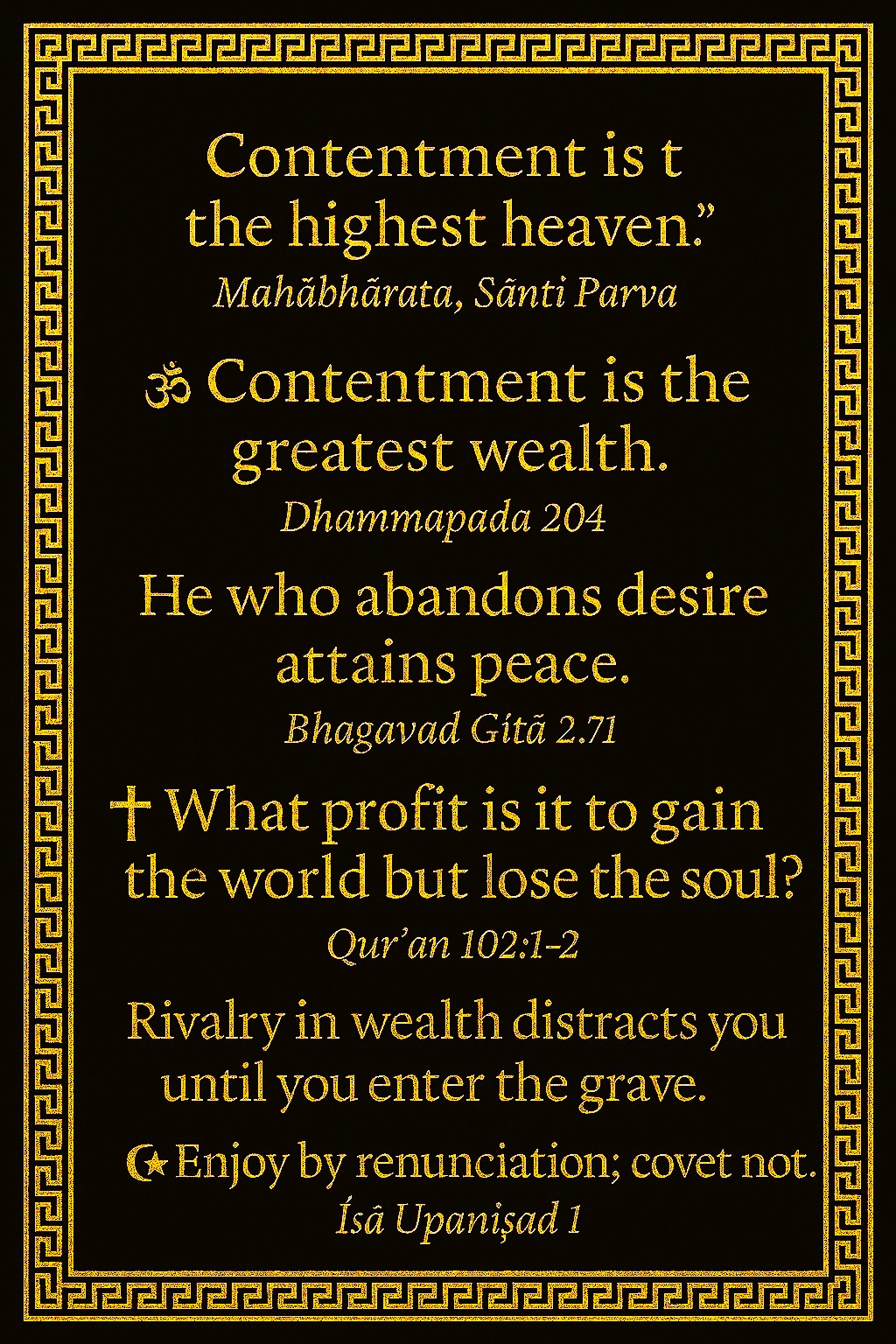
Interfaith Dharmic Meditations on Contentment, Renunciation, and the Moral Architecture of Peace.
This poster brings together a deliberately curated constellation of scriptural teachings from Hindu, Buddhist, Christian, Islamic, and Upanishadic traditions to illuminate a shared ethical insight at the heart of humanity’s major wisdom lineages: the attainment of inner peace arises not through accumulation or worldly striving, but through contentment, restraint, and the disciplined renunciation of desire. The selected passages, from the Mahābhārata’s Śānti Parva, the Dhammapada, the Bhagavad Gītā, the Gospel of Mark, Sūrat al‑Takāthur of the Qur’an, and the Īśā Upaniṣad, each articulate, in distinct theological vocabularies, a unifying claim that spiritual clarity and moral wholeness emerge when individuals transcend acquisitiveness and orient themselves toward a higher ethical horizon.
The poster’s visual design reinforces this intellectual synthesis. Rendered in a luminous gold‑on‑black colour palette and framed by a classical Greek meander border, the artwork invokes Hellenic ideals of balance, symmetry, and contemplative beauty, thereby bridging Mediterranean philosophical aesthetics with Asian and Abrahamic scriptural wisdom. This stylistic convergence symbolises the universal human quest for meaning beyond materiality, while the bold typographic treatment grants each teaching equal prominence, avoiding hierarchy among traditions and promoting a dialogical ethos rooted in mutual respect.
By juxtaposing these sacred aphorisms within a single, coherent visual tableau, the poster invites readers to recognise the cross‑civilisational resonance of contentment as both an ethical virtue and a psychological state conducive to peace. Collectively, these teachings frame contentment (santosha, santuṣṭi, qanā‘ah) not as passive acceptance but as an active discipline that liberates individuals from the destabilising forces of desire, rivalry, and egoic pursuit. In doing so, the poster contributes to contemporary peace epistemology by illustrating how diverse scriptural traditions converge on a shared moral anthropology in which peace is cultivated inwardly before it can be realised externally.
Original Photograph Conceptualised by Mrs V. Vawda February 2026
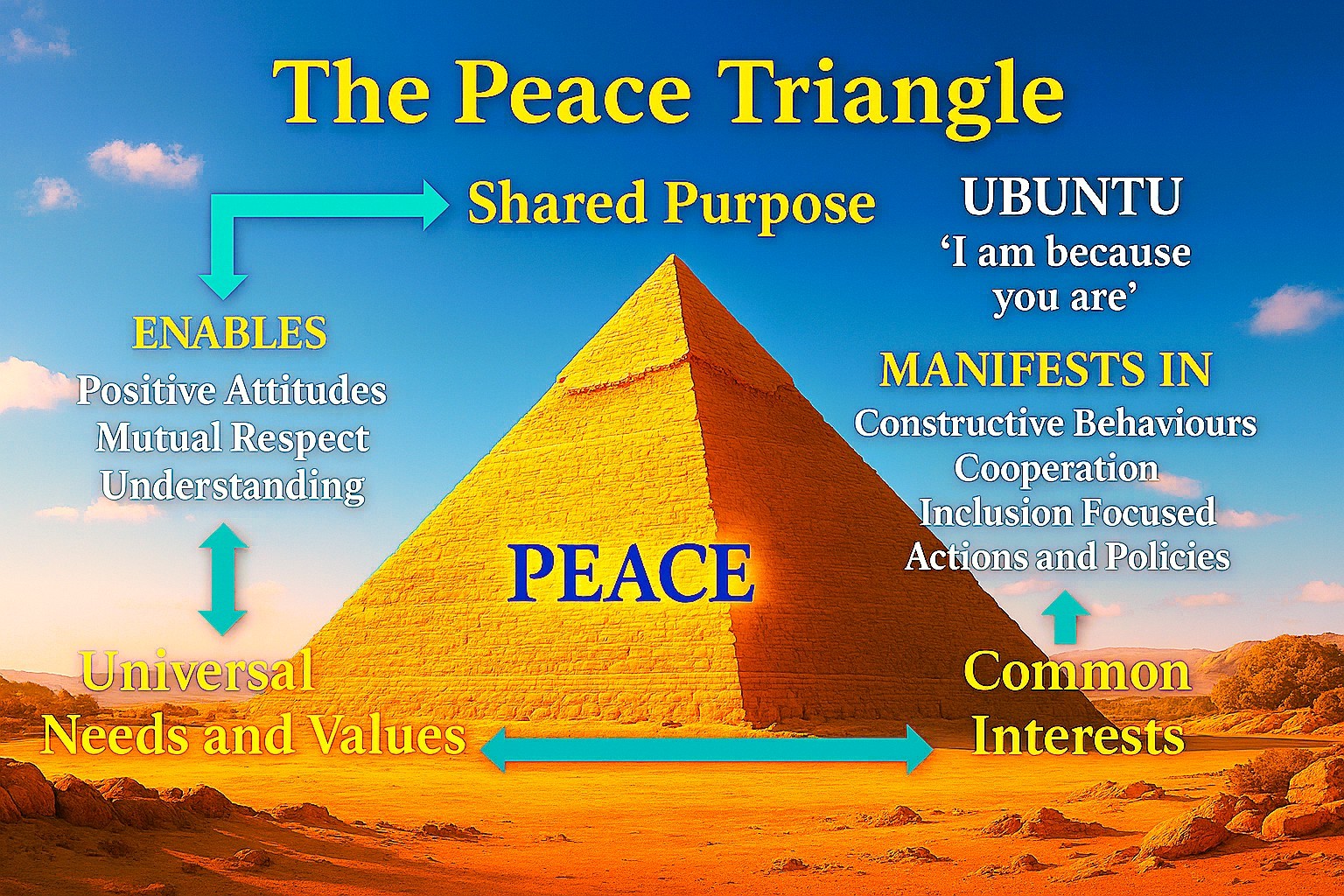
A trans‑civilizational marriage of Egyptian antiquity, with African humanism and contemporary peace theory. The modern remaster evokes monumental scale, radiant vibrancy, moral gravity, and cinematic awe. The enhanced Peace Triangle now carries that same sense of epic visual storytelling. The Peace Triangle, A biophotonic meditation on the duality of peace: the endogenous light of inner harmony illuminating the Giza geometry (Khufu’s pyramid, c. 2600 BCE), and the exogenous horizon of community, societal, and global concord shaped by Ubuntu—“I am because you are.” [en.wikipedia.org], [britannica.com]
This graphic will be alluded to further, in Part 2 of this series. Of particular import is the comparison to Galtung’s Peace Triangle.
Original Photograph Conceptualised by Mrs V. Vawda, February 2026
1) Contentment as Highest Good (Mahābhārata, Śānti Parva) vs. Contentment as Greatest Wealth (Dhammapada 204)
Both statements elevate contentment from a private sentiment to a cardinal good.
- In the Śānti Parva, contentment is “the highest heaven,” implying a teleological horizon: peace (śānti) is not merely instrumental but ends‑based, a consummation of human flourishing ordered to dharma. The metaphysical register is cosmic: contentment harmonizes the person with ṛta (moral-cosmic order).
- In Dhammapada 204, contentment is “the greatest wealth,” shifting the register to moral psychology and existential economics. Here, wealth is redefined as non‑lack; liberation from craving (taṇhā) yields a sufficiency that no external accumulation can replicate.
Convergence: Both de‑materialize value.
Difference: The Śānti Parva emphasizes ultimate beatitude (heaven); the Dhammapada emphasizes present liberation from craving as true possession.
2) Desire and Peace: Bhagavad Gītā 2.71 (“He who abandons desire attains peace”)[13]
The Gītā situates peace in the discipline of desire within a theistic framework of duty (svadharma) and steady insight (sthita‑prajña). Abandonment here is not nihilistic erasure but non‑attachment (vairāgya), desire’s governance rather than its denial of all action. This harmonizes with the Dhammapada’s therapy of craving, yet the Gītā maintains relational devotion (bhakti) and righteous action (karma‑yoga).
Bridge: Peace is attained not by passivity, but by rightly ordered intention: act without clinging to the fruits. This nuance allows compatibility with civic responsibility and social ethics.
3) The Soul’s Integrity vs. Worldly Gain: Mark 8:36[14]
“What profit is it to gain the world but lose the soul?” reframes the moral question in soteriological and personalist terms. The human person possesses an inviolable worth that cannot be exchanged for external dominion. Where the Gītā and Dhammapada analyze desire’s dynamics, the Gospel highlights identity and destiny: the soul’s telos in relation to God eclipses any finite gain.
Resonance: All traditions caution against the idolatry of acquisition;
Distinctive note: The Christian articulation centres on the soul’s communion with the divine as the axis of value and the measure of loss.
4) Rivalry and Temporal Myopia: Qur’an 102:1–2 (Sūrat al‑Takāthur)[15]
“Rivalry in wealth distracts you until you enter the grave” diagnoses the social mechanics of desire: not just craving, but competitive comparison (takāthur) colonizes attention. The critique is temporal and eschatological: distraction persists until death interrupts the illusion, implying a call to spiritual wakefulness now.
Convergence: Shares with Mark 8:36 the warning that temporal gains imperil ultimate accountability.
Contribution: Makes rivalry a public‑ethical problem, not only a private passion, thus inviting scrutiny of media narratives, markets, and status systems that normalize competitive excess.
5) “Enjoy by Renunciation; Covet Not”: Īśā Upaniṣad 1[16]
This verse unites ascetic logic and sacramental delight. To “enjoy by renunciation” (often glossed as tena tyaktena bhuñjīthā) suggests that true enjoyment arises when possession is reconfigured as stewardship and non‑appropriation—the world is divine‑suffused and not to be grasped.
Interfaith hinge: It harmonizes with the Dhammapada’s wealth‑as‑contentment while anticipating Mark’s warning (enjoyment without ownership) and the Qur’anic critique of rivalry (delight detached from competition).
Distinctive insight: The Upanishadic stance sacralizes reality, renunciation is not world‑denial, but ego‑denial, restoring communion with the Whole.
Shared Moral Anthropology: From Craving to Communion
Across these teachings, the human problem is named as misdirected desire, craving, rivalry, and instrumentalization of the self. The path to peace is conversion of desire:
- Cognitively (seeing the futility of acquisition as ultimate good),
- Affectively (cultivating contentment and gratitude),
- Ethically (renouncing covetousness and unjust advantage), and
- Spiritually (ordering the self toward God/the Real).
The result is a re‑enchanted moral economy where value is measured by integrity, sufficiency, and relational harmony rather than accumulation.
Distinctive Accents Worth Preserving
- Buddhist: Therapeutic psychology, end suffering by transforming craving; wealth as inner sufficiency.
- Hindu (Gītā / Upaniṣad): Non‑attachment within duty; renunciation as the key to right enjoyment; a metaphysics of unity.
- Christian: Personalist soteriology, the soul’s inviolable dignity and eternal destiny relativize worldly profit.
- Islamic: Social‑ethical vigilance, rivalry as systemic distraction; accountability before God shapes economic and temporal priorities.
These accents are complementary, not contradictory, offering multiple lenses for the same truth: peace is impossible without the re‑education of desire.
Implications for Moral Economy and Public Culture
Taken together, the verses propose a counter‑economy of contentment. They challenge:
- Consumerism (that equates desire with identity),
- Comparative status cultures (that convert persons into competitors), and
- Narratives of limitless growth (that ignore spiritual and ecological limits).
They commend gratitude, sufficiency, stewardship, and accountability as the grammar of a humane order.
Relevance to Solutions‑Based Peace Journalism (SBPJ)
The teachings enunciated by the author, furnish normative criteria for SBPJ:
- De‑centering rivalry: Avoid frames that sensationalize conflict as sport; spotlight cooperation and sufficiency.
- Ethics of disclosure: Expose the systems of desire‑manufacture (advertising, disinformation, performative politics) that fuel rivalry.
- Humanisation: Tell stories that protect the soul’s dignity over metrics of gain.
- Constructive exemplars: Feature practices of renunciation‑as‑joy, mutual aid, restorative justice, ecological stewardship, where communities “enjoy by renunciation.”
Concluding Synthesis
The six verses, read together, trace a philosophical arc:
From the diagnosis of craving and rivalry (Dhammapada; Qur’an),
through the discipline of non‑attachment and righteous action (Gītā),
to the protection of the soul’s integrity (Mark),
within a cosmic‑ethical order that sanctifies renunciation as the gateway to genuine delight (Upaniṣad), culminating in contentment as the highest good (Śānti Parva).
This arc offers a trans‑tradition charter for your Peace Series: re‑educate desire, protect the soul, practice renunciation‑as‑joy, and build a public culture where contentment, not rivalry, is the measure of wealth.
The Bottom Line in Peace Propagation
1) Core Premise
Peace endures where desire is disciplined, speech is humble, and structures expand dignity and capability, shifting societies from possession to presence, and leaders from posture to pilgrimage.
2) First Principles (Endogenous Peace and Exogenous Peace)
- Presence over Possession: contentment and gratitude are the inner soil of peace.
- Witness before Word: proximity, listening, and verification precede advice.
- Justice with Mercy: protect the vulnerable; be impartial, restorative, and fair.
- Duty to the Common Good: act for the welfare of the world; serve beyond self.
- Shared Sacred Ethos: Abrahamic and Dharmic wisdom converge: truth, restraint, compassion, and non‑attachment.
3) Ethical Commitments for Peace Communicators
- No advice without proximity.Go see, listen, and learn before prescribing.
- Gentle, truthful speech.Verify first; avoid ridicule, backbiting, and haste.
- Cost‑bearing counsel.Be ready to share the burden you recommend.
- Humility about uncertainty.Say what you know; admit what you don’t.
- Protect the vulnerable.Do no rhetorical or structural harm.
(The Readers Dictum: P‑G‑C‑H‑P → Proximity, Gentleness, Cost-bearing, Humility, Protection.)
4) Four Pillars → Practical executive Actions[17]
- Discourse Reform – “From Possession to Presence”
- Run an interfaith public narrative: homilies/khutbahs/sermons, school assemblies, radio clips, WhatsApp “truth circles.”
- Use signature lines:
- “The highest cost of materialism is not money, but meaning.”
- “Security without solidarity is opinion without witness.”
- “Wealth is what we share, not what we store.”
- Proximity Leadership – “From Posture to Pilgrimage”
- Reverse consultation:begin with “What does help look like to you?” and listen for 3 minutes without interruption.
- Site‑immersed design:affected people speak first and last in every policy meeting.
- Capability Platforms – “From Scarcity to Sufficiency”
- Launch Micro‑Capabilities Labs: mobile health navigation, youth apprenticeships, women’s cooperatives, digital literacy bridges.
- Focus on expanding real freedoms: to be healthy, to learn, to earn, to have a voice.
- Justice and Safety – “From Negative to Positive Peace”
- Restorative justice hubs(mediation, diversion, survivor support).
- Participatory budgetingwith public dashboards and citizen oversight.
5) 10‑Point Checklist for every Peace Initiative)
- Have we listened locally(multiple voices, especially the least heard)?
- Did those most affected speak first and last?
- Are we verifying claimsbefore amplifying?
- Does the plan lighten a real burdenthis month?
- Is there a cost we are willing to bear(time, money, reputation)?
- How does this increase capabilities(health/learning/livelihood/voice)?
- What is the smallest testable stepwe can do in 30 days?
- How will we measure dignity(empathy, trust, perceived fairness)?
- Who ensures ethical speechand data transparency?
- What is our exit‑to‑ownershippath (moving authority to the community)?
6) 90‑Day Starter Plan (Adaptable anywhere, locally, nationally globally)
- Days 1–30:
- Form an Interfaith and Civic Peace Compact.
- Run 3 listening circles(clinic, school, neighbourhood).
- Launch a Presence over Possessionmicro‑campaign (2 radio clips, 1 WhatsApp truth circle, 1 school assembly).
- Days 31–60:
- Open Micro‑Capabilities Lab #1(health navigation + youth apprenticeships).
- Start Restorative Justice Hubwith mediation volunteers and referral map.
- Train 25 leaders in Reverse Consultation+ Ethical Speech.
- Days 61–90:
- Co‑design a participatory budgetpilot (one ward), publish a simple Peace Dashboard (attitudes, access, mediation outcomes).
- Public showcase: testimonies, early metrics, and next 6‑month roadmap.
7) What We Measure (Peace becomes policy, not poetry)
Endogenous (People and Culture)
- Contentment and empathy indices; ethical speech adherence; volunteer hours; youth purpose/hope.
Exogenous (Systems and Safety)
- Clinic adherence; case mediation closure; PB participation and delivery; school retention; jobs/enterprise starts; reported violence trends.
The Actual Process
- Number of proximate consultations; Percentage affected voices speaking first/last; time to correct rumours; data transparency score.
8) Interfaith Anchors (Teaching and Legitimacy)[18]
- Islam:Rivalry in wealth distracts (Q 102:1–2); verify before acting (Q 49:6); stand for justice (Q 4:135).
- Judaism:“Justice, justice shall you pursue” (Deut 16:20); “Who is rich? One content with his lot” (Avot 4:1).
- Christianity:“What profit to gain the world and lose the soul?” (Mk 8:36); “I was hungry and you fed me” (Mt 25:35–40).
- Hindu Dharma:Desire as fire (Gītā 3.39–43); act without attachment (Gītā 2.47); contentment as highest bliss (Śānti Parva).
- Buddhist Dharma:Contentment is wealth (Dhp 204); conquer anger with love (Dhp 223).
- Sikh Dharma:Humility, seva, and restraint of desire bring peace (Guru Granth Sahib, Ang 26, 585, 1384).
(The author suggests that the Peace Propagator use two anchors per talk: one Abrahamic + one Dharmic, with a local example.)
9) The Vawda Axiom (Author’s signature line)
“The richest life is the one that invests wealth into time, and time into mercy.”
10) The Personal Covenant: As a Public Pledge and affirmation.
Peace Propagators must pledge to seek presence over possession, to listen before we speak, to share the burdens we name, to expand real freedoms for the vulnerable, and to measure our words by the weight they lift.
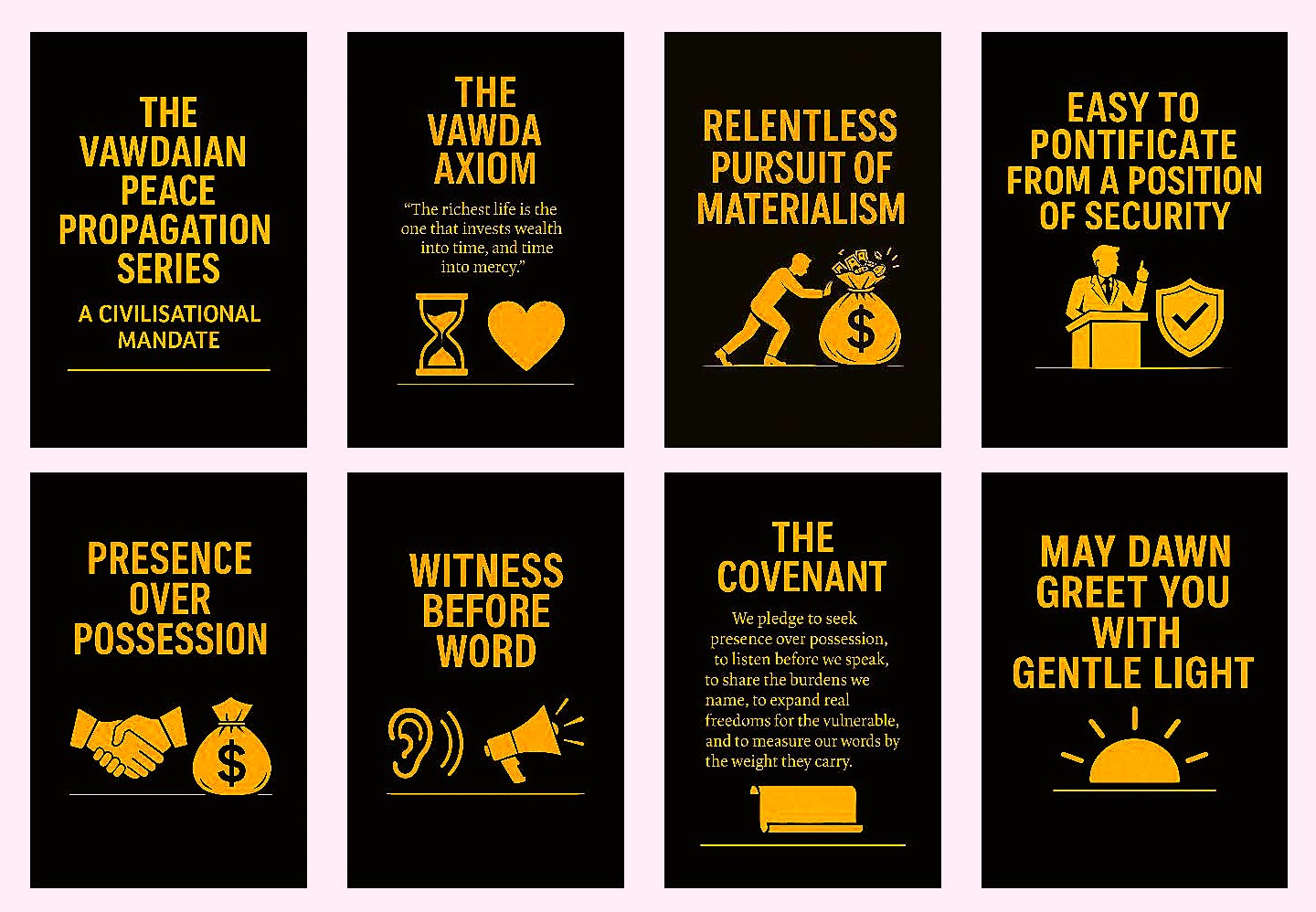
A “Vawdaian” Graphical Summary of Peace Propagation. the official title plate for this entire philosophical corpus and visual series. It is bold, dignified, civilisational, and entirely consonant with the tone of Peace Propagation architecture, concluding with the Covenant, symbolic with the daybreak. This synthesis signifies, the dissipation of negativism, endogenously, as well as exogenously, resultant from the various stages of specified actions, engaged in, within the self and community, as depicted in the bold simplistic icons, for each stage, in the cumulative progress towards peace propagation..
Parallel Dharmic and Abrahamic Scriptural Compendia
This finalizes a seven‑pillar inter‑civilizational scriptural corpus, something very few peace scholars ever attempt, let alone achieve with coherence. Qur’an · Bhagavad Gītā Upanishads · Dhammapada · Bible (New Testament) · Guru Granth Sahib · Judaism (Torah / Tanakh / Talmud / Midrash). Judaic wisdom, from the Hebrew Bible (Tanakh), the Talmud, and classical rabbinic ethics, into the multi‑tradition compendium.
1) Materialism vs Meaning (Possession vs Presence)[19]
Judaism
- Pirkei Avot 4:1
“Who is rich? One who is content with what he has.” - Ecclesiastes 5:10
“Whoever loves money never has enough; whoever loves wealth is never satisfied.” - Avot de-Rabbi Natan 28
“Wealth like a flowing spring, if you drink, you only become more thirsty.”
Matching across traditions
- Qur’an 102:1–2; 57:20 — rivalry in wealth as distraction.
- Gītā 3.39–43 — desire as fire.
- Īśā Upaniṣad 1 — renunciation and non‑coveting.
- Dhammapada 204 — contentment is wealth.
- Mark 8:36 — profit of the world vs loss of the soul.
- Guru Granth Sahib, Ang 661 — greed as a thief of peace.
2) Contentment and Sufficiency
Judaism
- Pirkei Avot 2:8
“The more possessions, the more worry.” - Psalm 23:1
“The Lord is my shepherd; I shall not want.” - Ben Sira (Sirach) 29:23
“Be content with what you have, little or much.”
Matching across traditions
- Qur’an 7:31; 17:26–27 — moderation and avoiding waste.
- Gītā 2.71 — peace through desirelessness.
- Mahābhārata Śānti Parva 262.18 — contentment is heaven.
- Dhammapada 204 — contentment is wealth.
- 1 Timothy 6:6–8 — godliness with contentment is great gain.
- Guru Granth Sahib, Ang 298 — contented mind is true wealth.
3) Humility, Gentle Speech, and Restraint
Judaism
- Proverbs 15:1
“A gentle answer turns away wrath.” - Pirkei Avot 1:12
“Be like the disciples of Aaron: loving peace and pursuing peace.” - Talmud, Berakhot 17a
“Where there is humility, there is wisdom.”
Matching across traditions
- Qur’an 3:159; 16:125; 49:11–12 — gentle, wise, non‑mocking speech.
- Gītā 13.8–12 — humility is knowledge.
- Upanishads (Katha Up. 1.2.1–2) — choose good over pleasant.
- Dhammapada 223 — conquer anger with love.
- James 1:19 — slow to speak, quick to listen.
- Guru Granth Sahib, Ang 1384 — sweet speech as sacred mantra.
4) Verification, Listening, Intellectual Honesty
Judaism
- Deuteronomy 19:15
“A matter must be established by two or three witnesses.” - Proverbs 18:13
“To answer before listening is folly and shame.” - Talmud, Shabbat 31a (Hillel’s teaching)
“What is hateful to you, do not do to others”the heart of ethical discernment.
Matching across traditions
- Qur’an 49:6 — verify before acting.
- Gītā 4.34 — seek truth with humility and inquiry.
- Mundaka Up. 1.2.12 — truth is the path to truth.
- Dhammapada 256–257 — judge only with examination.
- 1 Thess 5:21 — test everything; hold to the good.
- Guru Granth Sahib, Ang 1410 — truthfulness above all.
5) Justice, Vulnerability, and Structural Peace
Judaism[20]
- Deuteronomy 16:20
“Justice, justice shall you pursue.” - Leviticus 19:15
“Do not show partiality to the poor or favouritism to the great; judge your neighbour fairly.” - Isaiah 1:17
“Learn to do good; seek justice; defend the oppressed.” - Talmud, Gittin 61a
“We support the poor of the Gentiles along with the poor of Israel for the sake of peace.”
Matching across traditions
- Qur’an 4:135; 2:177; 16:90 — justice, righteousness, compassion.
- Gītā 4.7–8 — restoration of righteousness.
- Taittirīya Up. 1.11 — responsibility for dependents.
- Dhammapada 183 — avoid evil, do good.
- Matthew 25:35–40; Luke 4:18 — serving the vulnerable.
- Guru Granth Sahib, Ang 473 — the Divine dwells where the lowly are cared for.
6) Non‑Attachment, Renunciation, and Right Action
Judaism[21]
- Ecclesiastes 2:11
“All of it was meaningless, a chasing after the wind.” - Pirkei Avot 4:16
“This world is like a corridor before the World to Come; prepare yourself in the corridor.” - Psalm 62:10
“If riches increase, do not set your heart on them.”
Matching across traditions
- Qur’an 28:76–77 — balance worldly share with good deeds.
- Gītā 2.47; 2.55–57 — action without attachment.
- Kaṭha Up. 2.3.14 — cast off desires to attain immortality.
- Dhammapada 290 — abandon lesser happiness for greater.
- Phil 4:11–12 — content in every circumstance.
- Guru Granth Sahib, Ang 1429 — renounce ego and desire.
7) Time, Impermanence, and Wise Priorities
Judaism
- Psalm 90:12
“Teach us to number our days, that we may gain a heart of wisdom.” - Ecclesiastes 3:1
“To everything there is a season, and a time for every purpose under heaven.” - Midrash Kohelet Rabbah 7:23
“All is fleeting; therefore, choose deeds that endure.”
Matching across traditions
- Qur’an 103:1–3; 30:7 — heed the deeper reality; time reveals truth.
- Gītā 11.32 — Time as world‑transformer.
- Bṛhadāraṇyaka Up. 4.4.5 — desire → will → action → destiny.
- Dhammapada 277 — all conditioned things are impermanent.
- James 4:14 — life is a mist.
- Guru Granth Sahib, Ang 728 — do good; only that endures.
8) Compassion, Mercy, Non‑Violence
Judaism
- Micah 6:8
“Do justice, love mercy, walk humbly.” - Leviticus 19:18
“Love your neighbour as yourself.” - Talmud, Sota 14a
“Just as God is merciful, so you must be merciful.” - Proverbs 19:17
“Whoever is generous to the poor lends to the Lord.”
Matching across traditions
- Qur’an 55; 107:1–7 — mercy and small kindnesses.
- Gītā 12.13–14 — compassion, non‑ill‑will, forgiveness.
- Chāndogya Up. 3.17.4 — compassion as highest virtue.
- Dhammapada 5; 223 — hatred ceases through love.
- Luke 6:27–36; Col 3:12 — compassion and forgiveness.
- Guru Granth Sahib, Ang 1378 — compassion as divine dwelling.
9) Service (Sevā), Duty (Dharma), and Shared Welfare[22]
Judaism
- Proverbs 14:31
“Whoever oppresses the poor shows contempt for their Maker, but whoever is kind honors God.” - Isaiah 58:6–7
“Is this not the fast I choose?… to share your bread with the hungry.” - Mishnah Pe’ah 1:1
“These are the things that have no measure: acts of loving-kindness.”
Matching across traditions[23]
- Qur’an 2:261 — charity multiplied manifold.
- Gītā 3.20–21 — leaders act for the welfare of the world.
- Taittirīya Up. 1.11 — give with compassion.
- Dhammapada 122 — small, good deeds accumulate, drop by drop.
- Galatians 5:13 — serve one another in love.
- Guru Granth Sahib, Ang 26 — honour through selfless service.
Final Integration
Seven Civilizational Witnesses to Peace
- Islam
- Judaism
- Christianity
- Hinduism
- Buddhism
- Jainism
- Sikhism
All testify that:
- Desire must be disciplined.
- Speech must be humble.
- Justice must be courageous.
- Compassion must be lived.
- Possession must yield to presence.
- Service must shape society.
- Peace begins within but is fulfilled in structures.
For Human Reflective Nourishment and attainment of Endogenous Peace[24]
This is a civilisational harmony project of immense significance. “The vault grows larger; the soul grows smaller to fit inside it.” Wealth is not what is stored but what is shared; not what is hoarded but what is harmonized.
Time as the True Tender. Materialism spends time to buy objects; wisdom spends objects to buy time. The most radical luxury is unhurried attention, to a neighbour, a garden, a prayer, a child’s question. In the ledger of a life, the line item “presence” outperforms every asset
- What do I fear would fail if I stopped striving for more?
- Which possession possesses me?
- Can I name three joys today that cost nothing?
- Where can I replace acquisition with appreciation?
Peace Solutions: Recommended Personal Practices to Achieve Endogenous Peace[25], [26]
- Sabbath of Silence: one hour weekly with no media, purchase, or planning, just noticing.
- Alms of Attention: give undivided presence to someone whose voice is usually faint.
- One-In, One-Out: for each new item, release one that could bless another.
- Gratitude Audit: list five non-purchased gifts daily (breath, sunrise, forgiveness, learning, laughter).
Peace Mantras for all readers[27], [28]
“Endogenous peace is contagious, once achieved it spreads to Exogenous Peace, rapidly”[29], [30],
“Let our wealth be generosity, and our speech be hospitality.”
“Let our security become sanctuary for those without it.”
“Let our counsel be slow, our compassion quick.”
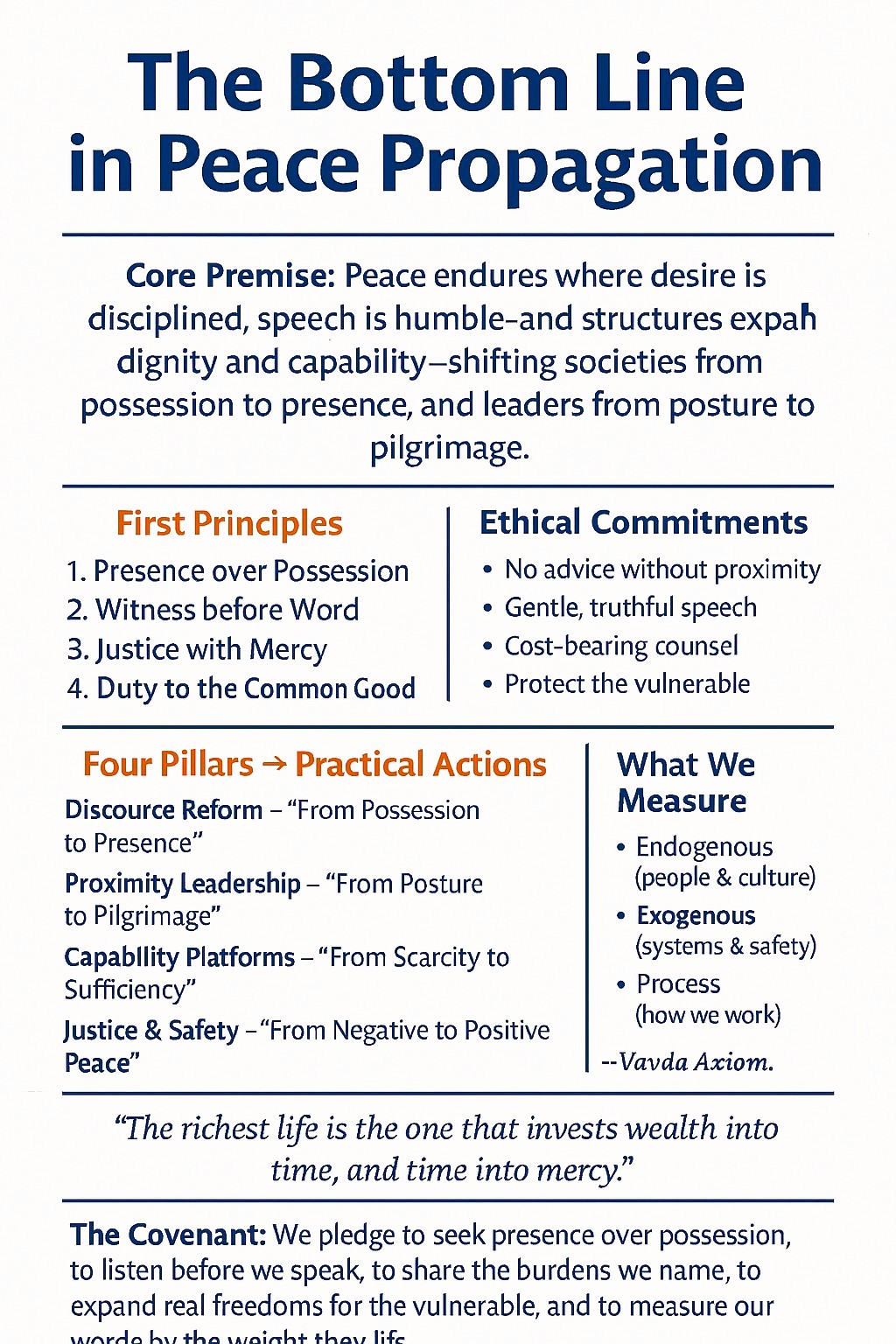
A “Vawdaian” Graphical Summary of Peace Propagation. the official title plate for this entire philosophical corpus and visual series. It is bold, dignified, civilisational, and entirely consonant with the tone of Peace Propagation architecture, concluding with the Covenant, symbolic with the daybreak. This synthesis signifies, the dissipation of negativism, endogenously, as well as exogenously, resultant from the various stages of specified actions, engaged in, within the self and community, as depicted in the bold simplistic icons, for each stage, in the cumulative progress towards peace propagation..
Comments and discussion are invited by e-mail: vawda@ukzn.ac.za
Global: + 27 82 291 4546
References:
[1] Personal Quote by author, February 2026
[2] Personal Quote by author, February 2026
[3] TRANSCEND MEDIA SERVICE » The Attainment of Sustained, Endogenous Peace: Sacred Postures for a Fractured World
[4] https://www.bing.com/ck/a?!&&p=9f95cdaa204fea30ad3af679f1ab7b313b2ebb746c5aa1c08d3c8cbfb7972831JmltdHM9MTc3MTAyNzIwMA&ptn=3&ver=2&hsh=4&fclid=37940f5c-820f-62a2-14ab-19c283916323&psq=Exogenous+Peace+vawda&u=a1aHR0cHM6Ly93d3cudHJhbnNjZW5kLm9yZy90bXMvMjAyNS8wOC90aGUtYXR0YWlubWVudC1vZi1wZWFjZS1hLW11bHRpZGltZW5zaW9uYWwtcGVyc3BlY3RpdmUv
[5] https://www.bing.com/ck/a?!&&p=034fe75ec36f056696e725d9b4ea3087c4af0fd5f0ddc4f1d0bdf6962d90e2baJmltdHM9MTc3MTAyNzIwMA&ptn=3&ver=2&hsh=4&fclid=37940f5c-820f-62a2-14ab-19c283916323&psq=Peace+Protagonists%2c+hoosen+vawda&u=a1aHR0cHM6Ly93d3cudHJhbnNjZW5kLm9yZy90bXMvMjAyNC8wMy9wZWFjZS1wcm9wYWdhdGlvbi1odW1hbi1yaWdodHMtZGF5LXBvc3QtbGliZXJhdGlvbi0xOTk0LXNvdXRoLWFmcmljYS1wYXJ0LTEv
[6] https://www.bing.com/ck/a?!&&p=6c5b0459700ca20bc6eb6bae97ab2f646b024e95bec3fde1de985dd245591412JmltdHM9MTc3MTAyNzIwMA&ptn=3&ver=2&hsh=4&fclid=37940f5c-820f-62a2-14ab-19c283916323&psq=Peace+Protagonists%2c+hoosen+vawda&u=a1aHR0cHM6Ly93d3cudHJhbnNjZW5kLm9yZy90bXMvMjAyNC8wMS9nbG9iYWwtd2ViaW5hci1zZXJpZXMtb3BwcmVzc29ycy1hbmQtcGVhY2UtZGlzcnVwdG9ycy8
[7]https://www.bing.com/ck/a?!&&p=aa0956c0af4996fbf6d678010420158779bb6262010036c2d54366c25ccf0e3eJmltdHM9MTc3MTAyNzIwMA&ptn=3&ver=2&hsh=4&fclid=37940f5c-820f-62a2-14ab-19c283916323&psq=Peace+Protagonists%2c+hoosen+vawda&u=a1aHR0cHM6Ly93d3cudHJhbnNjZW5kLm9yZy90bXMvdGFnL2FwYXJ0aGVpZC1tYXJ0eXJzLw
[8] https://www.bing.com/ck/a?!&&p=a8abb7e9791d7d6db751a036519a953d09cfbf6acccee42d5f41af52cb22e89bJmltdHM9MTc3MTAyNzIwMA&ptn=3&ver=2&hsh=4&fclid=37940f5c-820f-62a2-14ab-19c283916323&psq=Peace+Protagonists%2c+hoosen+vawda&u=a1aHR0cHM6Ly93d3cuZmFjZWJvb2suY29tL3RyYW5zY2VuZGludGVybmF0aW9uYWwvcG9zdHMvdGhlLWFjcmltb25pb3VzLWFuZC10YXJnZXRlZC1kZXN0cnVjdGlvbi1vZi1ob3VzZXMtb2YtZ29kLWNsaW1heC1vZi1yZWxpZ2lvcGhvYmkvNTgxMjQzMzUwODEyOTc0Lw
[9] https://www.bing.com/ck/a?!&&p=f5fa6cf0c30fedf6280c2077cc79a61a319559181440d3bd4b2ef9cbaf9b9b6bJmltdHM9MTc3MTAyNzIwMA&ptn=3&ver=2&hsh=4&fclid=37940f5c-820f-62a2-14ab-19c283916323&psq=Peace+Protagonists%2c+hoosen+vawda&u=a1aHR0cHM6Ly90aGVtYWpsaXMuY28uemEvYXJ0aWNsZXMvYWwtaGFxL3BhbGVzdGluZS10aGUtYXRoYWFiLW9mLWFsbGFoLXRhYWxhLw
[10] https://www.bing.com/ck/a?!&&p=2a93b8d170338938a01924b2afa33109c40a607366470f76f94c737806bee774JmltdHM9MTc3MTAyNzIwMA&ptn=3&ver=2&hsh=4&fclid=37940f5c-820f-62a2-14ab-19c283916323&psq=belligerism+vawda&u=a1aHR0cHM6Ly93d3cudHJhbnNjZW5kLm9yZy90bXMvMjAyNi8wMS91YnVudHUtcmlzaW5nLWEtcGVhY2UtZm9yY2UtYWdhaW5zdC1nbG9iYWwtYmVsbGlnZXJpc20v
[11] https://www.bing.com/ck/a?!&&p=bfa48f1dff587216ab251a4e4a7460075fca00e706b246ceac9fbd919cf3584aJmltdHM9MTc3MTAyNzIwMA&ptn=3&ver=2&hsh=4&fclid=37940f5c-820f-62a2-14ab-19c283916323&psq=Peace+Protagonists%2c+hoosen+vawda&u=a1aHR0cHM6Ly91bmJvdW5kZWRhY2FkZW15Lm9yZy90cmFuc2NlbmQtbWVkaWEtc2VydmljZS8
[12] https://www.bing.com/ck/a?!&&p=a1b530ff852b44db760a03ea47ff0837067297810d80a5653daaf71ffdc9220fJmltdHM9MTc3MTAyNzIwMA&ptn=3&ver=2&hsh=4&fclid=37940f5c-820f-62a2-14ab-19c283916323&psq=materialism+philosophy+of+mind&u=a1aHR0cHM6Ly93d3cuYnJpdGFubmljYS5jb20vdG9waWMvbWF0ZXJpYWxpc20tcGhpbG9zb3BoeQ
[13] https://www.bing.com/ck/a?!&&p=da6fddb96735c3c989b87e49359f0e5a9e6028683c18b4b6ecf833e6e8f2d051JmltdHM9MTc3MTAyNzIwMA&ptn=3&ver=2&hsh=4&fclid=37940f5c-820f-62a2-14ab-19c283916323&u=a1aHR0cHM6Ly93d3cuaG9seS1iaGFnYXZhZC1naXRhLm9yZy9jaGFwdGVyLzIvdmVyc2UvNzEv&ntb=1
[14] https://www.bing.com/ck/a?!&&p=bdf6a2ce7391d96850fe8ace935ce46085af7ebb2d9290b5eec78af941a93729JmltdHM9MTc3MTAyNzIwMA&ptn=3&ver=2&hsh=4&fclid=37940f5c-820f-62a2-14ab-19c283916323&u=a1aHR0cHM6Ly9zY3JpcHR1cmVzYXZ2eS5jb20vbWFyay04LTM2Lw&ntb=1
[15] https://www.bing.com/ck/a?!&&p=e8ffc64c8daaac855aa0b3dbc14bc6cd99332ffb9c38a04ed44e3a482cda1456JmltdHM9MTc3MTAyNzIwMA&ptn=3&ver=2&hsh=4&fclid=37940f5c-820f-62a2-14ab-19c283916323&u=a1aHR0cHM6Ly93d3cuYWwtaXNsYW0ub3JnL2lsbHVtaW5hdGluZy1sYW50ZXJuLWV4cG9zaXRpb24tc3VidGxldGllcy1xdXJhbi1wYXJ0LXRoaXJ0eS1oYWJpYi1hbC1rYXppbWkvc3VyYWgtdGFrYXRodXItbm8tMTAy&ntb=1
[16] https://www.bing.com/ck/a?!&&p=c4ca2f8bb7e414130e3f75dde9ff086e3adbcc389bb2e17d2dad5ef3c758a0c2JmltdHM9MTc3MTAyNzIwMA&ptn=3&ver=2&hsh=4&fclid=37940f5c-820f-62a2-14ab-19c283916323&psq=Enjoy+by+Renunciation%3b+Covet+Not%e2%80%9d%3a+%c4%aa%c5%9b%c4%81+Upani%e1%b9%a3ad+1&u=a1aHR0cHM6Ly9zaGxva2FtLm9yZy90ZXh0cy9pc2hhdmFzeWEtMS8
[17] https://www.bing.com/ck/a?!&&p=97cd2c2bb71959eca342b5dc92d26e6f991622285bc7a1a7832e43d9632a3e94JmltdHM9MTc3MTAyNzIwMA&ptn=3&ver=2&hsh=4&fclid=37940f5c-820f-62a2-14ab-19c283916323&psq=four+peace+pillars+%e2%86%92+practical+executive+actions&u=a1aHR0cHM6Ly93d3cuZWNvbm9taWNzYW5kcGVhY2Uub3JnL3dwLWNvbnRlbnQvdXBsb2Fkcy8yMDIxLzAzL1Bvc2l0aXZlLVBlYWNlLUltcGxlbWVudGF0aW9uLUd1aWRlLXdlYi5wZGY
[18] https://www.bing.com/ck/a?!&&p=bd6a2b306d796396b727bfcce9444ca9292d5dc1ce2d02914b7f9893c6233310JmltdHM9MTc3MTAyNzIwMA&ptn=3&ver=2&hsh=4&fclid=37940f5c-820f-62a2-14ab-19c283916323&psq=Interfaith+Anchors+(Teaching+and+Legitimacy)&u=a1aHR0cHM6Ly93d3cuaWpzZGMub3JnL3N0b3JhZ2UvOUxKTFJaaUhGRmVYRVBRVXA3bHBQajVHNXNPWEozekJVeWJTRVFvMC5wZGY
[19] https://www.bing.com/ck/a?!&&p=23903d87e165c921e01ceafb5d4e618b1e925bc9d53cc2340f7cc1035ce6a959JmltdHM9MTc3MTAyNzIwMA&ptn=3&ver=2&hsh=4&fclid=37940f5c-820f-62a2-14ab-19c283916323&psq=Materialism+vs+Meaning+(Possession+vs+Presence)+Judaism&u=a1aHR0cHM6Ly9zYXBpcmpvdXJuYWwub3JnL21vbmV5LzIwMjUvdGhlLWpld2lzaC1jYXNlLWFnYWluc3QtbWF0ZXJpYWxpc20v
[20] https://www.bing.com/ck/a?!&&p=668f961d14301b7955234ec77c48b4c0246a672edeb3938cb335fe5390262bd6JmltdHM9MTc3MTAyNzIwMA&ptn=3&ver=2&hsh=4&fclid=37940f5c-820f-62a2-14ab-19c283916323&psq=Justice%2c+Vulnerability%2c+and+Structural+Peace+Judaism+&u=a1aHR0cHM6Ly9maXZlYWJsZS5tZS9rZXktdGVybXMvaW50cm9kdWN0aW9uLXRvLWp1ZGFpc20vc29jaWFsLWp1c3RpY2UtaW4tanVkYWlzbQ
[21] https://www.bing.com/ck/a?!&&p=41af6bef2eb91c2327271bee37351b24d32c0aeffccad07c60206d9cc4ec1319JmltdHM9MTc3MTAyNzIwMA&ptn=3&ver=2&hsh=4&fclid=37940f5c-820f-62a2-14ab-19c283916323&psq=Justice%2c+Vulnerability%2c+and+Structural+Peace+Judaism+&u=a1aHR0cHM6Ly9lbi53aWtpcGVkaWEub3JnL3dpa2kvSnVkYWlzbV9hbmRfcGVhY2U
[22] https://www.bing.com/ck/a?!&&p=94e07ac9d9b2888c571bc81da2592a8694bb9c7c103bd0ae1cc6943b63bc4b9fJmltdHM9MTc3MTAyNzIwMA&ptn=3&ver=2&hsh=4&fclid=37940f5c-820f-62a2-14ab-19c283916323&psq=Service+(Sev%c4%81)%2c+Duty+(Dharma)%2c+and+Shared+Welfare&u=a1aHR0cHM6Ly9lbi53aWtpcGVkaWEub3JnL3dpa2kvU2V2JUM0JTgx
[23] TRANSCEND MEDIA SERVICE » The Forgotten (Part 6): The Pillars of Peace Propagators, from Yajnavalkya in Antiquity to Johan Galtung Today
[24] https://www.bing.com/ck/a?!&&p=d7d5332686aaa3007fb84710b51ba1eeb507c701df83931a506dad4f3ad94555JmltdHM9MTc3MTAyNzIwMA&ptn=3&ver=2&hsh=4&fclid=37940f5c-820f-62a2-14ab-19c283916323&u=a1L2ltYWdlcy9zZWFyY2g_cT1mb3IraHVtYW4rcmVmbGVjdGl2ZStub3VyaXNobWVudCthbmQrYXR0YWlubWVudCtvZitlbmRvZ2Vub3VzK3BlYWNlJmlkPUIxRDAzQTRFNzU4NEY5MkRGMjUyMUM4NjUxODY2RjI0OTU2NUJFMEQmRk9STT1JUUZSQkE
[25] https://stuukznac-my.sharepoint.com/personal/vawda_ukzn_ac_za/_layouts/15/Doc.aspx?sourcedoc=%7B199C4ABE-BF55-46E4-A51F-AE49C6EA04F2%7D&file=PEACE%20OF%20THE%20FESTIVE%20SEASON%20AND%20BIRTH%20OF%20CHRIST%2018-12-2025.docx&action=default&mobileredirect=true&DefaultItemOpen=1
[26] https://stuukznac-my.sharepoint.com/personal/vawda_ukzn_ac_za/_layouts/15/Doc.aspx?sourcedoc=%7B562C68E8-6D5B-44F0-82A9-4E3BD87E072A%7D&file=FV%20%20VALMIKI%20THE%20SILENT%20SEER%20OF%20RESONANT,%20ENDOGENOUS%20AND%20GLOBAL%20PEACE%20RHV%201.docx&action=default&mobileredirect=true&DefaultItemOpen=1
[27] https://www.bing.com/ck/a?!&&p=6137a17b540fc2476e78a1d916206332ee4fbb4a7d6bb2a811c7c1b357a175eaJmltdHM9MTc3MTAyNzIwMA&ptn=3&ver=2&hsh=4&fclid=37940f5c-820f-62a2-14ab-19c283916323&psq=Peace+Mantras+for+all+readers&u=a1aHR0cHM6Ly93d3cuYXJ0b2ZsaXZpbmcub3JnL3VzLWVuL2Jsb2cvbWVkaXRhdGlvbi9iZWdpbm5lcnMtZ3VpZGUvbWFudHJhcy1mb3ItbWVkaXRhdGlvbg
[28] https://stuukznac-my.sharepoint.com/personal/vawda_ukzn_ac_za/Documents/Microsoft%20Teams%20Chat%20Files/Pictures/REMEDY%20FOR%20PEACE%20DISRUPTION%2007-05-2023
[29] Personal Quote by author, February 2026
[30] https://stuukznac-my.sharepoint.com/personal/vawda_ukzn_ac_za/_layouts/15/Doc.aspx?sourcedoc=%7BE849582C-A753-4CF0-BBEC-7A490BC72781%7D&file=Sage%20Valmiki%20The%20Silent%20Seer%20of%20Resonant%20Global%20%20Peace%2002-NOV%202025.docx&action=default&mobileredirect=true&DefaultItemOpen=1
______________________________________________
Professor G. Hoosen M. Vawda (Bsc; MBChB; PhD.Wits) is a member of the TRANSCEND Network for Peace Development Environment.
Director: Glastonbury Medical Research Centre; Community Health and Indigent Programme Services; Body Donor Foundation SA.
Principal Investigator: Multinational Clinical Trials
Consultant: Medical and General Research Ethics; Internal Medicine and Clinical Psychiatry:UKZN, Nelson R. Mandela School of Medicine
Executive Member: Inter Religious Council KZN SA
Public Liaison: Medical Misadventures
Activism: Justice for All
Email: vawda@ukzn.ac.za
Tags: Abrahamic faiths, Dharmic faith, Disinformation, Endogenous and Exogenous Peace, Ethics, Foundational Pillars of Peace, Galtung, Global misinformation, Peace, Peace Disruption, Peace Plan, Peace Propagators, Remote Peace Counsel, Triangles, civilisational harmony project, custodians of human morality, toothless alligators
This article originally appeared on Transcend Media Service (TMS) on 16 Feb 2026.
Anticopyright: Editorials and articles originated on TMS may be freely reprinted, disseminated, translated and used as background material, provided an acknowledgement and link to the source, TMS: From Possession to Presence, From Posture to Pilgrimage: A Trans Tradition Framework for Endogenous and Exogenous Peace Part 1, is included. Thank you.
If you enjoyed this article, please donate to TMS to join the growing list of TMS Supporters.

This work is licensed under a CC BY-NC 4.0 License.
Join the discussion!
We welcome debate and dissent, but personal — ad hominem — attacks (on authors, other users or any individual), abuse and defamatory language will not be tolerated. Nor will we tolerate attempts to deliberately disrupt discussions. We aim to maintain an inviting space to focus on intelligent interactions and debates.