


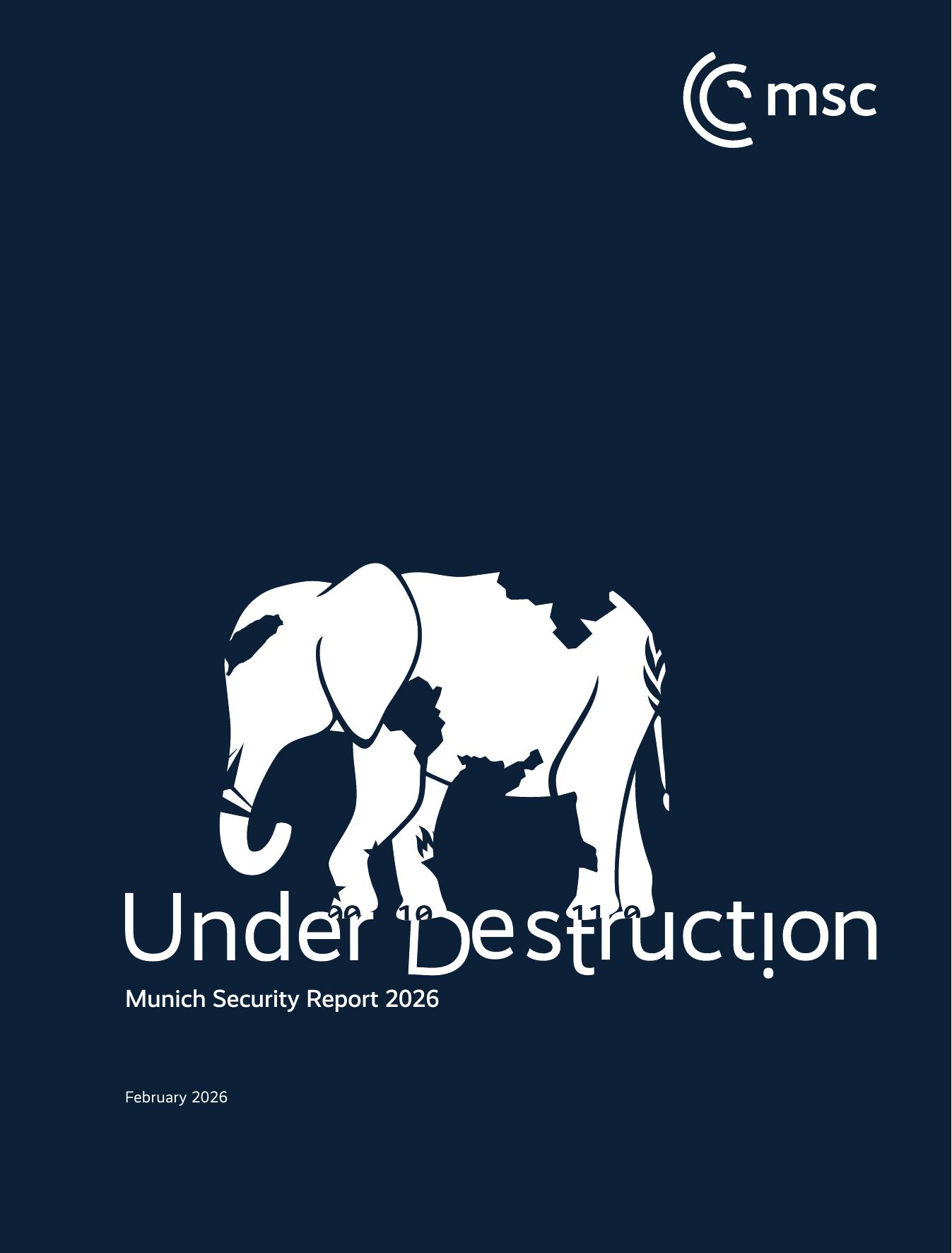
Munich Security Report 2026: Under Destruction
MILITARISM, 16 Feb 2026
Amb. Wolfgang Ischinger | Munich Security Conference - TRANSCEND Media Service
February 2026 – The Munich Security Conference 2026 is taking place at a moment of profound uncertainty. Rarely in the conference’s recent history have there been so many fundamental questions on the table at the same time: about Europe’s security, the resilience of the transatlantic partnership, and the ability of the international community to manage an increasingly complex and contested world.
The extraordinary attention Munich is attracting this year is not only a reflection of the many conflicts and crises that dominate the global agenda. It is also a result of the changing role of the United States in the international system. For generations, US allies were not just able to rely on American power but on a broadly shared understanding of the principles underpinning the international order. Today, this appears far less certain, raising difficult questions about the future shape of transatlantic and international cooperation.
These tensions were already visible at last year’s Munich Security Conference. The speech delivered by US Vice President J.D. Vance, which attracted considerable attention well beyond Munich, illustrated just how ditferent the current administration’s perspective on key issues is from the bipartisan liberal-internationalist consensus that has long guided US grand strategy. The implications of this shift for Europe, but also for the world at large, are hard to overstate.
Given the significance of this recalibration of US foreign policy, we decided that this year’s Munich Security Report should address the elephant in the room head-on. Many of the other challenges on the agenda – from Europe’s security architecture to the key principles of international law to trade and technology – are closely linked to the United States’ evolving view of the international order.
In recent years, the Munich Security Report has adopted a deliberately broad perspective, examining competing visions of order across a wide range of actors. This year, it focuses more specifically on the growing backlash against core principles of the post-1945 order, evident not only in the United States but in many parts of the world. The authors also look at security developments in both Europe and Asia, as well as surveying changes in the fields of trade and development cooperation, where the consequences have been particularly visible.
However one may assess the foreign policy of the current US administration, one thing is clear: It is already changing the world, and it has triggered dynamics whose full consequences are only beginning to emerge. We hope that this report will contribute to a constructive and informed debate about these issues and that the Munich Security Conference can once again help foster dialogue, stability, and ultimately peace in a rapidly changing world.
As ever, I am grateful to our partners, who contributed analyses, data, and infographics to the report, and wish you an engaging read!
— Ambassador Wolfgang Ischinger, Chairman of the Munich Security Conference
TO READ FULL REPORT DOWNLOAD PDF FILE:
Under_Destruction–Munich_Security_Report_2026
Tags: Arms Industry, Arms Race, Arms Trade, European Union, Military, Military Capitalism, Munich Security Report 2026, NATO, West
This article originally appeared on Transcend Media Service (TMS) on 16 Feb 2026.
Anticopyright: Editorials and articles originated on TMS may be freely reprinted, disseminated, translated and used as background material, provided an acknowledgement and link to the source, TMS: Munich Security Report 2026: Under Destruction, is included. Thank you.
If you enjoyed this article, please donate to TMS to join the growing list of TMS Supporters.

This work is licensed under a CC BY-NC 4.0 License.
Join the discussion!
We welcome debate and dissent, but personal — ad hominem — attacks (on authors, other users or any individual), abuse and defamatory language will not be tolerated. Nor will we tolerate attempts to deliberately disrupt discussions. We aim to maintain an inviting space to focus on intelligent interactions and debates.