



Empire Has an Identity Crisis — and the Global South Has a Memory
TRANSCEND MEMBERS, 2 Mar 2026
Raïs Neza Boneza – TRANSCEND Media Service
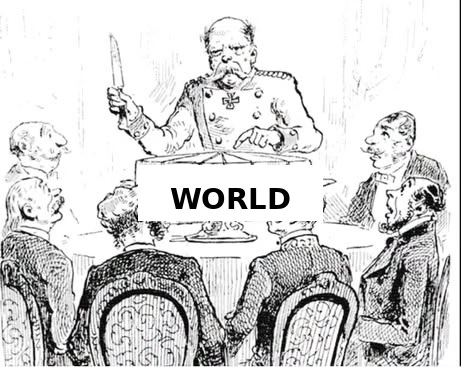
23 Feb 2026 – At the Munich Security Conference, the applause was smooth, the language careful, and the nostalgia unmistakable.
If you missed the speech by Marco Rubio, here is the short version: the West must be restored, civilization must be defended, and naturally, the United States should lead the parade. Preferably with Europe marching in step.
Marco Rubio rose to defend “Western civilization” — that sacred, endangered species that somehow only becomes visible when its dominance is challenged. Civilization, we are told, must be restored.
To our friends in the Global South: yes, you heard correctly. Civilization is back on the menu. Again.
History suggests we ask: Restored to what, exactly?
A Reminder from the Archives
In the Congo, under Leopold II, rubber quotas were enforced by amputating hands. Millions died in what was essentially a corporate state with a flag.
In 1906, Ota Benga was placed in a cage at the Bronx Zoo as a living anthropological exhibit. Visitors stared. Newspapers debated decorum. He later ended his life.
Sarah Baartman, the so-called “Hottentot Venus,” was paraded across Europe in the 19th century. Her body was displayed as spectacle. After her death, her remains were exhibited in a museum until 1974.
Not medieval Europe.
Modern Europe.
The British Empire wiped out the Aboriginal Tasmanians within a century. Bounties were paid per body. A human chain called the “Black Line” hunted the remaining survivors like wildlife. Civilization was very active in those years.
Yet today, the dominant anxiety is not historical accountability. It is that Western primacy might fade.
When sovereignty obstructs access, sovereignty becomes “problematic.”So, when Western officials lament cultural erasure today, forgive the Global South for double-checking definitions.
Cuba: The Crime of Disobedience
Now let’s add another chapter. In 1959, the Cuban Revolution overthrew a U.S.-backed dictatorship. It was messy. It was radical. It was sovereign.
Fidel Castro did something unforgivable in the eyes of the empire: he nationalized resources and declared political independence ninety miles away from Florida.
The response: The United States embargo against Cuba — a blockade that has lasted over six decades.
When Cuba struggles economically, headlines blame socialism. Rarely mentioned: a comprehensive sanctions regime designed precisely to make the system fail. Medicine shortages, financial strangulation, isolation from global markets.
It is the geopolitical equivalent of tightening someone’s oxygen mask and then criticizing their breathing technique.
Cuba’s revolution was not perfect. No revolution is. But its endurance under sustained economic siege is a case study in resistance. The lesson to the Global South was clear: Independence will be punished.
White Identity and the Fear of Not Being the Default
Meanwhile, in Western discourse, we are warned of “white cultural genocide.” When asked to define white culture, its defenders offer:
Church style. Food differences. Military pride. The Super Bowl halftime show being in Spanish.
Civilization trembling because of choreography.
“White” was not an ancient tribe. It was a political category constructed to unify European ethnic groups into a dominant bloc. Italians (Sicilians), Irish, etc.. — once excluded — were gradually admitted.
White identity was engineered to center itself. Now the center is shifting. Multipolarity feels like erasure when you are used to monopoly. But demographic change is not genocide. Tasmania was genocide. Congo’s rubber regime was crime against humanity
Ota Benga’s cage was dehumanization. Cuba’s blockade is coercion. A multilingual halftime show is not existential collapse.
The West Is Not in Crisis. Its Monopoly Is.
Western commentators speak of “global instability.” They lament the rise of China, the assertiveness of Russia, the stubborn independence of the so-called “middle powers. «But let us be clear: the planet is not collapsing. The West’s uncontested dominance is.
This is not a civilizational crisis. It is a monopoly dispute. When you build prosperity atop colonial extraction, slave routes, and postwar financial architecture tailored to your advantage, equality feels like decline. Multipolarity feels like injustice. Sovereignty in Africa feels like rebellion.
The anxiety we are witnessing is not about order. It is about control.
Europe and the Problem of “Wrong Victims”
Some commentators often reach for historical analogies when contemporary power politics begin to feel unsettling. Yet the more uncomfortable lesson does not lie in the comparison itself, but in what it reveals about how history is remembered, framed, and selectively applied.
What shocked Western moral consciousness in the twentieth century was not only the scale of industrial violence — it was the identity of those who suffered it. For the first time, white Europeans were not observing the logic of empire from a distance; they were experiencing its machinery firsthand.
For centuries, extermination, conquest, and racial hierarchy functioned as exported policies. They shaped colonies, structured global economies, and defined who counted as fully human. When similar methods appeared within Europe, the moral rupture was seismic. The violence was no longer peripheral. It was intimate.
Today’s geopolitical tensions echo that discomfort. The controversy is often less about the existence of dominance than about its direction and style. When power becomes openly transactional — tariffs as pressure, alliances as leverage, diplomacy as spectacle — familiar imperial logics become visible to those who once benefited from their invisibility.
In that sense, recent Rubio´s calls to Western leaders to “close ranks,” defend civilization, and reaffirm shared identity are not simply strategic messages. They are acts of memory. They signal an awareness, sometimes unspoken, that the world no longer accepts a hierarchy once taken for granted.
The applause, then, is not only agreement.
It is recognition.
Connecting the Dots: Haiti, Venezuela, Greenland
Haiti defeated slavery — and paid for it with crippling indemnities that engineered poverty. Venezuela sits atop oil reserves — and is sanctioned into economic suffocation.
Greenland becomes strategically valuable — and suddenly sovereignty becomes negotiable. When resources are at stake, morality is flexible.
When sovereignty resists, it becomes instability. This is not chaos. It is policy continuity.
Munich’s Standing Ovation
At Munich, Rubio warned of “revisionist powers” — China, BRICS, a world refusing Western primacy.
Europe applauded. Of course it did. The West is not afraid of disorder.
It is afraid of decentering.
BRICS may not be utopia. China is not altruism incarnate. But the mere fact that African and Caribbean nations have options unsettles a system built on singular authority.
When Cuba aligns with alternative partners, it is framed as rebellion.
When Africa negotiates with Beijing, it is framed as naivety.
When Latin America asserts autonomy, it is framed as instability.
Notice the pattern.
Empire has not disappeared. It has modernized. Boots became sanctions.
Conquest became compliance frameworks. Colonialism did not disappear. It updated its operating system. Boots became sanctions. Missionaries became development consultants. Chains became debt instruments. Colonial governors became IMF conditions. Cages became economic blockades.
And the language evolved:
Not domination — “rules-based order.” Not punishment — “pressure.”
Not supremacy — “civilization.”
Because when empire lectures the world about stability while redacting its own archives, when it warns of cultural genocide while sitting atop centuries of documented extermination, when it fears becoming a minority after centuries of making others one — irony becomes policy analysis. Here is the analytical core: When you have been the default setting for centuries, equality feels like loss. But equality is not erasure.
From the Global South
Congo remembers. Tasmania warns. Cuba endures.
Haiti testifies. The question is not East versus West.
It is sovereignty versus hierarchy. The world is not collapsing. It is rebalancing.
And if that feels like cultural genocide to those accustomed to permanent dominance, perhaps what is dying is not civilization —
but entitlement.
____________________________________________
 Raïs Neza Boneza is the author of fiction as well as non-fiction, poetry books and articles. He was born in the Katanga province of the Democratic Republic of Congo (Former Zaïre). He is also an activist and peace practitioner. Raïs is a member of the TRANSCEND Media Service Editorial Committee and a convener of the TRANSCEND Network for Peace Development Environment for Central and African Great Lakes. He uses his work to promote artistic expressions as a means to deal with conflicts and maintaining mental wellbeing, spiritual growth and healing. Raïs has travelled extensively in Africa and around the world as a lecturer, educator and consultant for various NGOs and institutions. His work is premised on art, healing, solidarity, peace, conflict transformation and human dignity issues and works also as freelance journalist. You can reach him at rais.boneza@gmail.com – http://www.raisnezaboneza.no
Go to Original – rboneza.substack.com
Tags: Europe, European Union, Marco Rubio, Munich Security Report 2026, USA, Western Civilization
DISCLAIMER: The statements, views and opinions expressed in pieces republished here are solely those of the authors and do not necessarily represent those of TMS. In accordance with title 17 U.S.C. section 107, this material is distributed without profit to those who have expressed a prior interest in receiving the included information for research and educational purposes. TMS has no affiliation whatsoever with the originator of this article nor is TMS endorsed or sponsored by the originator. “GO TO ORIGINAL” links are provided as a convenience to our readers and allow for verification of authenticity. However, as originating pages are often updated by their originating host sites, the versions posted may not match the versions our readers view when clicking the “GO TO ORIGINAL” links. This site contains copyrighted material the use of which has not always been specifically authorized by the copyright owner. We are making such material available in our efforts to advance understanding of environmental, political, human rights, economic, democracy, scientific, and social justice issues, etc. We believe this constitutes a ‘fair use’ of any such copyrighted material as provided for in section 107 of the US Copyright Law. In accordance with Title 17 U.S.C. Section 107, the material on this site is distributed without profit to those who have expressed a prior interest in receiving the included information for research and educational purposes. For more information go to: http://www.law.cornell.edu/uscode/17/107.shtml. If you wish to use copyrighted material from this site for purposes of your own that go beyond ‘fair use’, you must obtain permission from the copyright owner.
Join the discussion!
We welcome debate and dissent, but personal — ad hominem — attacks (on authors, other users or any individual), abuse and defamatory language will not be tolerated. Nor will we tolerate attempts to deliberately disrupt discussions. We aim to maintain an inviting space to focus on intelligent interactions and debates.