


The Williams Brothers: Afro-Basque Hybridity
EUROPE, 2 Mar 2026
Joan Pedro-Carañana, Toby Miller and Israel V. Márquez – TRANSCEND Media Service
23 Feb 2026 – Brothers Iñaki and Nico Williams play football for Athletic Club de Bilbao in Spain. With African roots—their parents migrated from Ghana—and a Basque-Navarrese upbringing, they symbolize a new era in the ideology of the club and the region.
Most black immigrants come to Spain for work. The majority are in precarious, low-paid jobs or outside formal labor and education. Two-thirds are Muslim. A quarter experience discrimination, the highest percentage in the EU. They are routinely stopped and searched by police without reason—at higher levels than the rest of the population.
An emerging Afro movement of collective expression and self-affirmation works against such marginalization. There has been significant activism and cultural production in the Basque Country, such as a festival of African cinema, AFRIKALDIA, and the AFRIKARTE cultural fair.
The País Vasco/Euskadi region itself has been a site of struggle—militant, political, and cultural—for centuries. Euskera, the only remaining paleo-European tongue, was severely repressed by the fascist regime of Francisco Franco, as were all regional languages and their dialects, such as català-valencià-balear, galego, aranés, and asturleonés. Before and after that period, centralist forces limited Basque freedom and autonomy, in alliance with the local ruling class.
During the Francoist dictatorship, resistance to the state included armed violence, which gained pace with Spain’s democratization via Euskadi Ta Askatasuna (ETA), a revolutionary socialist organization that favored secession. In 2011, ETA laid down its arms and was dissolved in 2018. Parliamentary representation of left-wing nationalism now focuses more on social issues than independence.
ETA’s existence testifies to the depth of anti-Spanish feeling in the region. An essentialist Basque notion of being the first Europeans, with the continent’s longest continuous heritage of semiosis, characterizes many nationalists, along with the belief that freedom and development are unattainable within the Spanish state. At a cultural level, such nationalism has led to a protectionism unique in Spanish sports.
1911 birthed the exclusionary policy, perhaps stimulated by Spanish limitations on immigration as much as regional cultural nationalism. For when the club began in 1898, its team was composed of a mix of British migrant workers and Basques who had studied in the UK (hence the English spelling of ‘Athletic Club’).
The brothers’ team has an endogamous policy (albeit with exceptions):
Athletic Club and all its supporters are characterised by a steadfast belief in a set of values which are becoming increasingly uncommon in football and 21st century sport. Athletic Club takes pride in its own and has a philosophy and way of seeing football that is unique in the world of football. This ideal is fully reflected in its policy of promoting academy players. Athletic Club is based in Bilbao, a city situated in Biscay, a province which makes up part of the Basque Country. The club’s sporting philosophy is governed by a code which states that Athletic Club may only field players who have come through its own academy or the academies of other clubs in the Basque Country, or players who were born in the following territories which constitute the Basque Country: Biscay, Gipuzkoa, Alava, Navarre, Labourd, Soule and Lower Navarre.
The policy amounts to the following: ‘Every single one of Athletic Club’s players was either born in the Basque Country or brought up here.’ The context is that, as of 2024, foreign nationals living in the region comprised around ten percent of the population, below the national average of 13%. A quarter are African, generally from Morocco.
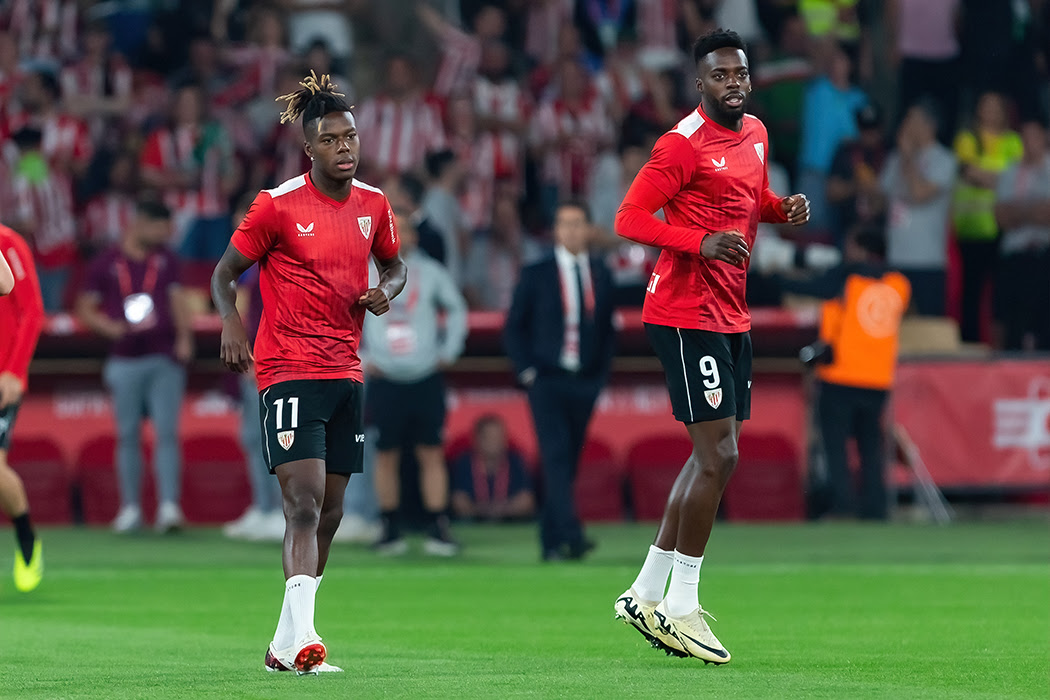
The Williams brothers, Nico (11) and Iñaki (9), in the final of the Copa del Rey 2024 between Athletic Club de Bilbao and Real Mallorca in Seville.Bilbao triumphed. (Shutterstock/Marta Fernandez Jimenez)
Athletic Club’s position can be seen as a form of resistance that protects a distinctive culture, or as anti-competitive nationalism that cuts the club off from the international division of sporting labor and refuses opportunities to minorities, other new arrivals, or outsiders. 1911 birthed the exclusionary policy, perhaps stimulated by Spanish limitations on immigration as much as regional cultural nationalism. For when the club began in 1898, its team was composed of a mix of British migrant workers and Basques who had studied in the UK (hence the English spelling of ‘Athletic Club’).
It can be no surprise that it took a century before an ethnic minority player appeared in the first team: Jonás Ramalho, who has an Angolan parent. Although the Williams brothers were brought up in the region and hence qualify, they break the mould in racial terms, incarnating a cultural hybridization that redefines Basque identity.
Iñaki and Nico occupy ‘an in-between space’: the bourgeois media relentlessly play up both their Basqueness and their blackness. This is often done via animalistic metaphors that trope longstanding racialized tendencies to depict black folks as other than human through genocide, enslavement, and stereotyping, with resonances of state and private hunting and sequestration. Like perhaps all black players outside Africa, the Williams confront racism both interpersonally and in the public realm.
That said, a small nationalism, per the Basques, has its virtues, as opposed to the imperial variety. Consider indigenous activism in settler colonies and Greenland’s resistance to empire, both near and far. The Williams’ successful mixture of localness and difference offers an internationalism, generosity, and cosmopolitanism—one brother chooses to play in the Spanish national team, the other for Ghana.
A Netflix documentary about them premiered at the 2024 San Sebastián International Film Festival. It testifies to the hopes and struggles of the family—and to an emergent political economy: Athletic’s former player and sporting director, Andoni Zubizarreta, argues that ‘When you’re different in a market where everyone does the same, your shirt is surely worth more money, your broadcasts are worth more money, your fans invest more in that merchandise.’
That may be Athletic Club’s “unique selling point,” to cite a ghastly cliché. But the brothers Williams represent far more than that.
__________________________________________
 Joan Pedro-Carañana is Associate Professor at Computense University of Madrid and a member of the Latin Union of Political Economy of Information, Communication and Culture (ULEPICC).
Toby Miller – School of Humanities and Education, Instituto Tecnológico de Monterrey, Guadalajara campus.
Israel V. Márquez – Department of Journalism and New Media, Complutense University of Madrid.
Copyright © Toby Miller, Joan Pedro-Carañana & Israel V. Márquez 2026
Tags: Africa, Basque Country, Ghana, Immigration, Racism, Soccer, Spain, Sports
This article originally appeared on Transcend Media Service (TMS) on 2 Mar 2026.
Anticopyright: Editorials and articles originated on TMS may be freely reprinted, disseminated, translated and used as background material, provided an acknowledgement and link to the source, TMS: The Williams Brothers: Afro-Basque Hybridity, is included. Thank you.
If you enjoyed this article, please donate to TMS to join the growing list of TMS Supporters.

This work is licensed under a CC BY-NC 4.0 License.
Join the discussion!
We welcome debate and dissent, but personal — ad hominem — attacks (on authors, other users or any individual), abuse and defamatory language will not be tolerated. Nor will we tolerate attempts to deliberately disrupt discussions. We aim to maintain an inviting space to focus on intelligent interactions and debates.