


Files Expose Britain’s Secret D-Notice Censorship Regime
MEDIA, 8 Dec 2025
Kit Klarenberg and William Evans | The Grayzone – TRANSCEND Media Service
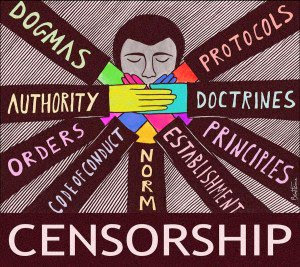
Documents obtained by The Grayzone reveal how British soldiers and spies censor news reporting on ‘national security,’ coercing reporters into silence. The files show the Committee boasting of a “90% + success rate” in enforcing the official British line on any controversial story – or disappearing reports entirely.
1 Dec 2025 – A new trove of documents obtained by The Grayzone through freedom of information (FOI) requests provide unprecedented insight into Britain’s little-known military and intelligence censorship board. The contents lay bare how the secretive Defence and Security Media Advisory (DSMA) Committee censors the output of British journalists, while categorizing independent media as “extremist” for publishing “embarrassing” stories. The body imposes what are known as D-Notices, gag-orders systematically suppressing information available to the public.The files provide the clearest view to date of the inner workings of the opaque committee, exposing which news items the British national security state has sought to shape or keep from public view. These include the bizarre 2010 death of a GCHQ codebreaker, MI6 and British special forces activity in the Middle East and Africa, the sexual abuse of children by government officials, and the death of Princess Diana.
The files show the shadowy Committee maintains an iron grip over the output of legacy British media outlets, transforming British journalists to royal court stenographers. With the Committee having firmly imposed themselves on the editorial process, a wide range of reporters have submitted “apologies” to the board for their media offenses, flaunting their subservience in order to maintain their standing within British mainstream media.
In addition, the documents also show the Committee’s intentions to extend the D-Notice system to social media, stating its desire to engage with “tech giants” in a push to suppress revealing disclosures on platforms like Meta and Twitter/X.
How The Grayzone obtained the files
The DSMA Committee describes itself as “an independent advisory body composed of senior civil servants and editors” which brings together representatives of the security services, army, government officials, press association chiefs, senior editors, and reporters. The system forges a potent clientelist rapport between journalists and powerful state agencies, heavily influencing what national security matters get reported on in the mainstream, and how. The Committee also routinely issues so-called “D-Notices,” demanding media outlets seek its “advice” before reporting certain stories, or simply asking they avoid particular topics outright.
The DSMA Committee is funded by and housed in Britain’s Ministry of Defence (MOD), chaired by the MOD’s Director General of Security Policy Paul Wyatt, and 36-year British Army veteran Brigadier Geoffery Dodds serves as its Secretary, raising serious questions about the extent to which British ‘news’ on national security could effectively be written by the Ministry of Defence.
Even though the MOD explicitly retains the right to dismiss its Secretary, the DSMA Committee insists it operates independently from the British government. This means the Committee isn’t subject to British FOI laws.
So how did The Grayzone obtain these files?
The unprecedented disclosure was the result of an effort by the Committee to assist Australia’s government in creating a D-Notice system of their own. In doing so, it established a papertrail which Canberra was forced to release under its own FOI laws. Australian authorities fought tooth and nail to prevent the documents’ release for over five months, until the country’s Information Commissioner forced the Department of Home Affairs to release them.
Official ‘advice’
The files obtained by The Grayzone comprise records of multiple meetings attended by officials from a variety of Australian government departments and the DSMA Committee, answers from the UK’s Committee staff to questions posed by Canberra on how the system functions in practice, and a 36-page report from a 2015 internal DSMA Committee review which outlines the history of the D-Notice system, and includes a comprehensive list of requests for “advice” received and submitted over the previous five years.
The Committee operates simultaneously secretly and above ground. The documents note “conversations between the DSMA system and journalists/media organisations are confidential.” In fact, the Committee states in a briefing given to Australian officials that it isn’t even “required to submit evidence from discussions with media as part of police investigations or court proceedings.”
In theory, the system is voluntary, and publications are not legally obliged to comply with the Committee’s orders to censor or distort information. But the vast majority of British journalists obey the DSMA Committee’s “advice,” with nearly all D-notices and advice resulting in stories being spiked or altered.
The Committee’s 2015 internal review, which was prompted by the Edward Snowden affair, explained how “in serious cases,” the British government can “seek a court injunction” or prosecute journalists who violate Committee advice under the Official Secrets Act – a point the DSMA Secretary, Brig. Dodds, emphasized in meetings with Australian officials. Since then, Britain has introduced sweeping new national security laws under which journalists and whistleblowers could also face prosecution.
TO CONTINUE READING Go to Original – thegrayzone.substack.com
Tags: Censorship, Europe, Fake News, Fake Report, Freedom of the press, Journalism, Media, Official Lies and Narratives, UK
DISCLAIMER: The statements, views and opinions expressed in pieces republished here are solely those of the authors and do not necessarily represent those of TMS. In accordance with title 17 U.S.C. section 107, this material is distributed without profit to those who have expressed a prior interest in receiving the included information for research and educational purposes. TMS has no affiliation whatsoever with the originator of this article nor is TMS endorsed or sponsored by the originator. “GO TO ORIGINAL” links are provided as a convenience to our readers and allow for verification of authenticity. However, as originating pages are often updated by their originating host sites, the versions posted may not match the versions our readers view when clicking the “GO TO ORIGINAL” links. This site contains copyrighted material the use of which has not always been specifically authorized by the copyright owner. We are making such material available in our efforts to advance understanding of environmental, political, human rights, economic, democracy, scientific, and social justice issues, etc. We believe this constitutes a ‘fair use’ of any such copyrighted material as provided for in section 107 of the US Copyright Law. In accordance with Title 17 U.S.C. Section 107, the material on this site is distributed without profit to those who have expressed a prior interest in receiving the included information for research and educational purposes. For more information go to: http://www.law.cornell.edu/uscode/17/107.shtml. If you wish to use copyrighted material from this site for purposes of your own that go beyond ‘fair use’, you must obtain permission from the copyright owner.
Join the discussion!
We welcome debate and dissent, but personal — ad hominem — attacks (on authors, other users or any individual), abuse and defamatory language will not be tolerated. Nor will we tolerate attempts to deliberately disrupt discussions. We aim to maintain an inviting space to focus on intelligent interactions and debates.