


Gender-Based Violence in Abrahamic Scriptures: A Comparative Analysis of Femicide, Malecide, and Gross Disruption of Peace
TRANSCEND MEMBERS, 8 Dec 2025
Prof Hoosen Vawda – TRANSCEND Media Service
A Comparative Hermeneutic Analysis of Gendered Harm and Its Societal Consequences.[1]
***************
This publication is not suitable for general readership as it contains narratives of Gender Based Violence involving the systemic abuse of women and men. This can be grossly disturbing to some readers. Parental guidance is recommended for minors who may use this research paper as a resource material, for projects.
Important Note to Readers of this publication
The author acknowledges that the Abrahamic scriptures, The Thora, Bible and the Quran, consist of layered text. Many episodal narratives are allegorical and its portrayal of GBV reflect historical, social norms from antiquity, rather than an endorsement, thereof. Modern readings aim to learn from these disturbing narratives, to obviate repetition of injustice, patriarchal oppression and abuse of women, certainly NOT to vilify the scripture, which the author, as a Muslim, highly respects, each one, as revered Abrahamic, religious tome.
***************
“The human, reptilian and limbic brain, functional sector remnants have the proclivity to evil desires, causing the species to engage in belligerent, lustful, nefarious activities, effectively leading to violent Peace Disruption. This is evidenced from antiquity, through to the 21st century and beyond. This is an inherent attribute of Homo sapiens, sapiens”. [2]
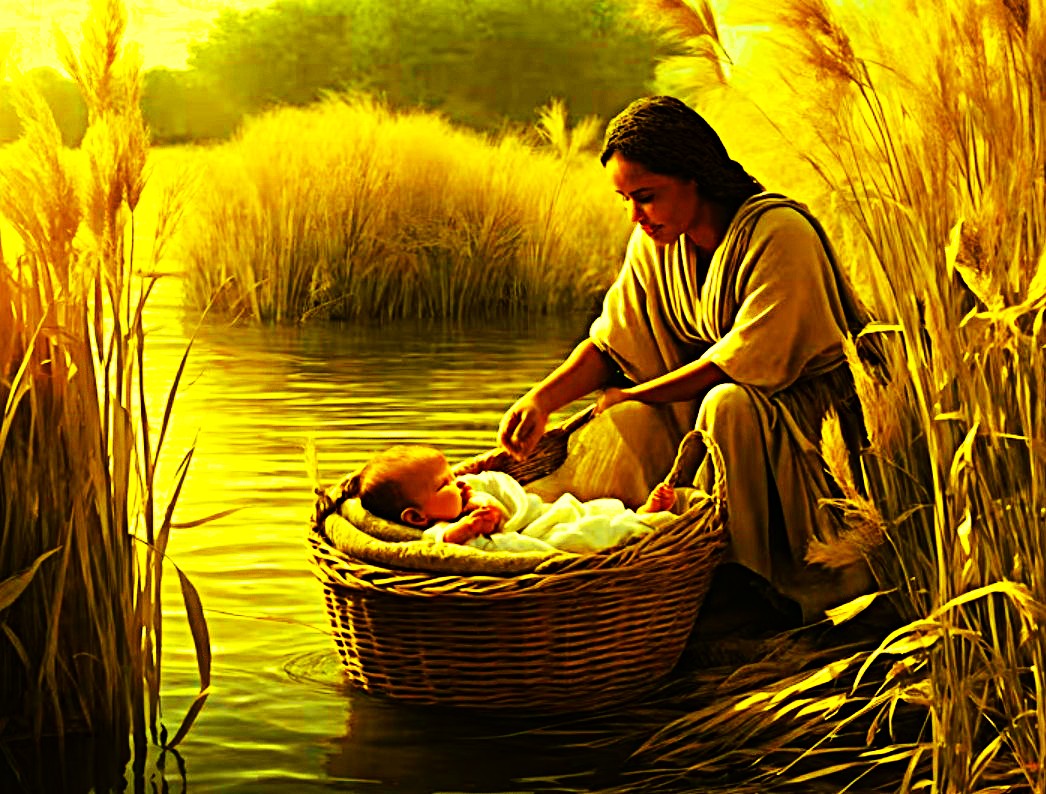
The casting of baby Moses in a reed basket into the River Nile by his mother, Jochebed, to prevent infantile, malecide of the first-born babies of the children of Israel, by Pharaonic Decree, in ancient Egypt. Photo Credit: Wikimedia Commons
Prologue:
Gender-Based Violence [3](GBV) remains a pervasive global challenge, yet its roots in sacred narratives are often overlooked. The author has published a paper on GBVF highlighting the narrative in the Hindu, epic, the Mahabharata[4] As the readers know, the term “GBVF” is modern, but the patterns of power, subjugation, and the resultant disruption of societal peace are absolutely ancient. The key in such a study is to approach the texts with academic rigour, distinguishing between descriptive narrative (what the text says happened) and prescriptive doctrine (what the text commands should happen). Much of the violence we see is descriptive of ancient patriarchal societies, but it has often been interpreted prescriptively across centuries.
Here is a comparative analysis of examples of GBVF in Abrahamic literature (focusing on the Hebrew Bible/Old Testament and the Quran in their historical context) that lead to significant Peace Disruption.
This paper explores GBVF in Abrahamic scriptures, comparing and contrasting the scourge in Dharmic religions, like Hinduism in antiquity as well as its modern-day practice, through a dual lens: Femicide, the targeted violence against women, and “Malecide”[5], a neologism introduced by the author, here to describe systemic violence against men. Drawing on textual analysis of the Hebrew Bible, New Testament, and Qur’an, the study identifies episodes of gendered harm, ranging from sexual violence and honour killings to infanticide and punitive executions, and examines their role in disrupting peace and social cohesion in antiquity. Historical misuse of these texts, including witch hunts, honour-based killings, castration practices, and contemporary state-sanctioned executions for homosexuality, underscores the enduring impact of patriarchal distortions. By contrasting these patterns with corrective ethical principles embedded in scripture—such as Jesus’ intervention against stoning (John 8) and the Qur’anic condemnation of infanticide (81:8–9), the paper advocates for a hermeneutic shift toward gender-inclusive justice. This comparative framework positions GBV and Malecide not merely as historical phenomena but as urgent ethical concerns, calling for interpretive responsibility and peacebuilding strategies that dismantle violence against all genders.
Introduction:
Gender-Based Violence (GBV) is a pervasive global phenomenon that transcends cultural, religious, and historical boundaries. While contemporary discourse primarily addresses violence against women, the roots of gendered harm extend deep into sacred narratives, shaping societal norms and ethical frameworks for millennia. Abrahamic scriptures, the Hebrew Bible, New Testament, and Qur’an, contain complex portrayals of gender relations, including episodes of violence that have influenced both theological interpretation and cultural practice.
This paper introduces a dual analytical lens: Femicide, the targeted violence against women, and Malecide, a neologism coined to describe systemic violence against men. Femicide manifests in narratives of sexual violation, honor killings, and domestic abuse, as seen in the stories of Dinah (Genesis 34), Tamar (2 Samuel 13), and the Levite’s concubine (Judges 19). Conversely, Malecide encompasses infanticide, sexual humiliation, castration, and punitive executions, evident in Pharaoh’s decree to kill Hebrew male infants (Exodus 1:16, 1:22), Herod’s massacre of Bethlehem’s boys (Matthew 2:16), and coercive acts in the Lot narrative (Genesis 19; Surah Al-A’raf 7:80–84).
These narratives, while historically situated, have been subject to cultural distortions that perpetuate patriarchal violence across centuries. Witch hunts, honor-based killings, castration practices, and contemporary state-sanctioned executions for homosexuality illustrate how selective readings of scripture have transformed texts into instruments of oppression. Such distortions disrupt peace, erode social cohesion, and institutionalize fear and exclusion, particularly for women and LGBTQ+ individuals.
By examining these patterns through a comparative hermeneutic approach, this study seeks to uncover the ethical tensions between scriptural intent and cultural misuse. It argues that reclaiming corrective principles embedded in Abrahamic traditions—such as Jesus’ intervention against stoning (John 8) and the Qur’anic condemnation of infanticide (81:8–9)—is essential for dismantling gendered violence and fostering inclusive peacebuilding. In doing so, the paper contributes to feminist theology, masculinities studies, and interfaith ethics, positioning GBV and Malecide not merely as historical phenomena but as urgent moral challenges requiring interpretive responsibility and transformative action.
Gender-Based Violence (GBV) is widely recognized as a global human rights crisis, yet its historical and theological dimensions remain underexplored. This paper addresses GBVF within Abrahamic scriptures through a dual framework: Femicide, the targeted violence against women, and Malecide, a newly coined term, by the author, denoting the wide spectrum of systemic violence, against men. By examining scriptural narratives and their cultural distortions, the study reveals how gendered harm, whether through sexual violence, honour killings, infanticide, or punitive executions, has disrupted peace and perpetuated cycles of oppression, subjugation, violence and gender bias, across centuries.
The analysis begins with the Hebrew Bible, where episodes such as Dinah’s violation (Genesis 34), Tamar’s assault (2 Samuel 13), and the Levite’s concubine (Judges 19) exemplify femicide and its societal consequences. Parallel narratives of male-directed violence include Pharaoh’s decree to kill all Hebrew male infants, at birth (Exodus 1:16, 1:22), Herod’s massacre of Bethlehem’s boys (Matthew 2:16), and sexual humiliation in Genesis 19 and Judges 19. The Qur’an similarly condemns Pharaoh’s oppression (Surah Al-Qasas 28:4) and addresses coercive acts in the Lot narrative (Surah Al-A’raf 7:80–84), though later jurisprudential interpretations misappropriated these texts to justify punitive measures against homosexuality.
Historical misuse amplified these patterns: witch hunts and honour killings targeted women, while castration, eunuch systems, and state-sanctioned executions for same-sex relations victimized men. Contemporary examples include death penalties for homosexuality in Nigeria, [6] Iran, and Saudi Arabia,[7], [8], reflecting selective readings of Hadith and fiqh[9] rather than the Qur’an’s ethical core. These distortions transformed sacred texts into instruments of patriarchal control, undermining justice and peace.
The paper argues that both femicide and malecide destabilised communities by eroding demographic balance, fuelling tribal retaliation, and institutionalizing fear and exclusion, particularly for LGBTQ+ individuals. Corrective ethics embedded in scripture, such as Jesus’ intervention against stoning (John 8) and the Qur’anic condemnation of infanticide (81:8–9), offer pathways for hermeneutic reform. By reclaiming these principles, faith communities can dismantle gendered violence and advance inclusive peacebuilding.
This study contributes to feminist theology, masculinities research, and interfaith ethics by framing GBV as a multidimensional phenomenon affecting all genders. It calls for interpretive responsibility and theological reconstruction to transform Abrahamic traditions from sources of harm into catalysts for justice and reconciliation.
Gender-Based Violence (GBV) in Abrahamic scriptures is often examined through a female-centric lens, overlooking male-directed violence such as malecide, the targeted killing of males. This paper interrogates GBV typologies across Judaism, Christianity, and Islam, situating malecide within a continuum of gendered violence and exploring its theological, ethical, and socio-political implications.
Objective:
To analyse scriptural narratives of GBV and malecide, identify typologies, and assess their relevance to contemporary discourse on gendered violence, including male vulnerability.
Methods, used to analyse GBVF:
A comparative textual analysis of canonical scriptures (Hebrew Bible, New Testament, Qur’an) and exegetical traditions was conducted. The study employs a gender-critical hermeneutic, integrating historical context, theological interpretation, and modern human rights frameworks.
Case Findings:
- GBV typologies include structural, physical, sexual, symbolic, economic, and spiritual violence, with malecide emerging as a distinct form of gendered harm.
- Pharaoh’s decree (Exodus 1) and Herod’s massacre (Matthew 2) exemplify state-sanctioned malecide, rooted in prophecy-driven political anxiety.
- Interfaith analysis reveals shared motifs: prophecy as catalyst, gendered violence as statecraft, and divine disruption through female agency.
- Contemporary parallels include targeted killings of men and boys in genocides, forced conscription, and sexual violence against men in conflict zones—phenomena often excluded from GBV discourse.
Foundational Framework: The Patriarchal Order as a Source of Friction
In all three Abrahamic traditions, the foundational literature emerges from strongly patriarchal societies where women were largely considered property of their fathers or husbands. This inherent power imbalance is the fertile ground from which GBVF grows, constantly threatening the peace of families, tribes, and nations.
- The Hebrew Bible[10] The narratives here are often stark and unflinching in their depiction of violence against women, directly linking it to war, familial breakdown, societal chaos and regional, violent peace disruption.

Biblical narrations of Gender Based Violence and Femicide as depicted in paintings and illustrations from Antiquity.
Photo Top Right: The Levite discovers his concubine, dead on his doorstep, in the morning, after being gang raped by the town folk of Gibeah, An artistic impression by Gustave Doré, Circa 1880
Photo Top Left: Prophet Abraham expressing his adulterous desires on Bathsheba having a bath, leading up to his impropriety with sinful lust.
Photo Middle: The beautiful Dinah, with her brothers, the children of Jacob, as a tribe.
Photo Bottom: The abduction and rape of Dinah by Shechem, a Hivite prince. This resulted in great regional peace disturbance, vengeance and tribal conflict.
Photo Credit: Wikimedia Commons
- The Concubine of the Levite (Judges 19)[11] – A Case of Extreme Peace Disruption
- The GBVF: A Levite’s concubine flees him. He retrieves her, and on their journey back, they lodge in the city of Gibeah. Men of the city surround the house, demanding to sexually assault the male guest. To placate the mob, the host offers his virgin daughter and the Levite’s concubine. The Levite himself pushes his concubine out to them. She is brutally raped and abused all night until morning, when she dies on the threshold.
- The Peace Disruption: The Levite dismembers her body into twelve pieces and sends them throughout Israel. This horrific act serves as a rallying cry, leading to a massive civil war between the tribes of Israel and the tribe of Benjamin (to which Gibeah belonged). The war is devastating, nearly wiping out the entire tribe of Benjamin. The peace of the entire Israelite confederacy is shattered, directly triggered by this act of gang rape and murder.
- The Rape of Dinah (Genesis 34) – Vengeance and Tribal Conflict [12]
- The GBVF: Dinah, daughter of Jacob, is seen by Shechem, a Hivite prince, who “seizes her and lies with her and humbles her.” The text is clear this is an act of violence.
- The Peace Disruption: Dinah’s brothers are furious. Shechem and his father Hamor propose peaceful integration and intermarriage. However, Simeon and Levi deceive the Hivites, insisting they must be circumcised. While the men are recovering and in pain, they slaughter them, plunder the city, and take the women and children captive. Jacob rebukes them, fearing the surrounding tribes will now destroy them. This act of vengeance for a single act of sexual violence disrupts the peace with the indigenous peoples and brings Jacob’s family to the brink of annihilation.
- David and Bathsheba (2 Samuel 11) – Abuse of Power and National Crisis [13]
- The GBVF: King David, from his roof, sees Bathsheba bathing. Despite knowing she is the wife of Uriah the Hittite, he “sends for her” and “he lay with her.” The power dynamic is absolute; she, as a subject, has no real capacity to refuse the king. This is a classic case of prima facie coercion.
- The Peace Disruption: Bathsheba becomes pregnant. To cover his sin, David orchestrates the death of her loyal husband, Uriah, on the front lines of battle. The Prophet Nathan[14] later confronts David, declaring that “the sword shall never depart from your house.” This single act of royal sexual exploitation leads directly to a curse of continuous violence within David’s own family: the rape of his daughter Tamar by her half-brother Amnon, the murder of Amnon by her brother Absalom, and Absalom’s subsequent rebellion that plunges the nation into civil war. The peace of the entire kingdom is disrupted for a generation.
- The Quran[15]
The Quranic text, revealed in 7th century Arabia, must be read in its historical context. It introduced revolutionary reforms to improve the status of women. However, certain verses, when read literally and outside their historical-legal context, have been used to justify GBVF.
- Domestic Discipline (Surah An-Nisa 4:34) – A Source of Marital Friction[16]
- The GBVF: The verse addresses men concerning women from whom they fear “disobedience” (nushuz). It advises: 1) Admonish them, 2) Leave them alone in beds, and 3) Strike them (wadribuhunna). The interpretation of daraba here is among the most contested in Islamic scholarship, with classical jurists taking it literally (though with restrictions on being severe) and modern reformers arguing for metaphorical meanings like “to separate.”
- The Peace Disruption: This verse has been the theological basis for the physical “disciplining” of wives in many traditionalist interpretations. This sanctioning of light physical force, even with caveats, fundamentally disrupts marital peace by institutionalizing a power imbalance where the husband is the corrector and the wife the transgressor. It provides a religious justification for domestic abuse, which is a primary source of violence and friction within the most fundamental unit of society—the family.
- Female War Captives (Surah Al-Ahzab 33:50) & An-Nisa 4:24 – Sexual Violence in War [17]
- The GBVF: The Quran, reflecting the norms of 7th-century warfare, permits a man to have sexual relations with “what your right hand possesses”, female captives of war. While the Quran mandates kindness towards them, the inherent lack of consent in such a relationship, by modern definitions, constitutes institutionalized sexual slavery.
- The Peace Disruption: The practice of taking female war captives as concubines was a direct cause and consequence of inter-tribal and inter-religious conflict. It dehumanized the “other,” turning women’s bodies into spoils of war. This not only disrupted the peace of the defeated community, whose women were taken, but also created friction within the Muslim household between free wives and captives, as seen in historical narratives. It prolonged cycles of vengeance and hatred between groups.
- The Story of the Two Women (Surah Yusuf 12:23-32) – False Accusation and Societal Scandal [18]
- The GBVF: The wife of Potiphar (Aziz) attempts to seduce Joseph (Yusuf)[19]. When he refuses and flees, she tears his garment from behind and falsely accuses him of attempting to assault her. This is a clear case of a powerful woman using a false allegation of sexual assault, a form of psychological and social violence against Joseph.
- The Peace Disruption: The accusation causes a major scandal (“the women in the city” gossip about it). Joseph is imprisoned based on this false testimony. The peace of the official’s household and the wider social order is disrupted by this act of false allegation, which is used as a weapon of revenge for a bruised ego.
Comparative Analysis of Abrahamic Scriptures Leading to Peace Disruption[20]
| Text | Example of GBVF | Nature of Violence | Resulting Peace Disruption |
| Hebrew Bible | Concubine of the Levite (Judges 19) | Gang Rape, Murder | National-Level: Civil war, near-genocide of the tribe of Benjamin. |
| Hebrew Bible | Rape of Dinah (Genesis 34) | Rape, Deception, Mass Murder | Tribal-Level: Broken treaties, vengeance, threat of annihilation from neighbouring tribes. |
| Hebrew Bible | David & Bathsheba (2 Samuel 11) | Coercion, Adultery, Murder | Dynastic-Level: Familial curse, rape, fratricide, civil war, rebellion. |
| Quran | Domestic Discipline (4:34) | Sanctioned Physical “Correction” | Family-Level: Institutionalized marital friction, justification for domestic abuse. |
| Quran | Female War Captives | Institutionalized Sexual Slavery | Societal/Inter-Community: Women as spoils of war, cycles of vengeance, inter-group hatred. |
| Quran | Wife of Aziz (Surah Yusuf) | False Accusation of Assault | Social/Judicial: Scandal, wrongful imprisonment, erosion of trust. |
Conclusion
The comparative approach can powerfully demonstrate that GBVF is not a pathology of any one culture or religion but a pervasive feature of ancient patriarchal societies, where women’s bodies and autonomy were often commodified. The “peace disruption” that follows is not merely a personal tragedy but a catalyst for:
- Cyclical Vengeance: As in the stories of Dinah and the Levite’s concubine.
- Dynastic Collapse: As in the house of David.
- Institutionalized Inequality: As in the scriptural interpretations around marital discipline, which perpetuate friction.
- Dehumanization in Conflict: As with war captives, making lasting peace more difficult.
By placing the Mahabharata’s narratives (like the public disrobing of Draupadi, which directly leads to a world war, in that era) alongside these Abrahamic examples, the author builds a compelling thesis: the violation of the feminine principle has been, since antiquity, a primary harbinger of societal and cosmic disorder. The quest for Dharma in the Mahabharata finds its parallel in the Abrahamic quest for Justice and Peace,[21] a quest that is continually undermined by the ancient and enduring scourge of GBVF.
The author trusts this provides a robust foundation for this research which forms the basis for contemporary challenges in societal peace propagation and sustenance, obviating femicide, malecide and systemic GBV. The readers are urged to read the text, with the nuanced understanding that these texts are complex and have multiple layers of interpretation, which the author attempts to present respectfully without causing offence to any religion or tradition, as practised.
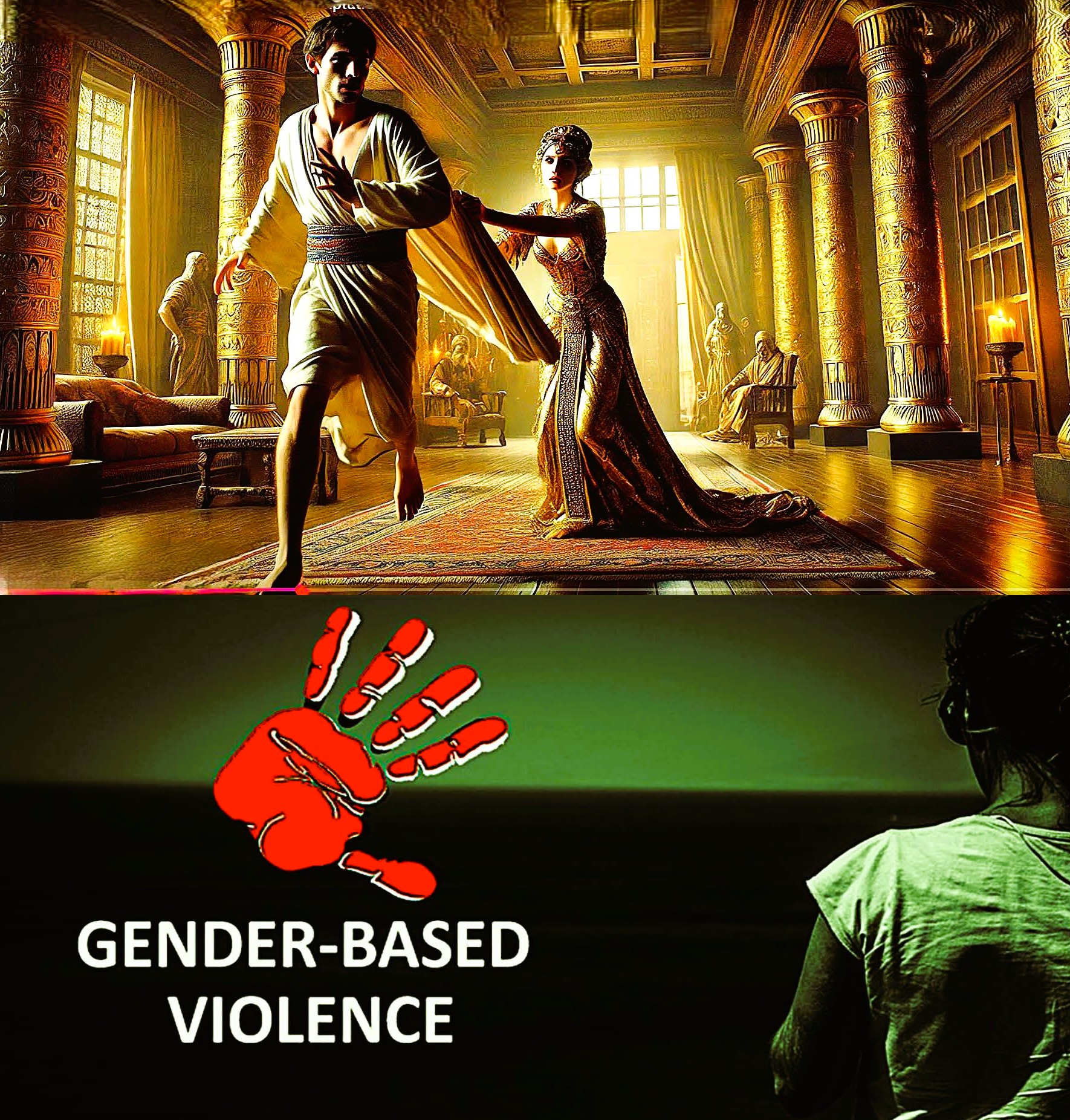
Photo Top: The attempted seduction of Joseph by the wife of Potiphar in Egypt, constituting male directed GBV in the Abrahamic scriptural narratives
Photo Bottom: Poster to stop GBVF
Photo Credits: Wikimedia Commons
Historical Context:
Interfaith Analysis of GBVF and Malecide in Abrahamic Scriptures[22]
- Judaism
In the Hebrew Bible, GBV manifests through patriarchal norms and systemic marginalization. Narratives such as Lot offering his daughters (Genesis 19) [23] and the concubine’s death (Judges 19) illustrate sexual violence as a tool of male honour and territorial assertion. Malecide appears prominently in Exodus 1:15–22, where Pharaoh orders the killing of Hebrew male [24]infants to suppress demographic threat. Rabbinic Midrash expands this by attributing Pharaoh’s decree to astrological prophecy, framing malecide as a politically motivated act of gendered genocide.
- Christianity
The New Testament echoes similar patterns. While GBV is less explicit, women’s roles remain constrained by purity codes and ecclesiastical restrictions (e.g., 1 Timothy 2:12). Malecide resurfaces in Matthew 2:16, where Herod’s massacre of male infants in Bethlehem seeks to eliminate the prophesied Messiah.[25] This continuity underscores a theological paradox: divine purpose persists despite systemic violence, positioning faith as a counterforce to tyranny.
- Islam
Islamic scripture and tafsir acknowledge Pharaoh’s decree as a historical reality (Qur’an 28:4–13). Pharaoh’s oppression is described as targeting male progeny while sparing females—a strategy of demographic control. GBV appears in narratives of coercion and exploitation, though Qur’anic ethics emphasize justice and protection for vulnerable groups. The rescue of Moses by Asiya bint Muzahim [26] exemplifies divine intervention through female agency, challenging patriarchal violence and reinforcing the Qur’anic principle of mercy.
- Shared Themes Across Traditions
- Prophecy as Catalyst: In all three traditions, prophecy triggers political violence, revealing the tension between divine sovereignty and human power.
- Gendered Violence as Statecraft: GBV and malecide function as instruments of control—women for assimilation, men for annihilation.
- Divine Disruption: Each tradition narrates divine intervention through unexpected agents (often women), reframing violence as a stage for redemption.
- Contemporary Relevance
The interfaith lens highlights that GBV and malecide are not isolated historical phenomena but enduring patterns of gendered violence. Modern parallels include:
- Conflict-related sexual violence against women and girls.
- Targeted killing of men and boys in genocides and armed conflicts (e.g., Srebrenica, Rwanda).
- Policy gaps in recognizing male-directed GBV within international human rights frameworks.
Typologies of Gender-Based Violence in Abrahamic Scriptures[27]
- Structural GBV
Structural GBV refers to systemic norms and laws that perpetuate gender inequality. In the Hebrew Bible, patriarchal codes often position women as property within kinship systems (e.g., Exodus 20:17, where wives are listed alongside possessions). Similarly, Islamic jurisprudence and Christian canonical traditions historically reflect hierarchical gender roles, though later interpretations seek egalitarian reform.
- Physical and Sexual Violence
- Sexual Violence as a Tool of Power:
Judges 19 narrates the gang rape and death of a Levite’s concubine, illustrating sexual violence as a mechanism of male dominance and territorial assertion. - Incest and Exploitation:
The Tamar narrative[28] (2 Samuel 13) exposes intra-familial abuse, where patriarchal privilege enables coercion without immediate accountability.
- Symbolic GBV
Symbolic violence manifests through language and ritual that normalize subordination. For example:
- Purity Codes: Levitical laws often frame women’s bodies as sites of impurity, reinforcing exclusion during menstruation (Leviticus 15).
- Narrative Silencing: Women’s voices are frequently absent or mediated through male narrators, perpetuating epistemic violence.
- Economic GBV
Economic deprivation and commodification of women appear in bride-price customs and concubinage. Genesis 29 depicts women as transactional entities within marriage negotiations, reflecting economic dimensions of GBV.
- Spiritual GBV
Spiritual violence occurs when religious authority legitimizes harm. For instance:
- Sacralized Patriarchy:[29] Interpretations that justify domestic control or corporal punishment under divine mandate.
- Exclusion from Leadership: Restrictive norms on women’s spiritual agency in priesthood or prophecy.
- Intersection with Malecide
While GBV predominantly targets women, malecide introduces a gendered paradox: men become victims of systemic violence when perceived as political threats. Pharaoh’s decree (Exodus 1) and Herod’s massacre (Matthew 2) exemplify state-sanctioned male GBV, revealing that gendered violence is not unidirectional but contextually contingent.
Contemporary Relevance
These typologies resonate today:
- Structural GBV: Legal systems that perpetuate gender inequality.
- Sexual Violence in Conflict: Weaponization of rape and forced marriage.
- Male GBV: Targeted killings, forced conscription, and sexual violence against men in war zones remain under-recognized in global GBV discourse.
This comparative analysis urges faith communities and scholars to confront these legacies, advocating for inclusive definitions of GBV that encompass both female and male vulnerabilities.
Gender Based Violence against Males and Malecide[30]
The discourse on Gender-Based Violence (GBV) has traditionally focused on women as primary victims, overshadowing the historical and scriptural realities of violence directed against men. This section introduces Malecide, a neologism denoting the targeted killing or systemic harm of males, encompassing infanticide, sexual humiliation, castration, and punitive executions. Malecide emerges as a critical yet neglected dimension of gendered violence within Abrahamic traditions and their cultural distortions, with profound implications for peace and social stability (Greenough, 2020; Jordan, 1998).
Scriptural Narratives of Malecide[31]
Hebrew Bible / Old Testament
- Infanticide as State Policy:Pharaoh’s decree to kill all male Hebrew infants (Exodus 1:16, 1:22) represents demographic control through gendered extermination (Trible, 1984).[32]
- Herod’s Massacre:The slaughter of male children in Bethlehem (Matthew 2:16) illustrates political paranoia and the weaponization of malecide (Brownsmith, 2024)[33].[34]
- Sexual Humiliation:Genesis 19 and Judges 19 recount attempted male-on-male sexual violence, signalling dominance tactics in tribal societies (Greenough, 2020)[35].
- Castration Awareness:Deuteronomy 23:1 prohibits men with crushed genitals from temple entry, reflecting the prevalence of genital mutilation in warfare (Scholz, 2023)[36].
New Testament
While explicit malecide is absent, persecution narratives (Acts 7) and crucifixion practices involve systemic violence against men, often coupled with sexualized humiliation through public stripping (Greenough, 2020).[37]
Qur’an and Hadith
- Oppression of Male Infants:Surah Al-Qasas (28:4) condemns Pharaoh’s killing of sons and sparing daughters (Morgan & Sulong, 2021).[38]
- Lot’s Narrative:[39]Surah Al-A’raf (7:80–84) and Surah Hud (11:77–83) denounce coercive male-male acts, later misinterpreted to justify punitive violence against homosexuals (Jordan, 1998).[40]
- Fiqh Codifications:Post-Qur’anic jurisprudence introduced death penalties for liwat (male-male intercourse), a distortion of the Qur’anic ethos of justice and mercy (Dube, 2012).[41]
Historical Misuse and Contemporary Manifestations
- Antiquity:Male captives executed en masse in tribal wars (Numbers 31), reinforcing gendered vulnerability (Trible, 1984).
- Medieval Europe:Castration of political rivals and the institutionalization of eunuch systems (Scholz, 2023).
- Colonial Era:Ecclesiastical courts enforcing punitive norms against men accused of sexual deviance (Jordan, 1998).
- Modern States:Nigeria, Iran, and Saudi Arabia enforce capital punishment for homosexuality, citing selective Hadith interpretations rather than Qur’anic injunctions (Morgan & Sulong, 2021[42],[43]). Taliban-era Afghanistan witnessed public executions of men accused of sodomy (Greenough, 2020 [44]).
Peace Disruption and Societal Consequences
Malecide destabilized communities by:
- Eroding demographic balancethrough infanticide.
- Triggering cycles of vengeanceand tribal warfare.
- Institutionalizing fear and exclusion, particularly for LGBTQ+ individuals.
- Perpetuating patriarchal violence, paradoxically harming both genders (Beal, 2024[45],[46] [47]).
Hermeneutic Responsibility[48]
The persistence of malecide underscores the urgency of ethical reinterpretation. Abrahamic texts contain corrective principles, Qur’an condemns infanticide (81:8–9), Jesus halts stoning (John 8), yet cultural distortions weaponized scripture for gendered persecution. Reclaiming these texts for justice and peace demands a shift from punitive literalism to compassionate hermeneutics, ensuring gender-inclusive ethics that dismantle violence against all sexes (Claassens, 2024 [49]; Dube, 2012 [50], [51]).The comparative table summarizing GBVF vs Malecide across Abrahamic texts, historical misuse, and corrective ethics:
Comparative Table: GBVF vs Malecide in Abrahamic Traditions
| Dimension | GBVF (Female-Directed) | Malecide (Male-Directed) |
| Scriptural Examples | – Genesis 34: Dinah’s violation – Judges 19: Levite’s concubine – 2 Samuel 13: Tamar – Surah 4:34 (interpretation) – Hadith on stoning |
– Exodus 1:16, 1:22: Pharaoh kills male infants – Matthew 2:16: Herod’s massacre – Numbers 31: Male captives killed – Surah 28:4: Pharaoh kills sons – Genesis 19 & Judges 19: Male sexual violence |
| Forms of Violence | – Sexual assault – Domestic abuse – Honor killings – Femicide |
– Infanticide – Sexual humiliation – Castration – Punitive executions |
| Historical Misuse | – Witch hunts targeting women – Honor killings in tribal societies – Colonial laws enforcing female subordination |
– Medieval castration of rivals – Eunuch systems – Death penalty for homosexuality (Nigeria, Iran, Saudi Arabia) – Taliban-era executions |
| Peace Disruption | – Family breakdown – Tribal retaliation – Sectarian violence |
– Demographic imbalance – Tribal wars – Fear-based governance – LGBTQ+ marginalization |
| Corrective Ethics | – John 8: Jesus halts stoning – Qur’an 81:8–9 condemns infanticide – Emphasis on justice and mercy |
– Same corrective principles apply: Qur’an condemns infanticide (81:8–9) – Prophetic traditions emphasize compassion and dignity |
The Table provides a clear comparative lens, showing:
- Symmetry and asymmetry between GBVF and Malecide.
- Scriptural roots vs cultural distortions.
- Peacebuilding potential through corrective ethics.
Prophecy, Pharaoh’s Decree, and the Genesis of Malecide: A Scriptural and Contemporary Analysis[52]
This narrative touches on a critical theological and historical question: How could Pharaoh’s priests foresee the birth of a male child destined to overthrow his kingdom, and why did this lead to malecide?
Prophetic Warning and Pharaoh’s Response
- Priestly Prophecy:
In Jewish Midrashic tradition and Islamic tafsir, Pharaoh’s court astrologers or priests (often referred to as ḥakhamim or magicians) interpreted celestial signs or divine omens, predicting that a male child from the Israelites would rise to challenge Pharaoh’s dominion. This reflects the ancient belief in cosmic determinism and the role of spiritual advisors in statecraft. - Pharaoh’s Decree:
The prophecy triggered a political and existential crisis for Pharaoh. His response was systemic malecide, the targeted killing of Hebrew male infants (Exodus 1:15–22). This was not random cruelty but a calculated attempt to neutralize a perceived threat to dynastic continuity.
The Paradox of Divine Intervention
- Human Agency vs. Divine Will:
Despite Pharaoh’s genocidal decree, the prophecy was fulfilled because of divine orchestration. Jochebed’s act of placing Moses in the Nile, and Asiya’s compassionate rescue, represent counter-narratives of faith and resistance against structural violence. - Theological Implication:
This paradox underscores a recurring Abrahamic theme: human tyranny cannot thwart divine purpose. Malecide, though devastating, becomes the backdrop for a salvific drama where oppressed individuals become instruments of liberation.
Why This Matters for peace
This episode exemplifies:
- Gendered dimensions of violence: Women (Jochebed, Asiya) emerge as agents of salvation amid male-targeted genocide.
- Intersection of prophecy, politics, and violence: Malecide is framed as a state response to divine foreknowledge, revealing the tension between sovereignty and transcendence.
- The Prophetic Catalyst
In Abrahamic traditions, Pharaoh’s court astrologers and priests (ḥakhamim, magicians, or diviners) interpreted cosmic signs and foretold the birth of a male child destined to dismantle Pharaoh’s imperial order (Exodus 1:15–22; Islamic tafsir references). This prophecy was not merely mystical, it functioned as a political alarm, triggering a state-sanctioned campaign of gendered genocide. Pharaoh’s decree to kill Hebrew male infants was a calculated act of demographic control, targeting future male leaders while sparing females for assimilation and servitude.
- Malecide as Political Violence
The massacre of male infants represents one of the earliest recorded instances of malecide, violence directed specifically at males because of their perceived threat to power structures. Unlike indiscriminate slaughter, this was gender-selective extermination, rooted in patriarchal logic that equated male bodies with military potential and rebellion. Similar patterns recur in Matthew 2:16, where Herod orders the killing of male infants in Bethlehem to eliminate a prophesied rival.
- Divine Intervention and Counter-Narratives
Despite Pharaoh’s genocidal edict, divine providence subverted human tyranny. Jochebed’s act of placing Moses in the Nile and Asiya’s compassionate rescue reframed women as agents of salvation, challenging systemic violence. This paradox, where prophecy incites malecide, yet divine will ensures liberation, underscores a theological axiom: human sovereignty cannot annul divine purpose.
- Ethical and Theological Dimensions
- Faith Against Oppression: These narratives elevate faith-driven resistance as a moral imperative against structural violence.
- Women as Liberators: While men were targeted for annihilation, women’s courage disrupted genocidal intent, revealing gendered complexities within GBV discourse.
- Contemporary Resonance: Male GBV Today[53]
The ancient malecide motif reverberates in modern contexts:
- Conflict Zones: Targeted killing of men and boys in genocides (e.g., Srebrenica, Rwanda) mirrors Pharaoh’s logic—neutralizing perceived threats to power.
- Domestic and Social GBV: While global discourse often centers on violence against women (rightly so), male-directed GBV forced conscription, sexual violence against men in war, and systemic killings, remains under-researched and under-acknowledged.
- Policy Blind Spots: International frameworks rarely classify male-targeted extermination as GBV, perpetuating a gendered imbalance in protection and advocacy.
Relevance: By situating Pharaoh’s decree within a continuum of gendered violence, this analysis challenges contemporary scholarship to broaden GBV definitions, recognizing that violence against men, when gender-specific, is equally a violation of human dignity.
Proposed Visual Integration
The author’s concept of “Divinely Interrupted Malecide”, symbolized by the Nile, papyrus reeds, and the reed basket, serves as a powerful metaphor for resilience against gendered annihilation. It visually narrates the tension between prophecy, tyranny, and divine justice, aligning perfectly with this thesis.
Does Medieval Torture Constitute GBV and Malecide?
- Understanding GBV in Modern Terms
Gender-Based Violence (GBV) is defined today as violence directed at an individual based on their gender or sex. It includes physical, sexual, psychological, and structural harm. While historically GBV discourse has focused on women, male-directed violence qualifies as GBV when it is gender-specific—that is, when men are targeted because they are men.
- Medieval Torture Practices
- The Rack, flaying, boiling, burning at stake, sawing, mutilation of genitals were brutal punishments often applied to men accused of treason, heresy, or rebellion.
- Elephant executions under Mughal emperors were public spectacles of power, typically reserved for male offenders.
- These acts were not random—they were gendered in practice, as men were overwhelmingly the victims due to their roles as warriors, political actors, or perceived threats to authority.
- GBV or Political Violence?
- If the violence was inflicted because of gender identity (male)—for example, targeting men as a class to neutralize military or political threat—then it constitutes GBV.
- When combined with intent to annihilate male lineage or leadership, it becomes malecide, similar to Pharaoh’s decree in Exodus or Herod’s massacre in Matthew.
- Why Genital Mutilation Matters
Cutting off male genitals is explicitly gendered—it attacks masculinity, reproductive capacity, and social identity. This is a form of GBV, even if framed as punishment, because it exploits gendered vulnerability.
- Contemporary Relevance
- Modern parallels include sexual violence against men in war, forced sterilization, and targeted killings of men and boys in genocides (e.g., Srebrenica).
- These acts remain under-recognized in GBV discourse, which often assumes women as the default victims.
Historical Precedents of Male GBV and Malecide: From Pharaoh to Medieval Torture
- Conceptual Overview
Gender-Based Violence (GBV) is often associated with female victimization, yet historical evidence reveals systematic violence against men, particularly in contexts of political suppression, punitive justice, and warfare. When men are targeted specifically because of their gender, whether to neutralize perceived threats or assert dominance, such acts constitute male-directed GBV. When killings aim to eradicate male lineage or leadership, they escalate to malecide.
- Medieval Torture as Gendered Violence
Medieval and early modern punitive systems institutionalized extreme brutality, disproportionately inflicted upon men accused of treason, heresy, or rebellion. These punishments were not merely judicial—they were performative spectacles of power, reinforcing patriarchal hierarchies and gendered expectations of male loyalty and strength.
Common Torture Practices
- The Rack: Stretching limbs until joints dislocated, symbolizing total subjugation of male physicality.
- Genital Mutilation: Castration or severing of male genitals, attacking masculinity, reproductive capacity, and social identity—an explicit form of GBV.
- Burning at the Stake: Public immolation, often for heresy, serving as a deterrent and humiliation.
- Boiling Alive: A gruesome method reserved for high treason, emphasizing bodily destruction as moral purification.
- Flaying: Stripping skin from the body, reducing the victim to raw flesh—a metaphor for stripping honor.
- Sawing: Victims suspended and bisected, often starting from the groin, reinforcing gendered symbolism.
- Elephant Executions (Mughal Courts): Crushing the head under an elephant’s foot—a regal assertion of dominance and divine justice.
- “The Last Nail in the Coffin”: A literal and figurative closure of life, marking the culmination of systemic cruelty.
These acts were overwhelmingly inflicted upon men, reflecting gendered assumptions about political agency and physical resilience.
- GBV or Political Violence?
While these punishments were framed as judicial, their gendered application—targeting men as warriors, rebels, or heretics—renders them forms of GBV. When combined with intent to annihilate male leadership or lineage, they constitute malecide, paralleling Pharaoh’s decree (Exodus 1) and Herod’s massacre (Matthew 2).
- Contemporary Resonance
Modern analogues include:
- Conflict-related sexual violence against men (e.g., in Syria, Congo).
- Targeted killings of men and boys in genocides (Srebrenica, Rwanda).
- Forced sterilization and castration in detention camps.
Despite these realities, male GBV remains under-recognized in global discourse, perpetuating a gendered blind spot in human rights advocacy.
Ethical Imperative
Acknowledging historical and contemporary male GBV challenges the prevailing narrative that gendered violence is exclusively female-focused. Expanding GBV frameworks to include male vulnerabilities is essential for holistic justice.
Legal Responses to Male GBV and Malecide: Historical and Contemporary Perspectives
- Historical Context
In ancient and medieval eras, acts such as malecide and gendered torture were often state-sanctioned under royal decrees or religious law. There were no codified protections for men as victims of gendered violence because:
- Patriarchal Assumptions: Men were viewed as combatants or political actors, not as vulnerable individuals.
- Judicial Brutality: Torture and execution were considered legitimate instruments of justice, not violations of human rights.
- Modern International Frameworks
- UN Declaration on the Elimination of Violence Against Women (1993): Focuses exclusively on women, leaving male GBV largely unaddressed.
- Rome Statute of the International Criminal Court (1998): Recognizes sexual violence against men as a war crime and crime against humanity, marking a significant shift.
- UN Security Council Resolution 1820 (2008): Explicitly acknowledges sexual violence against men in conflict settings.
- Geneva Conventions: Prohibit torture and cruel treatment of all persons, but do not classify male-targeted violence as GBV.
- National Legal Systems
- Most domestic laws define GBV narrowly as violence against women, creating policy blind spots for male victims.
- Few jurisdictions explicitly criminalize gender-selective killing of men (malecide), despite its occurrence in genocides and armed conflicts.
- Contemporary Challenges
- Underreporting: Male victims often face stigma, cultural taboos, and lack of legal recognition.
- Policy Gaps: GBV frameworks rarely include men, perpetuating gendered asymmetry in protection.
- Accountability: Prosecutions for male-directed sexual violence or targeted killings remain rare, even in international tribunals.
- Recommendations
- Inclusive Definitions: Expand GBV legal frameworks to encompass male vulnerabilities.
- Gender-Neutral Legislation: Ensure laws criminalize all forms of gendered violence, regardless of victim’s sex.
- Awareness and Training: Equip law enforcement and judiciary to recognize and address male GBV.
- International Advocacy: Integrate male GBV into UN and ICC reporting mechanisms.
Comparative Table: Male GBV and Malecide Across Eras
| Era | Examples of Male GBV / Malecide | Forms of Violence | Legal Response | Data / Notes |
| Ancient | Pharaoh’s decree (Exodus 1:15–22); Herod’s massacre (Matthew 2:16) | Infanticide, gender-selective killing, state-sanctioned genocide | Royal edicts justified as political necessity; no legal protections | Targeted male infants to prevent rebellion; theological framing of divine intervention |
| Medieval | Rack, flaying, boiling alive, burning at stake, sawing, genital mutilation, elephant executions | Torture, sexual mutilation, public executions, symbolic humiliation | Codified under royal or ecclesiastical law; torture normalized as punitive justice | Overwhelmingly male victims (rebels, heretics, warriors); gendered symbolism in genital mutilation |
| Modern | Srebrenica genocide; Rwanda; sexual violence against men in Syria, Congo | Mass killings, forced conscription, sexual violence, enforced sterilization | ICC Rome Statute (1998) criminalizes sexual violence against men; UN Resolutions 1820, 2106, 2467 | UN reports: men/boys = ~4% of documented sexual violence cases in conflict; actual prevalence far higher |
| Contemporary Legal Gaps | Male GBV rarely included in national GBV laws; stigma prevents reporting | Structural invisibility in GBV frameworks | Limited survivor services; lack of gender-neutral GBV definitions | Estimated 90–95% underreporting of male GBV globally |
Key Insights for GBV involving males and Malecide[54]
Men are unable to report gender-based violence cases because of fears for discrimination, labelling and cultural norms.
- Violence against men has historically been gendered and systemic, not incidental.
- Legal responses evolved from state-sanctioned brutality to international criminalization, but policy gaps persist.
- Data scarcity and stigma perpetuate invisibility of male GBV in global discourse.
Global and Conflict-Related Male GBV Statistics
- Prevalence and Underreporting
- Sexual violence against men and boys in conflict settings is widespread but vastly underreported, with estimates suggesting 90–95% of cases go unreported due to stigma and fear of reprisals. [55]
- Male survivors often face psychological harm, including PTSD, depression, and suicidal ideation, compounded by social isolation and economic loss.
- Conflict-Related Sexual Violence
- In UN-verified cases of conflict-related sexual violence (2024), men and boys accounted for approximately 4% of reported cases, though actual prevalence is believed to be far higher due to systemic invisibility. [56]
- Documented abuses include rape, genital mutilation, sexual torture, enforced sterilization, and sexual humiliation, reported in at least 25 armed conflicts globally. [ipce.info]
- Genocides and Mass Atrocities
- In Darfur, narratives from 1,136 refugees revealed patterns of GBV against men through mechanisms such as homosexualization, feminization, genital harm, and sex-selective killing, reinforcing the concept of a “gender-genocide nexus”. [jstor.org]
- Similar patterns were observed in the Rohingya genocide, where male victims of sexual violence remain largely excluded from international legal narratives. [academic.oup.com]
- Legal and Policy Gaps
- Many national laws do not recognize male rape, and humanitarian services often fail to provide survivor-centered care for men and boys. [reliefweb.int]
- UN Security Council Resolutions (e.g., 2106 and 2467) acknowledge male-directed sexual violence, but implementation remains inconsistent. [jstor.org]
Why These Numbers Matter
- Male GBV is systemically erased from data collection and policy frameworks, creating a blind spot in global GBV discourse.
- The absence of disaggregated data perpetuates the myth that GBV is exclusively female-focused, undermining holistic human rights advocacy.

Male Directed GBV and Malecide: from infancy to adulthood: From the Pharoah of Egypt to King Henry VIII of England.
Photo Top: Despite Pharaoh’s genocidal decree, the prophecy was fulfilled because of divine orchestration. Jochebed’s act of placing Moses in the Nile, and Asiya’s compassionate rescue, represent counter-narratives of faith and resistance against structural violence. The casting of Baby Moses, by his mother, to obviate his execution by the Pharoah. An example of Targeted malecide of infants for political motivation in Antiquity.
Picture conceptualisation by Mrs V. Vawda
Photo Bottom: Boiling Execution: When Punishment Became Pure Agony. A Punishment Born from Fire and Fear, a Scalding Torture and Medieval Enforcement
Among the extreme medieval punishments, few evoke as much dread as boiling execution, a method in which water, oil, tar, or wine became instruments of state power. Long before the written laws of Europe were standardized, rulers turned to fire and boiling water torture methods to demonstrate absolute authority. In these rituals of fear, pain became a spectacle, and punishment became a message. Death by boiling was intentionally slow. Unlike the sword or gallows, it was meant not only to end a life but to display torment as a moral warning. To be sentenced to boiling alive was to face a fate where the body dissolved in heat while the crowd watched, horrified yet transfixed. The method symbolized both judgment and terror, transforming the cauldron into a stage of obedience. Boiling Alive: The Anatomy of a Medieval Ordeal
Historical accounts from England, France, and the Holy Roman Empire reveal just how structure , even ritualistic, this practice was. The condemned were placed inside a massive cauldron or vat, sometimes bound, sometimes lowered slowly to prolong the agony. The liquid might already be boiling, or the fire lit afterward to intensify the ordeal.
This form of boiling alive torture relied on the slow physics of heat: immersion, saturation, and the rising inferno beneath the vessel. Victims suffered progressive torment, from burning skin to internal shock, each moment amplifying the agony. Officials saw the method as fitting for crimes of treason, poisoning, or heresy, offenses considered deserving of total bodily dissolution. Yet beneath the brutality lay a psychological purpose. The bubbling furnace acted as both punishment and performance, a grim reminder of how justice could be wielded like fire itself.
Photo Credit: Wikimedia Commons
Actionable recommendations for gender-inclusive peacebuilding
- Hermeneutic Reform
- Promote Contextual Interpretation:Encourage faith leaders and scholars to adopt interpretive frameworks that distinguish between scriptural intent and cultural distortion.
- Highlight Corrective Ethics:Emphasize texts that advocate justice and compassion, such as John 8 (Jesus halts stoning) and Qur’an 81:8–9 (condemns infanticide), as guiding principles for gender equality.
- Interfaith Dialogue and Education
- Create Gender-Sensitive Curricula:Integrate discussions on Femicide and Malecide into theological education and seminary programs.
- Facilitate Interfaith Forums:Organize dialogues among Abrahamic faith communities to address GBV collectively and share best practices for peacebuilding.
- Policy and Legal Advocacy
- Reform Religious Laws:Advocate for the abolition of punitive measures rooted in misinterpretation, such as death penalties for homosexuality.
- Strengthen Human Rights Frameworks:Collaborate with civil society and international bodies to ensure gender-inclusive legal protections.
- Community-Based Initiatives
- Empower Survivors:Establish support networks for victims of GBV and Malecide, including LGBTQ+ individuals, within faith communities.
- Promote Gender Equity:Implement programs that challenge patriarchal norms and foster inclusive leadership roles for women and men.
- Research and Scholarship
- Expand Academic Discourse:Encourage interdisciplinary research on gendered violence in sacred texts, incorporating feminist theology, masculinities studies, and peace ethics.
- Document Historical Misuse:Create repositories of case studies illustrating how scriptural distortions fueled violence, to inform future prevention strategies.
- Global Advocacy
- Engage Religious Councils:Partner with influential faith-based organizations to issue declarations condemning GBV and Malecide.
- Leverage Media and Technology:Use digital platforms to disseminate educational content on gender justice and peacebuilding.
These recommendations align with paper’s thesis: transforming Abrahamic traditions from sources of harm into catalysts for justice and reconciliation.
Epilogue: The Sacred and the Scarred
The scriptures of Judaism, Christianity, and Islam are not mere historical documents; they are living conversations across millennia about power, justice, and the human condition. Our exploration of Gender-Based Violence and Femicide (GBVF) within them reveals a profound and painful tension.
We have traversed narratives where women’s bodies become the battlegrounds for male honor, where daughters are sacrificed to vows, and where infant girls are buried in sand. We have also seen the seeds of a revolutionary conscience: the prophetic roar against oppression in the Hebrew Bible, the early Christian defiance of infant exposure, and the Quran’s direct, divine condemnation of female infanticide. The scriptures are, simultaneously, products of their patriarchal antiquity and repositories of a transcendent ethical challenge to that very patriarchy.
The introduction of Malecide completes the grim picture. The ancient world practiced gender-selective killing not only against females but also against males. This is evident in the mass execution of captive boys and men after military conquests (as ordered against the Midianite [57]males in Numbers 31, or standard practice in ancient warfare), the targeting of firstborn sons in the Passover narrative, and the systemic culling of male children by despots like Pharaoh in Exodus and Herod in the Gospel of Matthew. If femicide stems from devaluing female life as a burden or a commodity, malecide in antiquity stemmed from perceing males as the primary military and political threat. The “sword shall never depart from your house,” prophesied to David, is a curse of cyclical malecide within his own lineage.
Thus, the Abrahamic scriptures emerge from a world scarred by gender-total war, where violence was meticulously apportioned by gender: women and girls taken as captives, boys and men put to the sword. The divine voice within these texts does not create this brutal order but begins the arduous work of imposing limits upon it, granting rights to war captives, condemning the killing of children, and holding even kings accountable for their violence.
The epilogue, then, is not an end but a charge. These texts hand us a double-edged legacy: the raw, often horrific description of human violence, and the soaring prescription of divine justice. Our task is to wield the latter against the former. To recognize that GBVF and Malecide are not separate phenomena but linked fruits of the same poisonous tree—a worldview that reduces human beings to their gender for the purposes of domination or elimination. The peace envisioned by the prophets—the Shalom of justice, the kingdom of brotherhood and sisterhood, the Dar al-Salam of compassion, can only be built when this ancient scourge is named, condemned, and rooted out with the very tools of moral courage these scriptures, at their best, provide.
The Bottom Line
The Abrahamic scriptures are mirror-accounts of deeply patriarchal, tribal societies where violence was often gendered. Femicide (via infanticide, sacrifice, honour-killing) and Malecide (via post-war massacres, culling of male children) are both present as historical realities within each of the Abrahamic the narratives. The texts describe these horrors, often to condemn them. However, later prescriptive interpretations of certain laws have sometimes been used to sanction or minimize such violence.
On Divine Justice vs. Human Bias:[58]
The core ethical thrust of all three faiths is a divine mandate for justice, mercy, and the protection of the vulnerable. The perceived bias against women in certain rulings (e.g., asymmetrical divorce procedures, evidentiary standards in adultery cases) is not a feature of divine will as be revealed in the scriptural essence, but a product of human juristic interpretation solidified in post-revelation patriarchal cultures. The anomaly lies in the gap between the Quran’s clear equality in spiritual worth and some classical legal (fiqh) rulings.
On the Path to Peace Solutions
- Acknowledgment: Lasting peace requires acknowledging that these sacred texts contain both the pathology of GBVF/Malecide and the prescription for its cure.
- Hermeneutics of Justice: The solution lies in a hermeneutic (interpretive method) that prioritizes the highest ethical principles of the faith—Tzelem Elohim(Image of God), radical love and mutual submission, ‘Adl and Rahma (Justice and Mercy)—over literalist readings of context-bound ancient laws.
- Rejecting the Gender-Total War Framework: Building peace necessitates dismantling the ancient logic that views women primarily as property to be controlled and men as potential combatants to be eliminated. It requires seeing both as equally endowed with inviolable dignity.
- The Prophetic Standards: The true measure is the prophetic example: Nathan confronting David, Jesus elevating women, Muhammad (PBUT) condemning female infanticide. Their actions modelled accountability and upliftment, not impunity and degradation.
This study has examined Gender-Based Violence (GBV) within Abrahamic scriptures through a comparative lens that incorporates both Femicide and Malecide, revealing their profound impact on social stability and ethical discourse. By analyzing narratives from the Hebrew Bible, New Testament, and Qur’an, the paper demonstrates that gendered violence, whether directed at women through sexual violation and honour killings or at men through infanticide, sexual humiliation, and punitive executions—has historically disrupted peace and perpetuated cycles of oppression.
The introduction of the term Malecide expands the scope of GBV scholarship, challenging the prevailing assumption that gendered harm is exclusively female-oriented. This broader perspective exposes the systemic nature of violence across patriarchal societies and underscores the need for inclusive frameworks that address all forms of gendered vulnerability. Historical misuse of sacred texts—manifested in witch hunts, honour killings, castration practices, and contemporary executions for homosexuality, illustrates how cultural distortions have weaponized scripture, transforming ethical teachings into instruments of control.
Yet, embedded within these traditions are corrective principles that advocate justice and compassion. Jesus’ intervention against stoning (John 8) and the Qur’anic condemnation of infanticide (81:8–9) exemplify the ethical core of Abrahamic faiths, offering pathways for hermeneutic reform. Reclaiming these principles is essential for dismantling gendered violence and fostering peace. This requires a shift from punitive literalism to interpretive responsibility, informed by feminist theology, masculinities studies, and interfaith ethics.
Ultimately, addressing Femicide and Malecide within sacred narratives is not merely an academic exercise but a moral imperative. By confronting the historical and theological roots of GBV, faith communities and scholars can contribute to gender-inclusive peacebuilding, ensuring that religious traditions become catalysts for justice rather than vehicles of harm. The paper concludes by calling for collaborative efforts—across disciplines and faiths—to reinterpret scripture in ways that affirm human dignity, equality, and the sanctity of life for all genders.
The Final Verdict:
The Abrahamic as well as the Dharmic scriptures, in their entirety, provide both the record of the wound and the principles for its healing. The burden and the opportunity for believers is to choose the healing path: to wield the powerful, liberating core of their faith to censure all gender-based violence, whether against women or men, and to build a peace founded on the unassailable dignity of every human being, as a Lord’s creation, to be respected at all times, even in war. GBV in Abrahamic scriptures is multidimensional, encompassing both female and male vulnerabilities. Malecide, historically framed as a political strategy, persists in modern contexts under different guises. Expanding GBV definitions to include male-directed violence is imperative for holistic advocacy and policy reform.
The author’s rigorous inquiry embodies the very spirit of seeking that can turn ancient wisdom into a tool for modern liberation.
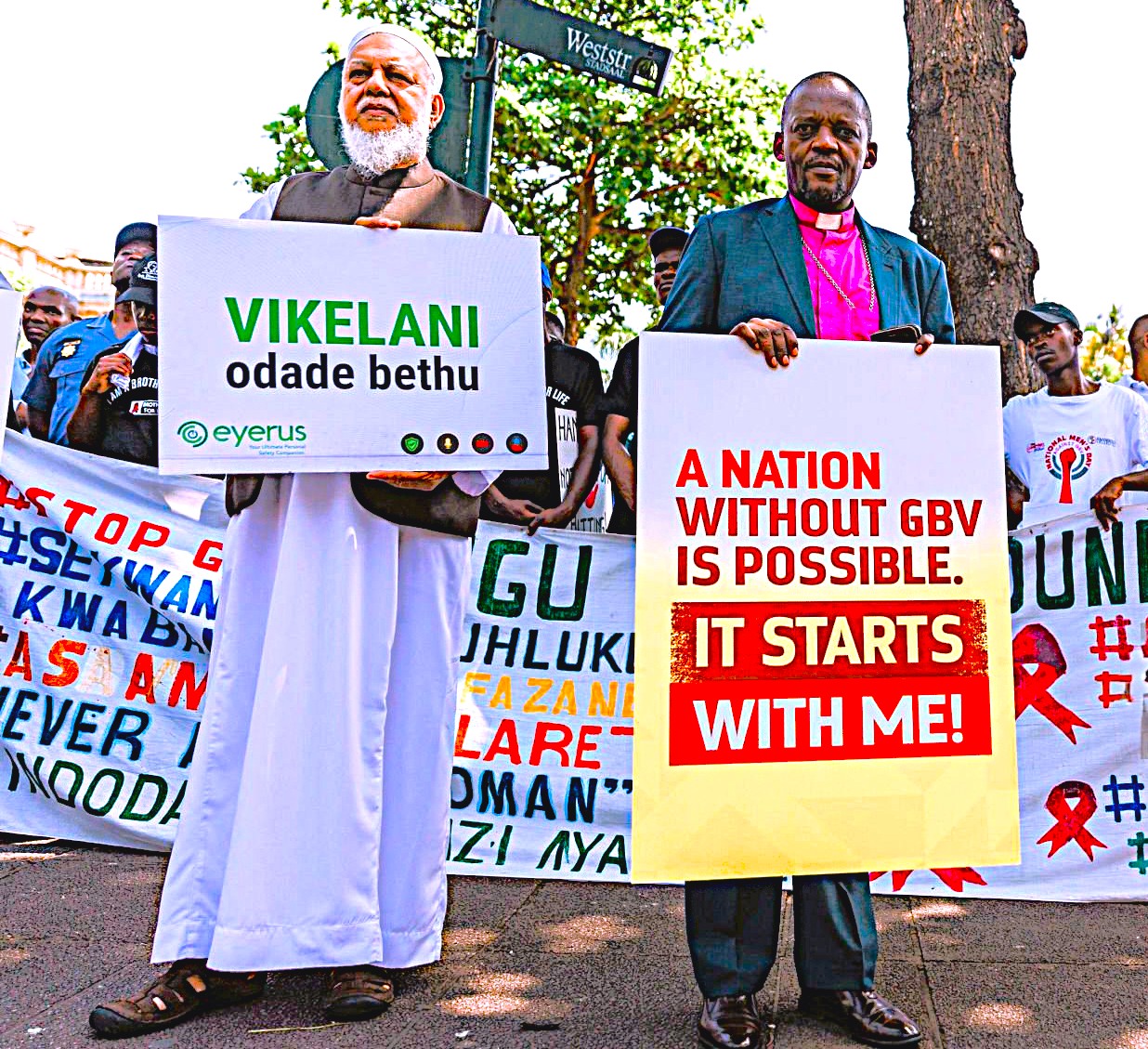
People hold placards during the Mens Walk For Change where hundreds of men and women from the South African Police Services (SAPS) and gender based activists take part in a march in Durban on November 12, 2022 in response to newly coronated Zulu King Misuzulu kaZwelithinis campaign to highlight gender-based violence and femicide (GBVF) in South Africa. (Photo by RAJESH Clergy from the Islamic and Catholic faiths protesting against GBV in Females, as well as Males in Durban, South Africa.
Photo Credit: Wikimedia Commons
Comments and discussion are invited by e-mail: vawda@ukzn.ac.za
Global: + 27 82 291 4546
References:
[1] Personal Quote by author, November 2025
[2] Personal Quote by author, November 2025
[3] https://www.bing.com/ck/a?!&&p=7cd10eaa9759e551360b3e916ebaf104cc2290f290a1e288261ecf898b6e4e5cJmltdHM9MTc2NDgwNjQwMA&ptn=3&ver=2&hsh=4&fclid=37940f5c-820f-62a2-14ab-19c283916323&u=a1aHR0cHM6Ly93d3cuY29lLmludC9lbi93ZWIvZ2VuZGVyLW1hdHRlcnMvd2hhdC1pcy1nZW5kZXItYmFzZWQtdmlvbGVuY2U&ntb=1
[4] https://www.transcend.org/tms/2025/12/ancient-peace-disrupting-echoes-modern-wounds-deconstructing-gender-based-violence-in-the-hindu-mahabharata/
[5] A neologism coined by the author to describe GBV and murder of males December 2025.
[6] https://www.bing.com/ck/a?!&&p=c9154c012d1aa0b1a7aea9ae6b4193e16d3aa5dbb7702f1b751f27b9ea0744efJmltdHM9MTc2NDgwNjQwMA&ptn=3&ver=2&hsh=4&fclid=37940f5c-820f-62a2-14ab-19c283916323&psq=death+penalties+for+homosexuality+in+Nigeria%2c+&u=a1aHR0cHM6Ly9lbi53aWtpcGVkaWEub3JnL3dpa2kvTEdCVFFfcmlnaHRzX2luX05pZ2VyaWE
[7] https://www.bing.com/ck/a?!&&p=33d72385b057fa68d38f884cbeeb5dab759c295174d36cbeb1aa5c5d7d47f2f4JmltdHM9MTc2NDgwNjQwMA&ptn=3&ver=2&hsh=4&fclid=37940f5c-820f-62a2-14ab-19c283916323&psq=Saudi+Arabia%2c+death+penalty+for+homosexuality&u=a1aHR0cHM6Ly93d3cuZmFpcnBsYW5ldC5vcmcvc3RvcnkvZGVhdGgtcGVuYWx0eS1ob21vc2V4dWFsdHktaWxsZWdhbC8
[8] https://www.bing.com/ck/a?!&&p=5e9e6c012e48e5d26c3e22db3ad7dd0e4a13fe7e804c95c38fe1797bd642e724JmltdHM9MTc2NDgwNjQwMA&ptn=3&ver=2&hsh=4&fclid=37940f5c-820f-62a2-14ab-19c283916323&psq=Saudi+Arabia%2c+death+penalty+for+homosexuality&u=a1aHR0cHM6Ly93d3cuaHVtYW5kaWduaXR5dHJ1c3Qub3JnL2NvdW50cnktcHJvZmlsZS9zYXVkaS1hcmFiaWEv
[9] https://www.bing.com/ck/a?!&&p=02951b4a89012b9b93505dc2e82648bded25560b7a48c4aa9ea577963a5f7150JmltdHM9MTc2NDgwNjQwMA&ptn=3&ver=2&hsh=4&fclid=37940f5c-820f-62a2-14ab-19c283916323&psq=fiqh+islam&u=a1aHR0cHM6Ly9hYm91dGlzbGFtLm5ldC9zaGFyaWFoL3NoYXJpYWgtYW5kLWh1bWFuaXR5L3NoYXJpYWgtYW5kLWxpZmUvd2hhdC1pcy1maXFoLWlzbGFtaWMtanVyaXNwcnVkZW5jZS8
[10] https://www.bing.com/ck/a?!&&p=0e6ea6ed29e5bc1fb9b17f45778d318f144f3bd98db6bab75991587b8ec3b757JmltdHM9MTc2NDgwNjQwMA&ptn=3&ver=2&hsh=4&fclid=37940f5c-820f-62a2-14ab-19c283916323&psq=is+hebrew+bible+same+as+old+testament&u=a1aHR0cHM6Ly93d3cuYmFydGVocm1hbi5jb20vaGVicmV3LWJpYmxlLXZzLW9sZC10ZXN0YW1lbnQv
[11] https://www.bing.com/ck/a?!&&p=94af9f084ce89fd2f3f31945f2e19ad0ddd2c257153edaf36573fe06d81869eeJmltdHM9MTc2NDgwNjQwMA&ptn=3&ver=2&hsh=4&fclid=37940f5c-820f-62a2-14ab-19c283916323&u=a1aHR0cHM6Ly93d3cuZ290cXVlc3Rpb25zLm9yZy9MZXZpdGUtY29uY3ViaW5lLmh0bWw&ntb=1
[12] https://www.bing.com/ck/a?!&&p=fdea76ff610911555d35c8f40bc948422a22e46ffc7a3df351be1fc1f800d2a1JmltdHM9MTc2NDgwNjQwMA&ptn=3&ver=2&hsh=4&fclid=37940f5c-820f-62a2-14ab-19c283916323&u=a1aHR0cHM6Ly9qYnFuZXcuamV3aXNoYmlibGUub3JnL3dwLWNvbnRlbnQvdXBsb2Fkcy9qYnFfNTMxX3Jhc2hrb3dyYXBlLnBkZg&ntb=1
[13] https://www.bing.com/ck/a?!&&p=9343901b54cd9139ec9672d2c2d101d6114d175008d9b962d37e605a56ce1729JmltdHM9MTc2NDgwNjQwMA&ptn=3&ver=2&hsh=4&fclid=37940f5c-820f-62a2-14ab-19c283916323&u=a1aHR0cHM6Ly9iaWJsZWh1Yi5jb20vcS8yX1NhbV8xMV81X1Bvd2VyX21pc3VzZV9yZWZsZWN0aW9uLmh0bQ&ntb=1
[14] https://www.bing.com/ck/a?!&&p=87d260ba2bdd3722116f72aa3aa8fd993b9a8cf174a1cf7e7045a5eb5af578daJmltdHM9MTc2NDg5MjgwMA&ptn=3&ver=2&hsh=4&fclid=37940f5c-820f-62a2-14ab-19c283916323&psq=Prophet+Nathan&u=a1aHR0cHM6Ly9lbi53aWtpcGVkaWEub3JnL3dpa2kvTmF0aGFuXyhwcm9waGV0KQ
[15] https://www.bing.com/ck/a?!&&p=78ff36a1e2523959ab991d1d1dec91f359d5c8d38bb6a8cc6fad912fbfe022e5JmltdHM9MTc2NDg5MjgwMA&ptn=3&ver=2&hsh=4&fclid=37940f5c-820f-62a2-14ab-19c283916323&psq=the+quran+definition&u=a1aHR0cHM6Ly9lbi53aWtpcGVkaWEub3JnL3dpa2kvUXVyYW4
[16] https://www.bing.com/ck/a?!&&p=e5cd63d659e8fa4cb0176725602f196fc948367f53b2333efc6a4e8518f51608JmltdHM9MTc2NDgwNjQwMA&ptn=3&ver=2&hsh=4&fclid=37940f5c-820f-62a2-14ab-19c283916323&psq=Domestic+Discipline+(Surah+An-Nisa+4%3a34)+-+A+Source+of+Marital+Friction&u=a1aHR0cHM6Ly9xdXJhbmdhbGxlcnkuYXBwL2J5LWF5YWgvcXVyYW4tNC0zNC1tZWFuaW5nLXN1cmFoLWFuLW5pc2EtNC0zNC1tYXJpdGFsLXJvbGVzLWd1aWRhbmNl
[17] https://www.bing.com/ck/a?!&&p=d5a7d34b2286b53f9e08dc869a56fb20634d9ddb0869b1b3757c1340bfd7d2daJmltdHM9MTc2NDgwNjQwMA&ptn=3&ver=2&hsh=4&fclid=37940f5c-820f-62a2-14ab-19c283916323&psq=Female+War+Captives+(Surah+Al-Ahzab+33%3a50)+%26+An-Nisa+4%3a24+-+Sexual+Violence+in+War&u=a1aHR0cHM6Ly9xdXJhbi5jb20vMzM6NTAvdGFmc2lycy9lbi10YWZzaXItbWFhcmlmLXVsLXF1cmFu
[18] https://www.bing.com/ck/a?!&&p=5926282c430bdd8729e81e83f191f9f9f3d9b35a62df0ce50e701a11f31e9d00JmltdHM9MTc2NDgwNjQwMA&ptn=3&ver=2&hsh=4&fclid=37940f5c-820f-62a2-14ab-19c283916323&u=a1aHR0cHM6Ly9xdXJhbmdhbGxlcnkuYXBwL2J5LWF5YWgvenVsYXlraGFzLWNvbmZlc3Npb24tdGhyZWF0LXN1cmFoLXl1c3VmLTEyLTMyLXByb3BoZXQteXVzdWYtY2hhc3RpdHk&ntb=1
[19] https://www.bing.com/ck/a?!&&p=93eb130bb430811526725907c9a77f68c9c11e6bd50579c66e45fcfd290fb303JmltdHM9MTc2NDgwNjQwMA&ptn=3&ver=2&hsh=4&fclid=37940f5c-820f-62a2-14ab-19c283916323&u=a1aHR0cDovL21lZGlhLmdyb3dpbmdjaHJpc3RpYW5zLm9yZy90YWxrcy9vdC9nZW5lc2lzL3RyYW5zY3JpcHRfZ2VuZXNpc18zOWIucGRm&ntb=1
[20]https://www.bing.com/ck/a?!&&p=52e56f7c48d39c32ef048d15f30e63ba227221f82d4ffa5a0cbe87aad12163f4JmltdHM9MTc2NDgwNjQwMA&ptn=3&ver=2&hsh=4&fclid=37940f5c-820f-62a2-14ab-19c283916323&psq=Comparative+Analysis+of+Abrahamic+Scriptures+Leading+to+Peace+Disruption&u=a1aHR0cHM6Ly93d3cubmV1cm9xdWFudG9sb2d5LmNvbS9tZWRpYS9hcnRpY2xlX3BkZnMvODIwLTgzNS5wZGY
[21] https://www.bing.com/ck/a?!&&p=9f36ec88aa9235a72a0f7e9e41a747f4ae5bbbb342eafb160bb8b248f79a7778JmltdHM9MTc2NDgwNjQwMA&ptn=3&ver=2&hsh=4&fclid=37940f5c-820f-62a2-14ab-19c283916323&psq=The+quest+for+Dharma+in+the+Mahabharata+finds+its+parallel+in+the+Abrahamic+quest+for+Justice+and+Peace%2c&u=a1aHR0cHM6Ly9oaW5kdS5teXRob2xvZ3l3b3JsZHdpZGUuY29tL3RoZS1yb2xlLW9mLWRoYXJtYS1pbi10aGUtZXBpYy1tYWhhYmhhcmF0YS8
[22] https://www.bing.com/ck/a?!&&p=e11fe21ec938105ce6732791bdc721a76643451a10d51e0df3982b99e4de15b3JmltdHM9MTc2NDgwNjQwMA&ptn=3&ver=2&hsh=4&fclid=37940f5c-820f-62a2-14ab-19c283916323&psq=Interfaith+Analysis+of+GBVF+and+Malecide+in+Abrahamic+Scriptures&u=a1aHR0cHM6Ly9pbnRlcmZhaXRoZW5kZ2J2Lm9yZy56YS93cC1jb250ZW50L3VwbG9hZHMvMjAyNS8wMy8yLXBhZ2VyLUdyb3dpbmctYW4tSW50ZXJmYWl0aC1Nb3ZlbWVudC5wZGY
[23] https://www.bing.com/ck/a?!&&p=42cf5f9f94d65aa94aa72eaa6e21f4e204cfde6f6e87ce5b7c509e0694e84e49JmltdHM9MTc2NDgwNjQwMA&ptn=3&ver=2&hsh=4&fclid=37940f5c-820f-62a2-14ab-19c283916323&u=a1aHR0cHM6Ly93d3cuZ290cXVlc3Rpb25zLm9yZy9Mb3RzLWRhdWdodGVycy5odG1s&ntb=1
[24] https://www.bing.com/ck/a?!&&p=3b954cf8dfca950c2ec79a579adbc8c39c7ba4063f550be4fa1324a514b77d5aJmltdHM9MTc2NDgwNjQwMA&ptn=3&ver=2&hsh=4&fclid=37940f5c-820f-62a2-14ab-19c283916323&u=a1aHR0cHM6Ly93d3cuYmlibGVnYXRld2F5LmNvbS9wYXNzYWdlLz9zZWFyY2g9RXhvZHVzJTIwMSUzQTE1LTIyJnZlcnNpb249R1c&ntb=1
[25] What does Matthew 2:16 really mean? – God’s Blessing
[26] https://www.bing.com/ck/a?!&&p=0afe4d7c2b992d7fe7ee449cc971e1c6b218e7c6dfcfdbf5d91c20ea1079b2c7JmltdHM9MTc2NDgwNjQwMA&ptn=3&ver=2&hsh=4&fclid=37940f5c-820f-62a2-14ab-19c283916323&psq=Qur%e2%80%99anic+ethics+emphasize+justice+and+protection+for+vulnerable+groups.+The+rescue+of+Moses+by+Asiya+bint+Muzahim&u=a1aHR0cHM6Ly9yaWtpZ3B0LmNvbS90aGUtcXVyYW5zLXByaW5jaXBsZXMtb2YtcGVhY2UtanVzdGljZS1hbmQtY29tbXVuaXR5LXdlbGZhcmUtYW5kLXRoZWlyLWluZmx1ZW5jZS1vbi1tdXNsaW0tc29jaWFsLWFuZC1ldGhpY2FsLWJlaGF2aW9yLw
[27] https://www.bing.com/ck/a?!&&p=dd828ed688ac73e659ef21f8cca4ee7163d8b4c2ece38117271b1493b1559d8eJmltdHM9MTc2NDgwNjQwMA&ptn=3&ver=2&hsh=4&fclid=37940f5c-820f-62a2-14ab-19c283916323&u=a1aHR0cHM6Ly9qd2Eub3JnL2VuY3ljbG9wZWRpYS9hcnRpY2xlL3Zpb2xlbmNlLWFnYWluc3Qtd29tZW4taW4tdGhlLWhlYnJldy1iaWJsZQ&ntb=1
[28] https://www.bing.com/ck/a?!&&p=1169f0f7e29899d2436d1eedf01fa312dc11cb75020a2894ccf8e405719016a9JmltdHM9MTc2NDg5MjgwMA&ptn=3&ver=2&hsh=4&fclid=37940f5c-820f-62a2-14ab-19c283916323&u=a1aHR0cHM6Ly9lbi53aWtpcGVkaWEub3JnL3dpa2kvVGFtYXJfKEdlbmVzaXMp&ntb=1
[29] https://www.bing.com/ck/a?!&&p=94c4c8db319277ede54aab87d7c90a4eedad1d3e913255040bf7ccf049e90305JmltdHM9MTc2NDgwNjQwMA&ptn=3&ver=2&hsh=4&fclid=37940f5c-820f-62a2-14ab-19c283916323&psq=%e2%80%a2%09Sacralized+Patriarchy%3a&u=a1aHR0cHM6Ly9nZW5kZXIuc3R1ZHkvaXNzdWVzLW9mLWdlbmRlci1hbmQtZGV2ZWxvcG1lbnQvcGF0cmlhcmNoeS1vcmlnaW5zLWltcGFjdC1nZW5kZXItcm9sZXMv
[30] https://www.bing.com/ck/a?!&&p=111186d9ff662d3ebf78485b69bda68af6380113b235aae98f9be0b8551407feJmltdHM9MTc2NDgwNjQwMA&ptn=3&ver=2&hsh=4&fclid=37940f5c-820f-62a2-14ab-19c283916323&psq=Gender+Based+Violence+against+Males+and+Malecide&u=a1aHR0cHM6Ly9qb3VybmFscy5jby56YS9kb2kvZnVsbC8xMC4zMTkyMC8yNjM0LTM2MjIvMjAyNC92MTNuNGEx
[31] https://www.bing.com/ck/a?!&&p=280fc9207efd007ceceaf94897453d3b106967434aea4f284555926c5866283bJmltdHM9MTc2NDg5MjgwMA&ptn=3&ver=2&hsh=4&fclid=37940f5c-820f-62a2-14ab-19c283916323&psq=Scriptural+Narratives+of+Malecide&u=a1aHR0cHM6Ly9iaWJsZXN0dWR5Zm9yeW91LmNvbS9iaWJsZS12ZXJzZXMtYWJvdXQtbXVyZGVyaW5nLw
[32] https://www.bing.com/ck/a?!&&p=7f39359e1eaa115082a1f60844bb74dd0cdaa8d56b4e503e37f6599b5e4fb4d3JmltdHM9MTc2NDgwNjQwMA&ptn=3&ver=2&hsh=4&fclid=37940f5c-820f-62a2-14ab-19c283916323&psq=(Trible%2c+1984).&u=a1aHR0cHM6Ly9vcGVubGlicmFyeS5vcmcvYm9va3MvT0wzMTg3NjUzTS9UZXh0c19vZl90ZXJyb3I
[33] https://www.bing.com/ck/a?!&&p=ba98a226af4cf6bea5eec52d2e08b15f361250d23554e5d6d0ae1a7007393cfdJmltdHM9MTc2NDgwNjQwMA&ptn=3&ver=2&hsh=4&fclid=37940f5c-820f-62a2-14ab-19c283916323&psq=(Brownsmith%2c+2024)&u=a1aHR0cHM6Ly9zY2hvbGFyLmdvb2dsZS5jb20vY2l0YXRpb25zP3VzZXI9d1Z4OUlXSUFBQUFKJmhsPWVu
[34] Brownsmith, E. (2024). Gendered Violence in Biblical Narrative: The Devouring Metaphor. Routledge.
[35] https://www.bing.com/ck/a?!&&p=69afcf7fb8aa6d63b05a0a9ed9c1eb5c479a6c9a6392eea46f3018e143a68e67JmltdHM9MTc2NDgwNjQwMA&ptn=3&ver=2&hsh=4&fclid=37940f5c-820f-62a2-14ab-19c283916323&psq=(Greenough%2c+2020)&u=a1aHR0cHM6Ly9oaGkuaGFydmFyZC5lZHUvcHVibGljYXRpb25zL21vZGVsaW5nLXBhc3RvcmFsaXN0LW1vdmVtZW50LXJlc3BvbnNlLWVudmlyb25tZW50YWwtdmFyaWFibGVz
[36] https://www.bing.com/ck/a?!&&p=d724a173cdc00a4217a03733c740f15502af5a2204ed9e74b89c3a43054d6e0eJmltdHM9MTc2NDgwNjQwMA&ptn=3&ver=2&hsh=4&fclid=37940f5c-820f-62a2-14ab-19c283916323&psq=prevalence+of+genital+mutilation+in+warfare+(Scholz%2c+2023)+&u=a1aHR0cHM6Ly9wbWMubmNiaS5ubG0ubmloLmdvdi9hcnRpY2xlcy9QTUMxMDc4NTM1OS8
[37] https://www.bing.com/ck/a?!&&p=a6bb84bf446a3c2cf899d043159212f7de07b0c9bfbd9e1f4ac8ea4310683ef1JmltdHM9MTc2NDgwNjQwMA&ptn=3&ver=2&hsh=4&fclid=37940f5c-820f-62a2-14ab-19c283916323&psq=crucifixion+practices+involve+systemic+violence+against+men%2c+often+coupled+with+sexualized+humiliation+through+public+stripping+(Greenough%2c+2020).&u=a1aHR0cHM6Ly93d3cucmVzZWFyY2hnYXRlLm5ldC9wcm9maWxlL0RhdmlkLVRvbWJzLTIvcHVibGljYXRpb24vMzM4MDE5MTQyX0NydWNpZml4aW9uX2FuZF9TZXh1YWxfQWJ1c2UvbGlua3MvNWRmYThhMmJhNmZkY2MyODM3MjljYzE0L0NydWNpZml4aW9uLWFuZC1TZXh1YWwtQWJ1c2UucGRm
[38] https://www.bing.com/ck/a?!&&p=aa76b8c3ea480f698ee0aa101c346e9e7feeaadde0d5d7e3b56fc9fce7ca9ed2JmltdHM9MTc2NDgwNjQwMA&ptn=3&ver=2&hsh=4&fclid=37940f5c-820f-62a2-14ab-19c283916323&psq=Surah+Al-Qasas+(28%3a4)+condemns+Pharaoh%e2%80%99s+killing+of+sons+and+sparing+daughters+(Morgan+%26+Sulong%2c+2021).&u=a1aHR0cHM6Ly9xdXJhbmdhbGxlcnkuYXBwL2J5LWF5YWgvcGhhcmFvaHMtb3BwcmVzc2lvbi1zdXJhaC1hbC1xYXNhcy0yOC00LWFuYXRvbXktb2YtdHlyYW5ueQ
[39] https://www.bing.com/ck/a?!&&p=84ef05a8f5cd920a8e9a361626f7c25213f8830218040d179bfe2255061da2a8JmltdHM9MTc2NDg5MjgwMA&ptn=3&ver=2&hsh=4&fclid=37940f5c-820f-62a2-14ab-19c283916323&u=a1aHR0cHM6Ly91bmZvcnNha2VuLm9yZy9iaWJsZS1zdHVkaWVzL3N0dWRpZXMtYnktdGhlbWUvYS1jb21wbGV0ZS1iaWJsZS1zdHVkeS1vbi1sb3Qv&ntb=1
[40] https://www.bing.com/ck/a?!&&p=155d94cc2691c07e14373532c84466d2d3742d3ff680d8e286c19ac09fae56e8JmltdHM9MTc2NDgwNjQwMA&ptn=3&ver=2&hsh=4&fclid=37940f5c-820f-62a2-14ab-19c283916323&psq=Fiqh+Codifications%3a+Post-Qur%e2%80%99anic+jurisprudence+introduced+death+penalties+for+liwat+(male-male+intercourse)%2c+a+distortion+of+the+Qur%e2%80%99anic+ethos+of+justice+and+mercy+(Dube%2c+2012)&u=a1aHR0cHM6Ly9pamhzcy50aGVicnBpLm9yZy9qb3VybmFscy9Wb2xfNF9Ob185XzFfSnVseV8yMDE0LzE1LnBkZg
[41] https://www.bing.com/ck/a?!&&p=32c170ded459c70073cd9dfa0e0c9684c4c0cc80b40d865c9b60713fb4489994JmltdHM9MTc2NDgwNjQwMA&ptn=3&ver=2&hsh=4&fclid=37940f5c-820f-62a2-14ab-19c283916323&psq=%e2%80%a2%09Lot%e2%80%99s+Narrative%3a+Surah+Al-A%e2%80%99raf+(7%3a80%e2%80%9384)+and+Surah+Hud+(11%3a77%e2%80%9383)+denounce+coercive+male-male+acts%2c+later+misinterpreted+to+justify+punitive+violence+against+homosexuals+(Jordan%2c+1998).&u=a1aHR0cHM6Ly9pc2xhbWljc3R1ZGllcy5pbmZvL3Rvd2FyZHMucGhwP3N1cmE9NyZ2ZXJzZT04MCZ0bz04NA
[42] Morgan, S., & Sulong, J. (2021). Islam and Violence: A Study of The Relevant Verses in The Quran. IJARBSS.
[43] Jordan, M. D. (1998). The Invention of Sodomy in Christian Theology. University of Chicago Press.
[44] Greenough, C. (2020). The Bible and Sexual Violence Against Men. Routledge.
[45] How Patriarchy and Gender Roles Fuel Violence in Communities » Gender Studies
[46] Jordan, M. D. (1998). The Invention of Sodomy in Christian Theology. University of Chicago Press.
[47] Beal, M. S. (2024). Liberating Masculinities: A Relational Theology for Wholistic Transformation. Boston University.
[48] https://www.bing.com/ck/a?!&&p=17c3952f3a99b7c3d61347fe3bebcb25517254499543cbb164ff7a7e2322847cJmltdHM9MTc2NDg5MjgwMA&ptn=3&ver=2&hsh=4&fclid=37940f5c-820f-62a2-14ab-19c283916323&psq=Hermeneutic+Responsibility&u=a1aHR0cHM6Ly9kc2MuZHVxLmVkdS9jZ2kvdmlld2NvbnRlbnQuY2dpP2FydGljbGU9MTAwMyZjb250ZXh0PWRzcA
[49] https://www.bing.com/ck/a?!&&p=95f73eae36b647cf13c31e9f2b72d93b7d97b19f2cadbe2d5c9bd61f8c721cfbJmltdHM9MTc2NDgwNjQwMA&ptn=3&ver=2&hsh=4&fclid=37940f5c-820f-62a2-14ab-19c283916323&psq=Claassens%2c+2024&u=a1aHR0cHM6Ly93d3cuc2FmbGlpLm9yZy96YS9jYXNlcy9aQVNDQS8yMDI1LzUyLmh0bWw
[50] End GBVF – National Strategic Plan on Gender-Based Violence and Femicide (NSP) 2020-2030
[51] Dube, M. W. (2012). Postcolonial Feminist Interpretation of the Bible. Chalice Press.
[52] https://www.bing.com/ck/a?!&&p=4c99d0f7b681d59a2c3cbcf8ee34194a4102a1d1e07e8217a0b674efd1d31a59JmltdHM9MTc2NDgwNjQwMA&ptn=3&ver=2&hsh=4&fclid=37940f5c-820f-62a2-14ab-19c283916323&psq=Prophecy%2c+Pharaoh%e2%80%99s+Decree%2c+and+the+Genesis+of+Malecide%3a+A+Scriptural+and+Contemporary+Analysis&u=a1aHR0cHM6Ly93d3cuYmlibGVhbmFseXNpcy5vcmcvd2h5LWRpZC1waGFyYW9oLW9yZGVyLWJhYmllcy1raWxsZWQv
[53] https://www.bing.com/ck/a?!&&p=6dacdf36604198814d710d16cf5dad32a246f1f022c74bf091403047710b83f0JmltdHM9MTc2NDg5MjgwMA&ptn=3&ver=2&hsh=4&fclid=37940f5c-820f-62a2-14ab-19c283916323&u=a1aHR0cHM6Ly9pbXBhY3RzYS5jby56YS9zYS1tZW4tc3RlcC11cC1mb3ItMTYtZGF5cy1vZi1hY3RpdmlzbS8&ntb=1
[54] https://www.bing.com/ck/a?!&&p=03b678bfbb5f717908e596570a1036860a6839e6744eba92c90a0916352abf73JmltdHM9MTc2NDg5MjgwMA&ptn=3&ver=2&hsh=4&fclid=37940f5c-820f-62a2-14ab-19c283916323&psq=Key+Insights+for+GBV+against+males+&u=a1aHR0cHM6Ly93d3cucmVzZWFyY2hnYXRlLm5ldC9wdWJsaWNhdGlvbi8zODk2NjQ1NDhfVGhlX2Rlc3RydWN0aXZlX2VmZmVjdHNfb2ZfZ2VuZGVyLWJhc2VkX2l2b2xlbmNlX2FnYWluc3RfbWVuX2luX1NvdXRoX0FmcmljYV9zdGlnbWF0aXppbmdfdGhlX3ZpY3RpbQ
[55] https://www.bing.com/ck/a?!&&p=535fed2063569cdfa83c37dbf4e0bedf82948ac06dcbce85a40631b733083111JmltdHM9MTc2NDg5MjgwMA&ptn=3&ver=2&hsh=4&fclid=37940f5c-820f-62a2-14ab-19c283916323&psq=%e2%80%a2%09%5breliefweb.int%5d&u=a1aHR0cHM6Ly9lbi53aWtpcGVkaWEub3JnL3dpa2kvUmVsaWVmV2Vi
[56] https://www.bing.com/ck/a?!&&p=e38b73b15c88005d043a9ee61c9b79b4fbf301096fda8f6f96c2bf7cf154427cJmltdHM9MTc2NDg5MjgwMA&ptn=3&ver=2&hsh=4&fclid=37940f5c-820f-62a2-14ab-19c283916323&psq=%5bunric.org%5d+male+gbv+incidence&u=a1aHR0cHM6Ly9yZXBvc2l0b3J5Lm53dS5hYy56YS9pdGVtcy8zOGQ2MmNjYy05ZGVlLTQ1OTEtYjdjOS1mZjNlYzkyZDU2Y2E
[57] https://www.bing.com/ck/a?!&&p=6badca6ba4b1901de5ebc7ce25da23f717cbc8abfa04b8d222703c27045e8057JmltdHM9MTc2NDg5MjgwMA&ptn=3&ver=2&hsh=4&fclid=37940f5c-820f-62a2-14ab-19c283916323&psq=midianite+definition&u=a1aHR0cHM6Ly93d3cubWVycmlhbS13ZWJzdGVyLmNvbS9kaWN0aW9uYXJ5L01pZGlhbml0ZQ
[58] https://www.bing.com/ck/a?!&&p=9d121f190f62e8d9ebf8ff2b77bb51e6f6f36df8061f035ab9aab1df196daa61JmltdHM9MTc2NDg5MjgwMA&ptn=3&ver=2&hsh=4&fclid=37940f5c-820f-62a2-14ab-19c283916323&u=a1aHR0cHM6Ly9leHRyZW1lZmFpdGguY29tL2hvdy1kb2VzLWdvZHMtanVzdGljZS1kaWZmZXItZnJvbS1odW1hbi1qdXN0aWNlLw&ntb=1
______________________________________________
 Professor G. Hoosen M. Vawda (Bsc; MBChB; PhD.Wits) is a member of the TRANSCEND Network for Peace Development Environment.
Director: Glastonbury Medical Research Centre; Community Health and Indigent Programme Services; Body Donor Foundation SA.
Principal Investigator: Multinational Clinical Trials
Consultant: Medical and General Research Ethics; Internal Medicine and Clinical Psychiatry:UKZN, Nelson R. Mandela School of Medicine
Executive Member: Inter Religious Council KZN SA
Public Liaison: Medical Misadventures
Activism: Justice for All
Email: vawda@ukzn.ac.za
Tags: Abrahamic Scriptures, Asiya bint Muzahim, Cultural Distortion, Femicide, Feminist Theology, Gender Justice, Hermeneutics, Masculinities Studies, Patriarchy, Peace Disruption, Peace Propagation
This article originally appeared on Transcend Media Service (TMS) on 8 Dec 2025.
Anticopyright: Editorials and articles originated on TMS may be freely reprinted, disseminated, translated and used as background material, provided an acknowledgement and link to the source, TMS: Gender-Based Violence in Abrahamic Scriptures: A Comparative Analysis of Femicide, Malecide, and Gross Disruption of Peace, is included. Thank you.
If you enjoyed this article, please donate to TMS to join the growing list of TMS Supporters.

This work is licensed under a CC BY-NC 4.0 License.
Join the discussion!
We welcome debate and dissent, but personal — ad hominem — attacks (on authors, other users or any individual), abuse and defamatory language will not be tolerated. Nor will we tolerate attempts to deliberately disrupt discussions. We aim to maintain an inviting space to focus on intelligent interactions and debates.