
UN World Court Begins Landmark Hearings on Rohingya Genocide Case against Myanmar
ASIA-UPDATES ON MYANMAR ROHINGYA GENOCIDE, 19 Jan 2026
Vibhu Mishra | UN News - TRANSCEND Media Service
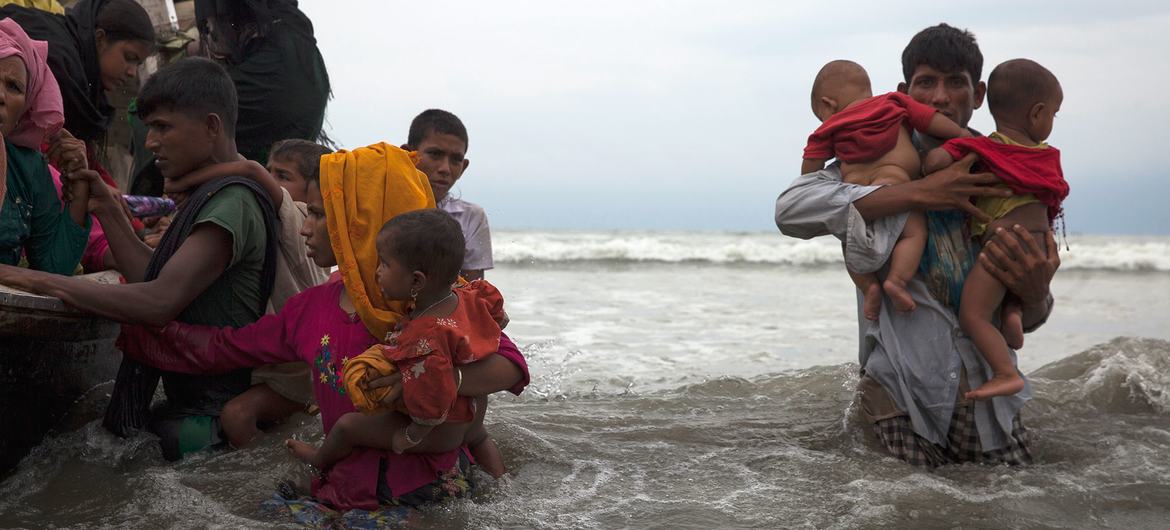
In this September 2017 photograph, a Rohingya man carrying his two children wades ashore in Cox’s Bazar district, Bangladesh, after fleeing Rakhine state on a rickety boat across the Bay of Bengal.
© UNICEF/Patrick Brown
12 Jan 2026 – Public hearings opened today at the International Court of Justice (ICJ) in a landmark case brought by the Gambia against Myanmar, alleging violations of the Genocide Convention over the military’s treatment of the Rohingya minority.
he proceedings, held at the Peace Palace in The Hague, mark the start of the merits phase in the case, after years of preliminary legal arguments.
Over the next three weeks, ICJ judges will hear oral arguments from both sides, examine witnesses and experts, and consider whether Myanmar breached its obligations under the Convention on the Prevention and Punishment of the Crime of Genocide, to which the country is a party.
Opening the hearings, Judge Iwasawa Yuji, President of the Court, outlined a detailed schedule that includes two rounds of pleadings by Gambia and Myanmar, as well as closed sessions to hear testimony from witnesses called by both Parties.
Speaking on behalf of Gambia, Attorney General and Minister of Justice Dawda Jallow told the court that his country brought the case “after reviewing credible reports of the most brutal and vicious violations imaginable” committed against the Rohingya, a Muslim minority in Myanmar’s Rakhine province.
“By all measures, this case is not about esoteric issues of international law,” Mr. Jallow said. “It is about real people, real stories, and a real group of human beings.”
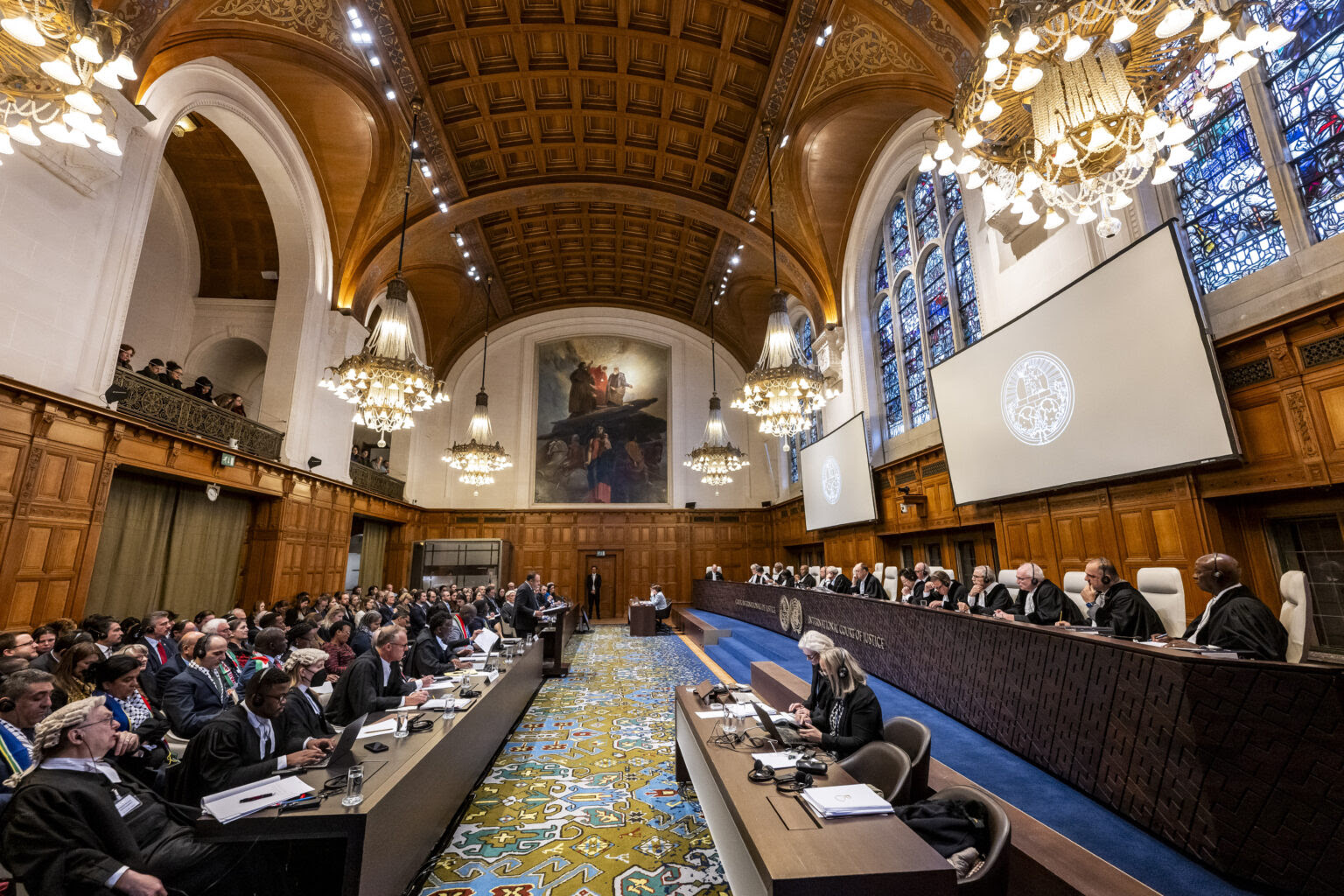
The International Court of Justice (ICJ), the principal judicial organ of the UN.
A case years in the making
Gambia filed its application in November 2019, accusing Myanmar of breaching the Genocide Convention through acts allegedly committed during so-called “clearance operations” carried out by the Myanmar military, or Tatmadaw.
Those operations escalated sharply in 2017, prompting more than 700,000 Rohingya to flee to neighbouring Bangladesh amid widespread killings, sexual violence, village burnings and other abuses. Zeid Ra’ad al-Hussein, the then UN High Commissioner for Human Rights, described the situation as a “textbook example of ethnic cleansing.”
A UN Human Rights Council-mandated fact-finding mission said in 2018 that it had reasonable grounds to conclude that serious crimes under international law, including genocide, crimes against humanity and war crimes, had been committed.
Nearly one million Rohingya remain living as refugees in camps in Bangladesh, while countless others are displaced or trapped inside Myanmar in dire conditions.
Provisional measures
In January 2020, the Court unanimously ordered provisional measures, directing Myanmar to take all steps within its power to prevent genocidal acts against the Rohingya, preserve evidence, and report regularly to the Court on its compliance.
Myanmar challenged the Court’s jurisdiction, but in July 2022 the judges ruled that they were competent to hear the case.
Eleven States also made written submissions in support of Gambia’s interpretation of the Genocide Convention.
Accountability and broader context
Addressing the judges, Mr. Jallow said Myanmar remained trapped in “a cycle of atrocities and impunity,” noting that no one had been held accountable for crimes against the Rohingya.
He also pointed to the February 2021 military coup, which overthrew the civilian government and plunged Myanmar into renewed nationwide conflict.
“Accountability is imperative,” he said, warning that impunity risks the repetition of atrocity crimes.
Myanmar’s arguments
Myanmar is expected to begin presenting its arguments later this week. The Court’s final judgment, which could take months or longer after the hearings conclude, will be legally binding.
The International Court of Justice is the United Nations’ principal judicial organ. It settles legal disputes between States and gives advisory opinions on questions of international law.
Unlike criminal courts, it does not try individuals but determines State responsibility.
Tags: Burma/Myanmar, Genocide, Rohingya, South Asia
DISCLAIMER: The statements, views and opinions expressed in pieces republished here are solely those of the authors and do not necessarily represent those of TMS. In accordance with title 17 U.S.C. section 107, this material is distributed without profit to those who have expressed a prior interest in receiving the included information for research and educational purposes. TMS has no affiliation whatsoever with the originator of this article nor is TMS endorsed or sponsored by the originator. “GO TO ORIGINAL” links are provided as a convenience to our readers and allow for verification of authenticity. However, as originating pages are often updated by their originating host sites, the versions posted may not match the versions our readers view when clicking the “GO TO ORIGINAL” links. This site contains copyrighted material the use of which has not always been specifically authorized by the copyright owner. We are making such material available in our efforts to advance understanding of environmental, political, human rights, economic, democracy, scientific, and social justice issues, etc. We believe this constitutes a ‘fair use’ of any such copyrighted material as provided for in section 107 of the US Copyright Law. In accordance with Title 17 U.S.C. Section 107, the material on this site is distributed without profit to those who have expressed a prior interest in receiving the included information for research and educational purposes. For more information go to: http://www.law.cornell.edu/uscode/17/107.shtml. If you wish to use copyrighted material from this site for purposes of your own that go beyond ‘fair use’, you must obtain permission from the copyright owner.
Join the discussion!
We welcome debate and dissent, but personal — ad hominem — attacks (on authors, other users or any individual), abuse and defamatory language will not be tolerated. Nor will we tolerate attempts to deliberately disrupt discussions. We aim to maintain an inviting space to focus on intelligent interactions and debates.
Read more
Click here to go to the current weekly digest or pick another article:
ASIA-UPDATES ON MYANMAR ROHINGYA GENOCIDE: