


The War beyond Gaza: Israel’s Silent Shock Campaign in the West Bank
PALESTINE ISRAEL GAZA GENOCIDE, 19 Jan 2026
Ramzy Baroud | Politics for the People – TRANSCEND Media Service
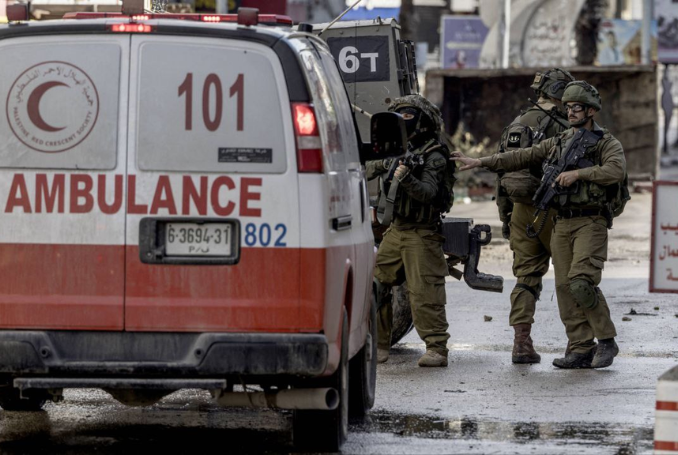
Israeli soldiers attack a Palestinian ambulance in the occupied West Bank.
(File Photo: via QNN)
14 Jan 2026 – A shock and awe. The phrase is apt in describing what Israel has done in the occupied West Bank almost immediately following the events of October 7, 2023, and the start of the Israeli genocide in Gaza.
In her book The Shock Doctrine, Naomi Klein defines “shock and awe” not merely as a military tactic, but as a political and economic strategy that exploits moments of collective trauma—whether caused by war, natural disaster, or economic collapse—to impose radical policies that would otherwise be resisted. According to Klein, societies in a state of shock are rendered disoriented and vulnerable, allowing those in power to push through sweeping transformations while opposition is fragmented or overwhelmed.
Though the policy is often discussed in the context of US foreign policy—from Iraq to Haiti—Israel has employed shock-and-awe tactics with greater frequency, consistency, and refinement. Unlike the US, which has applied the doctrine episodically across distant theaters, Israel has used it continuously against a captive population living under its direct military control.
Indeed, the Israeli version of shock and awe has long been a default policy for suppressing Palestinians. It has been applied across decades in the occupied Palestinian territory and extended to neighboring Arab countries whenever it suited Israeli strategic objectives.
In Lebanon, this approach became known as the Dahiya Doctrine, named after the Dahiya neighborhood in Beirut that was systematically destroyed by Israel during its 2006 war on Lebanon. The doctrine advocates the use of disproportionate force against civilian areas, the deliberate targeting of infrastructure, and the transformation of entire neighborhoods into rubble in order to deter resistance through collective punishment.
Gaza has been the epicenter of Israel’s application of this tactic. In the years preceding the genocide, Israeli officials increasingly framed their assaults on Gaza as limited, “managed” wars designed to periodically weaken Palestinian resistance.
These operations were rationalized through the concept of “mowing the lawn,” a phrase used by Israeli military strategists to describe the periodic use of overwhelming violence to “reestablish deterrence.” The logic was that Gaza could not be politically resolved, only indefinitely managed through recurrent destruction.
What unfolded in the West Bank shortly after the start of the Gaza genocide followed a strikingly similar pattern.
Beginning in October 2023, Israel launched an unprecedented campaign of violence across the West Bank. This included large-scale military raids in cities and refugee camps, the routine use of airstrikes—previously rare in the West Bank—the widespread deployment of armored vehicles, and a surge in settler violence carried out with the backing or direct participation of the Israeli army.
The death toll rose sharply, with hundreds of Palestinians killed in a matter of months, including children. Entire refugee camps, such as Jenin, Nur Shams, and Tulkarm, were subjected to systematic destruction: roads were torn up, homes demolished, water and electricity networks destroyed, and medical access severely restricted. Israeli forces repeatedly laid siege to communities, preventing the movement of ambulances, journalists, and humanitarian workers.
At the same time, Israel accelerated the ethnic cleansing of Palestinian communities, particularly in Area C. Dozens of Bedouin and rural villages were forcibly emptied through a combination of military orders, settler attacks, home demolitions, and the denial of access to land and water. Families were driven out through sustained terror designed to make daily life impossible.
Yet the most violent period of Israeli aggression in the West Bank since the Second Intifada (2000–2005) has been largely overlooked, in part because of the sheer scale and horror of Israel’s genocide in Gaza. The annihilation of Gaza has rendered the violence in the West Bank seemingly secondary in the global imagination, despite the fact that its long-term consequences may prove just as devastating.
At the same time, Israeli Prime Minister Benjamin Netanyahu and his extremist coalition succeeded in presenting themselves to the world as reckless, unrestrained, and ideologically driven—willing and able to expand the cycle of destruction far beyond Gaza, into the West Bank and across Israel’s borders into neighboring Arab countries. This performance of extremism functioned as a political strategy.
The consequences are now unmistakable. Large areas of the West Bank lie in ruins. Entire communities have been shattered, their social and physical fabric deliberately dismantled. According to UNRWA, more than 12,000 Palestinian children remain displaced, increasingly suggesting a displacement that may become permanent rather than temporary.
History, however, offers a critical lesson. The Palestinian struggle against Israeli settler-colonialism has repeatedly demonstrated that Palestinians do not remain passive indefinitely. Despite the paralysis and fragmentation of their political leadership, Palestinian society has consistently regenerated its capacity for resistance.
Israel understands this reality as well. It knows that shock is not infinite, that fear eventually gives way to defiance, and that once the immediate trauma begins to fade, Palestinians will reorganize and push back against imposed conditions of domination.
What is underway, therefore, is a race against time. Israel is working to consolidate what it hopes will become an irreversible new reality on the ground—one that enables formal annexation, normalizes permanent military rule, and completes the ethnic cleansing of large segments of the Palestinian population.
For this reason, a deeper and more sustained understanding of current events in the West Bank is essential. Without confronting this reality directly, Israeli plans will proceed largely unchallenged. To expose, resist, and ultimately defeat these designs is not only a matter of political analysis but a moral imperative inseparable from supporting the Palestinian people in restoring their dignity and achieving their long-denied freedom.
____________________________________________
 Dr. Ramzy Baroud is a journalist, author and editor of The Palestine Chronicle. His last book is The Last Earth: A Palestinian Story (Pluto Press, London) and his forthcoming book is These Chains Will Be Broken: Palestinian Stories of Struggle and Defiance in Israeli Prisons (Clarity Press, Atlanta). Baroud is a Non-resident Senior Research Fellow at the Center for Islam and Global Affairs (CIGA), Istanbul Zaim University (IZU). His website is www.ramzybaroud.net.
Go to Original – ramzybaroud.net
Tags: Anti Zionism, Ceasefire, Collective Punishment, Colonialism, Colonization, Crimes against Humanity, Cultural violence, Direct violence, Ethnic Cleansing, Famine, Genocide, Hunger, Israel, Israeli occupation, Nakba, Palestine, Palestinian Holocaust, Sociocide, State Terrorism, Structural violence, USA, War crimes, West Bank
JOIN THE BDS-BOYCOTT, DIVESTMENT, SANCTIONS CAMPAIGN TO PROTEST THE ISRAELI BARBARIC GENOCIDE OF PALESTINIANS IN GAZA.
DON'T BUY PRODUCTS WHOSE BARCODE STARTS WITH 729, WHICH INDICATES THAT IT IS PRODUCED IN ISRAEL. DO YOUR PART! MAKE A DIFFERENCE!
7 2 9: BOYCOTT FOR JUSTICE!
DISCLAIMER: The statements, views and opinions expressed in pieces republished here are solely those of the authors and do not necessarily represent those of TMS. In accordance with title 17 U.S.C. section 107, this material is distributed without profit to those who have expressed a prior interest in receiving the included information for research and educational purposes. TMS has no affiliation whatsoever with the originator of this article nor is TMS endorsed or sponsored by the originator. “GO TO ORIGINAL” links are provided as a convenience to our readers and allow for verification of authenticity. However, as originating pages are often updated by their originating host sites, the versions posted may not match the versions our readers view when clicking the “GO TO ORIGINAL” links. This site contains copyrighted material the use of which has not always been specifically authorized by the copyright owner. We are making such material available in our efforts to advance understanding of environmental, political, human rights, economic, democracy, scientific, and social justice issues, etc. We believe this constitutes a ‘fair use’ of any such copyrighted material as provided for in section 107 of the US Copyright Law. In accordance with Title 17 U.S.C. Section 107, the material on this site is distributed without profit to those who have expressed a prior interest in receiving the included information for research and educational purposes. For more information go to: http://www.law.cornell.edu/uscode/17/107.shtml. If you wish to use copyrighted material from this site for purposes of your own that go beyond ‘fair use’, you must obtain permission from the copyright owner.
Join the discussion!
We welcome debate and dissent, but personal — ad hominem — attacks (on authors, other users or any individual), abuse and defamatory language will not be tolerated. Nor will we tolerate attempts to deliberately disrupt discussions. We aim to maintain an inviting space to focus on intelligent interactions and debates.
Read more
Click here to go to the current weekly digest or pick another article:
PALESTINE ISRAEL GAZA GENOCIDE: