
The Spirit of the Mahatma in 2026 – An Introspection
TMS PEACE JOURNALISM, 2 Feb 2026
Vivek Umrao Glendenning | Ground Report India - TRANSCEND Media Service
The Observance
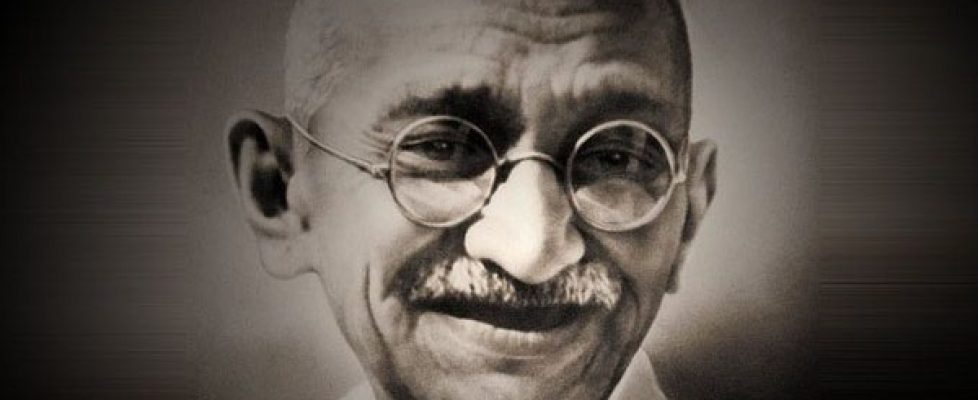
30 Jan 2026 – The observance on 30 Jan 2026, is far more than a scheduled national event in India; it is a date charged with profound moral, historical, and existential gravity, marking the seventy-eighth year since the assassination of Mohandas Karamchand Gandhi. The three bullets fired at him at Birla House silenced a physical voice, but the ensuing national moment of silence at 11:00 AM this Friday must transcend a simple, performative ritual of remembrance. It is a critical, analytical, and deeply necessary space demanding an unflinching introspection into the systemic decay that has afflicted the foundational ethos of Indian democracy and, by extension, the global commitment to non-violence, ethical governance, and basic human dignity.
This anniversary serves as a crucial diagnostic checkpoint for a nation at a definitive crossroads. India currently navigates a treacherous and fractured landscape characterised by pervasive bureaucratic impunity, administrative paralysis, and a deep-seated, widening alienation of the ruling class from the very ground realities and common people that Gandhi’s life was relentlessly dedicated to serving. The legacy of the Mahatma in 2026 presents a stark, painful, and often hypocritical dichotomy: globally, his image is frequently invoked—and often cynically exploited—as a diplomatic and political tool, a convenient, sanitised symbol of peace for international consumption. Yet, the internal architecture of the Indian state and its political culture appears to have systematically retreated from the foundational vision of the “country of Gandhi and Buddha.” The nation increasingly leans towards a social and political structure defined by rigid, undemocratic caste and class hierarchies and an arrogant administrative “steel frame” that has dangerously lost its connection, and its constitutional mandate, to the populace it is supposed to serve. This structural and ethical disconnect fundamentally undermines the democratic contract and poisons the well of public trust.
The Corruption of Political Character: From Selfless Service to Self-Interest
The most visible and damaging departure from the idealism of the Indian freedom struggle lies in a fundamental, corrosive shift in the national political character. Historically, opting for a life in politics was genuinely considered and undertaken as an act of profound self-sacrifice, dedicated service to society, and personal austerity—a noble characterisation that accurately described the generation that fought for and won independence. Regrettably, this selfless ethos has been largely abandoned, replaced by a new, disheartening paradigm of transactional governance.
A political career is now predominantly viewed as the most expedient and often guaranteed route to personal and familial enrichment, the consolidation of dynastic power, and the accumulation of unaccountable wealth. This transactional view of governance, focused on private gain, has ruthlessly replaced the transformative, public-spirited vision of the nation’s founding fathers.
The Punishing Contrast: The Integrity Lost in Translation

The historical legacy of figures like Sardar Vallabhbhai Patel offers a punishing and almost unbelievable contrast to the contemporary political reality. Upon his death, his daughter, Maniben Patel, meticulously recorded that he had left behind eighteen lakh rupees, a massive sum collected for party purposes at the time. Her immediate and unhesitating decision to inform Prime Minister Nehru and President Rajendra Prasad, and to hand over every single paisa to the party treasurer, reflects a level of transparent integrity and ethical stewardship that is virtually inconceivable in the modern political climate, where such public-raised funds are routinely absorbed into personal or familial coffers with complete impunity.
Furthermore, the relationship between Jawaharlal Nehru and Patel, though marked by acute administrative and political disagreements, remained profoundly cordial, civilised, and rooted in mutual respect for the national cause. Their communication, often mediated by Gandhi himself, showcases two leaders prepared to tender their resignations—not for political gain, personal leverage, or to destabilise the government—but solely to ensure the welfare of the country and the unity of the nascent ruling party. For them, no personal sacrifice, however great, was too much for the newly independent nation.
In 2026, this foundational civility has been replaced by a culture defined by character assassination, venomous name-calling, and the calculated planting of malicious stories in the press—a wanton, aggressive squandering of the ethical legacy left by the founding generation. The new crop of leaders prioritises power at any cost, where values, ideals, and principles are ruthlessly sacrificed for the sake of simply holding “the chair.” This systemic shift in political personality—from humble, selfless service to brazen arrogance and self-interest—carries deep and troubling implications for the future, as these figures serve as highly visible, yet ethically compromised, role models for the generations observing them. The salt has truly lost its savour in terms of genuine Indian patriotism and nationalism, and the sacred memories of the freedom struggle are increasingly squandered on unheeding ears, as short-term political gains consistently eclipse the long-term health and moral fibre of the republic.
Satyagraha and the Non-violence of the Brave
The final, intense phase of Gandhi’s life, spanning 1946–1948, particularly during his solitary missions in Noakhali and Bihar, saw the evolution of his philosophy into a refined, crucible-tested form: the “non-violence of the brave.” This period represents the most critical and dramatically challenging phase of his career, as he engaged in a solitary spiritual and ethical struggle against the communal frenzy that was violently tearing the subcontinent apart. It was here that his doctrine was tested not in the courts or through mass rallies, but in the face of mass bloodshed and sectarian hatred.
For Gandhi, conflict was not necessarily a pathology to be avoided; it was a perennial, often painful, and potentially desirable condition because shared conflict, when approached non-violently, could be the very mechanism that reminds antagonists of the deeper, transcendental unity of life, a unity far more profound than temporary social or political bonds. His distinctive and powerful approach was to systematically demolish violent and unjust structures (like untouchability, colonial rule, or communal divides) while meticulously preserving the people caught within them. He maintained the firm belief that structural purification alone was insufficient; self-purification—a rigorous, personal ethical discipline encompassing thought, word, and deed—was an equally essential and non-negotiable prerequisite for a true Satyagrahi (non-violent activist).
During the Noakhali mission, Gandhi embarked on a “Venture in Faith,” deliberately isolating himself from lifelong companions and political allies to live in the lonesome village of Srirampur. This act was a profound, almost reckless, test of his personal purity and the core doctrines of Satyagraha in a hostile, unprotected environment. Overwhelmed by a crushing loneliness when political leaders accepted the partition he had so vehemently opposed, he took the violence erupting around him as a sign of his own “faulty technique” or spiritual inadequacy. As a self-imposed penance for the misdeeds of his countrymen, he adopted a “lowest diet possible,” declaring that he could not find rest until he had performed this crucial measure of self-correction. His life was, quite literally, the laboratory for his political and ethical philosophy.
The Educational Vision: A Necessary Synthesis of Mahatma Gandhi and Dr B.R. Ambedkar
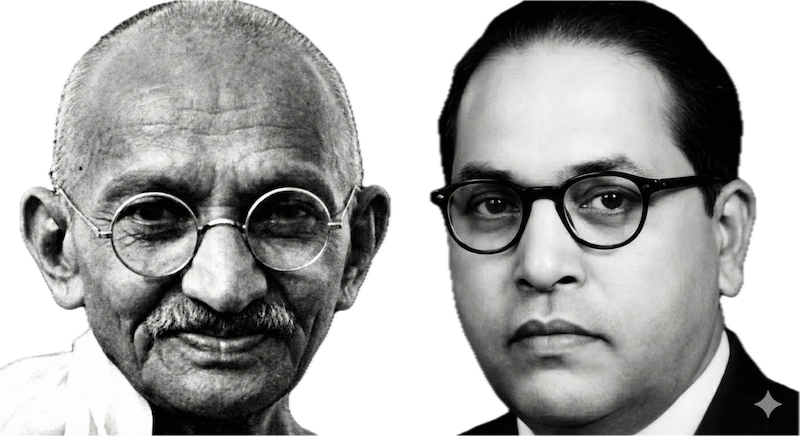
Any literary review of Gandhi’s relevance in 2026 must critically navigate the complex but utterly vital synthesis between his vision and that of Dr B.R. Ambedkar. Both were intellectual and social titans who recognised that the Indian subcontinent was so deeply steeped in religious idioms and tradition that pure, secular rationality or atheism would not be easily accepted by the vast masses. In their individual ways, both acted as powerful liberation theologians, reinterpreting tradition and existing frameworks to serve higher ethical, modern values of justice, human dignity, and equality. Their work, though sometimes adversarial and marked by intense debate, created the intellectual and constitutional bedrock for modern India.
The Role of Education in Transformative Social Change
Dr. Ambedkar, the chief architect of the Indian Constitution, unequivocally identified education as the single most potent and transformative force for social change. He saw it as the indispensable key to freeing individuals from the shackles of ignorance, superstition, and inherited caste obligations, empowering them to think critically, assert their fundamental rights, and ultimately fight for true dignity. His vision was constitutionally encoded in a document that sought to guarantee equal rights and dignity to every single citizen, irrespective of birth, caste, or creed.
Gandhi, operating concurrently, believed that enduring societal change could only be achieved through a sustained process of individual moral upliftment and the radical eradication of deeply ingrained social evils such as untouchability. He directly addressed the caste system’s purity/pollution dichotomy by personally taking up manual scavenging and strictly insisting that his followers do the same, thereby demonstrating the inherent dignity in all labour and attempting to dismantle the stigma associated with the lowest castes. As his views evolved, they became more radical and demanding; he famously refused to attend marriages that were not inter-caste, effectively fashioning a new, stringent ethical code out of his inherited Hinduism.
Today, in 2026, the very ability to collectively envision a society where every individual is guaranteed dignity and equality stands as an enduring testament to the unparalleled, yet often unacknowledged, sacrifices of these two figures. To truly realise their dreams, it is not enough to simply venerate them through symbolic holidays. It is incumbent upon the citizenry to actively embed these values of social justice and equality into the very fabric of daily life and societal structures. Education must be reclaimed as an instrument for raising profound social consciousness, for fostering critical thought, ethical empathy, and active citizenship, rather than being reduced to a mere utilitarian tool for producing submissively obedient subjects for the demands of corporations and governments.
Gram Swaraj and the Decentralised Economy: A Modern Antidote
The Gandhian vision for a decentralised, resilient economy, famously centred on “Gram Swaraj” or village self-rule, remains the only viable and ethically sound antidote to the current, debilitating crisis of over-centralisation, environmental destruction, and rampant economic exploitation by global capital. Gandhi firmly believed that India could never achieve true, meaningful independence until it could produce its own basic needs locally, thereby making its populace resilient to external manipulation and market volatility. The traditional spinning wheels (charkha) and looms were not just relics of a romantic past; they were potent, economic symbols of self-reliance, local production, and economic sovereignty.
The Modern Spinning Wheel: Technology as an Ally
In the 21st century, a powerful argument is made by some observers that the contemporary “spinning wheel” should be reimagined as software, biotechnology, and decentralised energy systems (like solar and wind micro-grids). These tools, used ethically and locally controlled, can provide the same economic and social benefits Gandhi desired—local production, dignified employment, and self-sufficiency—but through modern, decentralised technological means. The core philosophy of “Sarvodaya”—meaning “all rising,” with a special ethical emphasis on the last person first—is the moral foundation for current grassroots movements that aim for the collective ascension of all citizens, regardless of caste, religion, or gender. This is a commitment to profound economic justice and equitable distribution over simple, often concentrated, GDP growth.
The Root of Violence: The Adult War on Children
A profound and analytical review of Gandhi’s relevance in 2026 must penetrate to the psychological origin of human violence. Gandhi was keenly interested not only in the violence built into social structures (structural violence) but also in the pervasive violence one inflicts upon oneself and the environment. Contemporary analysis, which aligns with Gandhi’s interest in inner purification and self-knowledge, suggests that the fundamental, pervasive cause of all social and environmental violence in our world is the “adult war on children”—a systematic, often unconscious, assault through visible, invisible, and “utterly invisible” means that crushes the authentic self and internalises terror.
Conditioning and the Destruction of Individual Potential
Modern parenting and educational models are overwhelmingly preoccupied with the singular objective of producing submissively obedient students, docile workers, unquestioning soldiers, and compliant taxpayers. To achieve this, adults use a ruthless combination of violence (often euphemistically labelled as “punishment,” “discipline,” or “tough love”) to ensure that children become terrified, emotionally stunted, and self-hating individuals. This traumatic process systematically destroys the unique, authentic human individual and transforms them into a “socially constructed delusional identity.” Because the vast majority of adults were themselves terrorised into obedience as children, only the rarest individual ever reaches a point where they are able to consciously reflect on and deconstruct their own deep, pervasive conditioning.
Individual Transformation: Trauma into Purpose
Deep, personal pain, when understood, should be transmuted from a source of conflict and neurosis into a public mission dedicated to social justice and the understanding of human psychology, illustrating the principle of turning suffering into strength. If this fundamental, psychological cause of violence is not addressed, all combined efforts to tackle its other symptoms—war, exploitation, and climate catastrophe—must ultimately fail. Extinction at our own hand becomes inevitable if we do not nurture emotionally and intellectually resourceful individuals who are fully engaged with reality and the true consequences of their actions.
2026: Nonviolence or Nonexistence at the Brink of Extinction
The world has travelled a great distance further down the path of violence, to the point where nonexistence is now a stark and terrifyingly likely outcome for humanity. Analytical projections by researchers, such as Robert Burrowes, suggest that human extinction by 2026 is no longer a fringe theory but must be confronted as a serious possibility within a “last-ditch strategy” context for fighting for survival.
The Reverend Martin Luther King Jr., deeply inspired by Gandhi, identified the “Triple Evils” of poverty, racism, and militarism as interconnected barcodes of violence that exist in a vicious, self-perpetuating cycle. In 2026, the Earth and its precious lifeforms are under catastrophic assault on all fronts—from the omnipresent nuclear threat and ongoing conventional wars to the accelerating climate catastrophe. The global elite continue to strip the Earth bare of its life-support systems, relentlessly forcing people into precarious situations through brute force, economic coercion, and the constant, existential threat of starvation and precarity.
Gandhi’s Strategy for the 21st Century
Gandhi’s enduring strategy was to identify approaches to conflict that preserved the dignity and life of people while simultaneously and systematically demolishing evil structures. He maintained an unshakeable faith that the ways of truth (Satya) and love (Ahimsa) have always won in the long run. Tyrants and murderers, though they may seem invincible for a time, always fall in the end. However, this victory is not automatic; it requires a relentless, conscious, and sacrificial struggle to ensure that truth and love not only survive but prevail.
Interestingly, technology is often more amenable to peaceful revolutions and rapid scaling than deeply ingrained cultural norms, but cultural changes can be successfully induced through persistent non-violent methods, as evidenced by the slow but steady shifts in the Indian hierarchical caste system and the dismantling of apartheid in the USA. Reaching the desired goal of a just and peaceful society requires a proper, profound understanding of human nature vis-à-vis the rest of creation and the skilful use of the “humane weapon” of non-cooperation—the strategic withdrawal of consent from unjust systems.
The review of Gandhi in 2026 is one of both despair and hope.
Despair arises from the “suffocating and depressing situation” of global community living, where billions of rupees are recklessly wasted on “Junk-weapons of war” while billions of people are left without basic food security, shelter, and protection. Hope, however, is found in the “fragrance of love” that releases its perfume through the dedicated, sacrificial actions of committed individuals who choose ethical conduct and public service over personal comfort and self-interest.
The Dispossession Belt
Writers and activists are currently engaged in crucial work to demolish the “dispossession belt” that exists between citizens and their fundamental rights—a system that systematically robs them of agency and dignity, often through complex legal and financial instruments. This movement involves a “mass refusal” of the ugly, profit-seeking world and a collective, conscious decision on how humans truly wish to live out their mortality. The core of this necessary movement is the fostering of imagination and transparency—qualities that are inherently “above politics” and serve to unite people regardless of controversial differences.
Wishes for “SHAHEED DIWAS” — India as a World Leader
The collective wishes for Gandhi on January 30, 2026, are a fervent call for the resurrection of his spirit within the individual agency of every human being. True power resides not in positions of authority—which are often sharp, temporary, and oppressive—but in the unwavering firmness of ideas, the consistent adherence to ethical principles, and a deep, authentic connection with the populace.
As the nation marks the 78th year since his martyrdom, we must stop the superficial act of over-glorifying the person while simultaneously abandoning the essential content of his teachings. The lesson of his vast collective legacy is that social change is an ongoing, dynamic process that demands unceasing effort, unwavering commitment, and continuous introspection.
If India is to truly earn its place as a world leader, it must exit the tradition of sponsored, politically-backed social leadership and instead plant the seeds of internally inspired, spontaneous mass movements rooted in ethical conviction. The wishes for the Mahatma are that the country stop being a “copycat” society and instead bravely embrace the foundational principles of love, tolerance, and justice as the absolute bedrock of its national identity. As Gandhi famously noted, “Nobody can make you unhappy without your permission,” and “Whatever you do may seem insignificant to you, but it is most important that you do it.” On this Shaheed Diwas, the nation’s deepest collective hope is that the torch of freedom, held by self-purified individuals, will never be extinguished but will continue to illuminate the way toward a more compassionate, equitable, and ultimately, sustainable world.
________________________________________________________
 Vivek Umrao Glendenning ‘Social Nomad’:
-
- Founder, the Executive Editor: Ground Report India group
- Member, London Press Club, UK
- Member, International Association of Press Clubs (London Press Club)
- Member, International PEN
- Member, Sydney PEN
- International Board Member, the International Association of Educators for World Peace
- World Peace Ambassador 2018-22
- Wellness Consultant – Holistic Architect
- Author: Books
Tags: Ahimsa, Gandhi, History, India, Nonviolence, Nonviolent Action, Nonviolent Journalism, Nonviolent Peaceforce, Nonviolent communication, Satyagraha, South Africa
DISCLAIMER: The statements, views and opinions expressed in pieces republished here are solely those of the authors and do not necessarily represent those of TMS. In accordance with title 17 U.S.C. section 107, this material is distributed without profit to those who have expressed a prior interest in receiving the included information for research and educational purposes. TMS has no affiliation whatsoever with the originator of this article nor is TMS endorsed or sponsored by the originator. “GO TO ORIGINAL” links are provided as a convenience to our readers and allow for verification of authenticity. However, as originating pages are often updated by their originating host sites, the versions posted may not match the versions our readers view when clicking the “GO TO ORIGINAL” links. This site contains copyrighted material the use of which has not always been specifically authorized by the copyright owner. We are making such material available in our efforts to advance understanding of environmental, political, human rights, economic, democracy, scientific, and social justice issues, etc. We believe this constitutes a ‘fair use’ of any such copyrighted material as provided for in section 107 of the US Copyright Law. In accordance with Title 17 U.S.C. Section 107, the material on this site is distributed without profit to those who have expressed a prior interest in receiving the included information for research and educational purposes. For more information go to: http://www.law.cornell.edu/uscode/17/107.shtml. If you wish to use copyrighted material from this site for purposes of your own that go beyond ‘fair use’, you must obtain permission from the copyright owner.
Join the discussion!
We welcome debate and dissent, but personal — ad hominem — attacks (on authors, other users or any individual), abuse and defamatory language will not be tolerated. Nor will we tolerate attempts to deliberately disrupt discussions. We aim to maintain an inviting space to focus on intelligent interactions and debates.
Read more
Click here to go to the current weekly digest or pick another article:
TMS PEACE JOURNALISM: