
Michael Parenti: The War on Drugs Is a Cover for Imperialism and the CIA’s Own Drug Dealing
TRANSCEND MEMBERS, 9 Feb 2026
Ann Garrison | Black Agenda Report – TRANSCEND Media Service
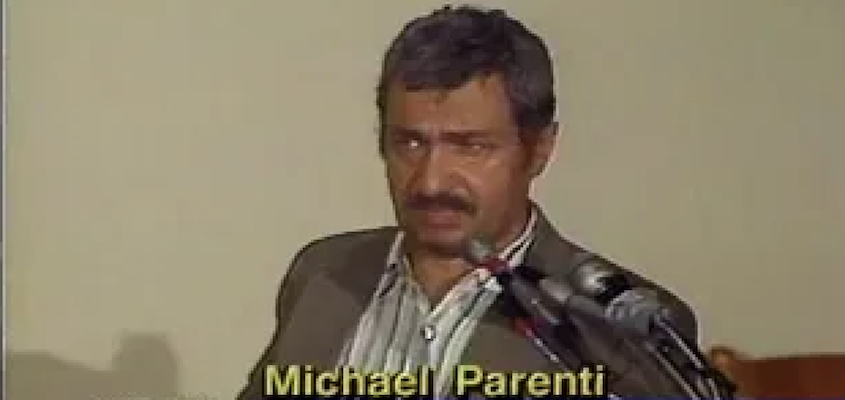
4 Feb 2026 – Michael Parenti’s legacy is clarity. He taught that U.S. policies like the drug war are successful strategies for maintaining power and profit.
Michael Parenti, a giant on the American left who influenced generations of activists, scholars and ordinary Americans, died on January 24. He was 92.
Michael grew up in an Italian working class family in New York City. He worked for several years after high school, then returned to school, earning a bachelor’s degree at the City College of New York, a Master’s Degree at Brown University, and a PhD in political science at Yale.
In 1971, while teaching at the University of Illinois in Urbana-Champaign, he joined a protest against the Kent State killings and the Vietnam War, during which state troopers clubbed him in the head and threw him in jail for two days. A prosecutor then charged him with disorderly conduct, resisting arrest, and aggravated battery of a state trooper. Shortly after being released on bond, he started a new job at the University of Vermont, but the following month, he was convicted on all three counts in Illinois and released on two years’ parole.
That December, the University of Vermont political science department voted unanimously to renew his teaching contract, but the UVM board of trustees and conservative state legislators intervened and insisted on letting the contract expire, citing Parenti’s “unprofessional conduct.” The battle to keep him on at UVM lasted into early 1972, but ultimately he lost his position there.
He was never able to secure a tenure track teaching job after that, but he managed to make a living speaking and writing, producing more than 20 books, beginning with “Democracy for the Few.” His books, articles, talks, and notable quotations are archived at the Michael Parenti Political Archive. His talks alone are compiled on YouTube at The Michael Parenti Library, and some of his best comic moments can be found at Michael Parenti’s Funniest Moments.
Many fans of Michael’s work particularly remember his response to the “conspiracy theory” aspersion used to dismiss critiques of elite machinations. You’re said to have a conspiracy theory, he said, when you suggest that the rich and powerful meet in rooms, behind closed doors, to discuss the best strategies for pursuing their interests. “Oh no,” he said. “They don’t sit around in a room and plan this. They meet on carousels, where they go up and down on merry-go-rounds, or they meet skydiving. Of course, they meet in rooms. Where else are they gonna meet?”
Michael’s brilliant Marxist analysis will be read, studied, and listened to for many years to come. One talk, “Imperialism, Drugs and Social Control,” is of particular relevance in the current moment, as Venezuelan President Nicolás Maduro sits in a US federal prison facing preposterous charges of narcotics trafficking. What follows are a few highlights meant to encourage taking time to listen to the whole hour.
The military-industrial cost of empire far exceeds its benefits, except to multinational corporations and the super-rich.
You can understand now why, when Reagan went into the Persian Gulf with that fleet to protect the oil supply coming out during the Iran-Iraq War, people said, “Wait a minute, this whole operation is costing us $2 for every dollar’s worth of oil we’re taking out. That’s a losing proposition.” But Reagan kept doing it. Why? Because the $2 was being paid by you out of that little paycheck that you get. They’re not protecting your oil supply. And they’re not protecting Japan and France’s oil supply. They’re protecting the oil supply of the Seven Sisters, the giant oil companies. They’re protecting Gulf and Exxon Mobil and British Petroleum . . . and they’ll spend $2 of your money to protect $1 of their money. They’ll spend $3, $4, $5 of your money. Money is no object when it’s your money, protecting my money.
The US empire always needs new enemies
If the Soviet Union disappears, and the Soviet Union cuts its military forces even more dramatically and withdraws from Eastern Europe, as it is doing, our leaders will still argue that we need a military machine.
. . .
Who are going to be the new enemies to justify this global military machine that is rationally and definitely needed as a form of capital formation, capital investment, capital return, capital accumulation, and as an instrument of imperialism? What are you going to justify? You conjure up new enemies, and you start talking about terrorists, international terrorist rings, narco-terrorists, and international drug trade. By the way, there is a real international drug trade, and it is a terrible thing, and it is doing terrible things to our communities.
. . .
What you also do with things like the Iraq intervention is you conjure up again the image that there’s a world of adversaries out there, and you can get defense secretary Cheney then saying, “Let’s put all those military cuts that you, Congress, wanted to do. Let’s put them on hold. Our boys are out there on the firing line, on the front line, and while they’re there facing this Hitler, demonic maniac, Saddam Hussein, the worst, worse than Hitler, worse than Genghis Khan, worse than anything that’s ever existed, anywhere, ever in the whole world. While our boys are facing that monster, you can’t deny them a single hand grenade or aircraft carrier, can you, Congressman?” “Well, I guess not, especially if the naval base is in my district.”
The War on Drugs is a cover for imperialism and the CIA’s own drug-dealing
You have another thing at this time to maintain this image of a world of adversaries and to maintain the global military machine, and also to serve as an excuse for counter-insurgency: the War on Drugs. The War on Drugs is mostly a phony war, I would argue. It’s a cover for imperialism, and it’s a cover for the CIA’s own drug dealing. It’s also a cover for the war against political dissidents in various countries. Americas Watch’s report, October 31, 1990, tells you that the one-year effort against drug traffickers actually has become a war against the political left in Colombia. The US is giving funds to military and paramilitary groups that are being used to torture and kill dissidents.
Americas Watch, actually Human Rights Watch, the parent of Americas Watch, made this report. These are the summary findings. The violence is mostly by the counter-insurgency, death squad actions against the legal left, that is, against student leaders, peasant co-op leaders, labor leaders, journalists, and others who are arguing for social change. This underscores the Colombian military’s unwillingness to allow a left electoral challenge, a peaceful left challenge. Many big drug dealers in Colombia are now rich. They own land, they have legitimate investments, and so they now share the right-wing campaign and the right-wing, rich, privileged class perspective against labor leaders, against critical journalists, against people who want social change, who want to give better wages to their campesinos, who work on their latifundios and such.
Unfortunately, the Human Rights Watch person, who, by the way, was giving this report on Pacifica Radio, went on to add to the fable, which often happens. He said, unfortunately, US policy is mistaken, and US policy is in error. And George Bush, in his haste to fight the War on Drugs, is giving money to the wrong people. And I’m saying he isn’t giving money to the wrong people. He’s giving money to the people he wants to give money to. What makes you think these guys are sleepwalkers? What makes you think they don’t know what they’re doing? Just because you don’t know what they’re doing doesn’t mean they don’t know what they’re doing.
Take the case of Panama. Panama is a perfect example of the War on Drugs.
The argument we got was that we had to go into Panama to get Noriega. And, of course, remember George Bush creating the casus belli there too. A casus belli means a cause for war . . . It’s a pretext for war. One of the arguments he gave was that one of our soldiers, a lieutenant, was killed . . . But what’d he do? He drove a jeep through a checkpoint right in front of the Panama military headquarters. The thing was well lit, well designated. That was a provocation. You see, he thought he was going to get arrested and held and roughed up, but they opened fire and killed him, which was even better.
Then a lieutenant and his wife were arrested by the Panamanian police because they were in a prohibited area. They had driven in also, and George Bush got up there, and he said, “I’m not going to stand idly by while these Noriega thugs brutally verbally assaulted an American woman.”
. . .
So they went in to get Noriega. Well, you know, they’re still there. There’s a US military occupation of Panama. It seems to have escaped the attention of the media that we already got Noriega. He’s in a Miami jail.
What the US is doing in Panama is purging the whole government. It’s had 1000 people in jail, and that included dissident journalists, included Escolastico Calvo. Mr. Calvo—who is a publisher of a newspaper that was giving too accurate and too vivid descriptions of the deaths of Panamanians, of the US military action, and of the repression that was going on—he got arrested and thrown into jail.
Journalists are in jail, intellectuals are in jail. Panama City University has been purged of anybody who was a dissident or critic of US policy, and the government elected by no one is now headed by Mr. Guillermo Endara and Vice Presidents Ricardo Arias and Guillermo Ford. All three of these men have been connected to drug laundering banks in Miami, and they’re up there. It wasn’t a war against drugs. These guys are druggies themselves. They’re the big pushers, the respectable pushers, and Endara also owned a whole chain of whorehouses in Panama City. You don’t hear Tom Brokaw out talking about that, do you?
Yeah, so drug dealing is an excuse for overthrowing governments. And the Noriega government was a populist, nationalist government. That’s what was wrong with it. It wasn’t the drugs. It was that it was a populist, nationalist government. The Panamanian Defense Force was a left force. They used to shake down the big banks and corporations in Panama and take money. It was like a Huey Long operation. Put a little in my pocket, a little for the boys. But they also would start these social programs for people, some of which were pretty good, including a social security program in Panama . . . What Salvadoran has social security? What Guatemalan has social security? And that’s why they went after them, because they were populist nationalists, because they were going that Qaddafi, Mossadegh, Sukarno route. They weren’t communists at all, but they were just doing that sort of thing.
. . . Official drug dealing, the massive—not the retail stuff—but the wholesale stuff that the CIA and the other intelligence operations do, is also a way of winning and bribing and keeping friends, the kind that kill and make the world safe for the multinationals.
I remember when Raymond Rodriguez appeared before Senator Kerry’s committee and they said, “What are you doing now?” Raymond Rodriguez, he said, “I’m doing 20 years for drug laundering.”
‘Oh, how much did you handle in a week?’
He said, “I used to handle about $10 million in cash a week.” (Can you imagine the size of this guy’s suitcases?) “And I used to go in and out of these countries.” And they said, “What countries besides Panama, did you go to, if any?”
“Well, Senator,” he said, “I went to Peru, Ecuador, Colombia, Guatemala, El Salvador, Costa Rica, Dominican Republic.” He named them all.
And he [the Congressman] said,”And who did you deal with there?”
And he said, “Well, I dealt with the top executive leaders and in many cases, top military leaders of all these countries.”
So if you want a war on drugs, why don’t you go and catch the right-wing fascist doing all this stuff in these countries? They don’t want a war on drugs. Those guys are on the drug payroll.
Senator D’Amato says, “How did you get through customs, carrying all that money?”
And I’m sitting there and saying, “Schmuck! Get through customs?”
And Rodriguez says, “Well, really, Senator, you know, when you have $10 million you don’t go through customs. They have, you know, helicopters and limousines for you and all that, and they have other special reasons.”
Drugs pacify oppressed and colonized populations
Supply has a way of creating demand, and what that does is you now have a whole generation of Latino men who are not joining Young Lords, who are not joining protest groups, revolutionary groups, as they did in the ’60s. You got a whole generation of Black men who are not joining the Black Panthers or some other groups like that. They’re not causing trouble. They’re too busy shooting each other up with guns and shooting themselves up with needles to be doing that. It’s a very, very, very functional form of social control.
When the British introduced great quantities of opium into China in the middle of the last century, it was not in response to some popular demand on the part of the Chinese. They didn’t just say, “We want to become dopeheads. You got any on you?”
For the British, it was a devilishly convenient way of taking a product grown in one colony—in India and in Egypt and places like that—and selling it in China to keep a vast population quiescent and doped up.
The video archive of Michael Parenti’s complete talk “Imperialism, Drugs and Social Control” is part of The Michael Parenti Library. Michael Parenti Presente!
_______________________________________________
 Ann Garrison is an independent journalist based in the San Francisco Bay Area. She attended Stanford University and is a member of the TRANSCEND Network for Peace Development Environment. In 2014 she received the Victoire Ingabire Umuhoza Democracy and Peace Prize for her reporting on conflict in the African Great Lakes region. She can be reached at ann@anngarrison.com
Go to Original – blackagendareport.com
Tags: CIA, Corruption, Narcotraffic, Power, USA, War on Drugs
DISCLAIMER: The statements, views and opinions expressed in pieces republished here are solely those of the authors and do not necessarily represent those of TMS. In accordance with title 17 U.S.C. section 107, this material is distributed without profit to those who have expressed a prior interest in receiving the included information for research and educational purposes. TMS has no affiliation whatsoever with the originator of this article nor is TMS endorsed or sponsored by the originator. “GO TO ORIGINAL” links are provided as a convenience to our readers and allow for verification of authenticity. However, as originating pages are often updated by their originating host sites, the versions posted may not match the versions our readers view when clicking the “GO TO ORIGINAL” links. This site contains copyrighted material the use of which has not always been specifically authorized by the copyright owner. We are making such material available in our efforts to advance understanding of environmental, political, human rights, economic, democracy, scientific, and social justice issues, etc. We believe this constitutes a ‘fair use’ of any such copyrighted material as provided for in section 107 of the US Copyright Law. In accordance with Title 17 U.S.C. Section 107, the material on this site is distributed without profit to those who have expressed a prior interest in receiving the included information for research and educational purposes. For more information go to: http://www.law.cornell.edu/uscode/17/107.shtml. If you wish to use copyrighted material from this site for purposes of your own that go beyond ‘fair use’, you must obtain permission from the copyright owner.
Join the discussion!
We welcome debate and dissent, but personal — ad hominem — attacks (on authors, other users or any individual), abuse and defamatory language will not be tolerated. Nor will we tolerate attempts to deliberately disrupt discussions. We aim to maintain an inviting space to focus on intelligent interactions and debates.