
The Image of the Non-violent Trinity
RELIGION, 30 Mar 2026
Prof. Antonino Drago – TRANSCEND Media Service
Beyond the Prohibition
28 Mar 2026 – The Decalogue of the Jews contains a precise imperative (listed third): “You shall not make for yourself a graven image or any likeness of anything that is in heaven…” (Exodus 20:4); the danger of idolatry was too great to allow the people to create material representations of that which transcend human life.
But Christians, with the incarnation of the Son of God on earth, had a human mediator with the divine. Therefore, representing His human figure cannot be considered idolatry. And in fact, albeit with periods of iconoclasm (literally: breaking of icons, that is, images), in Christianity the representation of Jesus as the Son of God became a popular practice to “draw closer to God.” Theologians later came, also with difficulty, to distinguish the “adoration” of images from their simple “veneration” (Council of Nicaea II, 787).
The Humanization of God
Indeed, the Christian people have dared this extraordinary, bold and adventurous undertaking, reaching aesthetic and theological heights.
This work is an invitation to achieve “science and awareness” of the visual imagination of man’s relationship with divinity, even in his conflicts with and within it.
A magnificent book (Boespflug F. 2008; hereinafter: B.) is a magnificent overview of a two-thousand-year history. It is exceptional both for the richness and completeness of the research undertaken and for its historical, artistic, and theological interpretation.
- emphasizes that this history “obeys an intrinsic logic” (B. 245) without significant influence from Catholic theologians (while Protestants are iconoclasts); even specific decree of the Council of Trent invited to avoid only inappropriate and monstrous images. It is an “immense process of humanizing God in pictorial form following his incarnation. An invincible process that no pope, council, or theological movement could have planned” (B. 486).
How many types of images?
In the myriad of representations, the following visual typologies can be distinguished:
1) Symbols (e.g., fire, perhaps with three flames of different colors, one inside the other).
2) Geometric figures: e.g., a triangle, perhaps with an eye or a hand inside; or the three intersecting rings forming an internal triangle called ‘Unity’; or the Scutum fidei (Faith shield, originated in the 13th century): a triangle with the three Persons in little circles at its vertices and for the Unity a little circle at its center; their relationships toward Unity are indicated by an ‘is’ and those between two Persons by a ‘not’ ; or the Trinity by Joachim a Flore (ca. 1030-1202): three circles in line, each symbolizing one of the three Persons, in their succession of historical discovery by humanity; here the Trinity is the highest expression of all human history.
3) Images of persons.
- a) So-called icons became widespread in the 6th and 7th centuries. The most famous, however, is Rublev’s “icon of icons” of 1425; he painted Abraham’s hospitality to three angels at Mambre. The icons are metaphysical in nature: a gold background, sacralized figures, and an ecstatic vision; rather than depicting, they allude to a higher reality.
- b) Perhaps the simplest and most authentic image of the Trinity is that of Hildegard of Bingen’s vision: Christ standing within a fire red circular area (the Father), in turn surrounded by a yellow circular area (the Holy Spirit) (B. 175, fig. 20).
- c) The image of an earthly event indicated by the Gospel. First, the theophany occurred during the baptism of Jesus. This image was first depicted in icons in the 12th century. The Gospel itself indicates how to represent the immaterial Holy Spirit with a dove; while the Father is represented either with an inscription (his declaration about Jesus, his Son), or with a hand; but from the 11th century onwards, people began to represent the human figure of the Father, justifying it by saying that whoever sees Jesus sees the Father: a face, and finally the figure of a man. Thus the “visual incarnation of the Father” occurred.
- d) The image of another earthly event (if the Father and the dove representing the Holy Spirit are also represented): the Archangel Gabriel’s annunciation to Mary. The image originated in the East in the 12th century and arrived in the West in the 14th century (B. 142).
- e) The image of a celestial event, but dogmatically true: the coronation of Mary by the Trinity. The human complementarity-conflict of masculine/feminine (explicitly declared in the Bible in Genesis 1, 27: “… in the image of God he created Adam, male and female he created them”) has always been represented by the figure of Mary.
The Pacified Trinitarian Image
5) Images of the Trinity no longer ad extra, but ab intra (or “immanent”), which therefore represents the internal relationships between the three Persons. Here, the Father is sometimes a young Person like the Son:
- a) three faces in one with four eyes, or
- b) three heads in one (an image begun in the 13th century and became more widespread in the 15th century; B. 280); or
- c) three men, either symbiotic identical, or different and separed; in the last case, the Father is most often an old man. The image originated in the 12th century in Egypt (Nibia), where it has remained very popular (B. 143).
- d) The “Trinity of the Psalter,” depicted within the initial letter of a psalm in the books on the Psalms and their commentaries: two Persons, even equal, seated on the same throne or on two separate ones, with a dove between them, or above. This is the first ambiguity of this image due to the controversy between the Eastern and Western churches on the Filioque: whether the Holy Spirit descends from the Father alone or from both other Persons. An early depiction (1023-36) is without a cross: the Father and the Son are seated in conversation, and Mary stands with the Child in her arms and her crowned head, on which rests the dove of the Holy Spirit (B. 168, fig. 16).
The great development of images of the Trinity occurred in the 12th century: “The 12th century is the key period…” (Wikipedia); it is called an “iconographic miracle of the 12th century.”
The image of the Trinity with conflict
6) These are images that, within the relationships of the three Persons (in which the Holy Spirit is always represented by a dove), include at least one symbol of conflict (e.g., the cross of the Son, or the wound in his side, or the body of the dead Jesus, or a press crushing Jesus).
- a) The Trinity of the Psalter in the 12th century becomes the “Glory of the Trinity” in heaven: the Father and the Son, who sometimes has the cross near him, and the dove between, or above the two Persons (and perhaps also Mary): e.g., the paintings of Solimena (B. 366-7, fig. 7) and Tiepolo (1737-8; B. 369, fig. 9).
- b) The so-called “Throne of Grace” (perhaps displayed publicly to combat the plague that ravaged the population in those centuries; B. 207): the Father holds the Son’s cross and a dove flies either above, between the two, or even below the cross. This pictorial scheme was based on the doctrine of various early Church Fathers but is virtually unknown in the East (as is the depiction of the Father as an old man with a large beard; B. 490). The image begins at the end of the 11th century in Norfolk, England, whose population had a strong and persistent cult of the Trinity and represented it with many images. B. (20) says that with this image occurred “the birth [of the figure] of God in human history”: from then on “God is susceptible of history”; this is precisely the idea that Gioacchino a Flore represented best. This image “had an immense and lasting popularity, it is the main contribution of the 12th century to the iconography of God. It is of another order of creativity” (B. 182). “Here a very important turning point occurs,… which leads to a new degree of freedom in the elaboration of images synthesizing the mystery” (B. 189). (Of lesser importance are the 12th-century Grottaferrata Trinity: the Son with a dove in his hand is before the Father. Then there is the “double Trinity” by, for example, Murillo from 1708: that in heaven and that of Jesus’ family on earth; and also the “double intercession”, born in 1324: in heaven the Father and the Holy Spirit, to whom Jesus addresses himself, who in turn is urged by Mary; and finally those by Lippi and Piero Francesco Fiorentini (both 15th century) which represent a nativity instead of the crucifix.) The most famous example is the painting by Masaccio in Santa Maria Novella in Florence (1426-8) whose novelty is above all the vault which gives a Brunelleschi-like spatial perspective. (This peinture is essentially objective; for example, to hold the cross, the Father rests his feet on the ground; thus, the perspective “competes with the Trinity” (B. 292). The contemporary Fra Angelico not only rejects the formality of perspective but also does not represent the Trinity and the Father, but only earthly persons (except for the angel of the Annunciation and the angels of his Last Judgment). This fact indicates a spiritual contrast. Perhaps it was Masaccio, with his objectifying perspective, who initiated in painting that loss of the search for the self that later characterized Western civilization.)
- b) “The Mystic Press”: it represents Christ’s sacrifice as allowing himself to be crushed by a press (an idea proposed by Augustine) turned by the Father. The image began in the 12th century (examples: Anonymous, 1511; Borgognone, 1528). It represents the theological doctrine of St. Anselm of Aosta (1033-1109); The Father’s wrath, due to the original sin of Adam and Eve, could not be appeased by the sacrifice of a mere man, but only by another divine Person, his Son; who, like a lamb, paid the debt that we could not extinguish; that is, Christ, in substitution for the insufficient human sacrifices possible, offered a vicarious reparation to give the Father satisfactio for the disobedience of Adam and Eve. Thus, he restored the relationship between God and man. This doctrine was dominant until the Vatican Council 2.
The popular iconographic tradition of the Tri-Unity with the cross within it has a second ambiguity here: the attitude of the Father. In the mystical press, he is an implacable executioner, who shows humanity, as a terrible warning, the sacrifice of the crucified Son that He has demanded. In other types of images, the face often has no precise expression; but in those of the “Piety of Father” (holding the body of the dead Son), he is clearly saddened, almost weeping.
The decline and then the interruption of the process
Speaking of the Trinity reminds us that we should also point to the fundamental acts of the Tri-Unity, the creation of his Unity and his reconciliation with humanity about the structural sin, called “original sin”; and, correspondingly, the fundamental act of the Christian faith: resolving conflicts with love for one’s enemies (Mt 5:21), that is, non-violently. Then we discover a surprising fact: very few representations of the Trinity show Christ dead on the cross and risen (B. 266). (The images of the Throne of grace has just perceived this problem: sometimes the lower part of the painting has depicted the Eucharist, that is, the transcendence of bread and wine into interior life and therefore indirectly the resurrection of Jesus who conquered death. Or there are images of already resurrected Christ in heaven, seated on a throne at the right hand of the Father, and remembering the crucifixion either by holding the cross or showing his side, or seen as a lamb (a symbol of Jesus’ docility in being crucified: Cranach). But none of these started a tradition.)
After a millennium of figurative representations of God in three Persons, we discover that these images have not represented the Christian conception of the resurrection, but only a partial approximation, without the resolution of the structural conflict. Yet Christ did not say: “I am the crucifixed,” but: “I am the resurrection” (John 11:25). By representing only the crucifiction, the means of the resolution is materialistically substituted for the end. Evidently, these images were questions of personal salvation rather than a sharing in Christ’s struggle and victory to resolve conflicts and build unity. It’s worth considering that this long history has probably not contemplated the resolution of conflict because in Western civilization the social practice very often contradicted the “love one’s enemies.” It’s also likely that this lack stems from a theological uncertainty, still present, about who performed Christ’s resurrection: it’s unclear whether it was the Father or the Holy Spirit.
In this light, we should welcome “the invitation of the Jesuit Moingt to ‘let [the age-old image of] God go,’ to free ourselves from the burden of old images… and to gain a new perspective” (B. 491-492).
But what is a conflict?
I think the story of M.K. Gandhi is very important. In the last century, he demonstrated through social practice that every conflict can be resolved without suppressing the adversary, even a non-violent way. Inspired by this, Johan Galtung recently proposed a definition of ‘conflict’ that goes beyond the many descriptions of conflict that are either purely subjective (“He’s bad!”), purely objective (“He did this evil to me!”), or purely motivational (“He’s biased against me”; “We start from different assumptions”). Galtung says that a conflict is composed of three dimensions: A, B, and C, namely: A = Assumptions, B = Behavior, and C = Internal Contradiction (Galtung 1999, chap. 2), which respectively indicate the constitutive, objective, and subjective aspects.
This covers all types of conflict, from wars (e.g., Clausewitz’s strategic theory), to social conflicts (e.g., Marx’s theory of class struggle), to interpersonal conflicts and the internal conflicts analyzed by Freud (Drago 2016, par. 2.5).
Galtung always represented the three dimensions with a triangle, which in fact corresponds to the geometric representation of the Trinity. Indeed, the three Persons also correspond to the contents of A-B-C: the Father (the Law) corresponds to motivations (A), the Son (incarnated in an active human person) to behavior (social and historical) (B), and the (immaterial) Holy Spirit to emotion (even contradictory) (C).
Galtung always represented the three dimensions with a triangle, which in fact corresponds to the geometric representation of the Trinity. Indeed, the three Persons also correspond to the contents of ABC: the Father (the Law) corresponds to motivations A, the Son (incarnated in human history) to behavior (social and historical) B, and the Holy Spirit (Immaterial) to emotion (even contradictory) C.
The Conflict Resolution Represented by the Tri-Unity
Following the historical example of Gandhi, it is natural to conceive of the Son’s earthly life as aimed at redeeming humanity from its structural sin by showing an example of how to fully carry out the Father’s will 1) when they come into conflict with social institutions that force transgressions of the Ten Commandments (e.g., by forcing participation in fratricidal wars) or impose scourges (e.g., that of servitude to the Roman Empire, suffered by Jesus); transgressions such as these must be countered at least with conscientious objection; 2) when they meet a conflict by “loving [even one’s enemies,” because the Father wants all men to remain brothers. This behavior also risks death, it’s true; but already Saint Paul (1 Corinthians 15:14-18) said that without the resurrection, Christianity would be foolish. Indeed, the resurrection of Christ represents God’s promise that whoever behaves in the same nonviolent way as He did will somehow win, either on this earth or in heaven. Understood in this way, the commitment to resolve one’s conflicts non-violently is not just an act of goodwill, but an act of faith in Christ, who came into the world precisely to teach this. Then conflict is no longer an act of wickedness or an affliction-misfortune, but an opportunity to express one’s Christian faith in an active effort to rebuild the social fabric of brotherhood.
The Tri-Unity and Peacemaking
It is clear, then, that we must invent new images in which Christ is resurrected and thus resolves the universal conflict between humanity and God.
- a) One suggestion is to represent the Tri-Unity with the Throne of graces, but with Jesus both on the cross and resurrected. To my knowledge, there are none. It would be enough to add, alongside the desolate image of the crucified Christ, the resurrection of Piero della Francesca or Bellini. Furthermore, there are crucifixion-resurrections from the time of the San Damiano crucifix (Christ is simply leaning on the cross, with his head raised and almost smiling; remember that Francis received the mission to save the Church from this image). Above all, from the 18th century there is that of the Master of the Pieve di Calci (the face is that of the Holy Face, and the body, with open arms, is dressed in a blue alb that conveys the idea of resurrection, and above it a large golden cross).
- b) The cross can be depicted as a Greek cross (i.e., with equal arms), holding together four inverted quarters of a circle, representing the world exploded due to unresolved conflicts (cross of the Community of the Ark of Lanza del Vasto). On it, depict the risen Christ, who, according to the Christian faith, is the one who resolved humanity’s conflict with God.
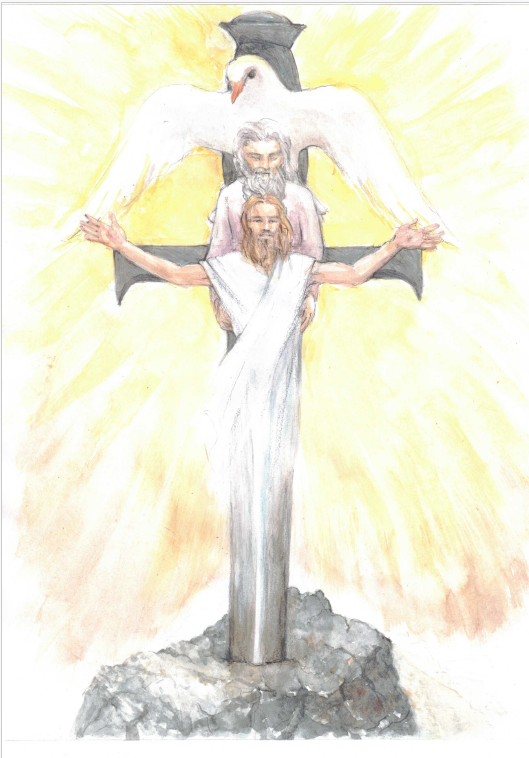
- c) But perhaps the most fitting image is that of the sword in the stone, a powerful expression of the will to end at least the greatest conflicts, wars. It would be necessary to depict a large rock with a large sword embedded in it, representing the risen Jesus, and then, above him, in order, the Father and the Holy Spirit-dove (an example is the figure at the bottom, a work by Elena Drago).
But then, as a consequence of this epochal action of Jesus, the other two Persons should also be dynamized. The dove is already sufficiently dynamized; because, since the Holy Spirit is immaterial, representing him with a dove is already a transfiguration; But this dove could be made even more expressive by drawing its wings longer, so as to embrace everything. The Father could be represented as an authority presiding over all and at the same time radiant, because his Son, fulfilling His law even before the institutions, has understood it thoroughly; or it could represent his wisdom, because with the crucifixion and resurrection of his Son, his prediction has proven true: humanity can be redeemed. It could be the Father in Canova’s Deposition of Jesus (1799): a radiant sun with a shining face within, and two open arms among the luminous rays.
Only when popular spirituality has acquired an image of the Trinity that also includes the resurrection of Jesus will it have understood that the Christian God has taken upon Himself, resolving it, the conflict of humanity, and then will it have an immediate understanding of the voluminous Christian Bible: the Christian God is a family which resolve internal and external conflicts non-violently.
Bibliography:
Boespflug F. (2008), Les images de Dieu. Une Histoire de l’Eternel dans l’Art, Paris: Bayard.
Drago A. (2016), “Improving Galtung’s A-B-C to a scientific theory of all kinds of conflicts”, Ars Brevis. Anuari de la Càtedra Ramon Llull Blanquenra, 21, pp. 56-91.
Galtung J. (1996), Peace by peaceful Means, London: Sage.
Wikipedia, “Paintings of the Holy Trinity”, https://commons.wikimedia.org/wiki/Category:Paintings_of_the_Holy_Trinity
______________________________________
 Prof. Antonino Drago: University “Federico II” of Naples, Italy and a member of the TRANSCEND Network. Allied of Ark Community, he teaches at the TRANSCEND Peace University-TPU. Master degree in physics (University of Pisa 1961), a follower of the Community of the Ark of Gandhi’s Italian disciple, Lanza del Vasto, a conscientious objector, a participant in the Italian campaigns for conscientious objection (1964-1972) and the campaign for refusing to pay taxes to finance military expenditure (1983-2000). Owing to his long experience in these activities and his writings on these subjects, he was asked by the University of Pisa to teach Nonviolent Popular Defense in the curriculum of “Science for Peace” (from 2001 to 2012) and also Peacebuilding and Peacekeeping (2009-2013. Then by the University of Florence to teach History and Techniques of Nonviolence in the curriculum of “Operations of Peace” (2004-2010). Drago was the first president of the Italian Ministerial Committee for Promoting Unarmed and Nonviolent Civil Defense (2004-2005). drago@unina.it.
Tags: Catholic Church, Christianity, Easter, Jesus Christ, Religion
This article originally appeared on Transcend Media Service (TMS) on 30 Mar 2026.
Anticopyright: Editorials and articles originated on TMS may be freely reprinted, disseminated, translated and used as background material, provided an acknowledgement and link to the source, TMS: The Image of the Non-violent Trinity, is included. Thank you.
If you enjoyed this article, please donate to TMS to join the growing list of TMS Supporters.

This work is licensed under a CC BY-NC 4.0 License.
Join the discussion!
We welcome debate and dissent, but personal — ad hominem — attacks (on authors, other users or any individual), abuse and defamatory language will not be tolerated. Nor will we tolerate attempts to deliberately disrupt discussions. We aim to maintain an inviting space to focus on intelligent interactions and debates.