
Lebanon Under Fire again – Israel Escalates Despite Ceasefire
MIDDLE EAST AND NORTH AFRICA, 11 May 2026
Ranjan Solomon | CounterCurrents - TRANSCEND Media Service
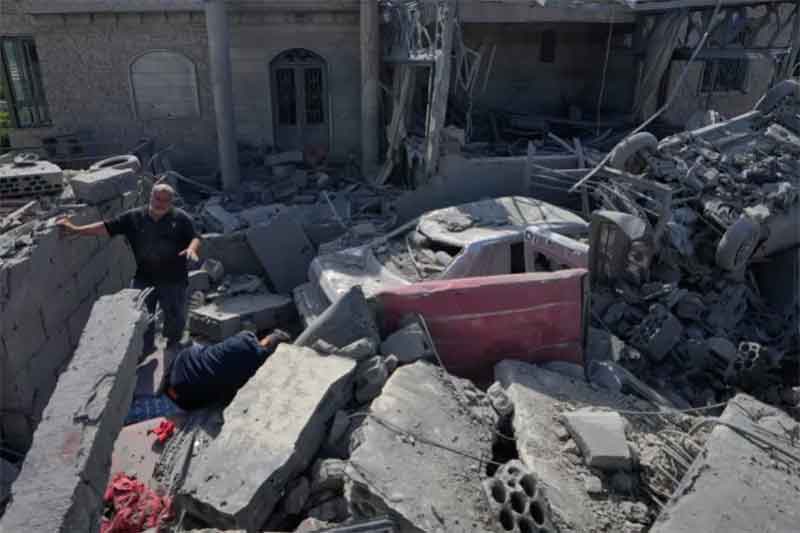
Residents search for survivors through the rubble of houses damaged by an Israeli air strike in Saksakiyeh, on 9 May 2026. [Mohammed Zaatari/ AP]
On Saturday, the Israeli occupation army carried out extensive drone strikes, artillery shelling, and demolition operations across southern Lebanon. According to reports from Al Jazeera, Israeli drones targeted the towns of Haris and Nabatieh al-Fawqa, while artillery shelling struck the outskirts of Kfar Tebnit, Harouf, and surrounding areas in Nabatieh province.
The attacks are not isolated incidents. Lebanese officials and residents say ceasefire violations have become routine since the agreement came into force. Villages in southern Lebanon remain trapped in an atmosphere of fear, uncertainty, and displacement. Civilians who had hoped the truce would allow them to rebuild shattered homes and lives now find themselves once again under the shadow of bombardment.
Israel continues to justify the attacks as “security operations” aimed at preventing threats from armed groups operating near the border, especially Hezbollah. Yet for many Lebanese, the strikes represent something broader: the continuation of a long history of military intimidation, territorial aggression, and disregard for Lebanese sovereignty.
The current escalation cannot be understood in isolation from the wider regional crisis unfolding across West Asia. Since the devastating war in Gaza intensified, tensions along the Lebanese border have steadily risen. Hezbollah and Israeli forces have exchanged fire repeatedly over recent months, raising fears that the region may slide into a much larger war involving Iran, Syria, and allied armed groups across the region.
The ceasefire reached in April was fragile from the outset because it addressed symptoms rather than causes. There was no political resolution, no serious diplomatic framework, and no accountability for violations. It emerged largely from international pressure and fear that uncontrolled escalation could ignite a wider regional confrontation with catastrophic consequences.
For ordinary civilians, however, geopolitical calculations offer little comfort. In southern Lebanon, drone warfare has transformed daily life into an exercise in survival. Farmers hesitate to cultivate their land. Children live beneath the constant sound of surveillance aircraft. Families displaced during previous attacks remain uncertain whether it is safe to return home.
The humanitarian implications are severe. Lebanon is already suffering one of the worst economic crises in its modern history. The country continues to struggle with financial collapse, political paralysis, spiralling inflation, mass unemployment, and failing public infrastructure. Entire sections of the population have been pushed into poverty over the past several years.
In such conditions, renewed military escalation deepens an already unbearable social crisis. Reconstruction becomes impossible when homes, roads, and public facilities remain vulnerable to repeated destruction. Trauma accumulates silently across communities forced to live between temporary calm and recurring violence.
There is also a profound psychological dimension to modern warfare that often escapes headlines. The constant presence of drones creates a condition of permanent fear. Civilians are denied even the basic human certainty of safety. War no longer arrives suddenly; it hovers continuously overhead.
The international response, meanwhile, reflects the deep double standards that increasingly shape global politics. Western governments routinely call for “restraint on all sides,” a phrase that obscures the enormous imbalance of military power between Israel and Lebanon. Such language often creates the illusion of symmetry where none exists.
The reality is that international law appears selectively enforced. Violations committed by powerful states are frequently treated as unfortunate necessities of security policy, while weaker nations are expected to absorb destruction with restraint and diplomatic patience. This selective morality has eroded faith in global institutions across much of the Global South.
The silence of major powers also emboldens further escalation. When repeated attacks produce no meaningful accountability, military aggression risks becoming normalized. Ceasefires then lose credibility because they are no longer seen as genuine pathways to peace, but merely intervals between rounds of violence.
The crisis in Lebanon also exposes the broader failure of international diplomacy in West Asia. Decades of militarisation, occupation, sanctions, proxy wars, and foreign intervention have created a region trapped in cycles of instability. Instead of addressing root causes — occupation, dispossession, inequality, and denial of political rights — global powers continue to manage crises through temporary arrangements that collapse at the first serious provocation.
For many across the Arab world, the continued bombing of Lebanon reinforces the belief that Palestinian suffering, Lebanese sovereignty, and Arab civilian lives are treated as secondary concerns within international power politics. This perception fuels anger, radicalisation, and distrust toward Western-led diplomacy.
Yet history shows that military superiority alone cannot create lasting peace. Bombardment may silence resistance temporarily, but it rarely eliminates the grievances that produce conflict. On the contrary, repeated destruction often deepens resentment across generations.
If the international community genuinely seeks stability in the region, it must move beyond crisis management and confront the structural realities driving violence: occupation, impunity, militarisation, and unequal enforcement of international law. Without justice, ceasefires remain fragile documents suspended over unresolved wars.
Until then, southern Lebanon will continue to live between fragile silence and renewed devastation – rebuilding homes while anticipating the next strike.
_________________________________________________
Ranjan Solomon has worked in social justice movements since he was 19 years of age. After an accumulated period of 58 years working with oppressed and marginalized groups locally, nationally, and internationally, he has now turned author- researcher-freelance writer focussed on questions of global and local/national justice. He has stayed in close solidarity with the Palestinian struggle for freedom from Israeli occupation and the cruel apartheid system since 1987. Solomon can be contacted at ranjan.solomon@gmail.com
Go to Original – countercurrents.org
Tags: Hezbollah, Israel, Lebanon, State Terrorism, USA, War of Aggression
DISCLAIMER: The statements, views and opinions expressed in pieces republished here are solely those of the authors and do not necessarily represent those of TMS. In accordance with title 17 U.S.C. section 107, this material is distributed without profit to those who have expressed a prior interest in receiving the included information for research and educational purposes. TMS has no affiliation whatsoever with the originator of this article nor is TMS endorsed or sponsored by the originator. “GO TO ORIGINAL” links are provided as a convenience to our readers and allow for verification of authenticity. However, as originating pages are often updated by their originating host sites, the versions posted may not match the versions our readers view when clicking the “GO TO ORIGINAL” links. This site contains copyrighted material the use of which has not always been specifically authorized by the copyright owner. We are making such material available in our efforts to advance understanding of environmental, political, human rights, economic, democracy, scientific, and social justice issues, etc. We believe this constitutes a ‘fair use’ of any such copyrighted material as provided for in section 107 of the US Copyright Law. In accordance with Title 17 U.S.C. Section 107, the material on this site is distributed without profit to those who have expressed a prior interest in receiving the included information for research and educational purposes. For more information go to: http://www.law.cornell.edu/uscode/17/107.shtml. If you wish to use copyrighted material from this site for purposes of your own that go beyond ‘fair use’, you must obtain permission from the copyright owner.
Join the discussion!
We welcome debate and dissent, but personal — ad hominem — attacks (on authors, other users or any individual), abuse and defamatory language will not be tolerated. Nor will we tolerate attempts to deliberately disrupt discussions. We aim to maintain an inviting space to focus on intelligent interactions and debates.
Read more
Click here to go to the current weekly digest or pick another article:
MIDDLE EAST AND NORTH AFRICA: