
The True Cost of the US Military in Hawaiʻi
PAPER OF THE WEEK, 8 Jun 2026
Christine Ahn, et al. - Institute for Policy Studies IPS - TRANSCEND Media Service
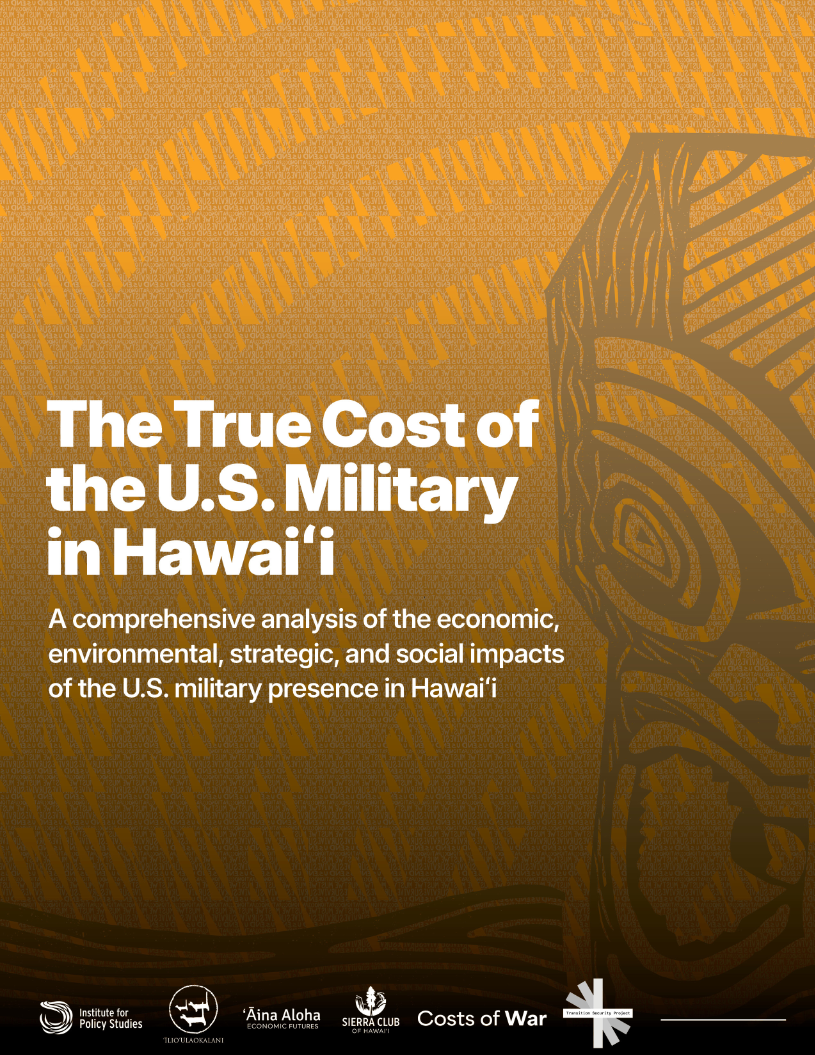
26 May 2026 – A comprehensive analysis of the economic, environmental, strategic, and social impacts of the U.S. military presence in Hawaiʻi.
Introduction
Hawaiʻi is central to the Trump administration’s planned military buildup against China. That buildup is now unfolding alongside a proposed $1.5 trillion Pentagon budget — even as costs of living rise and safety net programs face deep cuts. The collision of those pressures is bringing new scrutiny to what the military presence in Hawaiʻi actually costs, and who bears that burden.
The large military footprint in Hawaiʻi has often been touted by supporters as a boon for the islands’ security, job market, and economy. This new report — produced by the Institute for Policy Studies, alongside ʻĀina Aloha Economic Futures, The Costs of War Project, ʻĪlioʻulaokalani Coalition, Sierra Club of Hawai’i, and the Transition Security Project — challenges those claims.
The most comprehensive analysis of the military’s impact on Hawaiʻi ever conducted, our multi-disciplinary report examines what that presence actually costs and offers an alternative vision for how the land can be used. The expiration of military leases on public lands around 2029 presents a once-in-a-generation opportunity to change course.
A few key findings follow. Much more is available in the executive summary and the full-length PDF.
Key Findings
Finding 1: The military’s economic benefits are overstated.
The Pentagon and state officials claim the military contributes roughly $10 billion annually to Hawaiʻi’s economy. The real figure is $7.2 billion — nearly 30 percent less — representing 6.4 percent of GDP, not the purported 9.2 percent.
The military is not, as often claimed, one leg of a three-legged stool supporting the islands’ economy. Five industries — real estate, accommodation and food services, state and local government, retail, and health care — each represent a larger share of state GDP.
Dollar for dollar, military spending creates approximately 5.3 jobs per $1 million invested, compared to 12.3 jobs from the same investment in health care, education, housing, food production, or energy efficiency. Because most service members are legal residents of other states who rotate off the islands every two to three years, a significant share of military payroll represents economic leakage.
Finding 2: The true costs are hidden, uncounted, and enormous.
The military’s large footprint is built primarily on Crown and Government lands acquired through the 1893 illegal overthrow and contested annexation — leased since 1964 for $1. Applying standard methodology used to value military base land worldwide, this report finds the federal government owes back rent of up to $133.7 billion in 2025 dollars, not including environmental cleanup costs.
Decades of military use of PFAS (“forever chemicals”) have contaminated soil, groundwater, nearshore waters, fish and human blood far beyond installation boundaries. Remediation at just three installations is conservatively estimated at $493 million — yet cannot fully eliminate PFAS from Hawai’i’s environment. Indirect costs, including elevated cancer rates, drinking water filtration, and lost food production, could reach into the billions. The military has not committed to any meaningful remediation.
These environmental harms fall hardest on Native Hawaiians, Pacific Islanders, and low-income residents — communities near military bases that are more likely to report poor health and less access to resources. Military demand for off-base housing also inflates housing costs: in 2024, military personnel occupied 10.3 percent of O’ahu’s rental units, driving up average rents by an estimated 7.1 percent and costing non-military households an additional $234.8 million — about $1,848 per household.
The U.S. Indo-Pacific strategy, premised on a forward offensive posture with capacity for deep strikes into Chinese territory, intensifies the security dilemma with China and places Hawaiʻi at direct risk as a military target. A strategy of deterrence and defense by denial—built on resilience, defensive capabilities, and geography—would lower risk and make possible a substantially smaller military footprint in Hawai’i.
Finding 3: There are better uses for this land.
Hundreds of former military installations around the world have successfully converted to housing, schools, hospitals, parks, farms, cultural sites, and renewable energy projects. Nearly 300 ʻāina-based organizations already operate across the islands, building food systems, restoring watersheds, and creating place-based livelihoods.
A future rooted in aloha ʻāina — love of the land — and guided by Native Hawaiian governance offers an economic model that is place based, intergenerational, and resilient. An āina-based economic sector, adequately resourced, could rival or exceed the military’s 6.4 percent contribution to Hawaiʻi’s GDP while generating jobs insulated from the volatility of federal defense priorities and without further harming the people and environment.
Download Pdf:
Tags: Anti-militarism, Demilitarization, Environment, Hawaii, Military Capitalism, Nuclear Weapons, Pentagon, Poverty, US Military, War Economy, Warfare
DISCLAIMER: The statements, views and opinions expressed in pieces republished here are solely those of the authors and do not necessarily represent those of TMS. In accordance with title 17 U.S.C. section 107, this material is distributed without profit to those who have expressed a prior interest in receiving the included information for research and educational purposes. TMS has no affiliation whatsoever with the originator of this article nor is TMS endorsed or sponsored by the originator. “GO TO ORIGINAL” links are provided as a convenience to our readers and allow for verification of authenticity. However, as originating pages are often updated by their originating host sites, the versions posted may not match the versions our readers view when clicking the “GO TO ORIGINAL” links. This site contains copyrighted material the use of which has not always been specifically authorized by the copyright owner. We are making such material available in our efforts to advance understanding of environmental, political, human rights, economic, democracy, scientific, and social justice issues, etc. We believe this constitutes a ‘fair use’ of any such copyrighted material as provided for in section 107 of the US Copyright Law. In accordance with Title 17 U.S.C. Section 107, the material on this site is distributed without profit to those who have expressed a prior interest in receiving the included information for research and educational purposes. For more information go to: http://www.law.cornell.edu/uscode/17/107.shtml. If you wish to use copyrighted material from this site for purposes of your own that go beyond ‘fair use’, you must obtain permission from the copyright owner.
Join the discussion!
We welcome debate and dissent, but personal — ad hominem — attacks (on authors, other users or any individual), abuse and defamatory language will not be tolerated. Nor will we tolerate attempts to deliberately disrupt discussions. We aim to maintain an inviting space to focus on intelligent interactions and debates.