
Let’s Name the Country That’s Financing Mass Murder
AFRICA, 20 Jul 2026
Nicholas Kristof | NY Times/Genocide Watch - TRANSCEND Media Service
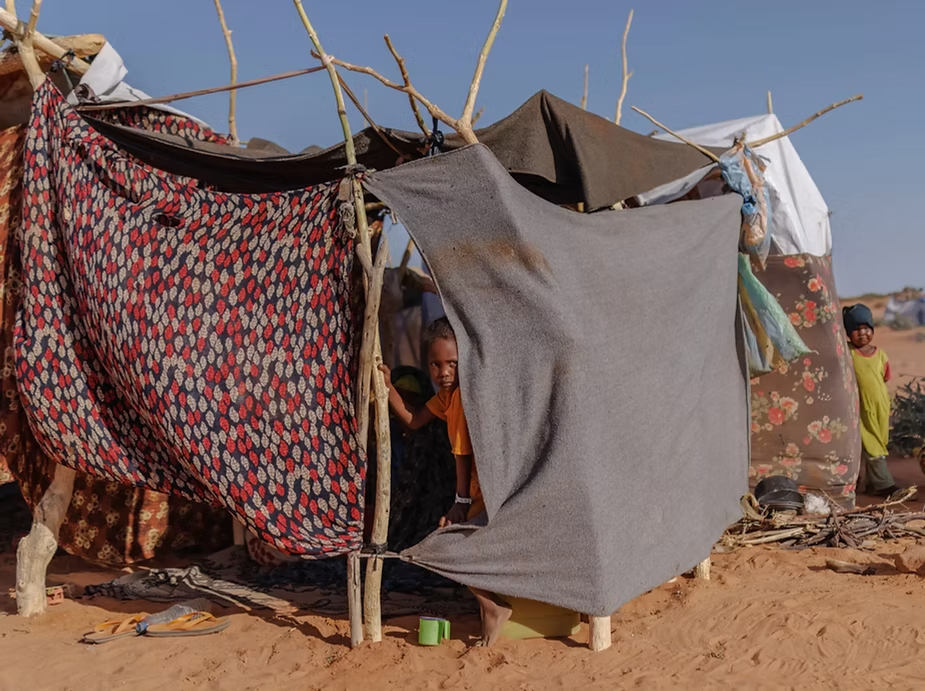
Credit: Dan Kitwood/Getty Images
11 Jul 2026 – Last year, human rights experts warned for many months that a brutal militia was about to overrun a major Sudanese city, El Fasher, and massacre inhabitants.
President Trump and other world leaders mostly shrugged. The militia went ahead and overran El Fasher, slaughtering some 60,000 people in a few weeks.
Now the same militia is besieging another major Sudanese city, El Obeid, which has half a million or more people, and is also threatening populations to the north in the Darfur region. Some inside El Obeid are starving, yet, again, Trump and many other world leaders seem largely indifferent.
Preventing the slaughter would not require military action. It would not even require money. Put aside the arguments over whether humanitarian assistance is worthwhile. (But first, let me say that I believe the billions spent on the Iran war would have been better allocated to $2 bed nets to save children’s lives from malaria.) It may be that all we need to do to avert atrocities in Sudan is to speak up.
The backdrop: Sudan is probably the world’s worst humanitarian crisis right now. The country is caught in a civil war between the army and a largely Arab militia, the Rapid Support Forces, or R.S.F., and while both sides have behaved viciously, the R.S.F. is particularly notorious for savagery, including for killing and raping members of several Black African ethnic groups.
While reporting on the Chad-Sudan border in 2024, I interviewed survivors who described the R.S.F.’s systematically killing men and boys over the age of 10 and gang-raping many women and girls.
“We don’t want to see any Black people,” one woman quoted an R.S.F. leader telling villagers before the militia slaughtered the men and boys, among them her five brothers.
The R.S.F. is now massing forces around El Obeid and attacking it with drones. Food is scarce and people are weakening. The region is suffering an outbreak of cholera, which, if it spreads, could greatly increase the suffering.
“Another human rights catastrophe is unfolding in Sudan,” Volker Türk, the U.N. high commissioner for human rights, warned a few days ago. He added that people in the region are being subjected to summary executions and sexual violence.
“Families have to queue for long hours to get water that is often unsafe for drinking,” the Norwegian Refugee Council reports. “Once they manage to bring water home, they must choose whether to use it to drink, cook or wash.”

It’s not entirely clear if the R.S.F. plans to overrun El Obeid or whether there would be a blood bath if it did. Compared to El Fasher, fewer people in El Obeid are members of the Black African ethnic groups that the R.S.F. targets. It’s even possible that the siege of El Obeid is a feint to distract from an attack elsewhere, such as on the Darfur city of Tawila.
Still, the risks are immense, and the United Nations Security Council issued a statement last month warning of the “imminent risk of mass atrocities.”
Leaders are willing to speak about the violence itself. Both the Biden and Trump administrations described the situation in Sudan as genocide. The State Department just last month warned of “alarming indications that mass atrocities could be imminent.”
But what American, European and United Nations officials won’t say openly is that the power behind the R.S.F. is the United Arab Emirates. Although the Emirates denies it, its backing of the R.S.F. is well established. Yet the Emirates is rich and influential, so it has become The Country That Must Not Be Named.
Tough public comments and other pressure from Washington and European capitals might shame the Emirates enough for it to tell its murderous friends in Sudan to back off; similar pressure led the Emirates to pull most of its forces out from a brutal war in Yemen in 2019. Instead, world leaders today tiptoe around the Emirates’ role.
The Emirates has particularly close financial ties to the Trump family. Indeed, Trump’s family income surged last year partly because an investment firm tied to the Emirates paid hefty sums for a stake in the family’s main crypto company.
Members of Congress, led by Senator Chris Van Hollen and Representative Sara Jacobs, have sponsored legislation that essentially would limit sales of weaponry to the Emirates as long as it arms the R.S.F. “This awful conflict could be ended if we had the political will to do so — instead of starting stupid wars with Iran,” Van Hollen said.
I share the belief that such a measure could end this catastrophe — but it is languishing from indifference. We should have the fortitude to speak up about human rights outrages whether the responsible party is Russia, China, Israel, America or the Emirates; if you care about human rights in only some places, you don’t actually care about human rights.
Sudan isn’t getting much attention, partly because the crisis areas are difficult to enter. I was organizing a trip to the conflict areas last month, but my route closed at the last minute, and I had to put the trip off. Enough information is trickling out for diplomats and aid groups to be able to ring the alarms; it’s just that the world is ignoring them.
“The international community must stop reacting to atrocities and start preventing them,” noted Rabab Mohamed Ali Baldo, a Sudanese activist originally from El Obeid.
This is an excellent moment to apply public pressure, for the Emirates [incredibly] appears to be lobbying for one of its top Foreign Ministry officials, Lana Zaki Nusseibeh, to be the next United Nations Secretary General.
“This won’t end until the Emirates are pressured to stop their advanced weapons superhighway to the R.S.F.,” said Nathaniel Raymond of the Yale Humanitarian Research Lab, which closely follows the crisis in Sudan.
“This war could end in two weeks if the R.S.F. entered an ammo drought because the Emirates decided it was no longer worth it.”
So, this is in part on us. Will we find the courage to speak up?
Copyright 2026 The New York Times Company
Tags: Africa, Genocide, Massacre, South Sudan, Sudan, World
DISCLAIMER: The statements, views and opinions expressed in pieces republished here are solely those of the authors and do not necessarily represent those of TMS. In accordance with title 17 U.S.C. section 107, this material is distributed without profit to those who have expressed a prior interest in receiving the included information for research and educational purposes. TMS has no affiliation whatsoever with the originator of this article nor is TMS endorsed or sponsored by the originator. “GO TO ORIGINAL” links are provided as a convenience to our readers and allow for verification of authenticity. However, as originating pages are often updated by their originating host sites, the versions posted may not match the versions our readers view when clicking the “GO TO ORIGINAL” links. This site contains copyrighted material the use of which has not always been specifically authorized by the copyright owner. We are making such material available in our efforts to advance understanding of environmental, political, human rights, economic, democracy, scientific, and social justice issues, etc. We believe this constitutes a ‘fair use’ of any such copyrighted material as provided for in section 107 of the US Copyright Law. In accordance with Title 17 U.S.C. Section 107, the material on this site is distributed without profit to those who have expressed a prior interest in receiving the included information for research and educational purposes. For more information go to: http://www.law.cornell.edu/uscode/17/107.shtml. If you wish to use copyrighted material from this site for purposes of your own that go beyond ‘fair use’, you must obtain permission from the copyright owner.
Join the discussion!
We welcome debate and dissent, but personal — ad hominem — attacks (on authors, other users or any individual), abuse and defamatory language will not be tolerated. Nor will we tolerate attempts to deliberately disrupt discussions. We aim to maintain an inviting space to focus on intelligent interactions and debates.