


Can One Philosophy Fit the Whole World?
PAPER OF THE WEEK, 3 Aug 2026
Jan Krikke – TRANSCEND Media Service
15 Jul 2026 – The dream of a philosophy that explains the whole is almost as old as philosophy itself. Plato sought eternal Forms. Confucius looked for harmony in human relationships. Nāgārjuna dismantled conceptual certainties. Spinoza envisioned reality as a single substance. Hegel interpreted history as the unfolding of Spirit. Each sought a deeper order underlying ordinary experience, yet each described that order in profoundly different terms.
Every age has produced new attempts to reconcile expanding knowledge with an enduring search for coherence. That aspiration has not faded. If anything, the fragmentation of modern knowledge has made it more urgent. Physics, psychology, economics, and religious studies now speak largely to themselves. The more we learn, the harder it becomes to see how the pieces fit together.
Few thinkers have taken up that challenge as boldly as Ken Wilber. Beginning in the late 1970s, he tried to build a framework wide enough to hold science and spirituality, East and West, psychology and religion, together. Developmental psychology, systems theory, Buddhism, Advaita Vedanta, and Christian mysticism all became elements of what he called Integral Theory.
For many readers it offered something intellectual life increasingly lacked: a map large enough to hold domains that specialization had pulled apart. Wilber’s work also broke from the Hegel-to-Teilhard de Chardin tradition of universal philosophy in one respect. He treated Buddhist and Vedantic traditions as indispensable partners in a comprehensive philosophy rather than as peripheral curiosities.
Whatever one concludes about Integral Theory, the scale of Wilber’s ambition is difficult to dismiss. But the ambition itself raises a question that goes beyond Wilber. Can any philosophy integrate the world’s traditions without quietly privileging one way of organizing knowledge?
Every comprehensive philosophy must confront that question, because bringing traditions together inevitably requires deciding which concepts provide the organizing framework and which become examples within it.
It helps to separate two claims that easily get blurred. A universal philosophy claims to offer concepts applicable to all human experience. A global philosophy seeks to engage the world’s major philosophical traditions on genuinely reciprocal terms. The two ambitions often overlap, but they are not identical. Integral Theory seeks to unite a universal account of human development with sustained engagement across the world’s major philosophical traditions. Whether any single framework can fully achieve both is the question that runs through this essay.
Wilber has never claimed Integral Theory is reality itself. He presents it as a conceptual map that remains open to criticism, refinement, and revision, and his later work on Integral Post-Metaphysics demonstrates that the project continued to evolve rather than solidify into doctrine. The question here is not whether his map succeeds. It is whether any single map can become fully global.
A political map shows borders. A geological map shows tectonic plates. A climate map shows weather systems. Each is true of the same world. None is complete, and none is false. Comprehensive philosophical frameworks work in much the same way: they do not just collect ideas, they organize them, and the organizing itself expresses assumptions about what counts as real and what counts as explanation.
Integral Theory illustrates the point particularly clearly. Its sources are genuinely diverse, but the architecture that relates them is developmental: reality unfolds through increasing complexity and widening perspective. That architecture has proved intellectually fruitful. The question is whether development is the only conceptual grammar capable of holding these traditions, or simply the one Wilber’s own intellectual lineage supplied.
Wilber, for instance, places what he calls egocentric and ethnocentric stages of development below worldcentric and kosmocentric ones. From within some Confucian perspectives, one might ask whether that ordering reflects a broadly modern liberal understanding of moral development rather than a culturally neutral account of consciousness.
Traditions often differ less in their answers than in the questions they regard as fundamental. That insight is worth holding in mind as we turn to the next section.
A Buddhist, a Christian mystic, and a neuroscientist might describe the same state of consciousness in entirely different terms. Wilber argues that the deepest contemplative traditions converge on a shared experiential horizon: that Zen, Advaita, and Christian mysticism, however different their languages, point toward the same realization.
Suppose that is true. Even so, the frameworks used to interpret that realization remain culturally distinct. Experience and interpretation are not identical, and two traditions can arrive at comparable experiences while explaining them through incompatible philosophical vocabularies.
The issue, then, is not whether these traditions belong in the same conversation. It is whether the conversation is already being held on one tradition’s terms, with one interpretive structure deciding what counts as a higher realization and what counts as a preliminary one.
Many influential strands of Western philosophy have sought universal explanatory principles—from Plato’s Forms and Aristotle’s categories to Kant’s critical philosophy and modern systems theory. That search profoundly shaped the emergence of modern science.
Other traditions often begin from different concerns. Many Buddhist schools ask not how reality develops historically but how suffering arises in present experience. Advaita Vedanta asks what remains when the distinction between subject and object dissolves. Classical Daoist texts emphasize responsiveness rather than control, while Confucian thought focuses on ethical cultivation and the quality of human relationships.
These are not merely different solutions to a common problem. They reflect different ways of framing philosophical inquiry itself. A developmental framework naturally highlights some of these questions while placing others in a supporting role—not because they are less important, but because every organizing logic privileges certain relationships over others.
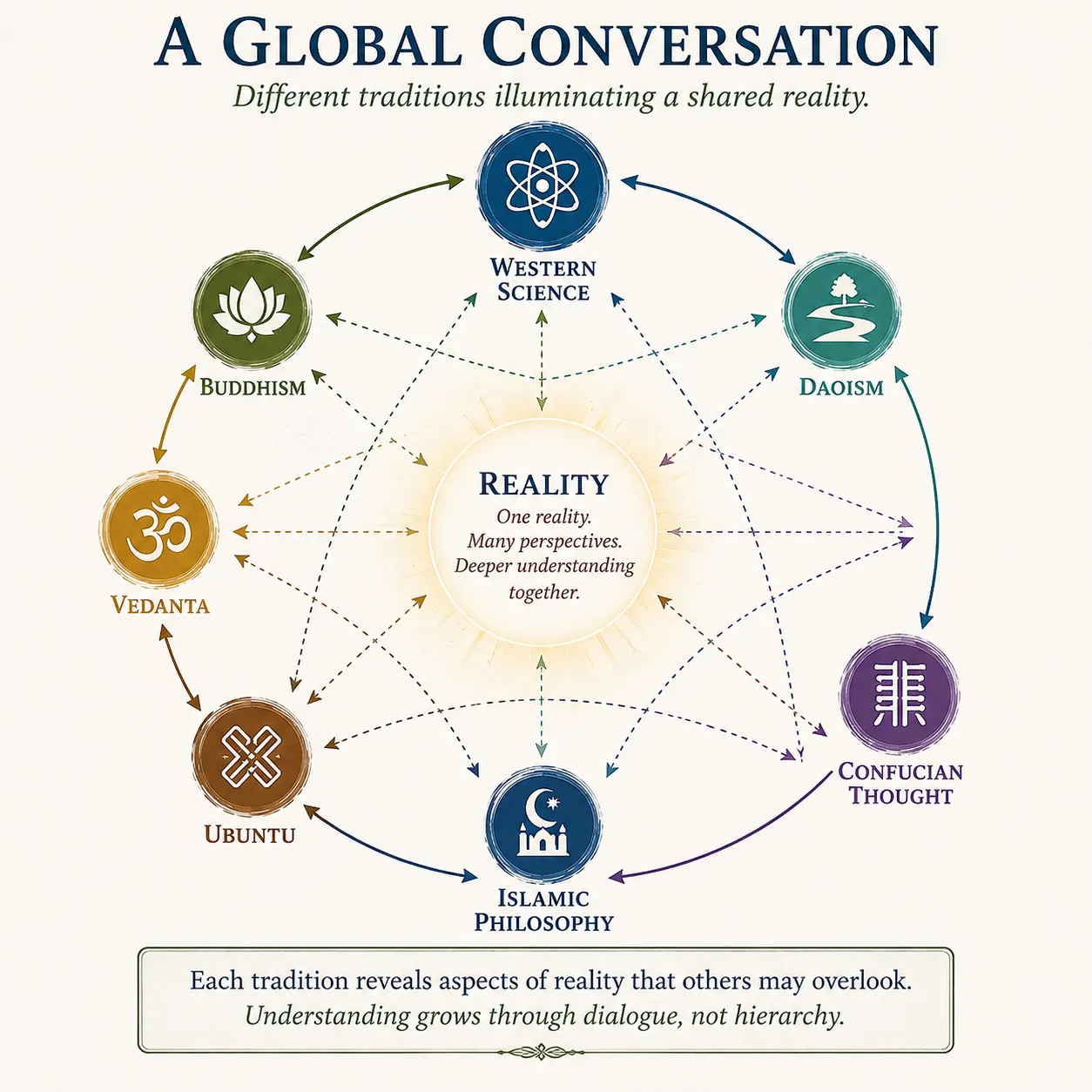
Perhaps the future of comparative philosophy lies less in building larger systems than in changing how traditions meet one another. Architecture implies a finished design; buildings get completed. Conversations do not. A conversation changes everyone who takes part in it, which suggests a different model of integration: traditions as partners rather than as building materials, each capable of reshaping the framework rather than simply filling a slot within it.
Here the distinction between universality and globality becomes particularly relevant. A universalizing approach asks which framework best explains reality. A globalizing approach asks how different philosophical traditions might illuminate reality without surrendering their own conceptual vocabularies. The former tends toward hierarchy; the latter toward dialogue.
That principle extends well beyond the traditions discussed so far. Ubuntu philosophy begins from relational understandings of personhood that challenge individualist assumptions. Islamic philosophy developed sophisticated syntheses of reason and revelation while preserving and transforming Greek thought. Many Indigenous traditions understand knowledge less as detached representation than as participation in living ecological relationships. These are not simply additional voices waiting to be accommodated within an existing framework. They invite us to reconsider the framework itself.
Perhaps the better metaphor is not architecture at all, but ecology. Architecture asks how the parts fit together. Ecology asks how the parts sustain one another.
A healthy forest is not made of one kind of tree; it thrives because different organisms occupy different niches, each contributing something the others lack. A forest of identical trees is vulnerable to a single disease. Their differences are not defects awaiting eventual correction. They are the source of the ecosystem’s resilience.
Human knowledge may work the same way. Modern science has proved exceptionally powerful for prediction and causal explanation. Contemplative traditions cultivate disciplined ways of examining consciousness from within. Ethical and political traditions explore responsibility, justice, and the texture of social life.
None of these supersedes the others, and each grows thin when reduced to the terms of another. A genuinely global philosophy might resemble an ecosystem more than a pyramid: not a search for the one framework that finally fits everything, but a set of conditions under which traditions can keep illuminating, challenging, and revising one another.
An ecological model shifts the emphasis from universality to globality. Rather than asking whether one conceptual framework applies everywhere, it asks how different traditions might enrich one another without being subsumed into a single interpretive structure.
But every ambitious synthesis creates the conditions for its own revision. A philosophy that genuinely seeks universality has to stay open to being changed by the traditions it hopes to include. That is not a rejection of Integral Theory. It is an extension of its own deepest aim.
The next stage may not be a bigger system. It may be a deeper willingness to be changed by what we encounter—not determining which tradition possesses the master framework, but creating the conditions under which every tradition can reshape it in turn.
The movement from architecture to ecology to conversation is not accidental. It reflects a progression from asking how things fit together, to asking how they sustain one another, to asking how they change one another. A genuinely global philosophy would not simply include the world’s traditions. It would allow them to transform one another.
Dialogue does not require abandoning the search for truth. It requires recognizing that no single philosophical vocabulary is likely to exhaust the ways in which truth can be articulated.
The future of philosophy may lie not in abandoning the search for universality, but in discovering that universality itself emerges through genuinely global conversation—not a final synthesis, but an enduring conversation.
Go to Original – krikke.substack.com
PAPER OF THE WEEK STAYS POSTED FOR 2 WEEKS BEFORE BEING ARCHIVED
Tags: Buddhism, Christianity, Confucius, Cooperation, Dialogue, Georg Wilhelm Friedrich Hegel, Islam, Karl Marx, Philosophy, Plato, Science, Spinoza, Taoism, Teilhard de Chardin, Ubuntu, Vedas, Wilber, World
DISCLAIMER: The statements, views and opinions expressed in pieces republished here are solely those of the authors and do not necessarily represent those of TMS. In accordance with title 17 U.S.C. section 107, this material is distributed without profit to those who have expressed a prior interest in receiving the included information for research and educational purposes. TMS has no affiliation whatsoever with the originator of this article nor is TMS endorsed or sponsored by the originator. “GO TO ORIGINAL” links are provided as a convenience to our readers and allow for verification of authenticity. However, as originating pages are often updated by their originating host sites, the versions posted may not match the versions our readers view when clicking the “GO TO ORIGINAL” links. This site contains copyrighted material the use of which has not always been specifically authorized by the copyright owner. We are making such material available in our efforts to advance understanding of environmental, political, human rights, economic, democracy, scientific, and social justice issues, etc. We believe this constitutes a ‘fair use’ of any such copyrighted material as provided for in section 107 of the US Copyright Law. In accordance with Title 17 U.S.C. Section 107, the material on this site is distributed without profit to those who have expressed a prior interest in receiving the included information for research and educational purposes. For more information go to: http://www.law.cornell.edu/uscode/17/107.shtml. If you wish to use copyrighted material from this site for purposes of your own that go beyond ‘fair use’, you must obtain permission from the copyright owner.
Join the discussion!
We welcome debate and dissent, but personal — ad hominem — attacks (on authors, other users or any individual), abuse and defamatory language will not be tolerated. Nor will we tolerate attempts to deliberately disrupt discussions. We aim to maintain an inviting space to focus on intelligent interactions and debates.