


Cuba’s Influence in the Demise of South Africa’s ‘Apartheid:’ A Silenced History
LATIN AMERICA AND THE CARIBBEAN, 3 Aug 2026
Mirko Casale | Resumen - TRANSCEND Media Service
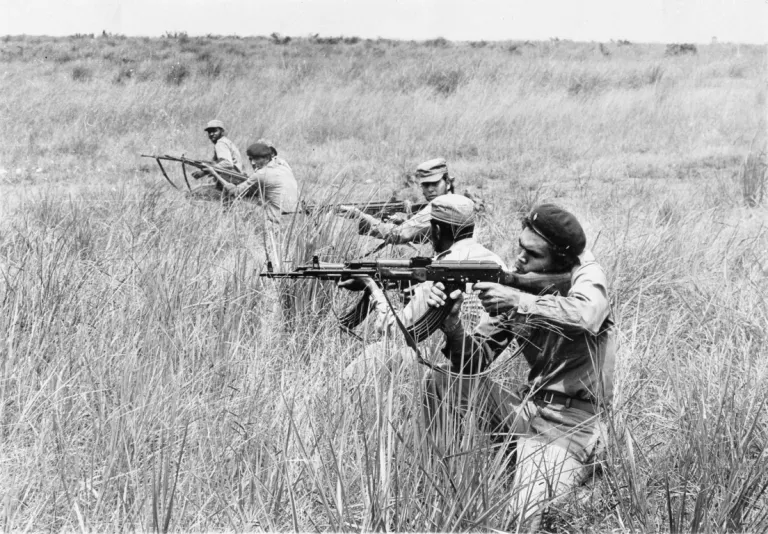
Cuban and Angolan troops, members of the MPLA, gather for a weapons training in San Vicente, near Cabinda (Angola), in 1976.
24 Jul 2026 – In 1948, a system of racial segregation was officially established in South Africa, through which the indigenous African population was marginalized by laws imposed by a white minority descended from European settlers.
Thanks to their enormous repressive power, their more or less covert connections with Western countries—which took decades to adopt serious measures against that racist regime—and their close alliance with another “apartheid” regime, that of Israel, the South African authorities managed to remain in power for decades despite resistance from the Black population, which constituted the overwhelming majority of the country.
In the 1970s, South Africa was also one of the region’s greatest military powers. It not only enforced racial segregation within its borders but also illegally occupied the territory of present-day Namibia and intervened against the anti-colonial and liberation movements emerging throughout southern Africa.
“Cuba’s true contribution to the fight against ‘apartheid’ extended far beyond South Africa’s borders,” explains Cuban journalist Hedelberto López Blanch, an expert on those events. Pretoria, he recalls, exerted enormous military and political influence over the entire southern African region at the time and had numerous allies and subordinate forces throughout the region.
To understand Cuba’s role in this story, we spoke with López Blanch, to whom we extend our special thanks for his efforts in sending us his responses despite the numerous technical and energy-related obstacles currently facing the island.
The First Ties to African Struggles
Cuba’s contribution to the collapse of apartheid began long before the major battles fought in Angola. During the 1960s, in parallel with the early years of the Cuban Revolution, numerous liberation movements took up arms against the European colonial powers. A mutual sympathy soon emerged, which translated into varying degrees of political, diplomatic, and military collaboration.
One such connection was forged between Havana and the Popular Movement for the Liberation of Angola (MPLA), which was fighting to end Portuguese colonialism.
López Blanch identifies a decisive moment in the contacts maintained by Ernesto “Che” Guevara with African revolutionary movements. It was then that Che met the Angolan leader Agostinho Neto, who asked Cuba for instructors to train his fighters. “Cuba began training some Angolan guerrillas in the Congo,” the journalist recounts. From that initial cooperation, an increasingly close relationship developed between the Cuban Revolution and the MPLA.
Cuban and Angolan troops, members of the MPLA, gather for a weapons training session at a training center in San Vicente, near Cabinda (Angola), in 1976. AP

1976: A road bridge over the Luchis River was destroyed after being blown up by UNITA to halt the advance of MPLA forces, led by Cuba, during the Angolan Civil War.
A decade later, Angolan independence groups with revolutionary and anti-imperialist leanings were on the verge of seizing power. That possibility set off alarm bells across the Western world, which, when it could not prevent the formal dissolution of its colonies, sought to replace them with supervised independence and governments subordinate to its interests.
Apartheid-era South Africa, for its part, feared that the anti-colonial example would spread throughout the region and jeopardize its control over Namibia and its own segregationist structure. Pretoria therefore decided to intervene directly in Angola.
As López Blanch explains, by 1974 the MPLA was already the dominant force in much of the country and controlled twelve provinces. To prevent it from declaring independence and taking power on November 11, 1975, South African troops advanced from the south, while forces from Zaire, under the command of Holden Roberto—leader of the National Liberation Front of Angola and an ally of the CIA and Pretoria—advanced from the north.
Operation Carlota
It was in this context—with Angola newly independent and various forces vying for power—some with an anti-imperialist orientation and others backed by the United States, South Africa, or both—that Cuba launched Operation Carlota.
The name paid tribute to an African slave who, in the 19th century, had led a rebellion against slavery in Cuba. The name encapsulated the political and historical significance that Havana attributed to its intervention in Africa.
Over the following years, and at the request of the Angolan government, tens of thousands of Cubans traveled to the country. Among them were military personnel, but also doctors, teachers, engineers, technicians, and numerous civilian aid workers. Neither Pretoria nor Washington was willing to accept what they interpreted as a “Cubanization” of southern Africa. The MPLA’s victory and consolidation threatened both the regional position of the racist South African regime and U.S. geopolitical interests.
1976: A destroyed highway bridge over the Luchis River, blown up by UNITA (National Union for the Total Independence of Angola) to halt the advance of the Cuban-led MPLA forces during the Angolan Civil War. Gettyimages.ru
The conflict escalated. The United States and South Africa backed armed groups such as the National Union for the Total Independence of Angola (UNITA), which operated on Angolan territory. At the same time, South African regular forces carried out constant military incursions into the country.
In the mid-1980s, a major offensive by UNITA and the South African Army put Angolan government troops in a critical situation. The fighting had destroyed or seriously weakened several of their battalions and threatened to bring about a defeat capable of destabilizing the government itself.
Faced with this situation, López Blanch recalls, President José Eduardo dos Santos once again requested military aid from Cuba. Havana agreed after assessing the circumstances, but set one condition: the leadership of the operations had to remain under Cuban command.
Cuito Cuanavale, the Turning Point
Those events culminated in the Battle of Cuito Cuanavale, considered the major turning point of the Angolan War and, by extension, of the regional dominance exercised by apartheid-era South Africa and its allied forces.
For months, clashes continued between Cuban and Angolan troops on one side and South African and UNITA forces on the other. Cuba significantly reinforced its military presence, deployed airpower, and combined the defense of Cuito Cuanavale with an offensive toward the southwest, in the direction of the Namibian border.
“There was constant fighting between Cuban, Angolan, and South African troops,” explains López Blanch. The entry into action of the Cuban MiG-23s proved particularly significant: “The air force began to strike the South Africans very hard,” while ground forces advanced southward and threatened Pretoria’s strategic positions.

1977: An Angolan soldier crawls under barbed-wire trenches during a training exercise.
South Africa eventually withdrew, leaving UNITA weakened and unable to achieve its military objectives. That defeat did not merely signify the failure of an offensive in Angola. It also dealt a decisive blow to the prestige, deterrent power, and regional hegemony of the apartheid regime.
The human cost was enormous. Cuba’s nearly fifteen years of involvement in the conflict left thousands dead, including more than 2,000 Cubans who died during the internationalist mission.
Their names are inscribed on the memorial at Freedom Park in Pretoria, where Cuba’s contribution to the struggle against the racist regime that oppressed Africa’s southernmost country for decades is recognized and commemorated.
Namibia’s Independence and the Weakening of ‘Apartheid’
Following the fighting in Angola, South Africa was left militarily and diplomatically weakened. Its policy of racial segregation and its interventions in neighboring countries had led to growing international isolation, but it was the defeats on the ground that definitively altered the regional balance of power.
“Those setbacks changed the course of history,” López Blanch asserts. The new situation allowed for progress in implementing United Nations Resolution 435, which established the process for Namibia’s independence—a territory that had been illegally occupied by South Africa for decades.
Subsequent agreements led to the withdrawal of Cuban troops from Angola, but also to South Africa’s withdrawal from Namibia and the country’s independence in 1990. Shortly thereafter, the apartheid regime itself began to dismantle itself within South Africa.
Díaz-Canel: “We bring teachers to the world, not bombs—that is socialism”
Of course, the Cuban sacrifice has been systematically ignored, downplayed, or erased from the narrative disseminated by the mainstream media and the political elites of the Global North.
In these sugarcoated versions of history, the racist regime appears to have collapsed almost magically thanks to peaceful resistance, benefit concerts, and indignant statements by Western leaders.
When Cuba’s presence is mentioned, Havana is often reduced to the role of a mere Soviet pawn in the Cold War.
López Blanch rejects that interpretation. In his view, the idea that Cuba’s intervention in Angola was carried out on orders from Moscow falls apart when one examines Cuba’s own history and its deep ties to Africa. During the colonial period, he recalls, more than a million Africans were forcibly brought to the island as slaves. Many of them and their descendants later fought alongside Cuban independence fighters against Spanish rule. “That is the legacy left by the Africans who arrived in Cuba, fought alongside the mambises, and helped shape Cuban culture,” he notes.
A Historical Debt to Africa
The Cuban intervention was therefore not presented as a conquest or as an operation aimed at acquiring territories, natural resources, or economic privileges. It was officially conceived as an internationalist duty and as the repayment of a historical debt.
López Blanch recalls a reflection made by Fidel Castro during a visit to Panama in 1998. Cuba, the revolutionary leader explained at the time, was paying off the debt it owed to Africa: the sons of that continent had been forcibly brought to the island and had contributed decisively to building its culture and winning its independence.
Nelson Mandela never forgot who had stood by the South African people when the major Western powers were still collaborating with “apartheid”
That is why, the journalist argues, Cuba’s presence in Angola cannot be understood without considering that historical bond. “That explains why Cuba went to Africa, why Cuba went to Angola, and why tens of thousands of soldiers traveled there, along with many other professionals in medicine, engineering, and various civilian sectors,” he states.
It was a story of solidarity and sacrifice that, despite attempts to distort or rewrite it, was always perfectly clear to the most renowned figure in the struggle against “apartheid.”
Nelson Mandela never forgot who had stood by the South African people when the major Western powers were still trading with, collaborating with, or appeasing the racist regime. That is why, when he regained his freedom, Cuba was the first country he visited outside of Africa. A story that cannot and must never be forgotten.
Go to Original – resumen-english.org
Tags: Africa, Angola, Apartheid, Che Guevara, Cuba, Ethnocentrism, Fidel Castro, History, Latin America Caribbean, Racism, South Africa, White Supremacy
DISCLAIMER: The statements, views and opinions expressed in pieces republished here are solely those of the authors and do not necessarily represent those of TMS. In accordance with title 17 U.S.C. section 107, this material is distributed without profit to those who have expressed a prior interest in receiving the included information for research and educational purposes. TMS has no affiliation whatsoever with the originator of this article nor is TMS endorsed or sponsored by the originator. “GO TO ORIGINAL” links are provided as a convenience to our readers and allow for verification of authenticity. However, as originating pages are often updated by their originating host sites, the versions posted may not match the versions our readers view when clicking the “GO TO ORIGINAL” links. This site contains copyrighted material the use of which has not always been specifically authorized by the copyright owner. We are making such material available in our efforts to advance understanding of environmental, political, human rights, economic, democracy, scientific, and social justice issues, etc. We believe this constitutes a ‘fair use’ of any such copyrighted material as provided for in section 107 of the US Copyright Law. In accordance with Title 17 U.S.C. Section 107, the material on this site is distributed without profit to those who have expressed a prior interest in receiving the included information for research and educational purposes. For more information go to: http://www.law.cornell.edu/uscode/17/107.shtml. If you wish to use copyrighted material from this site for purposes of your own that go beyond ‘fair use’, you must obtain permission from the copyright owner.
Join the discussion!
We welcome debate and dissent, but personal — ad hominem — attacks (on authors, other users or any individual), abuse and defamatory language will not be tolerated. Nor will we tolerate attempts to deliberately disrupt discussions. We aim to maintain an inviting space to focus on intelligent interactions and debates.
Read more
Click here to go to the current weekly digest or pick another article:
LATIN AMERICA AND THE CARIBBEAN: