



Denmark’s Ritual of Militarisation: The Copenhagen Security Summit 2025
TRANSCEND MEMBERS, 8 Dec 2025
Jan Oberg, Ph.D. | Transnational Foundation – TRANSCEND Media Service
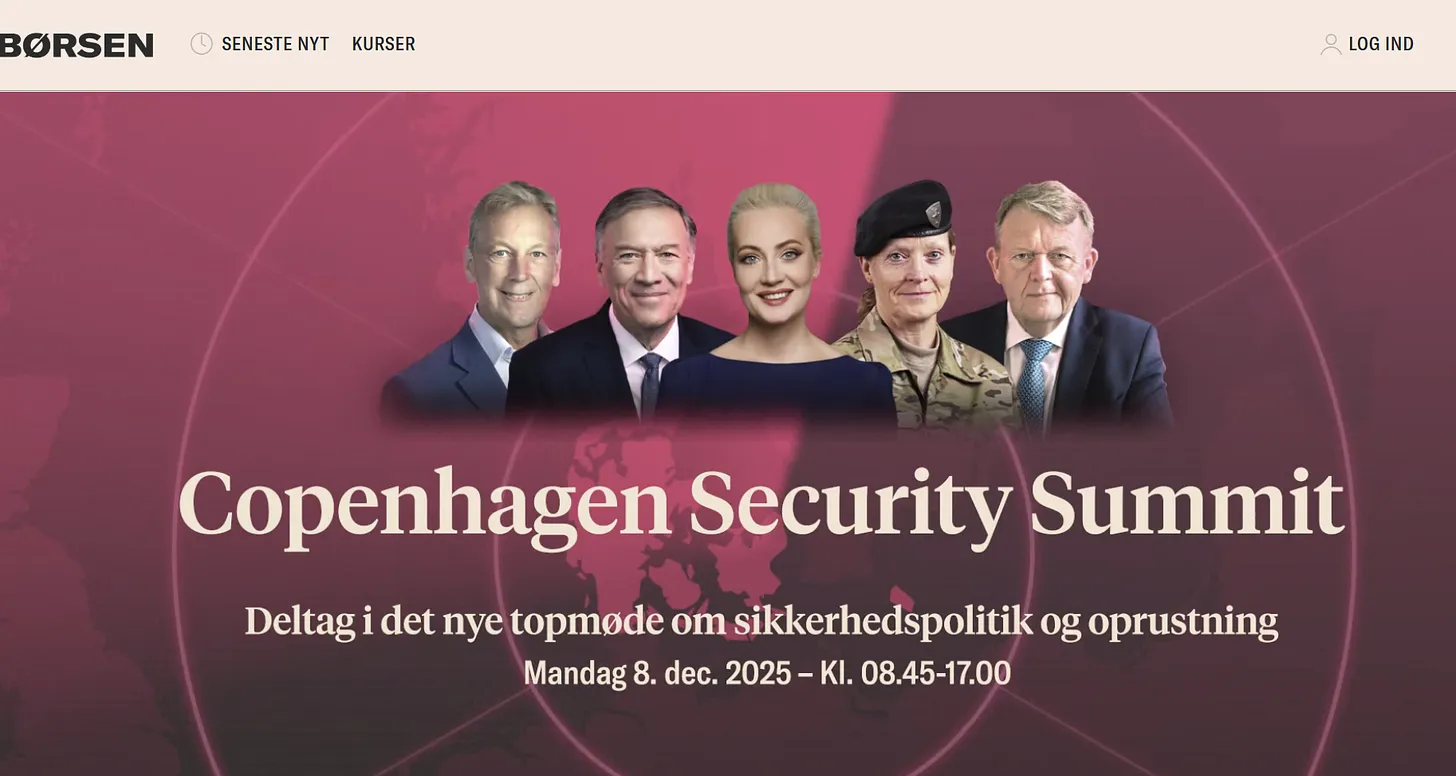
A showcase of the Military‑Industrial‑Media‑Academic Complex MIMAC, not wanting to know what peace and coexistence could be.
7 Dec 2025 – On 8 Dec 2025, the Copenhagen Security Summit convenes at Falkoner Centret in Frederiksberg. With 35 speakers and more than 1,200 participants, it is one of Denmark’s largest gatherings on geopolitics and security. Organised by Danish Industry (DI), Ernst and Young, Poul Schmith (The Chamber Attorney), Danske Bank, and the business newspaper Børsen, the summit features high‑profile figures such as Yulia Navalnaya, Mike Pompeo, and Lars Løkke Rasmussen.
The agenda moves through political framing, corporate responsibility, critical infrastructure resilience, and transatlantic dialogue. Its declared purpose is to explore “the role of business in a breaking world order,” explicitly linking corporate actors to Europe’s historically unique militarisation.
MIMAC in Action
The summit exemplifies the Military‑Industrial‑Media‑Academic Complex (MIMAC):
- Military: NATO officials, Pompeo, and Danish policymakers anchor the summit in alliance politics and defence spending. (Pompeo is a former CIA director, on video for being proud of lying, cheating and stealing, the inventor of the lies about genocide in Xinjiang and a fundamentalist hater of Russia and China…).
- Industrial: CEOs of Vestas, Terma, Danske Bank, Ernest & Young, and others are cast as “frontline actors” in security, normalising the militarisation of business.
- Media: Børsen is not merely reporting but co-organising, ensuring promotional coverage rather than critical journalism.
- Academic/Expert: Analysts and compliance specialists provide intellectual legitimacy, reframing militarisation as “resilience” and “risk management.”
- Legal: Kammeradvokaten’s presence ties the summit directly to the Danish state, embedding militarisation in law and governance.
This fusion dramatises a “breaking world order” where security is equated with militarisation, and business is enlisted into NATO’s orbit.
What Is Absent
Such a large‑scale, elite‑driven event would never be arranged around other pressing European or global challenges:
- Conflict resolution and peacebuilding: No panels on mediation, dialogue, or conflict analysis – in short, a forum of conflict‑ and peace‑illiterates who can only speak in military terms.
- Civilian roles in security: The EU’s civilian conflict‑management instruments and the UN’s peacekeeping and diplomacy are completely absent.
- Global challenges: Climate change, environmental degradation, and global governance are ignored, despite being existential threats.
The summit’s anti‑Russia character is explicit: Navalnaya symbolises resistance to Moscow, while Pompeo reinforces transatlantic confrontation. Yet no space is given to exploring diplomatic solutions, common security, trust-building, or peaceful coexistence.
Denmark’s Role
This summit is also a reflection of how Denmark, under Prime Minister Mette Frederiksen, has spearheaded militarisation. By hosting and promoting such events, Denmark positions itself as a loyal NATO member, implicitly endorsing further arming of Ukraine and a policy that leaves little room for stability with Russia. The emphasis is on confrontation and deterrence, not dialogue or coexistence – let alone peace.
Condemnation and Call to Action
The Copenhagen Security Summit is therefore not a neutral dialogue but a ritual of militarisation, staged by elites with vested interests in weapons production, defence procurement, and the securitisation of business. It condemns itself by omission: refusing to engage with peace, conflict resolution, or the civilian role of international institutions.
It is the ritual of the kakistocrats – an alliance of military, industry, media, and academia steering without a compass toward peace.
What is needed is a counter‑summit of peace and coexistence: a gathering where conflict analysts, peace researchers, environmental voices, and civil society can articulate alternative visions. Europe must reclaim the agenda from MIMAC and insist that security is not only about weapons, but about diplomacy, sustainability, intelligent/educated conflict-management and long-term trust-building.
Without such initiatives, Denmark risks being remembered not as a bridge‑builder, but as a spearhead of militarisation in Europe.
__________________________________________
 Prof. Jan Oberg, Ph.D. is director of the independent Transnational Foundation for Peace & Future Research-TFF in Sweden and a member of the TRANSCEND Network for Peace Development Environment. CV: https://transnational.live/jan-oberg
https://transnational.live.
Go to Original – thetransnational.substack.com
Tags: Copenhagen Security Summit, Denmark, Military, Military‑Industrial‑Media‑Academic Complex MIMAC, National Security, Scandinavia
DISCLAIMER: The statements, views and opinions expressed in pieces republished here are solely those of the authors and do not necessarily represent those of TMS. In accordance with title 17 U.S.C. section 107, this material is distributed without profit to those who have expressed a prior interest in receiving the included information for research and educational purposes. TMS has no affiliation whatsoever with the originator of this article nor is TMS endorsed or sponsored by the originator. “GO TO ORIGINAL” links are provided as a convenience to our readers and allow for verification of authenticity. However, as originating pages are often updated by their originating host sites, the versions posted may not match the versions our readers view when clicking the “GO TO ORIGINAL” links. This site contains copyrighted material the use of which has not always been specifically authorized by the copyright owner. We are making such material available in our efforts to advance understanding of environmental, political, human rights, economic, democracy, scientific, and social justice issues, etc. We believe this constitutes a ‘fair use’ of any such copyrighted material as provided for in section 107 of the US Copyright Law. In accordance with Title 17 U.S.C. Section 107, the material on this site is distributed without profit to those who have expressed a prior interest in receiving the included information for research and educational purposes. For more information go to: http://www.law.cornell.edu/uscode/17/107.shtml. If you wish to use copyrighted material from this site for purposes of your own that go beyond ‘fair use’, you must obtain permission from the copyright owner.
Join the discussion!
We welcome debate and dissent, but personal — ad hominem — attacks (on authors, other users or any individual), abuse and defamatory language will not be tolerated. Nor will we tolerate attempts to deliberately disrupt discussions. We aim to maintain an inviting space to focus on intelligent interactions and debates.