



Operation Condor: Transnational Murder Syndicate
LATIN AMERICA AND THE CARIBBEAN, 22 Dec 2025
Kit Klarenberg | Global Delinquents – TRANSCEND Media Service
16 Dec 2025 – On November 25th 1975, the 60th birthday of Chile’s CIA-installed dictator General Augusto Pinochet, high-ranking representatives of the repressive secret police forces of Argentina, Bolivia, Paraguay and Uruguay gathered in Santiago for a covert three-day summit. There, the quintet of US-sponsored Latin American fascist juntas forged an incendiary agreement. Dubbed ‘Operation Condor’ after Chile’s national bird, over the next eight years the endeavour blazed a gruesome trail of repression, torture, and murder throughout the hemisphere and beyond, with tens of thousands of killed.
Declassified records of the summit contain little trace of the horror that was to come. They primarily outline establishment of regular meetings between the oppressive agencies, formal and routine exchange of information, and the creation of a shared database “on people and organizations linked to subversion” in the region – in particular, individuals and entities “directly or indirectly linked to Marxism.” The only hint of belligerence is a brief snippet on the Operation being concerned with “attacking subversion related to our countries.”
Within months, Condor evolved into a transnational death squad nexus, with “subversives” the world over marked for execution. Of particular focus was the Revolutionary Coordinating Junta (JCR), an exile coalition of left-wing Latin American revolutionaries opposing the governments behind the Operation – which by 1976 also included Brazil. That July, a Condor meeting was convened, about which US intelligence learned. It was planned to insert operatives into Paris, where JCR was headquartered, to conduct intelligence gathering and ultimately, assassinations. A heavily redacted contemporary CIA memo noted:
“The basic mission of ‘Condor’ teams being sent to operate in France would be to liquidate top-level [JCR] leaders…Chile has ‘many’ (unidentified) targets in Europe…The Uruguayans also are considering targets…such as…opposition politician Wilson Ferreira Aldunate, if he should ever travel to Europe. Some leaders of Amnesty International might be selected for the target list.”
While the CIA installed all Condor’s constituent governments via military coups invariably involving mass disappearances and slaughter of political opponents, the Agency was anxious about its Latin American proxies conducting “offensive action outside their own jurisdictions,” as a late July 1976 CIA memo recorded. Not least because it raised the prospect of the Agency being “wrongfully accused” of responsibility for “this type of activity.” The State Department was also intensely worried about the Operation’s extraordinarily broad range of targets.
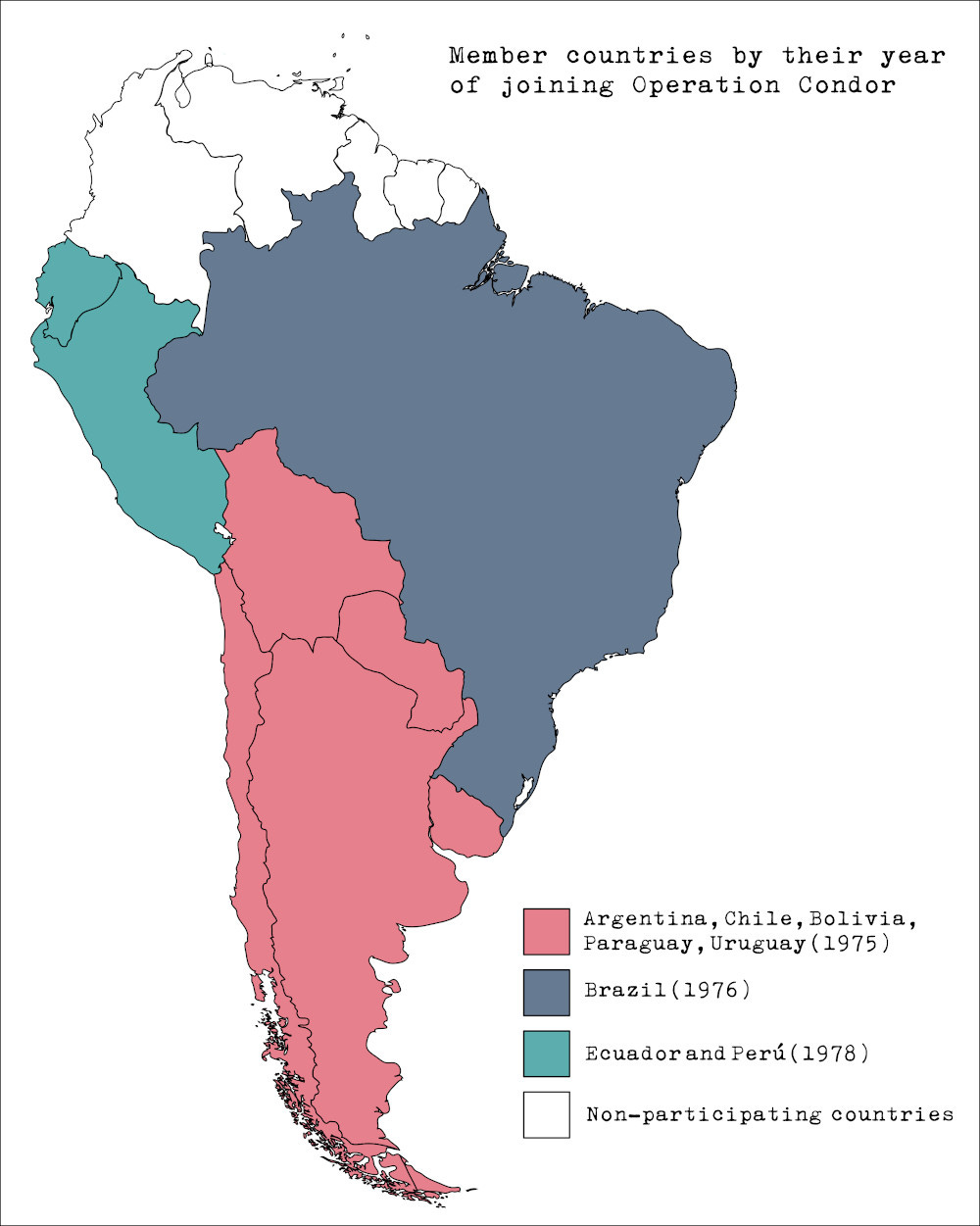
Operation Condor’s growth 1975 – 1978
‘Growing Problems’
A briefing dispatched to Secretary of State Henry Kissinger in August 1976 recorded how Condor’s members “see themselves as embattled” by phantom Marxist adversaries at home and abroad. “Despite near decimation of the Marxist left in Chile and Uruguay, along with accelerating progress toward that goal in Argentina,” the juntas were possessed of a “siege mentality shading into paranoia.” This was enhanced by “suspicion…the US has ‘lost its will’ to stand firm against Communism because of Vietnam,” and détente with the Soviet Union. As such:
“Fighting the absent pinkos remains a central goal of national security…Some ‘mistakes’ are made by the torturers, who have difficulty finding logical victims. Murder squads kill harmless people and petty thieves.”
In response to this illusory threat, pursuit of perceived “subversives” became absolutely central to the domestic and foreign policy of Condor governments. However, the State Department fretted how this crusade “increasingly translates into” vicious oppression of “non-violent dissent from the left and center left.” More generally, “subversion” was “never the most precise of terms.” In the Latin American context, the categorisation “has grown to include nearly anyone who opposes government policy.”
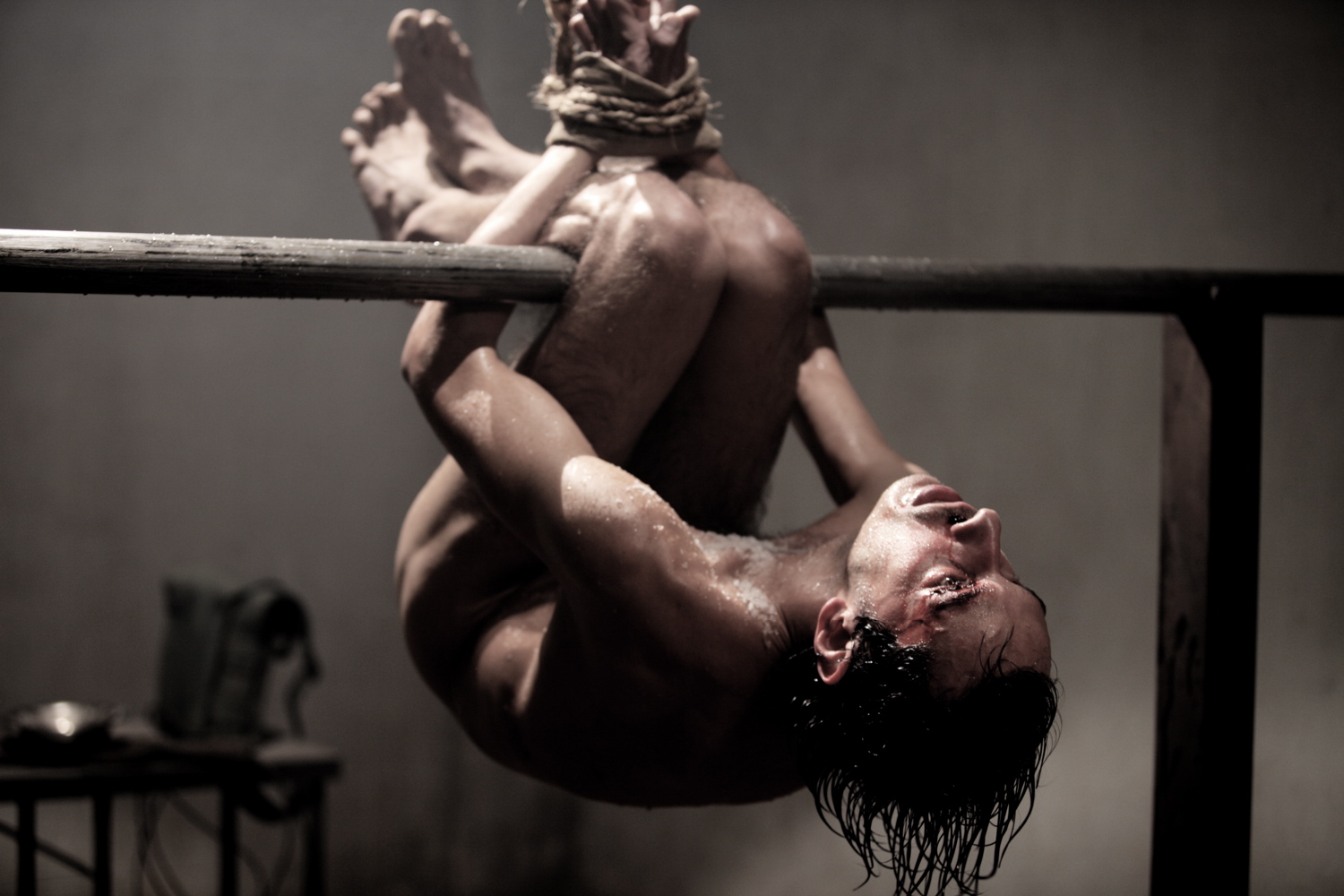
Pau-de-arara (“parrot’s perch”): Beatings, electric shocks applied to arms, legs, genitals and anus. A torture method introduced by the CIA in Brazil through Operation Condor, conducted by Kissinger supposedly against Communism. The TMS Editor was subject to such torture in 1970s for his anti-military/fascist/dictatorship activism in Brazil.
Resultantly, “there is a chance of persecution by foreign police acting on indirect, unknown information.” The memo recorded how “numerous Uruguayan refugees have been murdered in Argentina,” with “widespread” and “credible” accusations Buenos Aires was “doing their Uruguayan colleagues a favor,” and a high risk the victims were just average citizens, not engaged in political activism, let alone insurrectionary violence. Concurrently, many officials in Condor countries spoke of fighting a “Third World War” against Communism globally.
This narrative’s utility was clear. “It justifies harsh and sweeping “wartime” measures,” the State Department observed, while “[emphasising] the international and institutional aspect, thereby justifying the exercise of power beyond national borders.” Moreover, for the juntas involved in Operation Condor, “it is important to their ego, their salaries, and their equipment budgets to believe in a Third World War.” This shared self-interest was encouraging regional military governments to “[band] together in what may well become a political bloc of some cohesiveness.”
The State Department believed “the broader implications” of this development “for us and for future trends in the hemisphere” were “disturbing”, creating “a range of growing problems.” For one, Condor was damaging to the US’ from a public relations perspective, as “internationally, the Latin generals look like our guys.” Washington was “especially identified with Chile,” so the country serving as the Operation’s nucleus “cannot do us any good.” It was noted how Europeans “hate Pinochet & Co. with a passion that rubs off on us.”
TO CONTINUE READING Go to Original – kitklarenberg.com
______________________________________________
 Kit Klarenberg is a British investigative journalist exploring the role of intelligence services in shaping politics and perceptions.
Tags: Anglo America, Anti-hegemony, Anti-imperialism, Bullying, CIA, Chile, Invasion, Latin America Caribbean, Mafia, North America, Occupation, Operation Condor, Organized crime, Pentagon, South America, State Terrorism, Targeted Assassination, USA
DISCLAIMER: The statements, views and opinions expressed in pieces republished here are solely those of the authors and do not necessarily represent those of TMS. In accordance with title 17 U.S.C. section 107, this material is distributed without profit to those who have expressed a prior interest in receiving the included information for research and educational purposes. TMS has no affiliation whatsoever with the originator of this article nor is TMS endorsed or sponsored by the originator. “GO TO ORIGINAL” links are provided as a convenience to our readers and allow for verification of authenticity. However, as originating pages are often updated by their originating host sites, the versions posted may not match the versions our readers view when clicking the “GO TO ORIGINAL” links. This site contains copyrighted material the use of which has not always been specifically authorized by the copyright owner. We are making such material available in our efforts to advance understanding of environmental, political, human rights, economic, democracy, scientific, and social justice issues, etc. We believe this constitutes a ‘fair use’ of any such copyrighted material as provided for in section 107 of the US Copyright Law. In accordance with Title 17 U.S.C. Section 107, the material on this site is distributed without profit to those who have expressed a prior interest in receiving the included information for research and educational purposes. For more information go to: http://www.law.cornell.edu/uscode/17/107.shtml. If you wish to use copyrighted material from this site for purposes of your own that go beyond ‘fair use’, you must obtain permission from the copyright owner.
Join the discussion!
We welcome debate and dissent, but personal — ad hominem — attacks (on authors, other users or any individual), abuse and defamatory language will not be tolerated. Nor will we tolerate attempts to deliberately disrupt discussions. We aim to maintain an inviting space to focus on intelligent interactions and debates.
Read more
Click here to go to the current weekly digest or pick another article:
LATIN AMERICA AND THE CARIBBEAN: