



Winter Strikes Gaza with a Vengeance
PALESTINE ISRAEL GAZA GENOCIDE, 19 Jan 2026
Fedaa al-Qedra | The Electronic Intifada - TRANSCEND Media Service
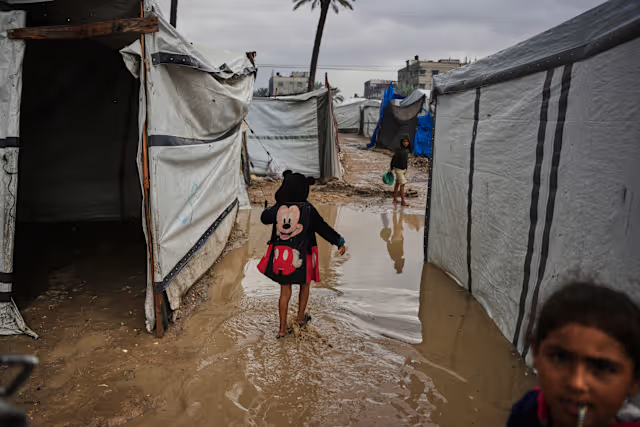
Everything is soaked’: Winter rains in Gaza bring new misery for Palestinians.
KSAT
17 Jan 2026 – In a crammed tent flooded with water and torn by the wind by the seaside in Mawasi, Khan Younis, Iyad Abu Jamea, 49, is trying to support his and his son’s family, a total of 14 people.
Around him, tents sit cheek-by-cheek as displaced families face the bitter winter cold with no proper shelter, while rain and sewage flood their homes, creating harsh and unsanitary living conditions.
Abu Jamea and his family were displaced from the al-Zana area on the eastern side of Khan Younis. In fact, he told The Electronic Intifada that, since the beginning of Israel’s genocide in Gaza, they had been displaced more than 20 times.
“Every time, we took this dilapidated tent with us. For a year and a half, we have been trying to repair it and keep it standing.”
During a recent cold spell, when a storm hit Gaza, the tent collapsed.
“The tent was uprooted and the fabric torn apart. I received three nylon sheets from UNRWA and built a new tent in preparation for winter weather, but rainwater flooded it while we were sleeping.”
The family sought shelter in a neighbor’s tent.
“The next morning, we tried to fix what was ruined,” he said.
All around him, the family’s possessions, mattresses and clothes, were spread out on the beach to dry. They had managed to repair some tears in the tent, but it was ad hoc work. They need help as winter deepens, Abu Jamea said.
That, however, is yet to come. Gaza’s 2 million people need assistance to provide decent shelters as winter deepens. Already, several people, among them children and at least four babies, have died as a result of cold weather and inadequate shelters. But international organizations are themselves dependent on Israel to open crossings. And Israel continues to block or delay the delivery of aid and humanitarian goods, including tents.
Even the UK was moved to protest in December that tents it had supplied were delayed for over a year.
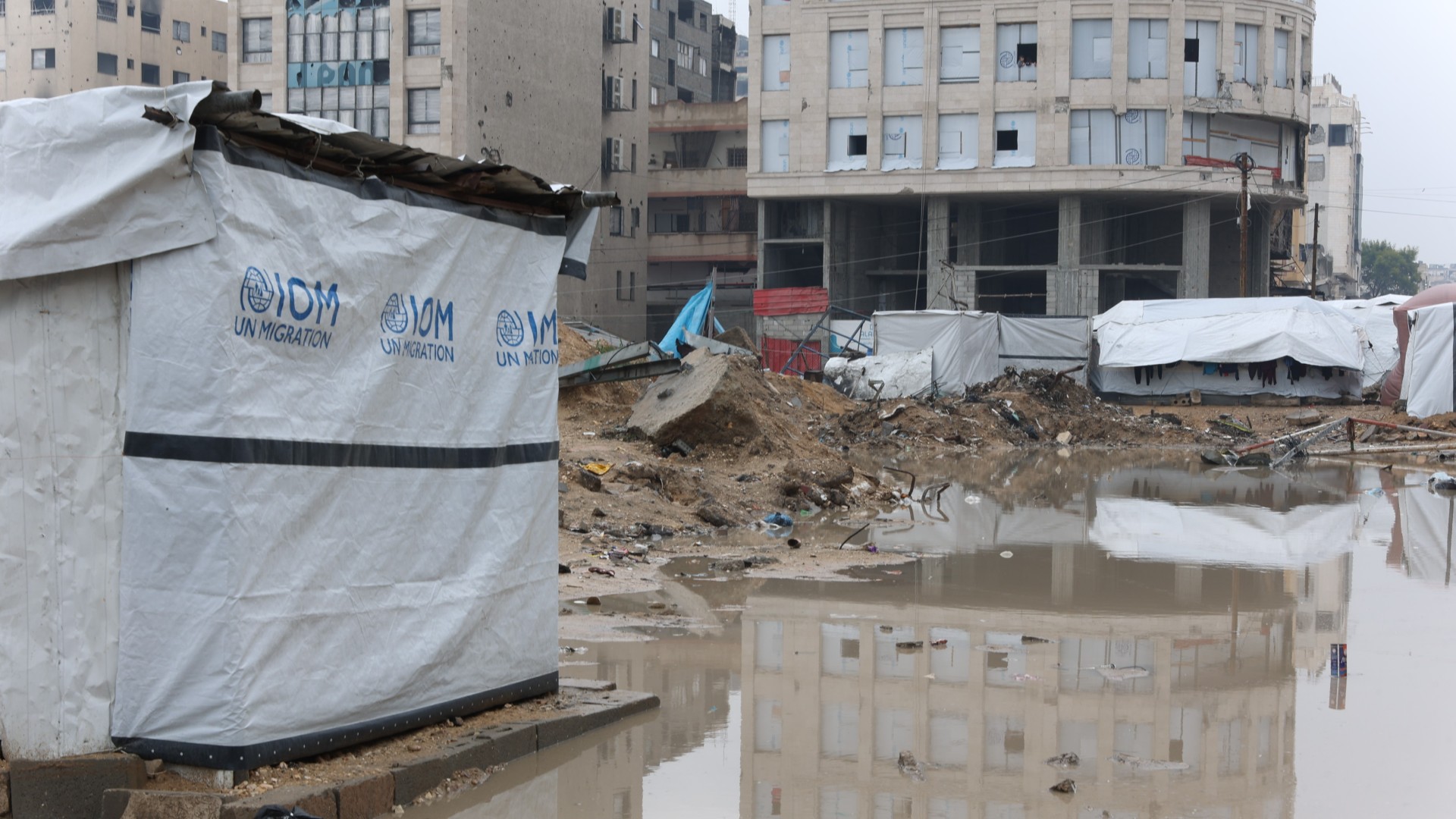
Life for Displaced Families in Gaza as Winter Returns. IOM Storyteller
Exposed
Olfat Mukhaimar, 39, a mother of five from the al-Satr al-Gharbi area of Khan Younis said she, her husband and children had little choice but to seek out the coast. Renting scarce land to pitch a tent has become expensive, and she, like everyone else, struggles for money.
But the coast is exposed to wind and rain.
“I received blankets and mattresses that helped us resist the cold, and we covered the tent with a nylon sheet,” she said about one particularly windy and rainy night. “But it couldn’t withstand the wind. The tent shook violently, and my children screamed.”
Her husband Hassan reinforced the tent with sand to keep it from flying away, but Mukhaimar still worries about the location. Her oldest son, Ali, 12, “spent the whole night digging sand berms” to keep out the water, and her daughters feared the sea would pull them in.
“The sea in front and sewage behind us,” she sighed.
Her son Mutasim, 10, recalled the same night in November: “We drowned. Sewage and rain came into the tent, and we were very scared.”
Nearby, Munira Abu Amer, 41, who lives with her family of 10, recounted her own tale of displacement that saw her and her family shelter on the shore with “nothing but a bag of clothes” and a sheet each.
They constructed a tent from wood, material and poles they had bought after they were displaced from Absan al-Kabira, on the eastern side of Khan Younis.
“When the rain came, my daughters and I stood in water until midnight. We screamed for help until a man offered us a tiny shelter where we tried to sleep squeezed into two meters. The cold and wind were unbearable.”
Of the two mattresses the family had secured, one sank in a puddle of sewage water. The material of their tent was torn and the family is now waiting for fabric to repair their shelter.
Inadequate protection
UNRWA estimates that more 1.9 million people – more than 80 percent of Gaza’s population – are internally displaced, living in tents or temporary shelters, many of which are simply inadequate for winter.
Of the 1.9 million displaced people, 1.3 million urgently require emergency shelter materials, according to the Shelter Cluster report of November 2025.
Displaced families on the seashore of Mawasi Khan Younis face the harshest conditions as winter intensifies. Between torn tents, muddy roads, sewage and contaminated water, they continue to suffer conditions not fit for life.
And it is not just the cold and wet.
“We suffered intestinal infections, joint pain and severe diarrhea,” Shahad Abu Taima, 18, told The Electronic Intifada. Conditions by the sea are difficult, she said, as there is no protection from the winds and rains, and sewage causes infections and other health issues.
“We need alternative places to live before the next depression. Winter is long … there are many days of suffering.”
___________________________________________
Fedaa al-Qedra is a journalist in Gaza.
Go to Original – electronicintifada.net
Tags: Anti Zionism, Ceasefire, Children, Collective Punishment, Colonialism, Colonization, Crimes against Humanity, Cultural violence, Direct violence, Ethnic Cleansing, Famine, Gaza, Genocide, Hunger, Israel, Israeli occupation, Palestine, Palestinian Holocaust, Sociocide, State Terrorism, Structural violence, USA, War crimes, Weather
JOIN THE BDS-BOYCOTT, DIVESTMENT, SANCTIONS CAMPAIGN TO PROTEST THE ISRAELI BARBARIC GENOCIDE OF PALESTINIANS IN GAZA.
DON'T BUY PRODUCTS WHOSE BARCODE STARTS WITH 729, WHICH INDICATES THAT IT IS PRODUCED IN ISRAEL. DO YOUR PART! MAKE A DIFFERENCE!
7 2 9: BOYCOTT FOR JUSTICE!
DISCLAIMER: The statements, views and opinions expressed in pieces republished here are solely those of the authors and do not necessarily represent those of TMS. In accordance with title 17 U.S.C. section 107, this material is distributed without profit to those who have expressed a prior interest in receiving the included information for research and educational purposes. TMS has no affiliation whatsoever with the originator of this article nor is TMS endorsed or sponsored by the originator. “GO TO ORIGINAL” links are provided as a convenience to our readers and allow for verification of authenticity. However, as originating pages are often updated by their originating host sites, the versions posted may not match the versions our readers view when clicking the “GO TO ORIGINAL” links. This site contains copyrighted material the use of which has not always been specifically authorized by the copyright owner. We are making such material available in our efforts to advance understanding of environmental, political, human rights, economic, democracy, scientific, and social justice issues, etc. We believe this constitutes a ‘fair use’ of any such copyrighted material as provided for in section 107 of the US Copyright Law. In accordance with Title 17 U.S.C. Section 107, the material on this site is distributed without profit to those who have expressed a prior interest in receiving the included information for research and educational purposes. For more information go to: http://www.law.cornell.edu/uscode/17/107.shtml. If you wish to use copyrighted material from this site for purposes of your own that go beyond ‘fair use’, you must obtain permission from the copyright owner.
Join the discussion!
We welcome debate and dissent, but personal — ad hominem — attacks (on authors, other users or any individual), abuse and defamatory language will not be tolerated. Nor will we tolerate attempts to deliberately disrupt discussions. We aim to maintain an inviting space to focus on intelligent interactions and debates.
Read more
Click here to go to the current weekly digest or pick another article:
PALESTINE ISRAEL GAZA GENOCIDE: