


From Diagnosis to Design, from Violence to Value: Ubuntu and the Transformative Peace Triangles of 21st Century – Part 2
TRANSCEND MEMBERS, 23 Feb 2026
Prof Hoosen Vawda – TRANSCEND Media Service
The need for an intercultural analysis of Ubuntu, Vawdaian Relational Architecture, and Galtung’s Diagnostic Lens in a Unified Peace Epistemology [1]
This publication is suitable for general readership. Parental guidance is recommended for minors who may use this research paper, as a resource material, for projects.
The author unconditionally apologises for any misrepresentation of esteemed Johan Galtung’s Peace Theories and interpretations expressed in this publication, while promoting global peace propagation for all of humanity.[2]
The Overall Inclusive Concept of Universal Peace, incorporating the Internal and External, Essential Elements of Peace
Original Photograph Conceptualised by Mrs V. Vawda, February 2026
Prologue
The author, in Part 1 of this topic, has formulated the concept of Endogenous[3] and Exogenous Peace[4] as well as proposed new theories about propagative peace.[5],[6],[7], [8], [9]. The present paper is Part 2 in the series, which reviews peace propagation in the 21st century, incorporating the uniquely South African concept of Ubuntu Peace philosophy, the Vawdaian peace theory and the Emeritus, late Professor Johan Galtung’s peace presentations to counteract global belligerism [10] across continents, by peace disrupting governments, in recent months. The author has concertedly attempted to embark on this project as a Peace Protagonists,[11]
Introduction
This paper advances a unified, humanity‑centred framework for peace in the 21st century by synthesising three epistemic traditions:
- Ubuntu [12],[13], as a meta‑epistemological foundation.
- Galtung’s Peace Triangle[14],[15]as a diagnostic model of violence; and
- The Vawdain Peace Triangle[16] as a generative architecture for building durable peace. This is conceptualised graphically by Madam V. Vawda
While classical peace theory in the 20th century focused primarily on the analysis of harm, mapping direct, structural, and cultural violence—contemporary peacebuilding requires a paradigm shift from diagnosing breakdowns to designing relational, ethical, and systemic coherence. This study proposes that Ubuntu, with its relational ontology articulated in the axiom Umuntu ngumuntu ngabantu (“A person is a person through other persons”), provides the philosophical ground on which such a shift becomes possible.
The further paper argues that Ubuntu functions not merely as an ethical value but as a meta‑epistemology[17], a theory about how knowledge of peace is formed, validated, and enacted. Ubuntu advances the insight that peace is not an individual or institutional phenomenon alone, but an emergent property of relational systems in which dignity, recognition, and interdependence are central. Within this relational paradigm, harm is not simply a moral violation but a structural incoherence in the web of shared personhood. Ubuntu thus reorients peace epistemology toward communal participation, mutual recognition, and restorative meaning‑making.
Situated within this philosophical, foundational ground, Galtung’s Peace Triangle is retained as an indispensable diagnostic instrument. By distinguishing between direct, structural, and cultural violence, Galtung’s model illuminates the systemic and symbolic drivers of conflict that must be dismantled for sustainable peace to emerge. It is important to remember that diagnostics alone cannot generate peace. This paper therefore integrates The Madam’s Peace Triangle, centred on Shared Purpose, Universal Needs and Values, as well as Common Interests, as a design engine for constructing peace through enabling attitudes, constructive behaviours, and inclusion‑focused policies. Where Galtung clarifies the machinery of harm, The Madam’s Triangle clarifies the architecture of alignment.
The Holistic Integration of seminal, foundational Peace Philosophies
The integration of these three models yields a triadic‑within‑triadic system: Ubuntu supplies the ontological and ethical foundation; Galtung identifies the forces that degrade relational coherence; and The Madam’s Triangle provides the procedural and structural pathways for building harmony. This unified framework is operationalised through an
- Attitudes–Behaviours–Policies (ABP) method for generative peace design and
- A Direct–Structural–Cultural (DSC) method for harm dismantling.
To evaluate interventions, the paper introduces a Coherence Test, inspired by biophotonic and neuro‑ethical metaphors, assessing whether attitudes, practices, and policies increase or reduce relational coherence within communities.
The resulting synthesis expands peace theory beyond absence‑of‑violence paradigms toward an ecology of dignity, reciprocity, and systemic alignment. It contributes to contemporary peace epistemology by linking African philosophy, decolonial thought, and systems design with classical conflict diagnostics, offering both conceptual clarity and practical tools for peace journalism, interfaith mediation, education reform, and community‑based reconciliation. The paper concludes that 21st‑century peace requires not only dismantling harm but cultivating coherent relational architectures grounded in shared humanity.
1) Rationale and Positioning
The 20th‑century canon of peace research gave us precise diagnostic tools for understanding how violence operates within and across societies. No framework has been more generative in this respect than Galtung’s Peace Triangle, which theorises violence in three mutually reinforcing domains, direct, structural, and cultural and thereby supplies a conceptual map for identifying the drivers and reproduction of harm. While indispensable for analysis, such diagnostics are not, by themselves, sufficient to build peace.
In contrast, The Madam’s Peace Triangle advances a generative architecture: peace is cultivated by aligning:
- Shared Purpose, Universal Needs and Values, and
- Common Interests
Then institutionalising this alignment through enabling attitudes, behaviours, and policies. Crucially, when this model is anchored in Ubuntu, the African meta‑epistemology that “a person is a person through other persons”, the result is a humanity‑centred design framework that complements, rather than replaces, diagnostic analysis. In short, Galtung explains how violence persists; the Madam–Ubuntu synthesis explains how peace can be constructed and sustained. This is a fundamental difference in the strategic approaches to firstly achieving endogenous peace and secondly spreading it to exogenous peace.
2) Conceptual Synthesis: A Triadic‑within‑Triadic Model[18]
We propose a triadic‑within‑triadic integration:
- Ubuntu (Meta‑epistemic ground)[19]
- Relational Ontology: Personhood is constituted in and through relationships.
- Moral Interdependence: Harm to the other is incoherent because it degrades the web that sustains the self.
- Epistemic Consequence: Knowledge about peace is communal, participatory, and restorative.
- The Madam Vawda’s Peace Triangle (Design engine)
- Shared Purpose→ co‑authored horizons of meaning and direction.
- Universal Needs and Values→ dignity, safety, recognition, fairness, belonging.
- Common Interests→ practical convergence that makes cooperation rational and beneficial.
- Galtung’s Peace Triangle (Diagnostic lens)
- Direct Violence→ immediate, visible harms.
- Structural Violence→ patterned inequities embedded in institutions.
- Cultural Violence→ legitimations that normalise harm (myths, symbols, ideologies).
Integrative Principle. Ubuntu provides the why (human worth and interdependence), The Madam’s Triangle provides the how (alignment and design), and Galtung’s Triangle clarifies the what to dismantle (the multi‑level machinery of harm). Peace work thus proceeds by dismantling the drivers of violence while building the architectures of alignment, guided by Ubuntu’s moral compass, as a unique operational mantra, which the western philosophies on Peace have largely ignored, perhaps to to the mind set of imperial colonialists of self-declared supremacy of the Europeans, against the functional and designated Nazi Aryan philosophy that every creation which is “not white “is unequivocally inferior. This is the bestowed classification of inferiority on the invaded, subjugated, exploited nations and their indigenous citizenry. This was the pattern of invasion of India, South Est and far Eastern states, and Australasia where indigenous “non-Aryan” people were heathens, pagans, uncivilised and there arose a need to convert them to Christianity and take over their land, by often genocidal means, as it occurred with the Mau people in East Africa, the North American First Nations, the annihilation of the Nama people and the Hereros in present day Namibia, by the Belgian king, all in the name of overt racism. The rich, highly evolved civilzations of South America and the institute of Grand Apartheid in South Africa, introduced by the invading Britannia, which really introduced apartheid in South Africa, but perfected by the White Afrikaner, Nationalist Government from 1948 until the peaceful liberation under the Nobel laureate, Nelson Rolihlahla Mandela[20], [21]who was duly elected democratically to become the first Black President of South Africa. The White Afrikaner[22] have proudly stated that We did not create apartheid, we just perfected it”. It is noteworthy and a sobering reminder, that sings proudly declaring “Coolies and Dogs not allowed”[23] outside elite British Clubs in mainland China and in India, where the supposedly civilised British have left, their ugly, oppressive footprints and robbed India[24],[25],[26] Kingdom of Benin, [27]Thailand and China[28] of trillions of sterling.
The question, the readers of and contributors to Transcend Media Service[29] need to raise is this trinational invasion, subjugation, oppression and exploitation still prevalent in the 21st century. The answer is an unequivocal YES, as aptly demonstrated by regime changes, orchestration of peace disturbances and overt military actions in sovereign nations for personal gains. It is lamentable that the rest of the Global North has elected NOT to curtail such peace disruptive activities of belligerent governments in the 21st century, reminiscent of what transpired from 16th century onwards. The present geopolitical scenarios are an re-enactment of the past strategies using different guises to achieve their primary goals, irrespective of the overt peace disturbances, globally.
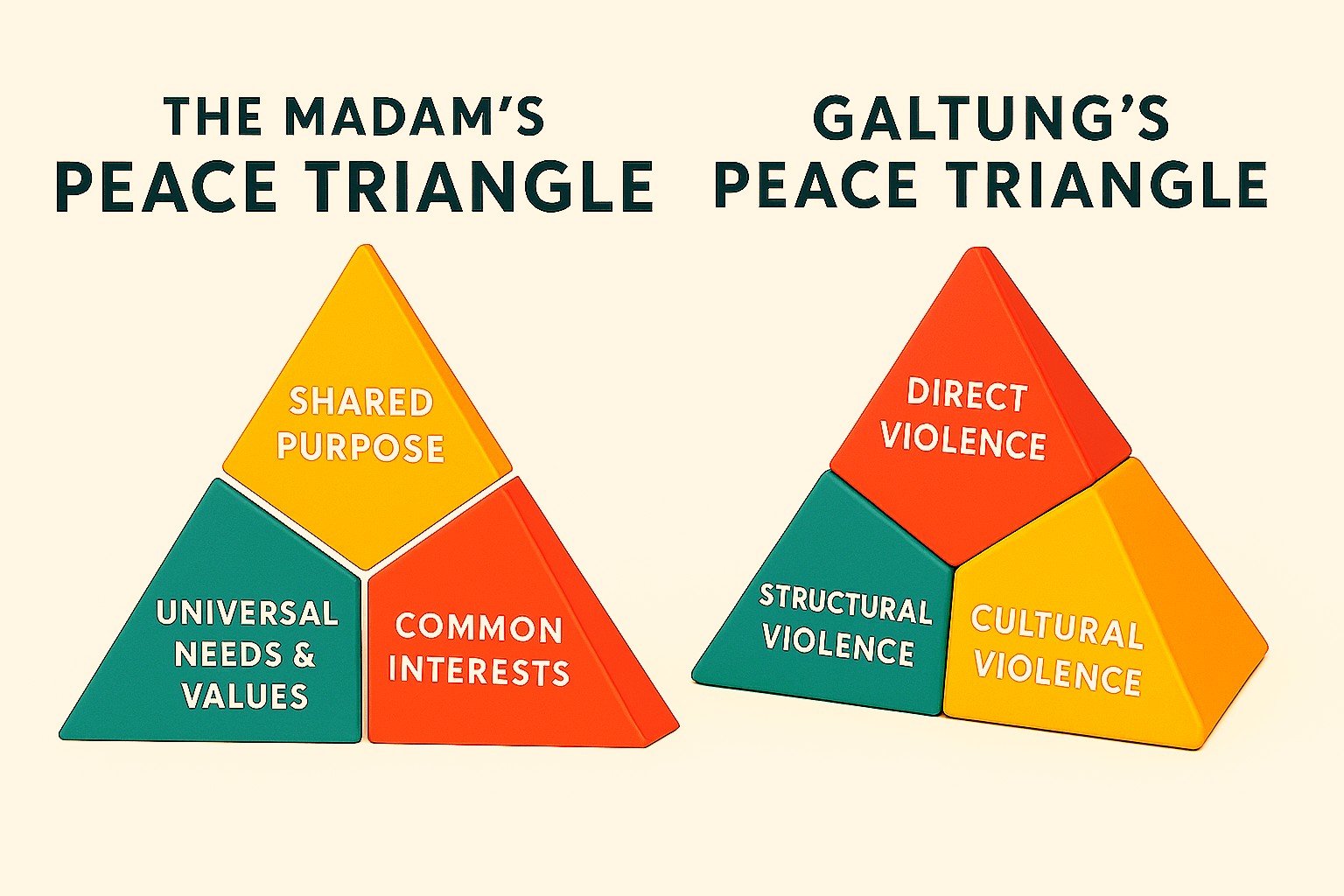
A Graphic, side by side depiction of Two Conceptually Different Peace Triangles, as proposed by Professor Johan Galtung (MHSRIEP) and Madam Vawda
Original Photograph Conceptualised by Mrs V. Vawda, February 2026
3) Operationalisation: From Norms to Practice
3.1 Attitudes → Behaviours → Policies
- Attitudes (Endogenous): cultivate empathy, humility, curiosity, and moral courage through education, reflective practices, and intergroup dialogue.
- Behaviours (Interpersonal/Organisational): institutionalise listening protocols, restorative circles, and codes of dignifying conduct.
- Policies (Exogenous/Systemic): embed inclusive rules—fair access, due process, equitable resource distribution, language inclusion, and protection of conscience.
3.2 Alignment Pathway (ABP Method)
- A – Articulate Shared Purpose: co‑draft a concise purpose statement acceptable to all stakeholders.
- B – Bridge Universal Needs & Values: map non‑negotiables (safety, dignity, fairness) and identify value‑conflict zones.
- P – Package Common Interests: design benefit‑sharing arrangements, cost‑reductions, and mutual‑gain projects.
3.3 Dismantling Pathway (DSC Method)
- D – Direct Harms: stop and redress immediate violence (safeguards, relief, accountability).
- S – Structural Harms: audit inequities (access, representation, outcomes) and correct via policy reform.
- C – Cultural Harms: counter dehumanising narratives with counter‑myths, inclusive rituals, and ethical storytelling.
- The Coherence Test (Ubuntu‑Biophotonic Heuristic)
In assessing each activity, it is necessary to use the metaphor of coherence, hence every proposed or effected intervention, is objectively evaluated by asking:
- Does this action increase relational coherence(trust, reciprocity, reliability)?
- Does it reduce decoherence(fear, confusion, humiliation, zero‑sum framing)?
- Can outcomes be experienced by vulnerable groups as dignifying and safe?
4) Measurement: Indicators and Methods
4.1 Multi‑Level Indicators
- Endogenous/Attitudes: empathy scales, moral elevation indices, bias‑reduction metrics, reflective‑practice logs.
- Interpersonal/Behaviours: frequency and quality of dialogue sessions; restorative justice participation and satisfaction.
- Systemic/Policies: equity audits (representation, access, outcomes), grievance redress time, language inclusion rates, procedural fairness scores.
4.2 Methods
- Mixed‑Methods(quant + qual) combining surveys, ethnography, content analysis of local media, and administrative data.
- Most Significant Change (MSC)stories to detect felt shifts in dignity and belonging.
- Participatory Action Research (PAR)to ensure communities co‑own both the questions and the answers.
4.3 Reporting Architecture
- Dashboardspairing Galtung indicators (harm reduction) with Madam–Ubuntu indicators (alignment gains).
- A simple RAG coherence gauge: Red (decoherence), Amber (transition), Green (coherence) at attitude/behaviour/policy levels.
5) Application Scenarios
- Education (universities, schools)
- Diagnostic: identify structural barriers to learning, hidden curricula, language exclusion, and assessment inequities.
- Design: co‑create shared purpose charters with students and staff; embed restorative practices; redesign assessment for inclusion; adopt multilingual support.
- Outcome: reduced grievance load, improved sense of belonging, increased performance for previously disadvantaged cohorts.
- Peace Journalism
- Diagnostic: analyse frames that normalise harm (enemy images, war metaphors, decontextualised incidents).
- Design: editorial policy commits to dignity framing, solutions orientation, and inclusion of marginal voices.
- Outcome: public discourse that de‑escalates, broadens empathy, and models cooperative imaginaries.
- Interfaith and Community Mediation
- Diagnostic: surface cultural and doctrinal narratives that justify exclusion.
- Design: articulate a shared ethical nucleus (dignity, compassion, non‑violence) while honouring doctrinal diversity; employ rotating hospitality.
- Outcome: cooperative action on common interests (health, safety, livelihoods) under a unifying Ubuntu ethic.
- Health and Social Care
- Diagnostic: address structural neglect (access, affordability), and cultural harms (stigma, disrespectful care).
- Design: patient‑centred charters; community health navigators; respectful‑care protocols; parity for traditional/faith healing referrals where appropriate.
- Outcome: improved adherence, trust, and well‑being; fewer complaints; better outcomes in vulnerable groups.
6) Ethics and Epistemology
6.1 Ubuntu as Meta‑Epistemology
As argued earlier, Ubuntu is not merely a moral value but a theory of knowledge: we come to know peace through relational participation and mutual recognition. The ethic of “I am because we are” requires that research and intervention design be conducted with communities, not on them.
6.2 Safeguards
- Non‑instrumentalisationof culture and religion: treat traditions as living sources of wisdom, not as tools for compliance.
- Reflexivity: practitioners keep reflective journals to track bias, power, and positionality.
- Do‑no‑harm expansions: include symbolic harmand procedural humiliation in risk assessments.
7) Limitations and Risk Management
- Conceptual Overreach: generative models can be misread as naïve if not paired with rigorous diagnostics; keep Galtungcentral to risk scanning.
- Tokenism: “Shared purpose” language can be co‑opted; mitigate by distributing agenda‑setting power and publishing participation metrics.
- Measurement Drift: coherence can feel “soft”; mitigate with explicit indicators, pre‑registration of evaluation plans, and third‑party audits.
- Context Sensitivity: Ubuntu articulations vary; adopt local custodianship(elders, scholars, community leaders) to steward adaptation.
8) Contribution and Conclusion
It is necessary to advance a unified peace architecture for the 21st century by placing Ubuntu (relational ontology and meta‑epistemology) at the centre of a dual‑triangle practice: Galtung for diagnosis of harm and The Madam Vawda’s Peace Triangle for design of harmony. The result is a coherence‑seeking praxis that treats peace not as the mere absence of violence but as a cultivated ecology of attitudes, behaviours, and policies aligned to human dignity. In an era of identity fragmentation, information disorder, and institutional distrust, this integrative framework offers both moral clarity and operational precision. This is an extremely relevant and politically important point to emphasise in al peace propagational crusades.
Key Definitions for editorial and reader clarity
- Ubuntu: Relational humanism in which personhood and knowledge arise through mutual recognition; ethical interdependence as first principle.
- Galtung’s Peace Triangle: A diagnostic model identifying direct, structural, and cultural
- The Madam Vawda’s Peace Triangle: A generative design model aligning Shared Purpose, Universal Needs & Values, Common Intereststhrough attitudes, behaviours and policies.
- Coherence/Decoherence: Heuristic for assessing whether interventions increase/diminish trust, clarity, fairness, belonging, and reliability.
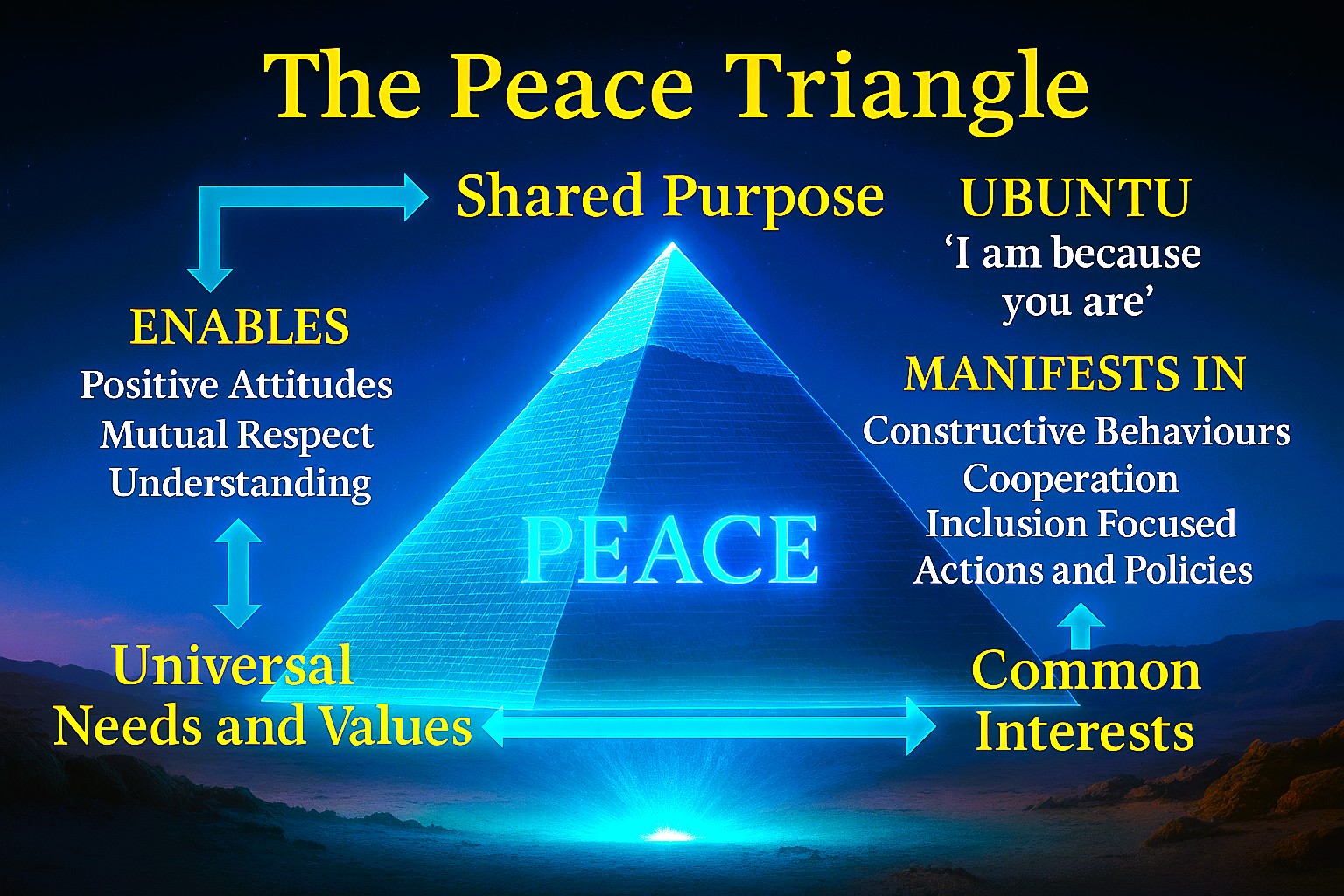
Original Photograph Conceptualised by Mrs V. Vawda February 2026
A trans‑civilizational marriage of Egyptian antiquity, with African humanism and contemporary peace theory. The exogenous horizon of community, societal, and global concord shaped by Ubuntu, “I am because you are.”
Original Photograph Conceptualised by Mrs V. Vawda, February 2026
How the Unified Peace Architecture Guides Practice
The Unified Peace Architecture is not only a conceptual diagram; it is an applied framework designed to guide peace practice across interpersonal, institutional, and societal levels. It does this by linking three essential functions:
- Diagnosing harm(Galtung’s Triangle)
- Grounding interventions in relational ethics(Ubuntu)
- Designing alignment and cooperation(The Madam Vawda’s Triangle)
Together, they function as a practical workflow, shaping how peace actors analyse a situation, choose interventions, and evaluate progress.
- Begin with Diagnosis: “What is the harm?”
Left side — Galtung’s Peace Triangle
Practitioners start by mapping how violence operates in the context:
- a) Direct Violence
- Immediate harms: physical, verbal, psychological, symbolic.
- Required action: Stop, contain, safeguard.
- b) Structural Violence
- Inequities in access, representation, opportunity, and outcomes.
- Required action: Audit systems, reform policies.
- c) Cultural Violence
- Norms that normalize or justify harm (stigma, stereotypes, myths).
- Required action: Challenge harmful narratives, uplift alternative stories.
Purpose of this step:
To prevent premature “solutions” that misdiagnose the root causes.
Galtung tells us where the system bleeds.
- Ground the response in Ubuntu: “Who are we to one another?”
Center: Ubuntu as foundational sphere
Ubuntu operationalizes several practical commitments:
- a) Relational accountability
Practitioners ask:
- Whose dignity is violated?
- Who must be seen, heard, and recognized?
- b) Communal knowledge
Wisdom is drawn from:
- Elders
- Local custodians
- Affected communities
- Youth, women, minorities
- c) Ethical boundaries
Actions must:
- Restore dignity
- Avoid humiliation
- Preserve humanity even in conflict
Purpose of this step:
To ensure the work is not technocratic or mechanical but human‑centered, culturally grounded, and morally coherent.
Ubuntu tells us what kind of people we must be as we practice peace.
- Design Alignment: “What future are we building?”
Right side — The Madam’s Peace Triangle
Once the harm is understood and relationships are ethically grounded, practitioners co‑design a peace architecture using three pillars:
- a) Shared Purpose
Crafting a co‑authored statement that unites all sides.
- b) Universal Needs and Values
Centering fairness, safety, dignity, belonging, recognition.
- c) Common Interests
Creating practical mutual‑gain outcomes that reduce conflict incentives.
Purpose of this step:
To build systems, structures, and behaviours that make cooperation easier and conflict harder.
The Madam’s Triangle tells us how to build harmony.
- The Procedural Loop: “What do we do next?”
Bottom arc — Dismantle Harm ↔ Build Alignment
This is the engine of ongoing practice:
When harm increases → shift left
- Re‑diagnose (DSC: Direct, Structural, Cultural)
- Strengthen safeguards
- Correct inequities
When trust increases → shift right
- Deepen shared purpose
- Strengthen constructive behaviours
- Scale policy coherence
This oscillation is normal and healthy.
Peace is not a one‑time achievement, but a continual balancing of:
- Reducing harm
- Increasing alignment
This loop guides practitioners month by month, year by year.
- The Coherence Ring: “How do we know if it’s working?”
Coherence is the evaluation principle:
Interventions are working when:
- Trust increases
- Misunderstandings decrease
- Procedures become fair
- Language becomes inclusive
- People feel recognized
- Relationships stabilize
- Confusion and fear decline
- Narratives become more humane
Interventions are failing when:
- Mistrust grows
- Interactions feel unsafe
- Zero‑sum thinking re‑emerges
- Groups retreat into identity enclaves
- Decisions feel arbitrary or humiliating
Coherence tells us whether peace is truly taking root.
In summary: How the model guides practice
- Diagnose harmusing Galtung.
- Ground ethics and identityusing Ubuntu.
- Design cooperationusing The Madam Vawda’s Triangle.
- Apply the procedural loopto decide the next step.
- Evaluate using coherenceas the litmus test.
This creates a holistic, culturally grounded, ethically responsible, and practically actionable system for peacebuilding in the 21st century.
Policy Brief
1) Summary
Harm persists because institutions excel at diagnosing conflict but lack architectures for designing cooperation. This brief operationalizes a Unified Peace Architecture that integrates:
- Galtung’s Triangle(diagnostics of direct, structural, cultural violence)
- Ubuntu(relational ontology and meta‑epistemology: “a person is a person through other persons”)
- The Madam’s Peace Triangle(design engine: Shared Purpose, Universal Needs and Values, Common Interests → enacted via Attitudes, Behaviours, Policies).
The approach runs on a procedural loop, Dismantle Harm ↔ Build Alignment, and is assessed through a Coherence Test (trust, dignity, clarity, reciprocity, fairness). It provides concrete actions, indicators, governance, and risk controls for implementation across education, media, interfaith work, and public services.
2) Problem Statement
- Fragmented interventions treat incidents, not systems.
- Technocratic fixes ignore relational ethicsand community wisdom.
- “Solutions” often reproduce structuraland cultural violence (exclusion, humiliation, stigma).
- Measurement frameworks overlook lived dignityand belonging.
3) Policy Objective
Build durable peace by simultaneously dismantling multi‑level violence and designing coherent, dignity‑centred systems, grounded in Ubuntu and evaluated through coherence outcomes.
4) Policy Framework (Unified Peace Architecture)
Diagnostics (Left – Galtung):
- Direct violence→ stop, protect, redress.
- Structural violence→ audit and reform inequities.
- Cultural violence→ replace dehumanising narratives.
Grounding (Centre – Ubuntu):
- Relational accountability, communal participation, ethical guardrails.
- Research and deliberation withcommunities, not on
Design (Right – Madam’s Triangle):
- Shared Purpose:a co‑authored horizon.
- Universal Needs & Values:dignity, safety, fairness, recognition, belonging.
- Common Interests:mutual gains that make cooperation rational.
Procedural Loop: Dismantle Harm ↔ Build Alignment
Evaluation Ring: Coherence (trust, clarity, reciprocity, predictability, fairness).
5) Priority Policy Actions (first 12 months)
- System Diagnostics & Safeguards (Months 1–4)
- Establish a Peace Diagnostics Unit (PDU)to map direct/structural/cultural harms.
- Implement immediate safeguards(protection protocols, grievance hotlines, ombud panels).
- Publish a Structural Equity Audit(access, representation, outcomes).
- Ubuntu‑Grounded Co‑Design (Months 3–8)
- Convene Ubuntu Councils(elders, youth, women, minorities, faith leaders) for co‑decision.
- Draft a one‑page Shared Purpose Charter.
- Co‑create a Values Compact(dignity, non‑humiliation, language inclusion).
- Identify Common‑Interest Projects(e.g., joint service hubs, safety corridors, livelihoods).
- Behavioural & Policy Architecture (Months 6–12)
- Embed restorative practices(dialogue circles, mediated apologies, restitution pathways).
- Issue inclusive language/representation policiesfor institutions and media.
- Introduce procedural fairness standards(transparent criteria, reasons‑giving, appeal).
- Fund capacity‑building(peace journalism, trauma‑informed services, intercultural facilitation).
6) Implementation Roadmap
Governance
- Steering Committee(multi‑stakeholder, chaired by a neutral convener).
- Secretariatto coordinate data, training, communications.
- Community Custodiansto ensure cultural fidelity and legitimacy.
Phases
- Set‑Up(0–3 months): PDU, baseline metrics, stakeholder mapping.
- Co‑Design(3–8 months): charters, compacts, pilot projects.
- Scaling & Institutionalisation(9–24 months): codify policies, budget lines, annual reports.
7) Indicators and Coherence Metrics
Endogenous (Attitudes)
- Empathy and moral elevation scales; bias‑reduction metrics; climate of respect.
Interpersonal/Organisational (Behaviours)
- Dialogue frequency/quality; restorative process participation and satisfaction; complaints resolved.
Systemic (Policies)
- Equity in access/representation/outcomes; grievance resolution time; language inclusion; reasons‑giving rate.
Coherence Index[30] (headline)
- Composite of trust, dignity (non‑humiliation), procedural clarity, reliability, reciprocity(RAG: Red/Amber/Green).
8) Use‑Case Capsules
Education: multilingual support, respectful‑assessment policy, restorative discipline, belonging index.
Peace Journalism: dignity framing guide, “conflict‑sensitive reporting” desk, narrative diversity quotas.
Interfaith Mediation: rotating hospitality, shared ethical nucleus, joint service initiatives.
Health & Social Care: respectful‑care standards, community navigators, referral parity for traditional/faith healing where appropriate.
9) Risk and Mitigation
- Tokenism→ Share agenda‑setting power; publish participation demographics.
- Elite capture→ Term limits in councils; randomised citizen panels.
- Measurement drift→ Pre‑registered indicators; independent audits.
- Cultural misuse→ Custodian review; ethics checks for non‑instrumentalisation.
- Backlash to reforms→ Transparent reasons‑giving; phased pilots; feedback loops.
10) Budget Lines (illustrative, scalable)
- Secretariat & PDU staffing; facilitation, and training; restorative justice operations; comms and media toolkits; monitoring & evaluation; seed grants for common‑interest pilots.
11) Decision Points for Leaders (next 90 days)
- Appoint the Steering Committeeand Secretariat.
- Mandate the Structural Equity Auditand baseline survey.
- Convene Ubuntu Councilsand approve the Shared Purpose Charter.
- Launch two Common‑Interest Pilotswith clear success metrics.
- Adopt procedural fairness and language inclusion
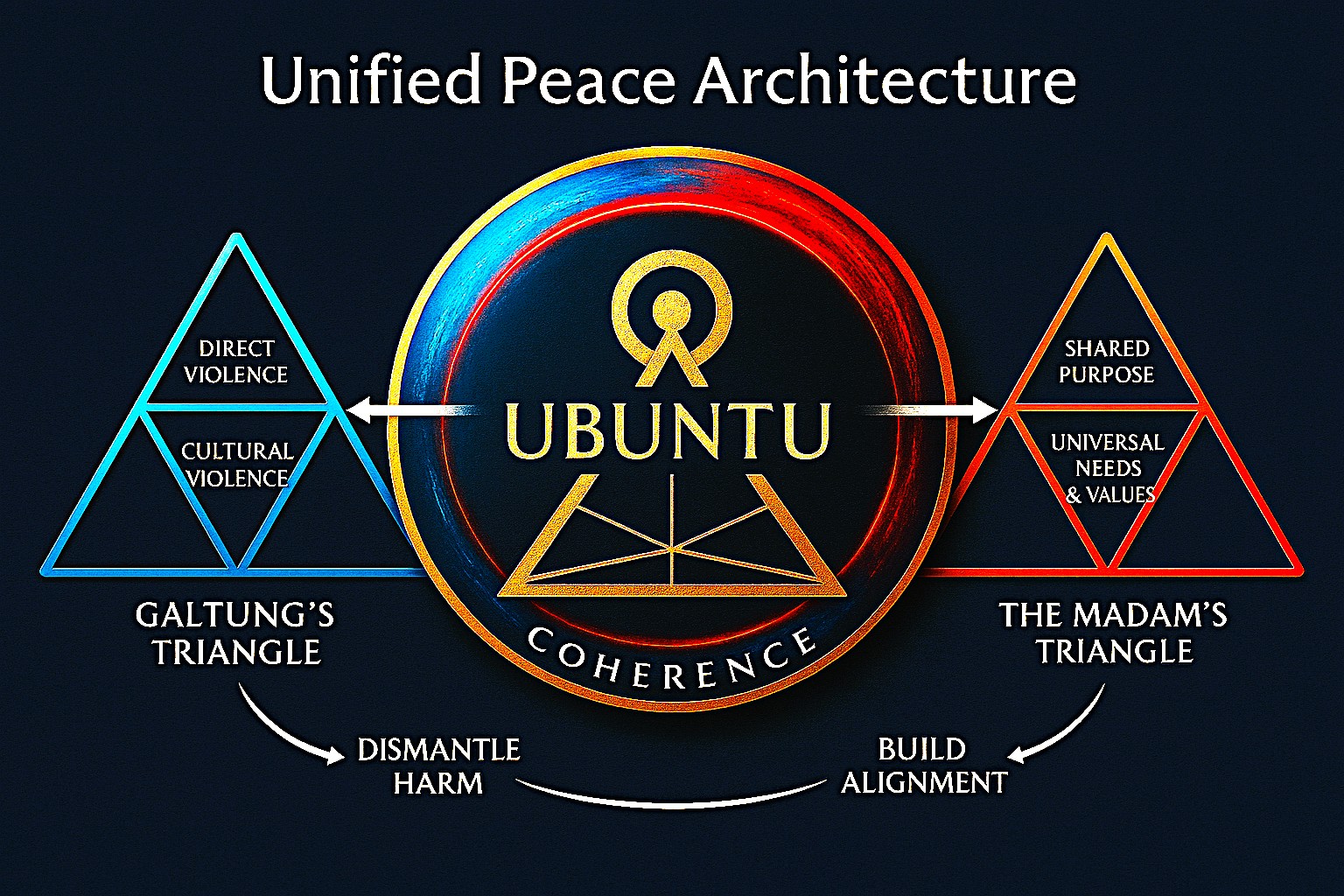
The Unified Peace Architecture
Unified Peace Architecture: Ubuntu (foundational sphere); left, Galtung’s Triangle (diagnostics); right, The Madam’s Triangle (design); central loop Dismantle Harm ↔ Build Alignment; outer ring Coherence.
Original Photograph Conceptualised by Mrs V. Vawda, February 2026
The Unified Peace Architecture and Operational Framework
This integrative visual synthesises three foundational components of contemporary peace theory into a single coherent framework. At the centre lies the element of Ubuntu, represented as the foundational sphere and epistemic ground of the model. Ubuntu, articulated through the maxim Umuntu ngumuntu ngabantu (“A person is a person through other persons”), embodies a relational ontology in which personhood, knowledge, and moral agency arise through interdependence. Its placement at the core signifies that all peacebuilding efforts, diagnostic, generative, affective, structural, and cultural, are intelligible only when grounded in a shared recognition of human dignity and mutuality.
The element in the graphic, to the left, stands Galtung’s Peace Triangle, the classical diagnostic model distinguishing Direct Violence, Structural Violence, and Cultural Violence. This analytic instrument identifies the layered and mutually reinforcing mechanisms that reproduce harm within societies. Its position on the left visually designates it as the point of departure for peace praxis: an account of what must be dismantled. The arrow pointing from Galtung’s model toward the Ubuntu centre signifies that understanding violence is a necessary precondition for restoring relational coherence.
The element to the right, in the graphic, is The Madam Vawda’s Peace Triangle, the generative design model grounded in Shared Purpose, Universal Needs and Values, and Common Interests.
Unlike Galtung’s framework, which maps harm, this model constructs alignment, cooperation, and ethical synergy. Its placement on the right denotes forward movement in peace practice: the active design of enabling attitudes, behaviours, and policies that build dignified social systems. The arrow pointing from Ubuntu toward The Madam’s Triangle represents the translation of relational ontology into institutional and interpersonal design.
The figure is bounded by an outer ring labelled Coherence, representing the systemic quality that unifies the entire architecture. Coherence in this context refers to the degree of relational clarity, trust, reciprocity, predictability, and ethical alignment experienced within a community or system. It is simultaneously a philosophical metaphor (drawn from African humanism and biophotonic analogies), an ethical principle (unity without uniformity), and a practical evaluative tool for peace interventions.
Beneath the models, the bidirectional arc: Dismantle Harm ↔ Build Alignment, illustrates the procedural loop at the heart of 21st‑century peacebuilding. Peace emerges not from isolated actions but from an iterative cycle: diagnosing and reducing violence in all its forms while simultaneously cultivating the relational, structural, and purpose‑based conditions that support harmony. The integrative structure of the diagram therefore conveys that sustainable peace is neither solely the absence of violence nor solely the presence of cooperation, but the dynamic interplay of harm reduction, alignment construction, and relational grounding in Ubuntu.
This unified architecture thus provides an epistemic and operational framework for peace scholars, mediators, policymakers, and interfaith practitioners seeking to navigate complex social conflicts. It demonstrates that peace is best understood as a multidimensional ecology in which analysis, design, and relational ethics converge in pursuit of coherent human flourishing.
Q.U.A.N.T.U.M. Universal Peace Framework[31],[32]
Quantum Ubuntu‑Aligned Network for Transcendent Universal Mediation
Q.U.A.N.T.U.M. is a humanity‑centred, systems‑ready framework that diagnoses harm, grounds ethics in Ubuntu, and designs alignment across attitudes, behaviours, and policies, evaluating everything through the lived experience of coherence.
1) Philosophy and First Principles
- Relational Ontology (Ubuntu):Umuntu ngumuntu ngabantu—personhood and knowledge emerge through relationships; peace is therefore relationally produced.
- Dual Triangles, Dual Tasks:
- Galtung’s Triangle→ diagnose and dismantle direct, structural, cultural violence.
- Madam’s Triangle→ design and institutionalise shared purpose, universal needs & values, and common interests.
- Coherence Heuristic:Peace is evaluated as increasing trust, dignity, clarity, reciprocity, predictability, and belonging, the felt texture of coherent life together.
- Iterative Praxis:Peace proceeds in loops: Dismantle Harm ↔ Build Alignment, calibrated continuously by coherence outcomes.
2) The Q.U.A.N.T.U.M. Acronym Core Pillars
Q: Quantum (Interconnection and Non‑linearity)
- Recognises complex systems, emergent effects, small actions with outsized impact.
- Practical implication: design light‑touch, high‑leverageinterventions; prefer feedback loops over single, linear fixes.
U: Ubuntu‑Aligned (Relational Ethics)
- All actions protect dignityand avoid humiliation; decisions are co‑created with
- Practical implication: establish Ubuntu Councilsand custodians for cultural fidelity.
A: Aligned (Purpose–Values–Interests)
- The Madam’s Triangle operationalised: Shared Purpose, Universal Needs & Values, Common Interests.
- Practical implication: write a Purpose Charter, a Values Compact, and a Mutual‑Gains Portfolio.
N: Network (Distributed Stewardship)
- Multi‑stakeholder governance with Steering Committee, Secretariat, and Community Custodians.
- Practical implication: create sector nodes(education, health, media, interfaith) that learn horizontally.
T: Transcendent (Meaning and Spiritual Depth)
- Invites interfaith/meaning systems to sustain compassion, forgiveness, and moral courage.
- Practical implication: rotating hospitalityand shared ethical nucleus (dignity, non‑violence, compassion).
U: Universal (Inclusion and Equity)
- Policy guardrails ensuring fair access, representation, outcomes, and language inclusion.
- Practical implication: run a Structural Equity Auditand publish reasons‑giving for decisions.
M: Mediation (Restorative Infrastructure)
- Normalises dialogue circles, RJ pathways, ombud functions, and apology/restitution protocols.
- Practical implication: maintain a Peace Diagnostics Unit (PDU)and Restorative Justice Office (RJO).
3) Operating Model (Step‑by‑Step)
Stage 1 Baseline and Safeguards (Months 0–3)
- Constitute Steering Committee(multi‑stakeholder) and Secretariat.
- Launch PDUto map Direct/Structural/Cultural
- Activate Immediate Safeguards: protection protocols, hotlines, ombud panel.
Stage 2 Ubuntu Grounding & Co‑Design (Months 2–6)
- Convene Ubuntu Councils(elders, youth, women, minorities, faith leaders).
- Draft a one‑page Shared Purpose Charter.
- Co‑author a Values Compact(dignity, non‑humiliation, fairness, inclusion).
- Identify Common‑Interest Pilots(mutual‑benefit projects).
Stage 3 Behavioural and Policy Architecture (Months 5–12)
- Embed Restorative Practices(dialogue circles, reparative actions, re‑entry rituals).
- Issue Inclusive Language & Representation Standards.
- Enforce Procedural Fairness(transparent criteria, reasons‑giving, appeal pathways).
- Build capacity (peace journalism, trauma‑informed practice, intercultural facilitation).
Stage 4 Scale, Monitor, Iterate (Months 9–24)
- Publish Equity and Coherence Dashboards.
- Iterate using the loop Dismantle Harm ↔ Build Alignment.
- Institutionalise in budgets, performance compacts, and annual public reports.
4) Methods and Toolkits
- A) DSC Diagnostic Protocol (Galtung)
- D (Direct): incident mapping, safeguarding, redress.
- S (Structural): access/representation/outcome audits; corrective policy.
- C (Cultural): frame analysis; counter‑narratives; inclusive rituals.
- B) ABP Design Protocol (Madam’s Triangle)
- A (Attitudes): empathy training, bias reduction, reflective practice.
- B (Behaviours): codes of dignifying conduct; listening protocols; restorative circles.
- P (Policies): language inclusion; reasons‑giving; equity targets; due process.
Ask of every change:
- Does it increase trustand reduce fear/confusion?
- Is dignity protected(non‑humiliation)?
- Are rules clear, predictable, appealable?
- Do vulnerable groups feel seen and safer?
5) Governance and Roles
- Steering Committee: sets direction; guards against capture; rotates leadership.
- Secretariat: metrics, training, communications, reporting.
- Peace Diagnostics Unit (PDU): runs DSC protocol; issues risk alerts.
- Restorative Justice Office (RJO): manages dialogue, repair, re‑entry.
- Ubuntu Councils and Custodians: ensure cultural legitimacy and ethical guardrails.
- Sector Nodes(Education, Health, Media, Interfaith, Local Government): implement and cross‑learn.
6) Measurement and Dashboards[35]
Headline Coherence Index (R/A/G)[36], [37]
- Trust(survey + grievance closure rates)
- Dignity/Non‑Humiliation(experience sampling; respectful‑care checklists)
- Procedural Clarity(reasons‑giving rate; appeal response time)
- Reciprocity & Reliability(agreement adherence; on‑time commitments)
- Belonging/Recognition(belonging index; representation parity)
Complementary Indicators
- Direct: incidents stopped, time‑to‑redress, survivor satisfaction.
- Structural: parity in access/representation/outcomes; resource allocation fairness.
- Cultural: media framing metrics, narrative diversity, inclusive ritual adoption.
7) Application Blueprints Strategies[38]
- Universities
- DSC:hidden curriculum, language bias, assessment inequities.
- ABP:multilingual support, respectful‑assessment policy, restorative discipline.
- Outcome:improved belonging, reduced complaints, equitable outcomes.
- Peace Journalism
- DSC:harm‑normalising frames; missing marginal voices.
- ABP:dignity framing guide; solutions desk; reasons‑giving for editorial choices.
- Outcome:de‑escalatory public discourse; broader empathy.
- Interfaith Councils
- DSC:exclusionary narratives; historical grievances.
- ABP:shared ethical nucleus; rotating hospitality; joint service projects.
- Outcome:sustained cooperation beyond doctrinal difference.
- Health and Social Care
- DSC:respectful‑care gaps; structural access issues; stigma.
- ABP:patient dignity standards; community navigators; referral parity to traditional/faith healing where appropriate.
- Outcome:adherence, trust, and better outcomes for vulnerable groups.
8) Risk Controls
- Tokenism →publish participation demographics; rotate agenda‑setting.
- Elite Capture →term limits; citizen panels by lottery.
- Measurement Drift →pre‑registered indicators; third‑party audits.
- Cultural Misuse →custodian review; non‑instrumentalisation clause.
- Backlash to Reforms →phased pilots; transparent reasons‑giving; feedback loops.
9) Outputs and Artefacts (What Q.U.A.N.T.U.M. Produces)
- Shared Purpose Charter(one page)
- Values Compact(dignity, fairness, inclusion, non‑humiliation)
- Common‑Interests Portfolio(mutual‑gain projects)
- Restorative Justice Handbook(dialogue, apology, restitution, re‑entry)
- Equity & Coherence Dashboard(quarterly)
- Annual Peace Report(narratives + metrics)
- Training Modules(ABP, DSC, Ubuntu ethics, trauma‑informed practice)
10) Field‑Ready “First 90 Days” Checklist
- Appoint Steering Committee& Secretariat; publish mandate.
- Stand up PDU; run baseline DSCscan; activate safeguards.
- Convene Ubuntu Councils; draft Shared Purpose Charter.
- Approve Values Compact; announce reasons‑giving
- Launch two Common‑Interest Pilotswith success metrics.
- Publish Month‑3 Dashboardwith Coherence Index and action notes.
11) Theoretical Contribution
- Recasts peace as a coherence‑seeking ecologyof attitudes, behaviours, policies.
- Unifies diagnostic rigor (Galtung)with design praxis (Madam) under Ubuntu’s meta‑epistemology.
- Provides a repeatable operating systemthat any institution or coalition can adopt.
Bottom Line: The Three Seminal Principles of Part 2
- Diagnose Harm with Precision
Galtung’s Peace Triangle remains indispensable for identifying and dismantling the multi‑layered machinery of violence—direct, structural, and cultural. Sustainable peace work begins with clarity: we cannot transform what we do not first see, name, and understand.
- Ground Peace in Ubuntu’s Relational Ethics
Ubuntu provides the moral and epistemic foundation for all peace practice. It reminds us that peace is not merely institutional, procedural, or strategic, it is relational, emerging from dignity, mutual recognition, and the lived understanding that “a person is a person through other persons.” Ubuntu ensures that every intervention is human‑centred, culturally grounded, and ethically coherent.
- Design Alignment Through The Madam Vawda’s Peace Triangle
The Madam’s Peace Triangle transforms diagnosis into constructive design. By aligning Shared Purpose, Universal Needs & Values, and Common Interests, it builds the attitudes, behaviours, and policies that enable harmonious coexistence. This is where peace becomes a system, a structure, and a lived reality, not just the absence of harm, but the presence of alignment.
The Essential Takeaway
Peace in the 21st century is achieved when we dismantle harm with diagnostic clarity, ground our actions in South Africa’s Ubuntu’s relational dignity, and design alignment through shared purpose, universal needs, and common interests, moving continuously toward systemic and relational coherence.
Epilogue
Unified Spiritual Epigraph for Peace Propagation[39]
“Peace is not merely the quiet that follows conflict; it is the coherence we nurture within ourselves and the harmony we cultivate with one another. We awaken to peace when truth is spoken without harm, when dignity is offered without condition, and when the light in one life becomes illumination for all. For in Ubuntu we rediscover that no life stands alone, our humanity is braided together in the unseen spaces between us, where compassion breathes, where presence heals, and where the heart’s quiet radiance becomes a blessing to the world.”
A Mantra for Natural, Effortless Peace Inculcation[40]
May my heart be clear enough to see the other.
May my actions be gentle enough to heal the world.
May our shared humanity become a light that guides us all.

Comments and discussion are invited by e-mail: vawda@ukzn.ac.za
Global: + 27 82 291 4546
References:
[1] Personal Quote by author, February 2026
[2] Personal Quote by author, February 2026
[3] TRANSCEND MEDIA SERVICE » The Attainment of Sustained, Endogenous Peace: Sacred Postures for a Fractured World
[4] https://www.bing.com/ck/a?!&&p=9f95cdaa204fea30ad3af679f1ab7b313b2ebb746c5aa1c08d3c8cbfb7972831JmltdHM9MTc3MTAyNzIwMA&ptn=3&ver=2&hsh=4&fclid=37940f5c-820f-62a2-14ab-19c283916323&psq=Exogenous+Peace+vawda&u=a1aHR0cHM6Ly93d3cudHJhbnNjZW5kLm9yZy90bXMvMjAyNS8wOC90aGUtYXR0YWlubWVudC1vZi1wZWFjZS1hLW11bHRpZGltZW5zaW9uYWwtcGVyc3BlY3RpdmUv
[5] https://www.bing.com/ck/a?!&&p=034fe75ec36f056696e725d9b4ea3087c4af0fd5f0ddc4f1d0bdf6962d90e2baJmltdHM9MTc3MTAyNzIwMA&ptn=3&ver=2&hsh=4&fclid=37940f5c-820f-62a2-14ab-19c283916323&psq=Peace+Protagonists%2c+hoosen+vawda&u=a1aHR0cHM6Ly93d3cudHJhbnNjZW5kLm9yZy90bXMvMjAyNC8wMy9wZWFjZS1wcm9wYWdhdGlvbi1odW1hbi1yaWdodHMtZGF5LXBvc3QtbGliZXJhdGlvbi0xOTk0LXNvdXRoLWFmcmljYS1wYXJ0LTEv
[6] https://www.bing.com/ck/a?!&&p=6c5b0459700ca20bc6eb6bae97ab2f646b024e95bec3fde1de985dd245591412JmltdHM9MTc3MTAyNzIwMA&ptn=3&ver=2&hsh=4&fclid=37940f5c-820f-62a2-14ab-19c283916323&psq=Peace+Protagonists%2c+hoosen+vawda&u=a1aHR0cHM6Ly93d3cudHJhbnNjZW5kLm9yZy90bXMvMjAyNC8wMS9nbG9iYWwtd2ViaW5hci1zZXJpZXMtb3BwcmVzc29ycy1hbmQtcGVhY2UtZGlzcnVwdG9ycy8
[7]https://www.bing.com/ck/a?!&&p=aa0956c0af4996fbf6d678010420158779bb6262010036c2d54366c25ccf0e3eJmltdHM9MTc3MTAyNzIwMA&ptn=3&ver=2&hsh=4&fclid=37940f5c-820f-62a2-14ab-19c283916323&psq=Peace+Protagonists%2c+hoosen+vawda&u=a1aHR0cHM6Ly93d3cudHJhbnNjZW5kLm9yZy90bXMvdGFnL2FwYXJ0aGVpZC1tYXJ0eXJzLw
[8] https://www.bing.com/ck/a?!&&p=a8abb7e9791d7d6db751a036519a953d09cfbf6acccee42d5f41af52cb22e89bJmltdHM9MTc3MTAyNzIwMA&ptn=3&ver=2&hsh=4&fclid=37940f5c-820f-62a2-14ab-19c283916323&psq=Peace+Protagonists%2c+hoosen+vawda&u=a1aHR0cHM6Ly93d3cuZmFjZWJvb2suY29tL3RyYW5zY2VuZGludGVybmF0aW9uYWwvcG9zdHMvdGhlLWFjcmltb25pb3VzLWFuZC10YXJnZXRlZC1kZXN0cnVjdGlvbi1vZi1ob3VzZXMtb2YtZ29kLWNsaW1heC1vZi1yZWxpZ2lvcGhvYmkvNTgxMjQzMzUwODEyOTc0Lw
[9] https://www.bing.com/ck/a?!&&p=f5fa6cf0c30fedf6280c2077cc79a61a319559181440d3bd4b2ef9cbaf9b9b6bJmltdHM9MTc3MTAyNzIwMA&ptn=3&ver=2&hsh=4&fclid=37940f5c-820f-62a2-14ab-19c283916323&psq=Peace+Protagonists%2c+hoosen+vawda&u=a1aHR0cHM6Ly90aGVtYWpsaXMuY28uemEvYXJ0aWNsZXMvYWwtaGFxL3BhbGVzdGluZS10aGUtYXRoYWFiLW9mLWFsbGFoLXRhYWxhLw
[10] https://www.bing.com/ck/a?!&&p=2a93b8d170338938a01924b2afa33109c40a607366470f76f94c737806bee774JmltdHM9MTc3MTAyNzIwMA&ptn=3&ver=2&hsh=4&fclid=37940f5c-820f-62a2-14ab-19c283916323&psq=belligerism+vawda&u=a1aHR0cHM6Ly93d3cudHJhbnNjZW5kLm9yZy90bXMvMjAyNi8wMS91YnVudHUtcmlzaW5nLWEtcGVhY2UtZm9yY2UtYWdhaW5zdC1nbG9iYWwtYmVsbGlnZXJpc20v
[11] https://www.bing.com/ck/a?!&&p=bfa48f1dff587216ab251a4e4a7460075fca00e706b246ceac9fbd919cf3584aJmltdHM9MTc3MTAyNzIwMA&ptn=3&ver=2&hsh=4&fclid=37940f5c-820f-62a2-14ab-19c283916323&psq=Peace+Protagonists%2c+hoosen+vawda&u=a1aHR0cHM6Ly91bmJvdW5kZWRhY2FkZW15Lm9yZy90cmFuc2NlbmQtbWVkaWEtc2VydmljZS8
[12] https://www.transcend.org/tms/2026/01/ubuntu-rising-a-peace-force-against-global-belligerism/
[13] https://www.transcend.org/tms/2025/11/the-johannesburg-g20-summit-gambit-ubuntus-challenge-to-a-fragmenting-world-order/
[14] https://www.transcend.org/tms/2025/08/the-attainment-of-peace-a-multidimensional-perspective/
[15] https://www.transcend.org/tms/2023/12/the-forgotten-part-6-the-pillars-of-peace-propagators-from-yajnavalkya-in-antiquity-to-johan-galtung-today/
[16] Novel peace concept triangle formulated by Mrs V. Vawda as the “Vawdaian Triangle” February 2026
[17] Metaepistemology – Wikipedia
[18] https://www.bing.com/ck/a?!&&p=6b4f3a5a1a6413b43eb418306b1e73906923dc4bba9ba001f87089279bf5849bJmltdHM9MTc3MTYzMjAwMA&ptn=3&ver=2&hsh=4&fclid=37940f5c-820f-62a2-14ab-19c283916323&psq=A+Triadic+within+Triadic+Model&u=a1aHR0cHM6Ly9zY2FsZXMuYXJhYnBzeWNob2xvZ3kuY29tL3RybS90cmlhZGljLXJlY2lwcm9jYWxpdHkv
[19] https://www.bing.com/ck/a?!&&p=daed28feb5afd951bcfcc76df7297093f8855bf11cfcebdf8be3b6641357bf30JmltdHM9MTc3MTYzMjAwMA&ptn=3&ver=2&hsh=4&fclid=37940f5c-820f-62a2-14ab-19c283916323&psq=Meta+epistemic+ground&u=a1aHR0cHM6Ly9hY2FkZW1pYy5vdXAuY29tL2Jvb2svMTI2MTM
[20] https://www.transcend.org/tms/2026/01/forging-a-righteous-future-a-five-year-strategic-plan-for-peace-stability-and-integrity-in-post-liberation-south-africa/
[21] https://www.transcend.org/tms/2023/09/heavenly-peace-of-the-oppressor-and-hellish-peace-of-the-oppressed/
[22] https://www.transcend.org/tms/2025/05/peace-disruption-the-neo-exodus-in-the-21st-century-of-the-south-african-white-afrikaners-to-the-us/
[23] https://www.bing.com/ck/a?!&&p=b35d4b3e2bcb2501a027c0c3e1d033f8ce59588f03cb12fd90c4d48dc9ac3245JmltdHM9MTc3MTYzMjAwMA&ptn=3&ver=2&hsh=4&fclid=37940f5c-820f-62a2-14ab-19c283916323&psq=Coolies+and+Dogs+not+allowed%e2%80%9d&u=a1aHR0cHM6Ly93d3cudGltZXNub3duZXdzLmNvbS9saWZlc3R5bGUvcGVvcGxlL3RoZS1icmF2ZS1yZXZvbHV0aW9uYXJ5LXdoby1idXJuZWQtZG93bi1hLWV1cm9wZWFuLWNsdWItd2l0aC1hLXNpZ24tdGhhdC1yZWFkLWRvZ3MtYW5kLWluZGlhbnMtbm90LWFsbG93ZWQtYXJ0aWNsZS0xNTE0ODAxOTM
[24] https://www.transcend.org/tms/2025/12/threads-of-muslin-exploitation-the-brutal-unravelling-of-indias-peace-and-prosperity-under-the-british-raj/
[25] https://www.transcend.org/tms/2022/03/imperial-colonial-thieves-the-long-odysseys-of-goddess-annapurna-and-treasures-of-india-part-2/
[26] https://www.transcend.org/tms/2022/02/imperial-colonial-thieves-the-looting-of-wealth-and-plundering-of-cultural-and-religious-treasures-of-india-part-1/
[27]https://www.transcend.org/tms/2022/03/imperial-colonial-thieves-the-annihilation-of-the-kingdom-of-benin-and-pillaging-of-the-royal-palace-by-british-soldiers-part-3/
[28] https://www.bing.com/ck/a?!&&p=e41c2a4f75359ab75bf7be6cfa4ea78ae5e8794f679338efbbff309a5265a2ccJmltdHM9MTc3MTYzMjAwMA&ptn=3&ver=2&hsh=4&fclid=37940f5c-820f-62a2-14ab-19c283916323&psq=imperial+britiann+stealing+wealt+of+china&u=a1aHR0cHM6Ly93d3cudGhlY29sbGVjdG9yLmNvbS9icml0aXNoLWltcGVyaWFsaXNtLWNoaW5hLw
[29] TRANSCEND MEDIA SERVICE » Articles by Hoosen Vawda
[30] https://www.bing.com/ck/a?!&&p=53eadcfb0a080a48b57497db63201ddcc1fb2f764331d96abffe1289a0e7d9cbJmltdHM9MTc3MTYzMjAwMA&ptn=3&ver=2&hsh=4&fclid=37940f5c-820f-62a2-14ab-19c283916323&psq=Coherence+Index&u=a1aHR0cHM6Ly96ZW5vZG8ub3JnL3JlY29yZHMvMTczMzQ5MjcvZmlsZXMvS3Jpc3RlbnNvbl8yMDI1X0NvaGVyZW5jZV9JbmRleF9XaGl0ZV9QYXBlci5wZGY
[31] https://www.bing.com/ck/a?!&&p=098d87e420f445fe4d69602fcbb555d72b3b6f3cf9f2c04fe329836edf9e856cJmltdHM9MTc3MTYzMjAwMA&ptn=3&ver=2&hsh=4&fclid=37940f5c-820f-62a2-14ab-19c283916323&psq=q.u.a.n.t.u.m.+universal+peace+framework+meaning&u=a1aHR0cHM6Ly9xdWFudHVtbWluZG5ldC5jb20v
[32] https://www.bing.com/ck/a?!&&p=b0fc36a09c537d02cbd7f98cc6144f62261939d651e54875340d2092857fd9cfJmltdHM9MTc3MTYzMjAwMA&ptn=3&ver=2&hsh=4&fclid=37940f5c-820f-62a2-14ab-19c283916323&psq=q.u.a.n.t.u.m.+universal+peace+framework+meaning&u=a1aHR0cHM6Ly93d3cubGlua2VkaW4uY29tL3B1bHNlL3F1YW50dW0tdW5pdmVyc2FsLWNvZGUtY3F1LW9udG9sb2dpY2FsLXRyYW5zZm9ybWF0aXZlLWphbm51enplbGxpLWduaWRmLw
[33] https://www.bing.com/ck/a?!&&p=5349375eb1e44ba4525ee2852fb2556cb2657ac4585b4d009505edbe173cf766JmltdHM9MTc3MTYzMjAwMA&ptn=3&ver=2&hsh=4&fclid=37940f5c-820f-62a2-14ab-19c283916323&psq=Ubuntu+Heuristic)&u=a1aHR0cHM6Ly9tYW5wYWdlcy51YnVudHUuY29tL21hbnBhZ2VzL2Jpb25pYy9lbi9tYW4zL1VSSTo6SGV1cmlzdGljLjNwbS5odG1s
[34] https://www.bing.com/ck/a?!&&p=2c15430ac4ef897035d5fac47beaaf0a44552fbb8a8d8556c570073e7bf0a9ddJmltdHM9MTc3MTYzMjAwMA&ptn=3&ver=2&hsh=4&fclid=37940f5c-820f-62a2-14ab-19c283916323&psq=Ubuntu+Heuristic)&u=a1aHR0cHM6Ly91amNvbnRlbnQudWouYWMuemEvZXNwbG9yby9vdXRwdXRzL2RvY3RvcmFsL0EtbWV0YS1oZXVyaXN0aWMtb3B0aW1pc2F0aW9uLWFsZ29yaXRobS1iYXNlZC1vbi85OTEwNTExNjA3Njkx
[35] https://www.bing.com/ck/a?!&&p=363ef4e502bf85f68e7191f5780f30c1c35b0f3740986d93e302fc90948f763fJmltdHM9MTc3MTYzMjAwMA&ptn=3&ver=2&hsh=4&fclid=37940f5c-820f-62a2-14ab-19c283916323&psq=dashboards&u=a1aHR0cHM6Ly93d3cudGFibGVhdS5jb20vZGFzaGJvYXJkL3doYXQtaXMtZGFzaGJvYXJk
[36] https://www.bing.com/ck/a?!&&p=31bb72d2ffb67bbbd2aee02a7832058150308368c71be0e5fdfa1296a6c0549aJmltdHM9MTc3MTYzMjAwMA&ptn=3&ver=2&hsh=4&fclid=37940f5c-820f-62a2-14ab-19c283916323&psq=Headline+Coherence+Index+(R%2fA%2fG)&u=a1aHR0cHM6Ly93d3cubWRwaS5jb20vMjA3OS05MjkyLzEzLzE3LzM1NTg
[37] https://www.bing.com/ck/a?!&&p=0684d8f93e0a1d75b113aa937fe04068bf45936a8e624f8f06e804c0810f6febJmltdHM9MTc3MTYzMjAwMA&ptn=3&ver=2&hsh=4&fclid=37940f5c-820f-62a2-14ab-19c283916323&psq=Headline+Coherence+Index+(R%2fA%2fG)&u=a1aHR0cHM6Ly93d3cuZGF0YXRlZ3kubmV0LzIwMjQvMDkvMjcvaG93LXRvLW1lYXN1cmUtcmFnLWZyb20tYWNjdXJhY3ktdG8tcmVsZXZhbmNlLw
[38] https://www.bing.com/ck/a?!&&p=a2e303128472eb60dfb4ac6bd0079a43a481125bf2422e5397c86586d9965394JmltdHM9MTc3MTYzMjAwMA&ptn=3&ver=2&hsh=4&fclid=37940f5c-820f-62a2-14ab-19c283916323&psq=Application+Blueprints+Strategies&u=a1aHR0cHM6Ly93d3cubW9iaWxlYWN0aW9uLmNvL2Jsb2cvYXBwLWdyb3d0aC1zdHJhdGVneS8
[39] https://www.bing.com/ck/a?!&&p=edec8a363059ec1a54adfd2cd2eccd7bcb79849a5308cd3f0b554ea6c50af06fJmltdHM9MTc3MTYzMjAwMA&ptn=3&ver=2&hsh=4&fclid=37940f5c-820f-62a2-14ab-19c283916323&u=a1L2ltYWdlcy9zZWFyY2g_cT11bmlmaWVkK3NwaXJpdHVhbCtlcGlncmFwaCtmb3IrcGVhY2UrcHJvcGFnYXRpb24mcXB2dD1VbmlmaWVkK1NwaXJpdHVhbCtFcGlncmFwaCtmb3IrUGVhY2UrUHJvcGFnYXRpb24mRk9STT1JR1JF
[40] https://www.bing.com/ck/a?!&&p=a297cf8aa415668a33c07c38e63c5ec0466863501752556f54a9e44b83cbf075JmltdHM9MTc3MTYzMjAwMA&ptn=3&ver=2&hsh=4&fclid=37940f5c-820f-62a2-14ab-19c283916323&u=a1L2ltYWdlcy9zZWFyY2g_cT1hK21hbnRyYStmb3IrbmF0dXJhbCUyYytlZmZvcnRsZXNzK3BlYWNlK2luY3VsY2F0aW9uJnFwdnQ9QStNYW50cmErZm9yK05hdHVyYWwlMmMrRWZmb3J0bGVzcytQZWFjZStJbmN1bGNhdGlvbiZGT1JNPUlHUkU
______________________________________________
Professor G. Hoosen M. Vawda (Bsc; MBChB; PhD.Wits) is a member of the TRANSCEND Network for Peace Development Environment.
Director: Glastonbury Medical Research Centre; Community Health and Indigent Programme Services; Body Donor Foundation SA.
Principal Investigator: Multinational Clinical Trials
Consultant: Medical and General Research Ethics; Internal Medicine and Clinical Psychiatry:UKZN, Nelson R. Mandela School of Medicine
Executive Member: Inter Religious Council KZN SA
Public Liaison: Medical Misadventures
Activism: Justice for All
Email: vawda@ukzn.ac.za
Tags: Galtung’s Peace Triangle, Global belligerism, Madam Vawda’s Peace Triangle, Peace Mantra, Peace Propagators, Ubuntu Peace Philosophy, Vawdain Endogenous and Exogenous Peace
This article originally appeared on Transcend Media Service (TMS) on 23 Feb 2026.
Anticopyright: Editorials and articles originated on TMS may be freely reprinted, disseminated, translated and used as background material, provided an acknowledgement and link to the source, TMS: From Diagnosis to Design, from Violence to Value: Ubuntu and the Transformative Peace Triangles of 21st Century – Part 2, is included. Thank you.
If you enjoyed this article, please donate to TMS to join the growing list of TMS Supporters.

This work is licensed under a CC BY-NC 4.0 License.
Join the discussion!
We welcome debate and dissent, but personal — ad hominem — attacks (on authors, other users or any individual), abuse and defamatory language will not be tolerated. Nor will we tolerate attempts to deliberately disrupt discussions. We aim to maintain an inviting space to focus on intelligent interactions and debates.