


‘We Returned from Hell’: Report Details Israeli Torture against Palestinian Journalists
MEDIA, 23 Feb 2026
Kevin Gosztola | The Dissenter – TRANSCEND Media Service
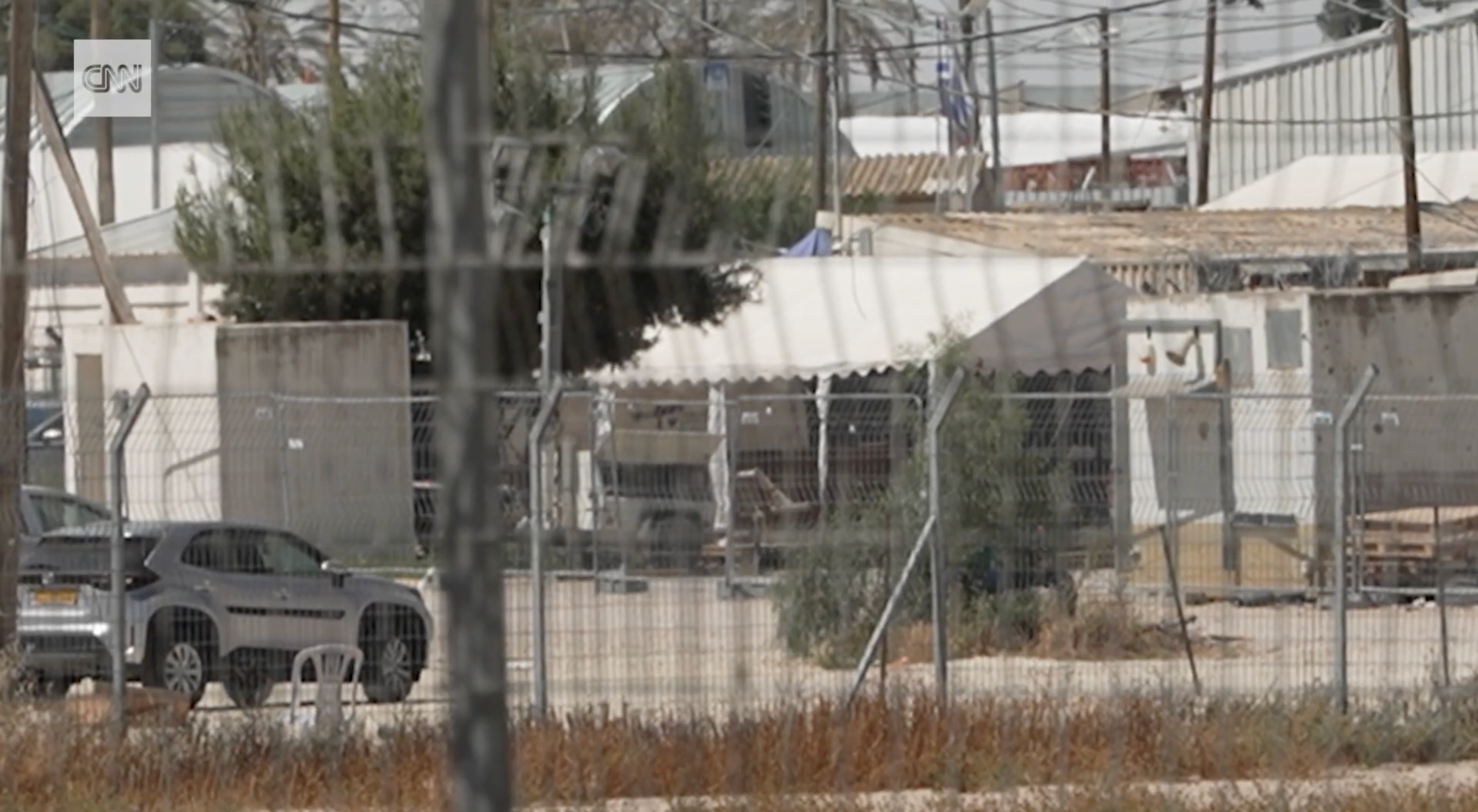
Screen shot from CNN report on Sde Teiman, an Israeli military detention camp.
(Source) | Fair use as it is included for the purpose of news and commentary.
Fifty-nine Palestinian journalists shared their stories of torture and abuse at the hands of the Israeli military.
20 Feb 2026 – A report from the Committee to Protect Journalists (CPJ) features testimonies from Palestinian journalists, who were detained and tortured by Israeli security forces.
Israeli forces detained “at least 94 Palestinian journalists and one media worker in that period—32 journalists and one media worker from Gaza, 60 from the West Bank, and two in Israel,” CPJ stated. “Thirty remain in custody, as of February 19, 2026. CPJ’s 2025 Prison Census found that Israel has been listed as a top jailer of journalists since 2023.”
The figure of 94 journalists is lower than the number shared by the Palestinian Journalists Syndicate, which previously reported that 153 journalists were detained between October 2023 and October 2025.
Crucially, the press freedom organization collected 59 interviews with journalists [PDF] that were subject to torture, abuse, and “other forms of violence” since the Israeli military carried out a genocide against Gaza.
CPJ regional director Sara Qudah said the report exposes a “deliberate strategy to intimidate and silence journalists, and destroy their ability to bear witness. The continued silence from the international community only enables this.”
“Ten journalists requested anonymity, alleging explicit threats of re-arrest or death from Israeli interrogators and prison service officials if they spoke publicly. These threats appear in 31 of the individual testimonies, and have driven many journalists away from their work,” CPJ indicated.
Several journalists described torture that they survived at Sde Teiman, a military detention camp that was the focus of widespread media attention in 2024 after Israeli whistleblowers at the camp spoke to CNN. (Israeli journalist Guy Peleg reported on the torture, which included sexual assaults, and he subsequently faced threats of imprisonment.)
“We returned from hell,” journalist Imad Ifranji recalled, “using the term other detainees used for a section at Sde Teiman.”
Gaza photojournalist Shadi Abu Sido told CPJ that he was “shackled, blindfolded, and forced through a corridor of soldiers who beat him with batons and kicks. He later learned he had a broken rib.”
“Another journalist, Osama al-Sayed, said he and other detainees were stripped naked and attacked by trained dogs in Sde Teiman. He described the incident as rape, adding that soldiers laughed while filming the assault,” according to CPJ.
Also, at Sde Teiman, journalists were “subjected to prolonged exposure to high-volume sound, including continuous amplified music, resulting in sleep deprivation and sensory disorientation.” Israeli soldiers additionally used “round-the-clock dog barking” to torment detainees.
The New York Times previously reported that detainees at Sde Teiman were classified as “unlawful combatants” under legislation that the Israeli government adopted. A person could be detained for 75 days “without judicial permission” and denied access to a lawyer for up to 90 days. Their location could be hidden from rights. Groups like the International Committee of the Red Cross.
Two of the Palestinian journalists that CPJ spoke to reported that they were sexually assaulted. Freelance journalist Sami al-Sai described how he was “taken to a small cell in Megiddo prison, and soldiers removed his trousers and underwear, and penetrated him with batons and other objects.”
“In total,” according to the report, “CPJ documented 17 journalist testimonies involving sexual violence and 19 more describing humiliating strip searches. The alleged acts included assaults on the journalists’ genitals, attempted forced penetration with objects, forced nudity and recording, threats of rape, and other methods of sexualized coercion.”
At other detention facilities, eleven journalists said Israeli soldiers subjected them to strappado or “ghost hanging.” They were “hung, suspended by their arms, bound behind the back, and then pulled upward.” Or in some cases “they were made to kneel or lay face forward for hours, as well as restrained under rain, direct sun, and sewage water.”
Starvation, which the Israeli military has used as a method of warfare against Gaza, was inflicted upon detained journalists. “Fifty-five of the 59 journalists interviewed reported extreme hunger or malnutrition,” with an average weight loss of 54 pounds or 23.5 kilograms.
Israeli soldiers, according to al-Sayed, called him “Jazeera.” He was “beaten up gravely” after he revealed to the soldiers that he was a journalist. Abu Sido said a soldier told him “you will learn the meaning of journalism in Tel Aviv” after he was detained while filming.
Journalist Amin Baraka, who worked for Al Jazeera, recounted, “An Israeli soldier told me, word for word in Arabic, that Al Jazeera correspondent Wael Al-Dahdouh defied us and stayed in the Gaza Strip, so we killed his family, and we will kill yours too.”
The Israeli government has waged a war against any individual affiliated with Al Jazeera, banning the Arabic news network and bombing them in Gaza.
In 2025, Reporters Without Borders (RSF) found that the Israeli military was responsible for nearly half of all journalist deaths worldwide. Military forces specifically targeted 29 media professionals—making the Israeli army “the worst enemy of journalists.”
As of CPJ’s report, at least 30 Palestinian journalists remain in Israeli detention. Twenty-five of them have not been charged with any offenses.
___________________________________________
 Kevin Gosztola is managing editor of Shadowproof, host of the Dissenter Weekly, co-host of the podcast Unauthorized Disclosure, and member of Society of Professional Journalists (SPJ).
Go to Original – thedissenter.org
Tags: Gaza, Genocide, Human Rights, Israel, Journalism, Media, Palestine, Palestinian Rights, State Terrorism, Torture, War crimes, West Bank
DISCLAIMER: The statements, views and opinions expressed in pieces republished here are solely those of the authors and do not necessarily represent those of TMS. In accordance with title 17 U.S.C. section 107, this material is distributed without profit to those who have expressed a prior interest in receiving the included information for research and educational purposes. TMS has no affiliation whatsoever with the originator of this article nor is TMS endorsed or sponsored by the originator. “GO TO ORIGINAL” links are provided as a convenience to our readers and allow for verification of authenticity. However, as originating pages are often updated by their originating host sites, the versions posted may not match the versions our readers view when clicking the “GO TO ORIGINAL” links. This site contains copyrighted material the use of which has not always been specifically authorized by the copyright owner. We are making such material available in our efforts to advance understanding of environmental, political, human rights, economic, democracy, scientific, and social justice issues, etc. We believe this constitutes a ‘fair use’ of any such copyrighted material as provided for in section 107 of the US Copyright Law. In accordance with Title 17 U.S.C. Section 107, the material on this site is distributed without profit to those who have expressed a prior interest in receiving the included information for research and educational purposes. For more information go to: http://www.law.cornell.edu/uscode/17/107.shtml. If you wish to use copyrighted material from this site for purposes of your own that go beyond ‘fair use’, you must obtain permission from the copyright owner.
Join the discussion!
We welcome debate and dissent, but personal — ad hominem — attacks (on authors, other users or any individual), abuse and defamatory language will not be tolerated. Nor will we tolerate attempts to deliberately disrupt discussions. We aim to maintain an inviting space to focus on intelligent interactions and debates.