


Applied Peace: Ubuntu Humanism, Usage of Indigenous, Mother Tongue Language and the Practice of Peace in Plural Societies
TRANSCEND MEMBERS, 30 Mar 2026
Prof Hoosen Vawda – TRANSCEND Media Service
Part 3 of the Trilogy of Trinity
This publication is suitable for general readership. Parental guidance is recommended for minors who may use this research paper, as a resource material, for projects.
“South Africa is a country comprised of the “Rainbow Nation”, as described by the Emeritus, Late, Bishop Desmond Tutu. The importance of preservation and daily usage of Indigenous languages is the key to Sustainable Peace in post democratic era of Madibaism.”[1]
“The preservation and usage of the mother tongue, is the single most important pillar of Peace in multicultural societies, globally”.”[2]
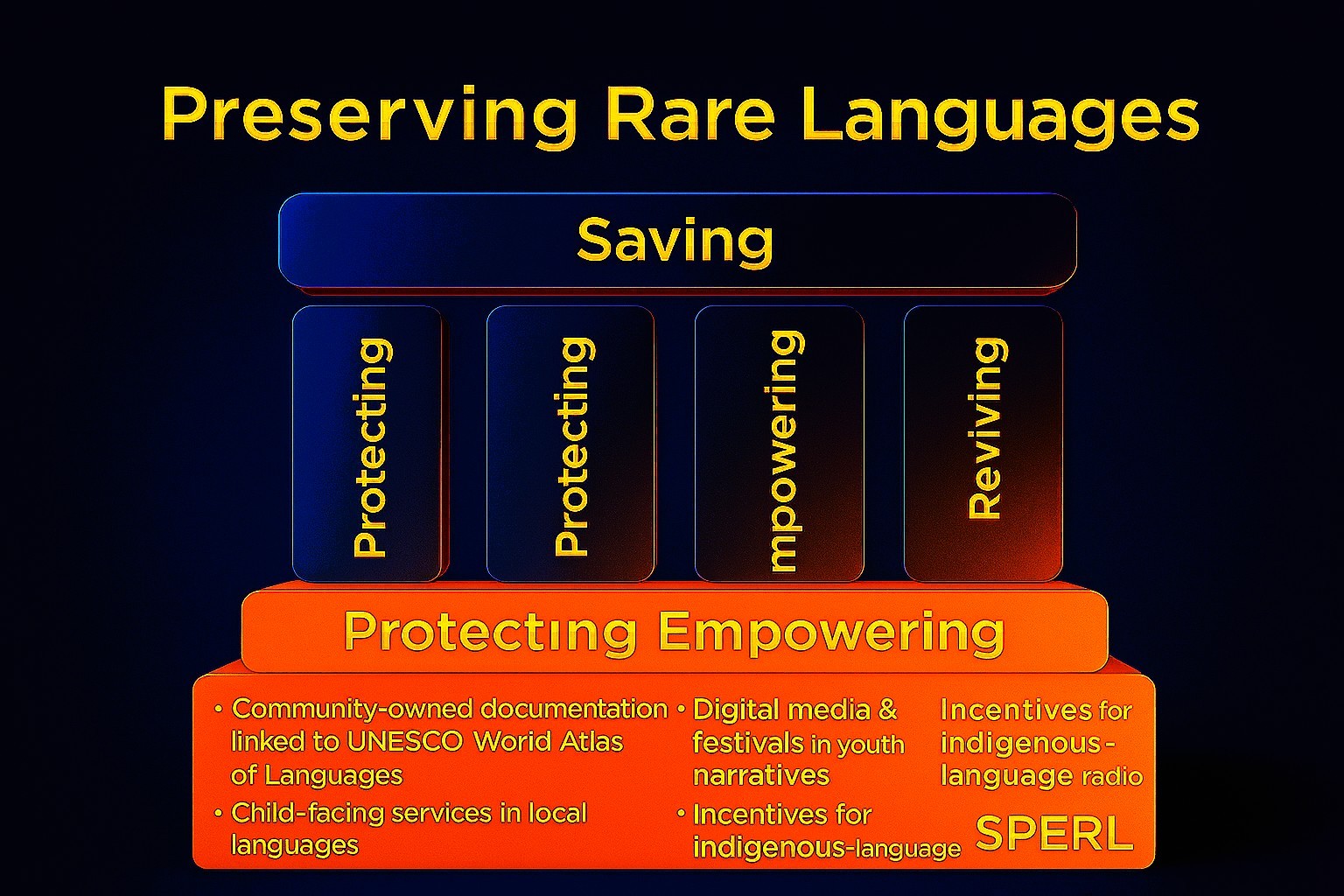
The Importance of Preserving Rare Languages depicted by the Four Foundational Pillars
Original Graphic Conceptualised by Mrs V. Vawda, March 2026
- Prologue
This paper operationalises Ubuntu humanism[3], expressed linguistically in the Nguni [4] insight umuntu ngumuntu ngabantu [5] (“a person is a person through other persons”), to design applied peace architectures for diverse societies. Building on Parts 1 [6] and 2 [7], the author shows how language choice, rights, and mother‑tongue vitality are not peripheral to peace but constitutive of recognition, dignity, and identity. We integrate Mandela’s language ethos [8] with sociolinguistic and neurocognitive evidence[9]: native‑language contexts yield deeper emotional resonance and trust formation than foreign‑language contexts, impacting moral judgement and reconciliation outcomes. The paper culminates in an implementable SPERL programme (Saving, Protecting, Empowering, Reviving Languages) aligned to UNESCO’s International Decade of Indigenous Languages (2022–2032) [10] and to constitutional duties on multilingual equity, translating ethical commitments into policies, budgets, and measurable indicators.
(2) Introduction
Ubuntu philosophy centres relational personhood: we become fully human through one another. This is not abstraction; it is linguistically enacted in greetings, proverbs, and the everyday ethics of speech. The idiom umuntu ngumuntu ngabantu frames language as world‑making action, not mere information transfer. In South Africa, Ubuntu gained renewed public force through the democratic transition and truth‑seeking, complementing a constitutional order that recognises 11 official languages and imposes duties to advance indigenous languages in state services.
This, Part 3 therefore asks: How do we practice peace, daily, institutionally, and intergenerationally, so that language becomes the medium of recognition, dignity, and identity? We answer by coupling Ubuntu ethics with sociolinguistic and neurocognitive validation and with a rights‑to‑results pathway.
(3) Applied Peace – Ubuntu Humanism
3.1 Ethical Premise: Relational Personhood → Relational Speech
- Ubuntu frames personhood as fundamentally relational; speech is the primary vehicle through which we affirm or denythe other’s humanity.
- Operational implication:design peace processes, services, and schools where people can speak and be served in their languages; otherwise recognition and trust are compromised.
3.2 The Institutional Bridge: Constitutional Multilingualism[11]
- Section 6 and the Official Use of Languages Act (2012)mandate equitable language use and departmental language units, an actionable bridge from ethical Ubuntu to deliverable services.
- Scholarship on language rights cautions that implementation lagswithout positive measures and monitoring, hence the need for scorecards and budgets.
3.3 The Peace Design: Where Ubuntu Meets Policy[12]
- Justice and Reconciliation:testimony [13], apology, and restorative agreements are more authentic and accurate when conducted in L1; interpreters should augment, not replace, L1 proceedings. (Please refer to Part 2 evidence below.)
- Education:mother‑tongue‑based multilingual education (MTB‑MLE) for early grades; Ubuntu pedagogy (proverbs, community elders, oral narratives) as routine curricular assets aligned to national policy.
- Health and Social Services:child‑facing services (clinics, child protection) must default to local languages to avoid rights‑limiting misunderstandings; this is both Ubuntu‑consistent and rights‑compliant.
(4) Philosophical and Sociolinguistic Exploration[14]
4.1 Language as the Praxis of Recognition[15]
To address a person in their language is to say “I see you”. Ubuntu moves this from nicety to moral requirement; sociolinguistics adds that worldviews are encoded in languages, so loss of a language is loss of a mode of recognition itself.
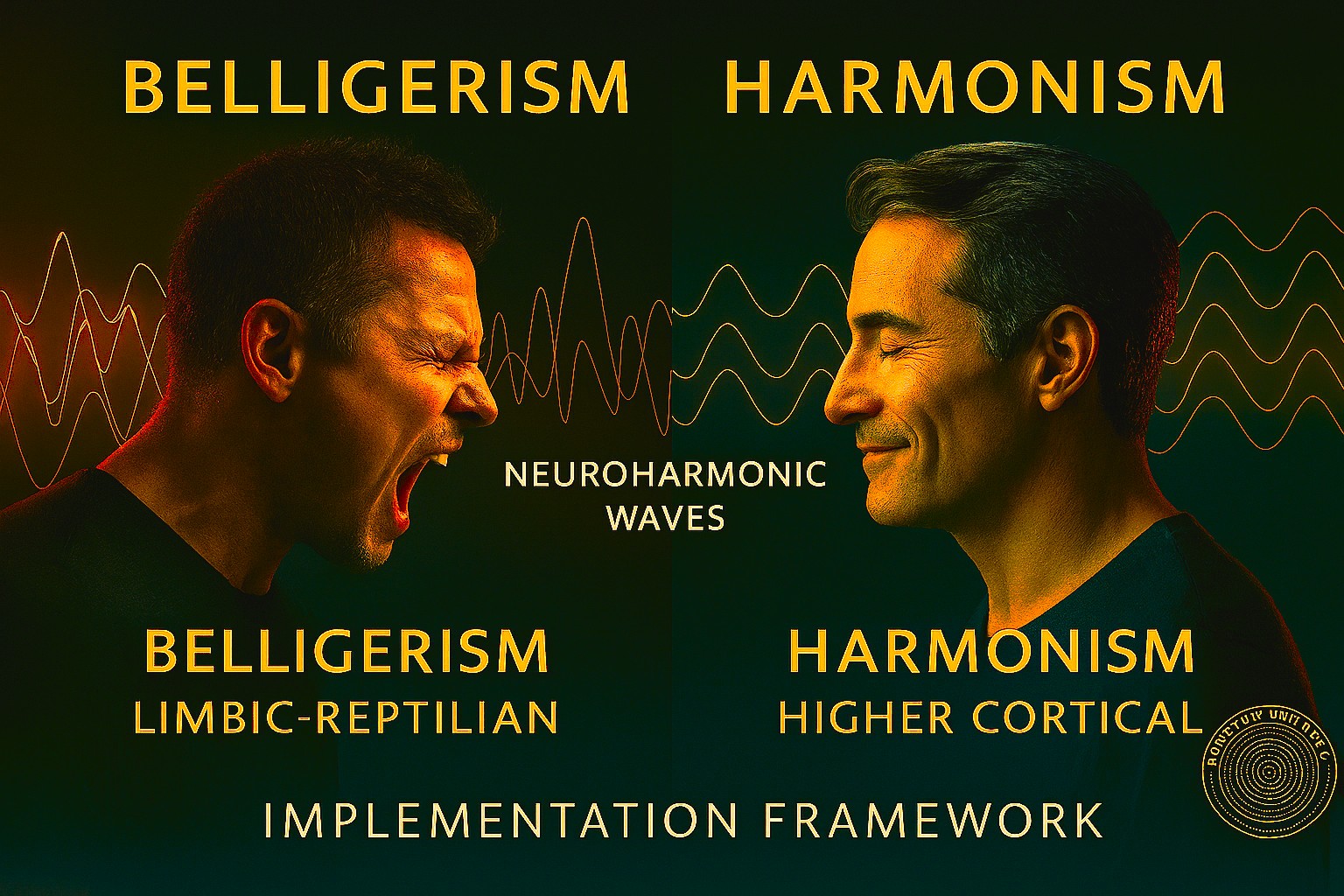
Bimodal Neurocognitive and Sociolinguistic States Under Belligerism and Harmonism, Demonstrating How Mother‑Tongue (L1) Processing Promotes Peaceful Harmonisation While Foreign‑Language (L2+) Processing Is More Strongly Associated with Reactive Belligerent Modes. Original Graphic Conceptualised by Mrs V. Vawda, March 2026
This conceptual image contrasts two neuro‑sociolinguistic states, Belligerism and Harmonism, as expressions of underlying brain‑system dynamics influenced by language context.
On the left, Belligerism is illustrated through desynchronised neuroharmonic waves, representing heightened activity within the limbic–reptilian complex, including structures such as the amygdala, periaqueductal grey, basal ganglia, and hypothalamus. These regions mediate rapid threat detection, impulsive reactivity, and defensive aggression, functions that correspond to heightened emotional arousal. Research in bilingual affective neuroscience demonstrates that individuals exhibit greater autonomic activation, including increased skin‑conductance responses, when processing emotionally salient content in their non‑native or foreign language (L2+), reflecting more effortful cognitive processing, reduced emotional grounding, and increased psychological distance. This decoupling contributes to desynchronised neuroharmonic patterns, a marker of reduced integrative coherence and increased susceptibility to conflict‑oriented behaviour. [saflii.org], [gov.za]
On the right, Harmonism is represented by synchronised neuroharmonic waves, corresponding to activation within the higher cortical network, especially the prefrontal cortex, anterior cingulate cortex, temporoparietal junction, and medial prefrontal regions implicated in empathy, prosocial reasoning, inhibitory control, and moral judgement. Scientific evidence shows that processing emotionally rich material in one’s mother tongue (L1) elicits stronger emotional resonance, deeper autobiographical access, and more integrated cognitive‑affective responses than in L2. This heightened resonance is accompanied by greater cortical synchronisation, enabling reflective judgement, self‑regulation, and empathic recognition, core neural substrates of non‑violence and peace‑oriented behaviour. [canada.ca]
From a sociolinguistic and peace‑studies perspective, the contrast illustrates how L1 communication fosters interpersonal trust, cultural grounding, and relational dignity, aligning with Ubuntu’s axiom umuntu ngumuntu ngabantu (“a person is a person through other persons”). In contrast, L2‑dominant interactions, particularly when imposed or associated with historical trauma, may attenuate affective connection and contribute to misunderstanding or relational distance, thereby increasing susceptibility to belligerent modes of engagement. This bimodal representation visually synthesises the growing literature demonstrating that language choice is not merely communicative but neuro‑ethical, shaping patterns of emotional regulation, cognitive integration, and ultimately the likelihood of peaceful versus conflictual behaviour.
4.2 Dignity, Identity, and the Linguistic Self[16]
Dignity requires authentic self‑expression; identity is audible in the metaphors and memories of a language. Global frameworks warn that many languages are threatened, hence dignity and identity are at stake, with UNESCO’s Decade providing both impetus and tools (e.g., the World Atlas of Languages).
(5) Mandela’s Language Ethos, Practice as Peace Technology[17]
Mandela leveraged language as moral persuasion and psychological bridge‑building, famously choosing the interlocutor’s language to reach the heart, not only the head. While oft‑quoted lines are sometimes paraphrased, their spirit and context, speaking Afrikaans to Afrikaners, African languages to Black South Africans, are historically grounded and aligned with Ubuntu’s dignity ethic.
Mandela also insisted that children are the rock on which our future will be built[18], making education and child‑centred language access a national priority, again converting ethos into policy direction. Address by President Nelson Mandela at the dedication of Qunu and …
(6) Philosophical Power in Practice: Recognition, Dignity, Identity[19]
These three pillars instantiate peace when embedded in institutions:
- Recognition→ Language choice in frontline services and dialogue tables.
- Dignity→ Parity of esteem and non‑discrimination in official communications.
- Identity→ Heritage language schooling, media, and ceremonies that normalise and honour local speech.
(7) Cognitive Validation, Why Language Choice Matters[20] (L1 vs. L2+)
- Physiological evidence:Bilingual studies show greater skin‑conductance reactivity to taboo words and childhood reprimands in L1 than L2, objective markers of deeper affect.
- Decision science:The Foreign‑Language Effect [21]demonstrates that reasoning in a foreign language reduces framing biases and loss aversion but also dampens emotional immediacy; meta‑analysis confirms robustness across moral and risk domains. Implication: for trust‑building and confession, L1 is ethically and practically superior; for certain analytic tasks, L2 can be strategically useful.goodreads+1
(8) Ubuntu as Linguistic Ethic[22]
Ubuntu’s maxim, umuntu ngumuntu ngabantu, makes language an ethical act: to speak in ways that maintain harmony, interdependence, and communal identity.[23] Linguistic studies trace Ubuntu/hunhu/botho across Bantu languages, showing deep historical roots and shared moral grammar. Operational Ubuntu means designing speech environments where relational dignity is structurally supported (rights, interpreters, schooling, media), not left to chance.
(9) Epilogue
“To preserve a language is to preserve the conscience of a community.”
[24]Applied Ubuntu turns conscience into curriculum, service, and law, so that hearts can meet without translation.
(10) Call to Action , Preventing Extinction with SPERL[25]
- Saving:Community‑owned documentation (kid‑corpora, oral histories) deposited in national repositories and linked to UNESCO’s World Atlas of Languages.
- Protecting:Enforce the Official Use of Languages Act in child‑facing services; publish a Language Equity Scorecard
- Empowering:Scale MTB‑MLE; fund L1 teacher upskilling; parents as co‑educators with dual‑language readers. (Aligns with Ubuntu pedagogy.)
- Reviving:Commission L1 digital media for youth; seed proverb/slam festivals; incentivise local radio in indigenous languages; align to IDIL 2022–2032 action areas.
- Languages (governance):Budget‑tag multilingual delivery; inter‑departmental Language Units; quarterly compliance audits.
(11) Take‑Home Message
Language is not an accessory to peace; it is peace’s operating system[26].
When we recognise persons in their languages, we dignify their humanity and anchor their identities, producing trust, moral salience, and civic cohesion.
(12) Conclusion
Part 3 completes your Trilogy’s arc by converting Ubuntu philosophy and sociolinguistic evidence into institutional practice.[27] It pairs ethical intent with constitutional capacity and global frameworks, embedding language at the centre of peace architecture. With SPERL as the execution engine, states and communities can bend the vitality curve upward for endangered languages while improving justice, education, and social healing.
(13) The Bottom Line (National and Global Relevance)[28]
- Multilingual equityis a human‑rights deliverable and a peace dividend.
- Ubuntu’s relational ethic, locally rooted, globally intelligible, offers a portable templatefor plural democracies.
- UNESCO’s Decadeprovides timing, tools, and legitimacy to act decisively before more languages fall silent.
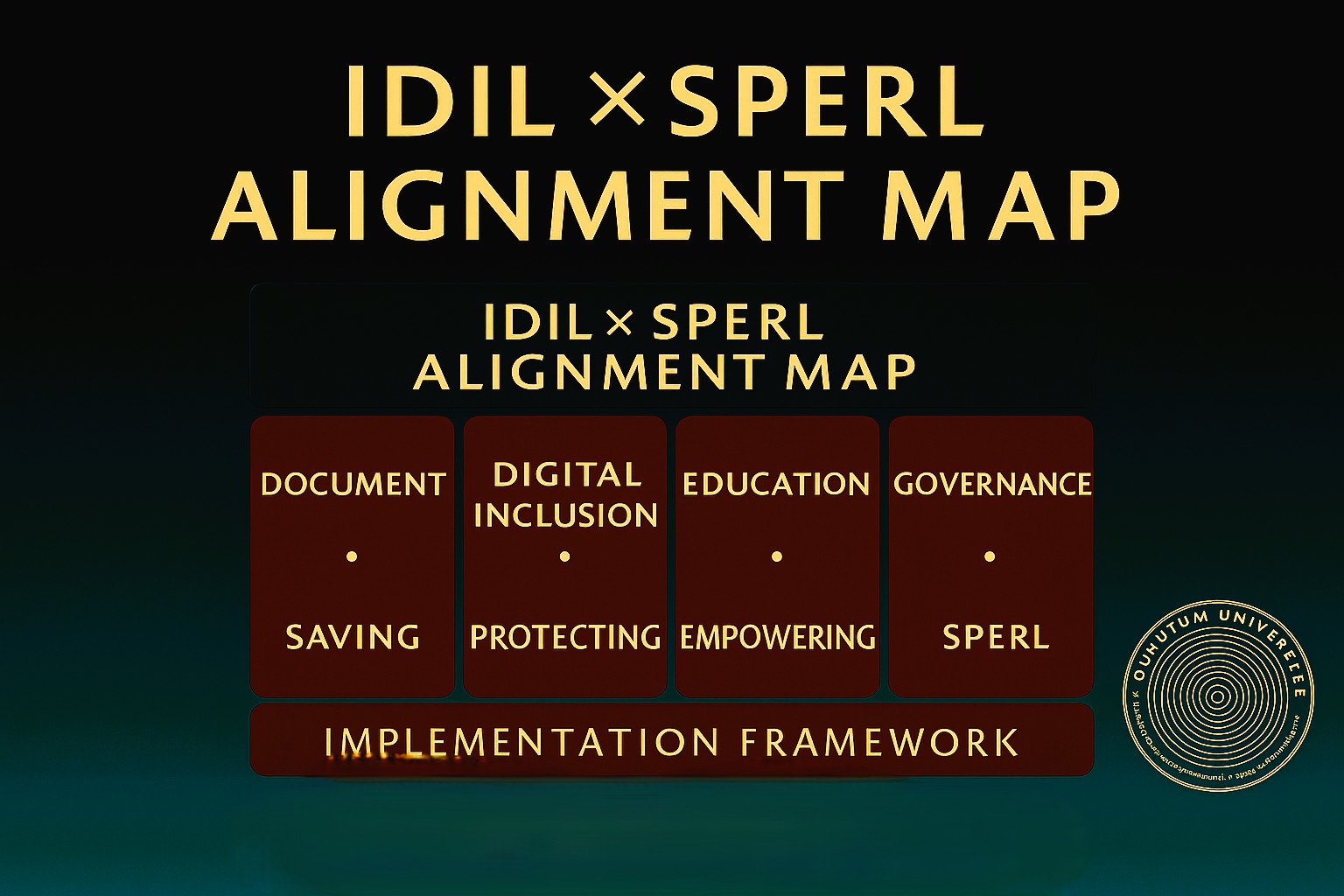
Alignment matrix illustrating the convergence between UNESCO’s International Decade of Indigenous Languages (IDIL 2022–2032) action areas and the SPERL framework (Saving, Protecting, Empowering, Reviving Languages), presented within a unified implementation architecture. Original Graphic Conceptualised by Mrs V. Vawda, March 2026
The UNESCO IDIL and SPERL Framework
This alignment map situates SPERL’s operational pillars within the core thematic domains defined by the UNESCO Global Action Plan for IDIL 2022–2032, namely Documentation, Digital Inclusion, Education, and Governance. These international action areas emphasise the urgent need for (1) safeguarding linguistic heritage through systematic documentation and community‑owned archiving; (2) advancing digital empowerment, access, and technological inclusion for indigenous and threatened languages; (3) strengthening mother‑tongue–based and multilingual education systems; and (4) embedding language rights and revitalisation within national governance mechanisms, monitoring processes, and multi‑stakeholder coordination frameworks.
Within this matrix, SPERL provides a structured, state‑aligned model for operationalising IDIL.
- Saving aligns with IDIL’s documentation mandate through community archives, oral‑heritage capture, and national–global data integration.
- Protecting corresponds to digital and policy inclusion, ensuring linguistic rights within public services, justice systems, and digital ecosystems.
- Empowering is situated within the educational domain, emphasising teacher preparation, mother‑tongue literacy, child‑centred pedagogy, and intergenerational transmission.
- Reviving aligns with cultural and governance objectives, promoting indigenous‑language media, festivals, youth content creation, and structural revitalisation efforts.
By linking SPERL’s domestic implementation pathways with IDIL’s global action areas, the figure demonstrates how national linguistic revitalisation, through constitutional obligations, policy instruments, and community partnerships, can be coherently integrated with international frameworks. This alignment ensures that national programmes are not only locally grounded but also globally benchmarked, ethically coherent, and strategically positioned to prevent further endangerment of linguistic diversity while advancing social cohesion, cultural dignity, and sustainable peace.
Ministerial Policy Brief
Applied Peace: Ubuntu Humanism and Linguistic Equity for National Cohesion[29]
A SPERL‑Driven Implementation Framework (2026–2032)[30]
- Executive Summary
South Africa’s constitutional democracy recognises 11 official languages and requires the State to take “practical and positive measures” to elevate and advance indigenous languages and ensure parity of esteem among them. Simultaneously, UNESCO’s International Decade of Indigenous Languages (2022–2032) calls for urgent global action to prevent language extinction through documentation, revitalisation, and policy integration across sectors. [saflii.org] [unesco.org]
This brief presents a 5‑pillar SPERL implementation roadmap, Saving, Protecting, Empowering, Reviving Languages, and a cross‑cutting governance pillar, anchored in Ubuntu humanism and supported by neurocognitive evidence showing that native‑language contexts foster deeper emotional resonance, trust, and social cohesion.
It outlines operational steps, timelines, and measurable indicators for national departments, provincial governments, and public entities, aligned with the Use of Official Languages Act (Act 12 of 2012) [31]and the UNESCO Global Action Plan.[32]
- Purpose of the Brief
- Translate Ubuntu principles and constitutional mandates into deliverable, budgeted language equity programmes.
- Enable reporting and compliance under the Use of Official Languages Act (Language Units, monitoring duties, annual reports). [gov.za]
- Position South Africa as an African leader in the UN International Decade of Indigenous Languages 2022–2032 through measurable institutional action. [idil2022-2032.org]
- Policy Principles
3.1 Ubuntu as Public‑Service Ethic
Ubuntu’s relational maxim umuntu ngumuntu ngabantu frames language as an ethical responsibility, recognising dignity, identity, and personhood through language choice.
3.2 Constitutional and Legislative Imperative[33]
- Section 6: Advance indigenous languages; ensure equitable use; protect diminished languages.
- Use of Official Languages Act (2012):
- Each national department must adopt a language policy,
- Establish a Language Unit,
- Monitor and report annually on official‑language use,
- Coordinate with the National Language Unit. [gov.za], [saflii.org]
3.3 Global Alignment
- IDIL 2022–2032 identifies language loss as a severe risk and calls for documentation, digital inclusion, and national action plans. [34][unesco.org]
- Operational Framework: SPERL Pillars[35]
Below are the required actions, timelines, and indicators.
- Operational Steps, Timelines, and Metrics
Pillar 1 , Saving
Community‑Owned Documentation and Knowledge Preservation[36]
Operational Steps
- Establish District Language Documentation Hubs in partnership with universities and local communities.
- Record children’s oral heritage (stories, songs, proverbs) in partnership with schools and elders.
- Upload validated material to national archives and integrate with the UNESCO World Atlas of Languages digital repository. [unesco.org]
Timeline
- Q3 2026: 11 pilot hubs, one per official language group.
- 2027–2030: Scale to all districts.
Metrics
- Number of hours of L1 recordings archived.
- Number of communities participating.
- Number of languages with updated vitality profiles in the World Atlas.
Pillar 2 , Protecting
Language Rights in Public Services[37]
Operational Steps
- Ensure each department complies with the Use of Official Languages Act by:
- Publishing updated Language Policies (minimum 3 languages for communication).
- Establishing Language Units with annual reporting duties. [gov.za]
- Require all child‑facing services (clinics, social development, SAPS child units) to default to local languages for intake, forms, and signage.
- Implement a national Language Equity Scorecard.
Timeline
- Q1 2027: All national departments compliant.
- Q2 2027: Scorecard published with Cabinet reporting.
Metrics
- % of departments with fully operational Language Units (target: 100%).
- % of public‑service points offering services in ≥3 official languages.
- Complaints resolved within 30 days.
Pillar 3 , Empowering
Education, Skills, and Cognitive‑Based Inclusion[38]
Operational Steps
- Expand Mother‑Tongue Based Multilingual Education (MTB‑MLE) for Grades R–3.
- Train educators in L1 reading science, translation techniques, and Ubuntu pedagogy.
- Provide dual‑language learning materials aligned with UNESCO’s emphasis on education and digital empowerment for indigenous languages. [unesco.org]
Timeline
- 2026–2028: Teacher upskilling rollout across provinces.
- By 2030: 80% of primary schools using MTB‑MLE.
Metrics
- Improvement in Grade 3 L1 literacy scores.
- Number of teachers certified in L1 pedagogy.
- % of learners receiving dual‑language materials.
Pillar 4 , Reviving
Media, Culture, Festivals, and Digital Futures[39]
Operational Steps
- Fund local‑language radio, youth podcasts, folklore festivals, and proverb‑slam competitions.
- Develop indigenous‑language children’s media and digital learning apps.
- Incentivise private broadcasters to meet local‑language content quotas.
Timeline
- 2026–2027: Content funding pipeline established.
- By 2032: All official languages represented across digital‑media ecosystems.
Metrics
- Hours of local‑language media annually broadcast.
- Youth participation rates in festivals and school competitions.
- Digital app downloads and usage data.
Pillar 5 , Languages (Cross‑Cutting Governance)
Coordination, Monitoring, Budgeting, and Reporting[40]
Operational Steps
- Create a National Coordinating Secretariat for IDIL 2022–2032, aligning national action with UNESCO’s Global Action Plan in monitoring and evaluation, multi‑stakeholder governance, and resource mobilisation. [en.iyil2019.org]
- Introduce Language Budget‑Tagging in departmental Estimates of National Expenditure.
- Produce an Annual State of South Africa’s Languages Report to Parliament.
- Embed language indicators into national population surveys.
Timeline
- Q4 2026: Secretariat established.
- 2027–2032: Annual reports tabled.
Metrics
- Budget allocation trends for language programmes.
- Number of departments meeting reporting requirements.
- Annual improvements in linguistic access indicators.
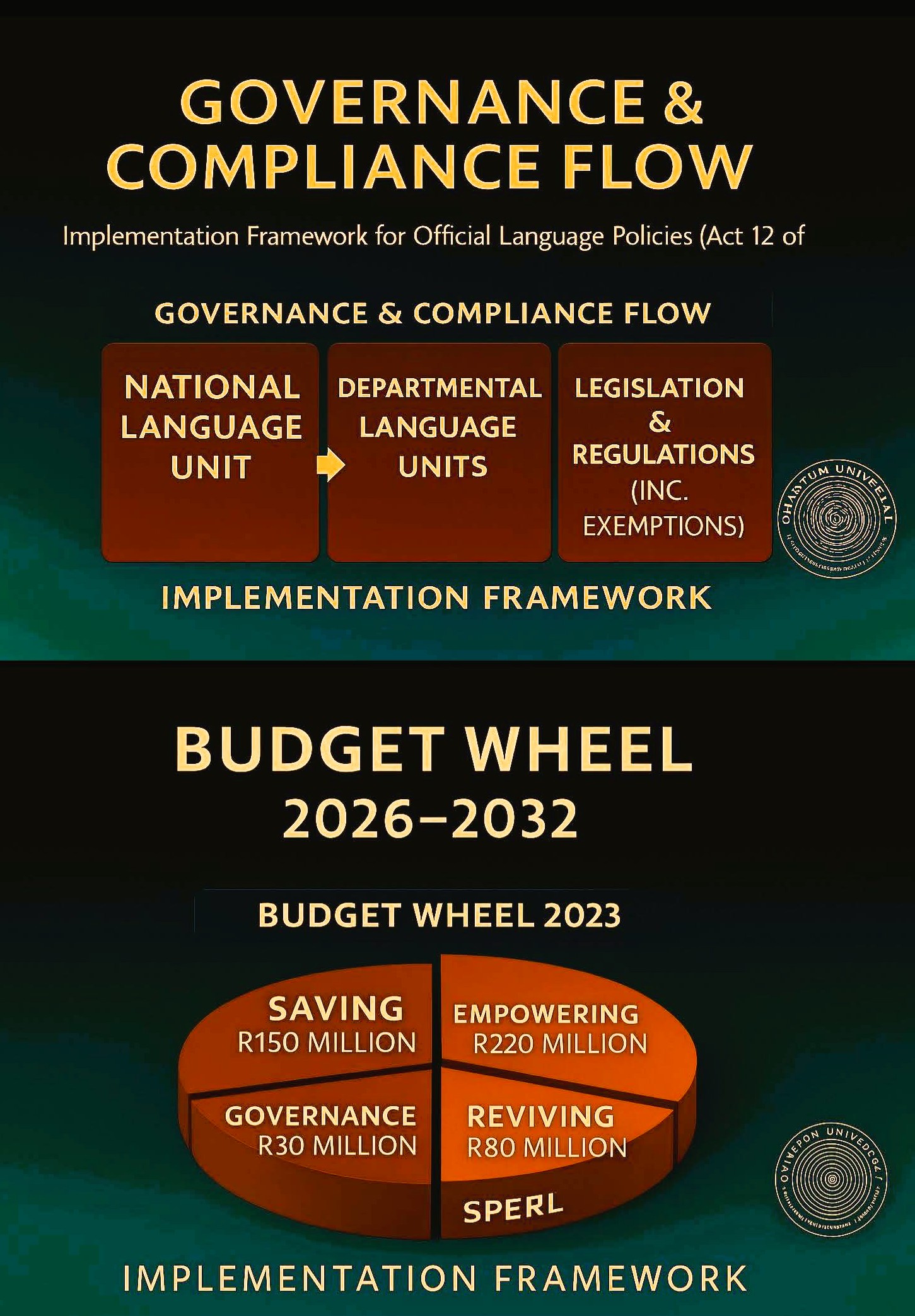
The Budget Wheel and Implementation Framework
Governance, Compliance and Budgetary Architecture for Implementing South Africa’s Multilingualism Mandate Under the Use of Official Languages Act (Act 12 of 2012), aligned with SPERL and the UNESCO International Decade of Indigenous Languages (IDIL 2022–2032).
Top Graphic: depicts the institutional governance and compliance framework established by the Use of Official Languages Act, 2012, which obliges every national department, public entity, and public enterprise to:
Adopt an official Language Policy specifying the minimum number of official languages to be used for government communication;
Establish an internal Language Unit responsible for monitoring departmental language use, ensuring equitable access, advising on implementation and preparing annual compliance reports;
Coordinate with the National Language Unit, which provides national oversight, facilitates inter‑departmental alignment, and ensures that reporting is submitted to Parliament as required under the Act.
This governance flow positions multilingualism not as a symbolic commitment but as a regulated public‑service obligation, supported by monitoring cycles, reporting duties, and legislative provisions for exemptions.
Bottom Graphic: presents the Budget Wheel for 2026–2032, illustrating the proposed financial architecture that operationalises the SPERL framework , Saving, Protecting, Empowering, Reviving Languages, with a cross‑cutting governance allocation. The distribution reflects the priorities emphasised by both the Act and the UNESCO Global Action Plan for the International Decade of Indigenous Languages (2022–2032), which identifies documentation, education, digital inclusion, and governance as essential domains requiring sustained investment. Funding for Saving supports community‑based documentation hubs and national digital heritage repositories; Protecting covers language rights enforcement, public‑service translation, and accessibility; Empowering finances mother‑tongue‑based education, teacher development, and curriculum reform; Reviving funds indigenous‑language media, cultural festivals, and youth digital content; and Governance ensures monitoring, evaluation, and inter‑departmental coherence.
Together, the two graphics demonstrate how governance compliance mechanisms and sustained budgetary commitment are jointly necessary to convert constitutional multilingualism, Ubuntu humanism, and IDIL global priorities into a functioning national language system , one capable of safeguarding linguistic diversity, enabling equitable service delivery, and strengthening South Africa’s long‑term peace, identity, and cultural resilience.
- Risk Analysis and Mitigation[41]
| Risk | Mitigation Strategy |
| Non‑compliance with Act 12 of 2012 | Treasury incentives + reporting penalties; DG performance indicators. |
| Capacity shortages in Language Units | National training academy + partnerships with universities. |
| Low community participation | Community co‑ownership; elders as “heritage partners”; youth media incentives. |
| Digital divide | Offline‑compatible apps; community Wi‑Fi hubs; radio as universal fallback. |
- Budgeting Framework (2026–2032)[42]
Aligned with UNESCO’s call for sustained resourcing for revitalisation efforts. [social.desa.un.org]
- R150 million annually: Documentation hubs and archives
- R220 million annually: MTB‑MLE teacher training
- R80 million annually: Indigenous‑language digital media
- R30 million annually: Monitoring and evaluation, Secretariat
- R50 million annually: Provincial implementation grants
- Governance
- Lead Department: Arts, Culture and Language Services
- Co‑Lead: Basic Education, Higher Education, Social Development, Health
- National Language Unit: Oversight, coordination, monitoring, and reporting under Act 12 of 2012.
- UNESCO/IDIL Alignment: Work through Global Task Force and national partners to ensure synergy with international commitments.
- Conclusion
This SPERL‑aligned policy brief provides a nationally actionable roadmap to fulfil constitutional obligations, meet UNESCO targets, and embody Ubuntu as a practical peace architecture. Implementing these steps will strengthen recognition, dignity, and identity across communities while safeguarding the country’s linguistic heritage.
- Take‑Home Message
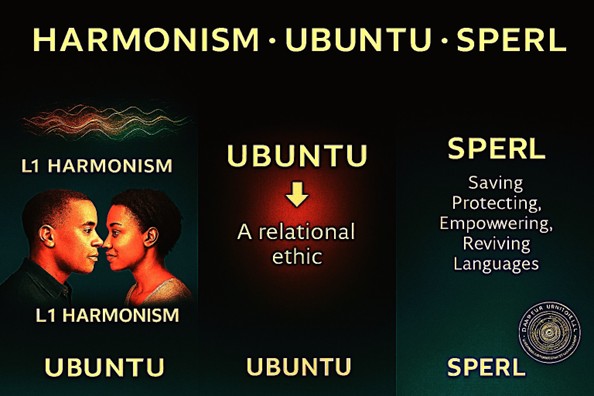
Language equity is not a cultural luxury, it is a peace, development, and identity imperative. The appreciation of this message is the basis for intercultural peace and harmony. Conceptual pathway illustrating how mother‑tongue (L1) harmonisation enables Ubuntu relational ethics, activates SPERL (Saving, Protecting, Empowering, Reviving Languages), and culminates in a coherent Peace Architecture.
This 3D conceptual diagram visualises a sequential peace‑generation model grounded in sociolinguistics, neurocognition, and African humanist philosophy. At the foundation lies L1 Harmonism, representing communication in an individual’s mother tongue , the linguistic mode consistently shown to evoke greater emotional resonance, autobiographical memory access, and integrative cognitive‑affective processing than later‑acquired languages.[43],[44] Studies in psycholinguistics and affective neuroscience demonstrate that native‑language contexts activate higher cortical integrative systems, such as the prefrontal cortex and anterior cingulate cortex, which support reflective reasoning, empathy, and prosocial judgement, thereby promoting intra‑ and interpersonal coherence. Conversely, foreign‑language contexts (L2+) often induce cognitive distance and attenuated affect, a phenomenon documented in bilingual decision‑making research. [saflii.org], [gov.za]
The central tier depicts Ubuntu, articulated in the Nguni philosophical maxim umuntu ngumuntu ngabantu (“a person is a person through other persons”). Ubuntu conceptualises personhood as inherently relational, foregrounding interconnectedness, dignity, mutual recognition, and collective flourishing.[45] Linguistically, Ubuntu is enacted through relational speech, where language itself becomes a mechanism of ethical recognition: to address another in their L1 affirms their humanity and cultural identity. This aligns with global frameworks emphasising that language is essential for human dignity, participation, and social cohesion. [Address by…nu and …]
From Ubuntu emerges SPERL, a structured action framework comprising Saving, Protecting, Empowering, and Reviving Languages, anchored in national legislative duties such as the Use of Official Languages Act (2012), which mandates language policies, Language Units, and annual monitoring across departments.[46] SPERL also aligns with UNESCO’s International Decade of Indigenous Languages (IDIL 2022–2032) and its Global Action Plan, which calls for documentation, digital inclusion, education, and multi‑stakeholder governance to safeguard threatened languages. [unesco.org] [eha.eco], [Address by…nu and …]
At the apex is the formation of a Peace Architecture, a systemic configuration where language rights, Ubuntu ethics, and neurocognitive harmonisation converge. This is evident in African Peace and Security Architecture (APSA)[47]. In this model, peace is not conceptualised merely as the absence of conflict, but as a constructive state of harmonised neurocognitive regulation, mutual linguistic recognition, and institutionalised multilingual equity.[48] When SPERL actions are implemented within Ubuntu’s relational framework and grounded in L1 Harmonism[49], the result is an evidence‑based pathway toward stable, just, and culturally inclusive peace systems.[50]
A framework of Peace Architecture: The South Africa Peace Philosophy: Languages, using Ubuntu as an anchor
The Vawdaian concept of Language and Peace inter-connectedness and the uniquely South African philosophy of Ubuntu
The Society for the Preservation of Extinction of Rare Languages ensuring sustained peace
Original Photographs Conceptualised by Mrs V. Vawda, March 2026
Comments and discussion are invited by e-mail: vawda@ukzn.ac.za
Global: + 27 82 291 4546
References:
[1] https://www.transcend.org/tms/2025/11/valmiki-the-silent-seer-of-resonant-endogenous-and-global-peace/
[2] Personal Quote by author, February 2026
[3] https://www.bing.com/ck/a?!&&p=7d53a79db9b0a79565fbadf3b4539c093d0e7410d2bfda286ce26816379148e8JmltdHM9MTc3Mzk2NDgwMA&ptn=3&ver=2&hsh=4&fclid=2b35ea2c-b8d0-63b3-2370-fd36b95362a4&u=a1aHR0cHM6Ly93d3cudGhlZ290b2d1eS5jby56YS9wb3N0L3VidW50dS1hbi1hZnJpY2FuLXBoaWxvc29waHktb2YtY29tbXVuaXR5LWFuZC1odW1hbml0eQ&ntb=1
[4] https://www.bing.com/ck/a?!&&p=0fcda404416db67961ca1ddbabf9eb2d23d05c95b00114c3eaaf3d6946b13e27JmltdHM9MTc3Mzk2NDgwMA&ptn=3&ver=2&hsh=4&fclid=2b35ea2c-b8d0-63b3-2370-fd36b95362a4&psq=nguni+languages&u=a1aHR0cHM6Ly9lbi53aWtpcGVkaWEub3JnL3dpa2kvTmd1bmlfbGFuZ3VhZ2Vz
[5] https://www.bing.com/ck/a?!&&p=9c16fbc14c06b5eb8ff30964f2ddfd536934ac63d91d3f709e75cd750724403fJmltdHM9MTc3Mzk2NDgwMA&ptn=3&ver=2&hsh=4&fclid=2b35ea2c-b8d0-63b3-2370-fd36b95362a4&psq=umuntu+ngumuntu+ngabantu&u=a1aHR0cHM6Ly90aGVwYW5hZnJpY2EuY29tL3VidW50dS10aGUtcGhpbG9zb3BoeS1vZi1zaGFyZWQtaHVtYW5pdHkv
[6] https://www.transcend.org/tms/2026/03/the-foundations-of-communal-peace-sustaining-threatened-languages-as-peace-infrastructure-part-1/
[7] https://www.transcend.org/tms/2026/03/sustained-indigenous-languages-and-peace-the-mandela-ubuntu-language-interactivity-part-2/
[8] https://www.bing.com/ck/a?!&&p=e825cdf155f52a279ee41468bee79de1fa555e1e437d7fa7b316588261baf0e1JmltdHM9MTc3Mzk2NDgwMA&ptn=3&ver=2&hsh=4&fclid=2b35ea2c-b8d0-63b3-2370-fd36b95362a4&u=a1aHR0cHM6Ly93d3cuc29jcmF0aWMtbWV0aG9kLmNvbS9xdW90ZS1tZWFuaW5ncy9uZWxzb24tbWFuZGVsYS1pZi15b3UtdGFsay10by1hLW1hbi1pbi1hLWxhbmd1YWdlLWhlLXVuZGVyc3RhbmRzLXRoYXQtZ29lcy10by1oaXMtaGVhZC1pZi15b3UtdGFsay10by1oaW0taW4taGlzLWxhbmd1YWdlLXRoYXQtZ29lcy10by1oaXMtaGVhcnQ&ntb=1
[9] https://www.bing.com/ck/a?!&&p=b7d9d75c56ff3960da5e1261ad9113ee0fc16c911025167249f5bcc26703e436JmltdHM9MTc3Mzk2NDgwMA&ptn=3&ver=2&hsh=4&fclid=2b35ea2c-b8d0-63b3-2370-fd36b95362a4&u=a1aHR0cHM6Ly90YXlsb3JhbmRmcmFuY2lzLmNvbS9rbm93bGVkZ2UvTWVkaWNpbmVfYW5kX2hlYWx0aGNhcmUvUHN5Y2hpYXRyeS9OZXVyb2NvZ25pdGlvbg&ntb=1
[10] https://www.bing.com/ck/a?!&&p=5f10be4252e7057ca719fcd2bda89c922bd29fdcb0c6bb7a7025b48fd5c93c97JmltdHM9MTc3Mzk2NDgwMA&ptn=3&ver=2&hsh=4&fclid=2b35ea2c-b8d0-63b3-2370-fd36b95362a4&u=a1aHR0cHM6Ly9kaWdpdGFsbGlicmFyeS51bi5vcmcvcmVjb3JkLzM5NTg5MjI&ntb=1
[11] https://www.bing.com/ck/a?!&&p=50b6c40a3461fdedbea01df08a764f6d1eac772caf281c7bcec94cb035c97e4bJmltdHM9MTc3Mzk2NDgwMA&ptn=3&ver=2&hsh=4&fclid=2b35ea2c-b8d0-63b3-2370-fd36b95362a4&u=a1aHR0cHM6Ly93d3cuZ292LnphL3NpdGVzL2RlZmF1bHQvZmlsZXMvZ2Npc19kb2N1bWVudC8yMDE0MDkvMjAwOThibjU0MC5wZGY&ntb=1
[12] https://www.bing.com/ck/a?!&&p=b744192c41d0a2293582dfe9c93c248e569ada64451abafe53cc21c8564c01b2JmltdHM9MTc3Mzk2NDgwMA&ptn=3&ver=2&hsh=4&fclid=2b35ea2c-b8d0-63b3-2370-fd36b95362a4&psq=the+peace+design%3a+where+ubuntu+meets+policy+requirements&u=a1aHR0cHM6Ly93d3cudHJhbnNjZW5kLm9yZy90bXMvMjAyNi8wMi9mcm9tLWRpYWdub3Npcy10by1kZXNpZ24tZnJvbS12aW9sZW5jZS10by12YWx1ZS11YnVudHUtYW5kLXRoZS10cmFuc2Zvcm1hdGl2ZS1wZWFjZS10cmlhbmdsZXMtb2YtMjFzdC1jZW50dXJ5LXBhcnQtMi8
[13] https://www.bing.com/ck/a?!&&p=697d11fce6a8cd98ea1f983ab2f0d726a2771d9328ddf0e213461fc8ad965ab1JmltdHM9MTc3Mzk2NDgwMA&ptn=3&ver=2&hsh=4&fclid=2b35ea2c-b8d0-63b3-2370-fd36b95362a4&u=a1aHR0cHM6Ly93d3cuaWpyLm9yZy56YS9ob21lL3dwLWNvbnRlbnQvdXBsb2Fkcy8yMDE5LzA5L1RSQy1GdW5kYW1lbnRhbC1Eb2N1bWVudC5wZGY&ntb=1
[14] https://www.bing.com/ck/a?!&&p=d78a2e1f0edcf9004d29dcfc302b20cdbe015432f2ae5c953368e6fcf60d2d1aJmltdHM9MTc3Mzk2NDgwMA&ptn=3&ver=2&hsh=4&fclid=2b35ea2c-b8d0-63b3-2370-fd36b95362a4&u=a1aHR0cHM6Ly9hc3NldHMuY2FtYnJpZGdlLm9yZy85NzgxMTA3MC82MjI4My9leGNlcnB0Lzk3ODExMDcwNjIyODNfZXhjZXJwdC5wZGY&ntb=1
[15] https://www.bing.com/ck/a?!&&p=5df576a8bc45c46608d90c5e9c162e76286b1aae3766d2cde330cda305545b29JmltdHM9MTc3Mzk2NDgwMA&ptn=3&ver=2&hsh=4&fclid=2b35ea2c-b8d0-63b3-2370-fd36b95362a4&u=a1aHR0cHM6Ly9zbGFuZ3NjaWVuY2UuZ2l0aHViLmlvL3NsYW5nL3BhcGVycy9QcmF4aXMlMjBhbmQlMjBsYW5ndWFnZSUyMGFyZSUyMGxpbmtlZC5wZGY&ntb=1
[16] https://www.bing.com/ck/a?!&&p=35c2f19761a732b9afdd0e2c97dc771d2ad1901f03866b55985a0be1e16ee256JmltdHM9MTc3Mzk2NDgwMA&ptn=3&ver=2&hsh=4&fclid=2b35ea2c-b8d0-63b3-2370-fd36b95362a4&u=a1aHR0cHM6Ly9kaXZlcnNlZGFpbHkuY29tL2xhbmd1YWdlLWFuZC1jb25jZXB0dWFsaXphdGlvbi1vZi1zZWxmLWludmVzdGlnYXRpbmctaG93LWxhbmd1YWdlLWluZmx1ZW5jZXMtc2VsZi1pZGVudGl0eS1hbmQtYWdlbmN5Lw&ntb=1
[17] https://www.bing.com/ck/a?!&&p=08faa737df1f673e3a37a106bb6da801423f15ec2ba9714b0be31ee675b4d0cdJmltdHM9MTc3Mzk2NDgwMA&ptn=3&ver=2&hsh=4&fclid=2b35ea2c-b8d0-63b3-2370-fd36b95362a4&u=a1aHR0cHM6Ly9ldS1vcGVuc2NpLm9yZy9pbmRleC5waHAvZWpzb2NpYWwvYXJ0aWNsZS92aWV3LzE4NTQ3&ntb=1
[18] https://www.bing.com/ck/a?!&&p=f4c12e3b7e6a4af46375600478578cd0e79224ff48d5a1968dae7ab57d6826b8JmltdHM9MTc3Mzk2NDgwMA&ptn=3&ver=2&hsh=4&fclid=2b35ea2c-b8d0-63b3-2370-fd36b95362a4&u=a1aHR0cHM6Ly93d3cuYXpxdW90ZXMuY29tL2F1dGhvci85MzY1LU5lbHNvbl9NYW5kZWxhL3RhZy9jaGlsZHJlbg&ntb=1
[19] https://www.bing.com/ck/a?!&&p=257c355e6b676bfd8213129be28d4848c6e140ba5d9148dc82271e17457288a2JmltdHM9MTc3Mzk2NDgwMA&ptn=3&ver=2&hsh=4&fclid=2b35ea2c-b8d0-63b3-2370-fd36b95362a4&u=a1aHR0cHM6Ly9zY2hvbGFyLnN1bi5hYy56YS9zZXJ2ZXIvYXBpL2NvcmUvYml0c3RyZWFtcy8xNmU0MDJhMC00NGU4LTRkYWEtOGRjOC1kMjk1OTBkZTBlNjIvY29udGVudA&ntb=1
[20] https://www.bing.com/ck/a?!&&p=7869641f731b947b676b336024c660564f1ceecf3ec1caa290fec9f95a45bbfeJmltdHM9MTc3Mzk2NDgwMA&ptn=3&ver=2&hsh=4&fclid=2b35ea2c-b8d0-63b3-2370-fd36b95362a4&u=a1aHR0cHM6Ly9rbm93bGVkZ2UuZGVjay5uby9sYW5ndWFnZXMtYW5kLWxpbmd1aXN0aWNzL3BzeWNob2xpbmd1aXN0aWNzL2xhbmd1YWdlLWFuZC10aG91Z2h0L2xhbmd1YWdlLWFuZC1kZWNpc2lvbi1tYWtpbmc&ntb=1
[21] https://www.bing.com/ck/a?!&&p=4a81830e22ccf1c5573cae16b84317e750753ee05f18b8a6a6e4fb486ce17221JmltdHM9MTc3Mzk2NDgwMA&ptn=3&ver=2&hsh=4&fclid=2b35ea2c-b8d0-63b3-2370-fd36b95362a4&u=a1aHR0cHM6Ly93d3cuY2FtYnJpZGdlLm9yZy9jb3JlL2pvdXJuYWxzL2JpbGluZ3VhbGlzbS1sYW5ndWFnZS1hbmQtY29nbml0aW9uL2FydGljbGUvZGVjaXNpb25tYWtpbmctZGVwZW5kcy1vbi1sYW5ndWFnZS1hLW1ldGFhbmFseXNpcy1vZi10aGUtZm9yZWlnbi1sYW5ndWFnZS1lZmZlY3QvMzU3Q0RERjk0OERCN0ZDM0MxMDE1MzRGMUVBMzQ0MkE&ntb=1
[22] https://www.bing.com/ck/a?!&&p=7a66923be72a09cb94b9875fc2d3595997715bc7eaed836a3aa3bdfa87e0d7c9JmltdHM9MTc3Mzk2NDgwMA&ptn=3&ver=2&hsh=4&fclid=2b35ea2c-b8d0-63b3-2370-fd36b95362a4&psq=Ubuntu+as+Linguistic+Ethic&u=a1aHR0cHM6Ly9waGlsb3BlZGlhLm9yZy90cmFkaXRpb25zL3VidW50dS1waGlsb3NvcGh5Lw
[23] https://www.bing.com/ck/a?!&&p=f3b8ff048ec98d9bb2adf665327c3b4e47d01bbc9cee704e13751182f190886fJmltdHM9MTc3Mzk2NDgwMA&ptn=3&ver=2&hsh=4&fclid=2b35ea2c-b8d0-63b3-2370-fd36b95362a4&psq=maintain+harmony%2c+interdependence%2c+and+communal+identity.&u=a1aHR0cHM6Ly9sZWFkZXJzaGlwZm9ydW1jb21tdW5pdHkub3JnL3Jlc291cmNlL3VidW50dS10aGUtYWZyaWNhbi1waGlsb3NvcGh5LW9mLWludGVyY29ubmVjdGVkbmVzcy8
[24] https://www.bing.com/ck/a?!&&p=149e9878c7e547b30e3f848f57169129b721dc49b12f8ef6d366a7fac8d3a660JmltdHM9MTc3Mzk2NDgwMA&ptn=3&ver=2&hsh=4&fclid=2b35ea2c-b8d0-63b3-2370-fd36b95362a4&u=a1aHR0cHM6Ly9md2Rla2xlcmsub3JnL3ByZXNlcnZpbmctc291dGgtYWZyaWNhcy1pbmRpZ2Vub3VzLWxhbmd1YWdlcy1hLWxpdmluZy1sZWdhY3ktZm9yLWZ1dHVyZS1nZW5lcmF0aW9ucy8&ntb=1
[25] https://www.bing.com/ck/a?!&&p=73f985a7eee94ff464495f49b91df4e1b448df822812a63788bfa11e5c01bf42JmltdHM9MTc3Mzk2NDgwMA&ptn=3&ver=2&hsh=4&fclid=2b35ea2c-b8d0-63b3-2370-fd36b95362a4&psq=Call+to+Action+%2c++Preventing+Extinction+with+SPERL&u=a1aHR0cHM6Ly9pdWNuLm9yZy9jb250ZW50L3dvcmRzLWFjdGlvbi1rZXktb3JnYW5pemF0aW9ucy10ZWFtLXN0b3AtZXh0aW5jdGlvbi1jcmlzaXM
[26] https://www.bing.com/ck/a?!&&p=aa0ed8dffc796c5ca67795bae50ea66fc8888c65ad4a3d27cb99de3b9c5f7934JmltdHM9MTc3Mzk2NDgwMA&ptn=3&ver=2&hsh=4&fclid=2b35ea2c-b8d0-63b3-2370-fd36b95362a4&psq=Language+is+not+an+accessory+to+peace%3b+it+is+peace%e2%80%99s+operating+system&u=a1aHR0cHM6Ly9lYWpvdXJuYWxzLm9yZy9pamFzY3Qvd3AtY29udGVudC91cGxvYWRzL3NpdGVzLzM4LzIwMjQvMDkvUm9sZS1vZi1MYW5ndWFnZS5wZGY
[27] https://www.bing.com/ck/a?!&&p=e1b71ffd9137121e8504ccddb79e73bb05b0bcfbd6a756ca1a0949a516358010JmltdHM9MTc3Mzk2NDgwMA&ptn=3&ver=2&hsh=4&fclid=2b35ea2c-b8d0-63b3-2370-fd36b95362a4&u=a1aHR0cHM6Ly93d3cuaGlsbHB1Ymxpc2hlci5jb20vQXJ0aWNsZURldGFpbHMuYXNweD90eXBlPVBERiZjaWQ9NTM3Ng&ntb=1
[28] https://www.bing.com/ck/a?!&&p=2cb1d83d62157f68e70f216903ba7d1635b07e96fe5fbd369ec3db717e76637cJmltdHM9MTc3Mzk2NDgwMA&ptn=3&ver=2&hsh=4&fclid=2b35ea2c-b8d0-63b3-2370-fd36b95362a4&psq=The+Bottom+Line+(National+and+Global+Relevance)&u=a1aHR0cHM6Ly9zdHVkeS5zdXN0YWluYWJpbGl0eS1kaXJlY3RvcnkuY29tL2xlYXJuL3doYXQtaXMtdGhlLWNvbmNlcHQtb2YtdGhlLXRyaXBsZS1ib3R0b20tbGluZS1hbmQtaXRzLXJlbGV2YW5jZS1oZXJlLw
[29]https://www.bing.com/ck/a?!&&p=250b84ad368d38705b16b09f75ce6d912ab26390cda18bf5e52ab28855c52dc6JmltdHM9MTc3Mzk2NDgwMA&ptn=3&ver=2&hsh=4&fclid=2b35ea2c-b8d0-63b3-2370-fd36b95362a4&psq=applied+peace%3a+ubuntu+humanism+and+linguistic+equity+for+national+cohesion&u=a1aHR0cHM6Ly93d3cuYWNhZGVtaWEuZWR1LzExOTEwNjc1Ny9Jc19VYnVudHVfYV90b29sX2Zvcl9wZWFjZV9Ecl9MdWNfWndhZW5lcG9lbF91YnVudHVfYXRfY3VsdHVyZV9vZl9wZWFjZV9hdF9zcGlyaXR1YWxfdWJ1bnR1X2F0X21vbnRfRmxldXJfYXRfVHV0dV9hdF9NYW5kZWxhX2F0X1RydXRo
[30] https://www.bing.com/ck/a?!&&p=ec151db7c883cf34ede18e95347f583c26a24f45e746af325c9f6b6e1e75aea1JmltdHM9MTc3Mzk2NDgwMA&ptn=3&ver=2&hsh=4&fclid=2b35ea2c-b8d0-63b3-2370-fd36b95362a4&psq=A+SPERL+Driven+Implementation+Framework+(2026%e2%80%932032)&u=a1aHR0cHM6Ly9zdHJhdGVnaWNwbGFuLnVuZHAub3JnL2Fzc2V0cy9kb2NzL1VORFAtU3RyYXRlZ2ljLVBsYW4tRW5nbGlzaC1TdW1tYXJ5LnBkZg
[31] https://www.bing.com/ck/a?!&&p=5d58ea800f5fe8ab7315e5f5ccf0cad62208577caf36a28959b054ad0aa25255JmltdHM9MTc3Mzk2NDgwMA&ptn=3&ver=2&hsh=4&fclid=2b35ea2c-b8d0-63b3-2370-fd36b95362a4&u=a1aHR0cHM6Ly93d3cuZ292LnphL2RvY3VtZW50cy91c2Utb2ZmaWNpYWwtbGFuZ3VhZ2VzLWFjdA&ntb=1
[32] https://www.bing.com/ck/a?!&&p=09aeded558faf6112d992ecfcc8ddf7f04b2e81aff017eea1fe60e8f553c1845JmltdHM9MTc3Mzk2NDgwMA&ptn=3&ver=2&hsh=4&fclid=2b35ea2c-b8d0-63b3-2370-fd36b95362a4&psq=UNESCO+Global+Action+Plan.&u=a1aHR0cHM6Ly91bmVzZG9jLnVuZXNjby5vcmcvYXJrOi80ODIyMy9wZjAwMDAzNzk4NTM
[33] https://www.bing.com/ck/a?!&&p=06530f8ea240d15b5d645f3e291b325ca11656470e9daa0a57caed520f3be3a2JmltdHM9MTc3Mzk2NDgwMA&ptn=3&ver=2&hsh=4&fclid=2b35ea2c-b8d0-63b3-2370-fd36b95362a4&psq=Constitutional+and+Legislative+Imperative&u=a1aHR0cHM6Ly93d3cuZGVyZWJ1cy5vcmcuemEvY29uc3RpdHV0aW9uYWxseS1pbXBlcmF0aXZlLWVuc3VyaW5nLXB1YmxpYy1wYXJ0aWNpcGF0aW9uLWluLXRoZS1sYXctbWFraW5nLXByb2Nlc3Mv
[34] https://www.bing.com/ck/a?!&&p=f72e836a09a229110b4bbd8a4fc5eba65588ebd320947867bc97fc588bf1bca9JmltdHM9MTc3Mzk2NDgwMA&ptn=3&ver=2&hsh=4&fclid=2b35ea2c-b8d0-63b3-2370-fd36b95362a4&u=a1aHR0cHM6Ly93d3cudW5lc2NvLm9yZy9lbi9kZWNhZGVzL2luZGlnZW5vdXMtbGFuZ3VhZ2Vz&ntb=1
[35] https://www.bing.com/ck/a?!&&p=cda4ec2e82cbd1b2bbe19781e7de0bb5ff1cd725ed51a92d8d9d7c7260f9da6aJmltdHM9MTc3Mzk2NDgwMA&ptn=3&ver=2&hsh=4&fclid=2b35ea2c-b8d0-63b3-2370-fd36b95362a4&psq=Operational+Framework%3a+SPERL+Pillars&u=a1aHR0cHM6Ly93d3cuNnNpZ21hLnVzL2J1c2luZXNzLXByb2Nlc3MtbWFuYWdlbWVudC1hcnRpY2xlcy9waWxsYXJzLW9mLW9wZXJhdGlvbmFsLWV4Y2VsbGVuY2Uv
[36] https://www.bing.com/ck/a?!&&p=fd8da722d1d19064aa40e493c9d3e7606b53c3d2b6d675624e7ff987c247f77cJmltdHM9MTc3Mzk2NDgwMA&ptn=3&ver=2&hsh=4&fclid=2b35ea2c-b8d0-63b3-2370-fd36b95362a4&u=a1aHR0cHM6Ly9wcmVzZXJ2YXRpb25jcmFmdC5jb20vMjAyNS8wNi8xNi9jaXRpemVuLXNjaWVuY2UtaW4tcHJlc2VydmF0aW9uLWhvdy1jcm93ZHNvdXJjaW5nLWlzLXJldm9sdXRpb25pemluZy1oZXJpdGFnZS1kb2N1bWVudGF0aW9uLw&ntb=1
[37] https://www.bing.com/ck/a?!&&p=2e93354730509c1c6d4e7f402879e1adc984aa2f0f73a45677674d88b38084e1JmltdHM9MTc3Mzk2NDgwMA&ptn=3&ver=2&hsh=4&fclid=2b35ea2c-b8d0-63b3-2370-fd36b95362a4&u=a1aHR0cHM6Ly93d3cuZ292LnphL3NpdGVzL2RlZmF1bHQvZmlsZXMvZ2Npc19kb2N1bWVudC8yMDE3MDMvNDA3MzNnZW4yNDQucGRm&ntb=1
[38] https://www.bing.com/ck/a?!&&p=f18e3be09ecbeec1722d2c686028128772b33d8da27da1698a3c5f1f79c4cc6bJmltdHM9MTc3Mzk2NDgwMA&ptn=3&ver=2&hsh=4&fclid=2b35ea2c-b8d0-63b3-2370-fd36b95362a4&psq=Education%2c+Skills%2c+and+Cognitive+Based+Inclusion&u=a1aHR0cHM6Ly9saW5rLnNwcmluZ2VyLmNvbS9jaGFwdGVyLzEwLjEwMDcvOTc4LTMtMDMyLTA3OTkyLTNfNA
[39] https://www.bing.com/ck/a?!&&p=5bcaba535c3f9c85c50a38455e9f284ec734c1542a738699cdaeb514c79f2575JmltdHM9MTc3Mzk2NDgwMA&ptn=3&ver=2&hsh=4&fclid=2b35ea2c-b8d0-63b3-2370-fd36b95362a4&psq=Media%2c+Culture%2c+Festivals%2c+and+Digital+Futures&u=a1aHR0cHM6Ly93d3cuY29ubm9sbHljb3ZlLmNvbS9jdWx0dXJhbC1mZXN0aXZhbHMtaW4tdGhlLWFnZS1vZi10ZWNobm9sb2d5LWRpZ2l0YWwtaW5ub3ZhdGlvbi8
[40] https://www.bing.com/ck/a?!&&p=543a9738e0fb4f05d3ba95c17a9d8b0a787707f6b5acf5863ad4f72d861d1108JmltdHM9MTc3Mzk2NDgwMA&ptn=3&ver=2&hsh=4&fclid=2b35ea2c-b8d0-63b3-2370-fd36b95362a4&psq=Coordination%2c+Monitoring%2c+Budgeting%2c+and+Reporting&u=a1aHR0cHM6Ly93d3cuZHBtZS5nb3YuemEva2V5Zm9jdXNhcmVhcy9Qcm92aW5jaWFsJTIwUGVyZm9ybWFuY2UlMjBQdWJsaWNhdGlvbi9Eb2N1bWVudHMvR292ZXJtZW50JTIwV2lkZSUyMFBsYW5uaW5nJTIwUHJvY2VzcyUyMC1zaG9ydGVyJTIwLSUyMDExMDMyMDIxJTIwLSUyMEVYQ08ucGRm
[41] https://www.bing.com/ck/a?!&&p=9fb2e0026f791ece9b3e8a99bad639a97fcf93eb17afb0d0cb51499a827248b0JmltdHM9MTc3Mzk2NDgwMA&ptn=3&ver=2&hsh=4&fclid=2b35ea2c-b8d0-63b3-2370-fd36b95362a4&psq=Risk+Analysis+and+Mitigation+in+languages&u=a1aHR0cHM6Ly90cmFuc2xhdGVkLmNvbS9yZXNvdXJjZXMvdHJhbnNsYXRpb24tcXVhbGl0eS1yaXNrLW1hbmFnZW1lbnQtbWl0aWdhdGlvbi1zdHJhdGVnaWVzLWNvbXBsaWFuY2UtZnJhbWV3b3Jr
[42] https://www.bing.com/ck/a?!&&p=59c0a7b42017b726c28ddfa12d347b505b5e5f564f20fd070b99f134b3ad8274JmltdHM9MTc3Mzk2NDgwMA&ptn=3&ver=2&hsh=4&fclid=2b35ea2c-b8d0-63b3-2370-fd36b95362a4&psq=Budgeting+Framework+(2026%e2%80%932032)+for+preserving+indigenous+languages&u=a1aHR0cHM6Ly93d3cuY2FuYWRhLmNhL2VuL2NhbmFkaWFuLWhlcml0YWdlL3NlcnZpY2VzL2Z1bmRpbmcvYWJvcmlnaW5hbC1wZW9wbGVzL2xhbmd1YWdlcy5odG1s
[43] https://www.bing.com/ck/a?!&&p=90e85ad6c9d2f9c05ec0d48d6f18452af682cae93e09082d37a74a1439fce675JmltdHM9MTc3Mzk2NDgwMA&ptn=3&ver=2&hsh=4&fclid=2b35ea2c-b8d0-63b3-2370-fd36b95362a4&psq=evoke+greater+emotional+resonance%2c+autobiographical+memory+access%2c+and+integrative+cognitive+affective+processing+than+later+acquired+languages.&u=a1aHR0cHM6Ly93d3cuc2NpZW5jZWRpcmVjdC5jb20vc2NpZW5jZS9jaGFwdGVyL2Jvb2tzZXJpZXMvcGlpL1MwMDc5NzQyMTI0MDAwMDIx
[44] https://www.bing.com/ck/a?!&&p=829b5b8bf22aef279880f772ec02e408cc06db7bf33f08e71e05bb4bc547f8ddJmltdHM9MTc3Mzk2NDgwMA&ptn=3&ver=2&hsh=4&fclid=2b35ea2c-b8d0-63b3-2370-fd36b95362a4&psq=evoke+greater+emotional+resonance%2c+autobiographical+memory+access%2c+and+integrative+cognitive+affective+processing+than+later+acquired+languages.&u=a1aHR0cHM6Ly93d3cudGFuZGZvbmxpbmUuY29tL2RvaS9wZGYvMTAuMTA4MC8wMjY5OTkzMS4yMDI1LjI1NDk5NjY
[45] https://www.bing.com/ck/a?!&&p=0aee524f49d48553d56bd1b3cb56a4a2abc4277e031fb813395e973e1eb4aa3aJmltdHM9MTc3Mzk2NDgwMA&ptn=3&ver=2&hsh=4&fclid=2b35ea2c-b8d0-63b3-2370-fd36b95362a4&psq=evoke+greater+emotional+resonance%2c+autobiographical+memory+access%2c+and+integrative+cognitive+affective+processing+than+later+acquired+languages.&u=a1aHR0cHM6Ly93d3cubmF0dXJlLmNvbS9hcnRpY2xlcy9zNDE1OTktMDIzLTAxOTI2LTE
[46] https://www.bing.com/ck/a?!&&p=51f60ab9c7ff9bafa75558a6681ccb06b90a196b9ab53a9a4e6649fa8fb8c1dbJmltdHM9MTc3Mzk2NDgwMA&ptn=3&ver=2&hsh=4&fclid=2b35ea2c-b8d0-63b3-2370-fd36b95362a4&psq=Structured+action+framework+comprising+Saving%2c+Protecting%2c+Empowering%2c+and+Reviving+Languages%2c+anchored+in+national+legislative+duties+such+as+the+Use+of+Official+Languages+Act+(2012)%2c+which+mandates+language+policies%2c+Language+Units%2c+and+annual+monitoring+across+departments.&u=a1aHR0cHM6Ly93d3cudGhlcHJlc2lkZW5jeS5nb3YuemEvc2l0ZXMvZGVmYXVsdC9maWxlcy8yMDI1LTA1L1N0cmF0ZWdpYyUyMFBsYW4lMjAyMDI1LTIwMzAucGRm
[47] https://www.bing.com/ck/a?!&&p=e97dfc62c9a1b4afbb6fa505bb0076b25d25152fefdc4122345545f5367b11acJmltdHM9MTc3Mzk2NDgwMA&ptn=3&ver=2&hsh=4&fclid=2b35ea2c-b8d0-63b3-2370-fd36b95362a4&psq=african+peace+and+security+architecture&u=a1aHR0cHM6Ly9lbi53aWtpcGVkaWEub3JnL3dpa2kvQWZyaWNhbl9QZWFjZV9hbmRfU2VjdXJpdHlfQXJjaGl0ZWN0dXJl
[48] https://www.bing.com/ck/a?!&&p=34a40dc44fc7ab54fc53bd0c490e2c636da966d3b0d590ab060cb6c7fd188aecJmltdHM9MTc3Mzk2NDgwMA&ptn=3&ver=2&hsh=4&fclid=2b35ea2c-b8d0-63b3-2370-fd36b95362a4&psq=african+peace+and+security+architecture&u=a1aHR0cHM6Ly91bm9hdS51bm1pc3Npb25zLm9yZy9zaXRlcy9kZWZhdWx0L2ZpbGVzL2FmcmljYW5fcGVhY2VfYW5kX3NlY3VyaXR5X2FyY2hpdGVjdHVyZS5wZGY
[49] https://www.bing.com/ck/a?!&&p=ab8947c4983825c2969596c2ddbe48af8a8cbcbc4c65e70000df60ac23a47909JmltdHM9MTc3Mzk2NDgwMA&ptn=3&ver=2&hsh=4&fclid=2b35ea2c-b8d0-63b3-2370-fd36b95362a4&psq=L1+Harmonism&u=a1aHR0cHM6Ly90aGVoYXJtb25pc3RsZWRnZXIuc3Vic3RhY2suY29tL3AvaGFybW9uaXNtLWEtcHJhY3RpY2FsLW9yaWVudGF0aW9u
[50] https://www.bing.com/ck/a?!&&p=722216d2e602ab3f81381800354e6c32a9c26ceb2502edb8c09ed06d6aa61c6eJmltdHM9MTc3Mzk2NDgwMA&ptn=3&ver=2&hsh=4&fclid=2b35ea2c-b8d0-63b3-2370-fd36b95362a4&psq=african+peace+and+security+architecture&u=a1aHR0cHM6Ly93d3cucmVzZWFyY2hnYXRlLm5ldC9wdWJsaWNhdGlvbi8yNzAyNzk0MzlfVGhlX0FmcmljYW5fUGVhY2VfYW5kX1NlY3VyaXR5X0FyY2hpdGVjdHVyZV9JbnRyb2R1Y3Rpb25fdG9fdGhlX1NwZWNpYWxfSXNzdWU
______________________________________________
Professor G. Hoosen M. Vawda (Bsc; MBChB; PhD.Wits) is a member of the TRANSCEND Network for Peace Development Environment.
Director: Glastonbury Medical Research Centre; Community Health and Indigent Programme Services; Body Donor Foundation SA.
Principal Investigator: Multinational Clinical Trials
Consultant: Medical and General Research Ethics; Internal Medicine and Clinical Psychiatry:UKZN, Nelson R. Mandela School of Medicine
Executive Member: Inter Religious Council KZN SA
Public Liaison: Medical Misadventures
Activism: Justice for All
Email: vawda@ukzn.ac.za
Tags: Biophoton, Emotional Resonance Curve., Global belligerism, Harmonism, Language Vitality, Mandela, Neuroharmonics, Neuroharmonics Peace Propagation, Nguni, Peace Crusade, Peace Mandala, Peace Propagation, Peace Propagators, Photobionts, SPERL Initiative, Society for the Prevention of Extinction of Rare Languages, Ubuntu, Urdu, Vawdaian Peace Triad, cyber-harmonics
This article originally appeared on Transcend Media Service (TMS) on 30 Mar 2026.
Anticopyright: Editorials and articles originated on TMS may be freely reprinted, disseminated, translated and used as background material, provided an acknowledgement and link to the source, TMS: Applied Peace: Ubuntu Humanism, Usage of Indigenous, Mother Tongue Language and the Practice of Peace in Plural Societies, is included. Thank you.
If you enjoyed this article, please donate to TMS to join the growing list of TMS Supporters.

This work is licensed under a CC BY-NC 4.0 License.
Join the discussion!
We welcome debate and dissent, but personal — ad hominem — attacks (on authors, other users or any individual), abuse and defamatory language will not be tolerated. Nor will we tolerate attempts to deliberately disrupt discussions. We aim to maintain an inviting space to focus on intelligent interactions and debates.