



International Law, Peace Journalism, Incendiary Truths
EDITORIAL, 9 Mar 2026
#941 | Maung Zarni – TRANSCEND Media Service
In Times of Wars and Coloniality
As many of you know at TRANSCEND Media Service, individual members of the Editorial Group write their opinion editorials. Unlike mainstream editorial practices whereby a group of editors on the board process the draft together, in tone, choice of words, etc., we at TRANSCEND honour intellectual independence of each member who signs up for particular dates, picks his or her topics of choice relevant to peace, or lack thereof.
In the face of the very real possibility of a world war wherein nuclear sable-rattling gets louder by the day, I have started to feel unbearably light and insignificant in seeking to uphold professional conventions of how to do things, what language and tone are appropriate in our articulations.
What has profoundly unsettled me these days is not simply the absence of peace as such, but that our world is already in “the early days of the Third World War”, as warned by Jeffrey Sachs, the staunchly anti-Zionist and anti-imperialist American Jewish scholar at Columbia University.
To be sure, I am not giving into my own creeping sense of despair. For despair is not an option for anyone who engages in any type of activism – for peace, social justice, liberation, what have you.
Still, I start to feel the gravity of the climate of pervasive uncertainty and, yes, the ever-increasing grave risks to life on earth as we know it.
Beyond petroleum prices at our pumps and the expected $150.00 per barrel of the crude oil, (from the current price tag of $80.00), we need to be concerned about the gathering clouds of the US-Israel-generated clouds of a world war.
Yesterday it was 2.3 million Palestinians of Gaza scores of whom were slaughtered and starved to death, or incinerated in their barren tents, daily.
Today it is the toxic black rain falling on the 12-million residents of Tehran under daily US-Israeli’s joint bombardments since 28 February.
Who amongst us can guarantee that we won’t wake up to the thermonuclear clouds at 5,000 degrees in centigrade?
Against this chilling scenario, perhaps even more seriously, as a member of a global intelligentsia, that is, professionals with a deep sense of moral obligations to the wider community of fellow humans worldwide, I start to question what I do as a matter of vocation: read, study, think, observe, write, and join any collective actions such as street protests, signing petitions, and speaking out.
I am not alone in feeling doubtful about my own craft and its impact or meaning.
Amidst the ongoing genocide of his fellow Palestinians in Gaza, a young Palestinian, a citizen of 1948 Israel, studying law for his undergraduate degree in law at a premier Israeli university, dropped out. His scholar-turned-Knesset legislator father told me that it was a complete disconnect between law as an intellectual concept and a governing tool and the savage realities 7-million Palestinians live in variously occupied land, including the UN-imposed Israel.
I met him for the second time as I joined the two different delegations of intellectual interfaith and scholars’ delegations in 2024 and 2025. Two years on, his words about his son’s disillusionment with the idea of law and its universality, still reverberate in my ears.
Fast-forward to 6 March, last week.
Craig Mokhiber, the highly respected human rights lawyer who famously resigned from his important position as the head of the UN Human Rights in New York, wrote on his Facebook wall,
“(a)s an international lawyer, I know how the blacksmiths felt at the advent of the Industrial Revolution. My trade is becoming increasingly irrelevant.
The law books are burning in the bonfire of fascism and Zionism. The Axis is shepherding in a new dark age, in which there are no moral or legal redlines.
Either we will stand up to oppose this evil march, or we will damn ourselves and future generations to a world that will make WWII look like an enlightened historical moment by comparison.
It’s late. Fight this.”
The world without law, as such. No UN. No UN Charter. And the lawyer bins his tool, and trumpeted the call to “fight the Axis of Zionism and (American) Fascism.”
A fellow TMS editor dropped me a line the other day in response to a note of mine which tossed any convention of professional politeness:
“(t)he world is going to Hell and good manners are not essential. And what most breaks my heart and my spirit is the almost complete irrelevance of so-called Peace Journalism.”
Recently, in the New York Review of Books, I read the heart-wrenching story of Walter Benjamin, the German Jewish philosopher of posthumous fame, dragging a leather brief case stuffed with his manuscript, while travelling on foot from S. French Pyrenees to Spain in his attempt to get to a refugee, safe from the occupying Nazis.
That is, before he decided to take his own life, instead of being handed over to or captured by the Gestapo.
A deep anti-Zionist thinker and writer who held on to his weapon – a manuscript – until he decided that he needed to pop dozens of pills after he realized that he had no possibility of a safe passage out of the Nazi-occupied Europe, but at least felt satisfied that he brought his manuscript with him to a place where it could see the light of the day.
When do lawyers, writers, peace journalists bin their craft and “fight”? What does their fight look like?
Well, that’s for each to decide.
Finally, I wish to recount my own “fight”, or a battle, no longer for peace or mediation, but for truth. I mean utterly unvarnished and irreverent truth.
Amidst Israel’s de facto annexation, state-sanctioned “settler violence”, and the unfinished genocide in Gaza, I found myself last week in the middle of a sit-down dinner conversation at Cambridge wherein a group of high society VIP guests discussed the predicament that Palestinians are in. Seated across the beautifully laid table from me, a former British ambassador to Israeli who now heads a large medieval Cambridge college. In our cluster of guests, there were a couple of very distinguished individuals including the former Archbishop of Canterbury, retired Provost of the University of Cambridge and a Dame, said to be King Charle’s representative.
My immediate right was a retired German professor from London who told me that he felt ashamed to be a German because of Germany’s genocide collaboration with Israel. In our frank chat, we were each condemning the respective native countries, of Myanmar and Germany, both the contemporary societies and the political states, for our respective genocidal crimes. He was telling me that he could no longer have any decent or rational conversation with his own sister who lives in Germany.
Amidst our chat, we couldn’t help but hear that the Dame and former senior diplomat, telling the young Cambridge student of African descent who heads the Cambridge Student Union,
“I think Yasar Arafat could have and should have made more compromises and sign the Camp David Accord.”
The CSU President with sympathies for Palestinians, was polite. But I felt as if that was my Benjamin and the briefcase moment. The situation was my fight, in retrospect.
So, I abruptly entered the conversation, having thrown away polite society’s conventions but telling it like it is. Here was my intervention verbatim directed in my rapid fire “Third World” English at the good old Her Majesty’s diplomat: she served in Elizabeth II’s diplomatic service, before the old lady gave up her throne naturally to the older son Charles, not in the Epstein Files.
“Excuse me for interjecting. I don’t think Arafat could have compromised more with the Israeli. But more importantly, it is the primary responsibility of the British state that gave away the land it didn’t belong to it. The British Secretary of State Lord Balfour, who later became the Chancellor of Cambridge University, gave Lord Rothschild, Palestine to build the Jewish National Homeland in November 1917. The British Mandate (from the League of Nations) did not begin until a few years later in 1922. Besides, the Zionist movement of the secular Jews like Herzl was predated by Christian Zionists led by the likes of Sir Isaac Newton, from this university, by about 200 years. Christian Zionists wanted British Jews to “return” to convert or burn en masse. So, I think Britain should take responsibility for the situation in Palestine.”
The Dame was stunned to have received a non-diplomatic interjection spiked with bitter truths.
The retired Provost, another former Her Majesty’s ambassador, responded rather meekly,
“Well, at the time it was thought to be in the best interests of everyone. Half of the Balfour’s letter was meant to protect the Arab interests.”
At that point, I decided to have keep my mouth shut and embraced the futility in dialoguing with British colonialists who after a century have grown neither the moral strength nor intellectual integrity to say, “Yes, we are responsible.” We are ashamed and we condemn what our forefathers did to the Palestinians (and 25% of humanity whom we treated as Untermenschen.
Alas, no amount of politeness, diplomacy, and mediation will transcend the colonized and the colonizer, formerly or contemporaneously, the oppressed and the oppressor.
We throw away our crafts in situations where there is no shared humanity. And Craig Mokhiber urges, “(i)t is late. Fight it (still).” Walter Benjamin dragged around his brief case and a bottle of pills. Some of us wreck dinner chats meant only to touch on dogs, weather and flowers.
___________________________________________
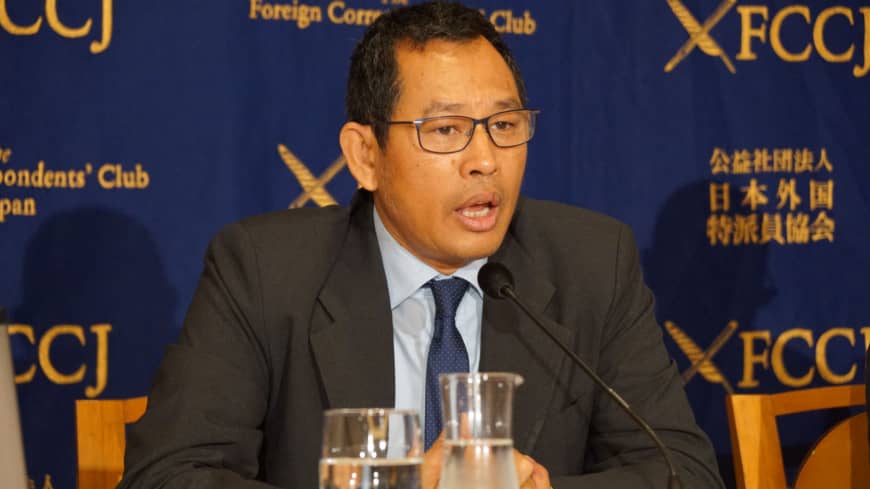 A Buddhist humanist from Burma (Myanmar), Maung Zarni, nominated for the 2024 Nobel Peace Prize, is a member of the TRANSCEND Media Service Editorial Committee, of the TRANSCEND Network for Peace Development Environment, former Visiting Lecturer with Harvard Medical School, specializing in racism and violence in Burma and Sri Lanka, and Non-resident Scholar in Genocide Studies with Documentation Center – Cambodia. Zarni is the co-founder of FORSEA, a grass-roots organization of Southeast Asian human rights defenders, coordinator for Strategic Affairs for Free Rohingya Coalition, and an adviser to the European Centre for the Study of Extremism, Cambridge. Zarni holds a PhD (U Wisconsin at Madison) and a MA (U California), and has held various teaching, research and visiting fellowships at the universities in Asia, Europe and USA including Oxford, LSE, UCL Institute of Education, National-Louis, Malaya, and Brunei. He is the recipient of the “Cultivation of Harmony” award from the Parliament of the World’s Religions (2015). His analyses have appeared in leading newspapers including the New York Times, The Guardian and the Times. Among his academic publications on Rohingya genocide are The Slow-Burning Genocide of Myanmar’s Rohingyas (Pacific Rim Law and Policy Journal), An Evolution of Rohingya Persecution in Myanmar: From Strategic Embrace to Genocide, (Middle East Institute, American University), and Myanmar’s State-directed Persecution of Rohingyas and Other Muslims (Brown World Affairs Journal). He co-authored, with Natalie Brinham, Essays on Myanmar Genocide.
Tags: Activism, Armageddon, Engaged Journalism, International Law, Journalistic Ethics, Peace Journalism, Truth, WWIII, Warfare
This article originally appeared on Transcend Media Service (TMS) on 9 Mar 2026.
Anticopyright: Editorials and articles originated on TMS may be freely reprinted, disseminated, translated and used as background material, provided an acknowledgement and link to the source, TMS: International Law, Peace Journalism, Incendiary Truths, is included. Thank you.
If you enjoyed this article, please donate to TMS to join the growing list of TMS Supporters.

This work is licensed under a CC BY-NC 4.0 License.
Join the discussion!
We welcome debate and dissent, but personal — ad hominem — attacks (on authors, other users or any individual), abuse and defamatory language will not be tolerated. Nor will we tolerate attempts to deliberately disrupt discussions. We aim to maintain an inviting space to focus on intelligent interactions and debates.