


‘I Felt I Was a Monster’: IDF Soldiers Talk about the ‘Moral Injury’ – and the Silence
PALESTINE ISRAEL GAZA GENOCIDE, 20 Apr 2026
Tom Levinson | Haaretz - TRANSCEND Media Service
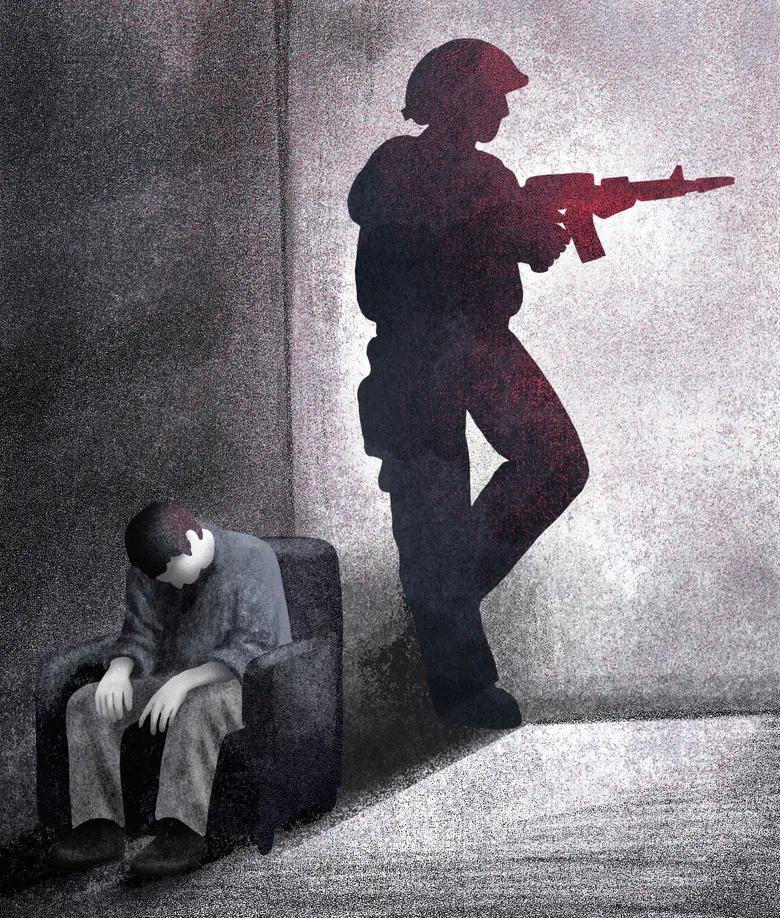
Illustration: Shumisat Rasulaeva
Some of them killed civilians in Gaza; others just looked on, or witnessed abuse and cover-ups in the name of revenge. Now they’re trying to cope with something a bit different than PTSD.
17 Apr 2026 – Yuval sits biting his nails, his legs fidgety. It’s noon in Tel Aviv and the street is full of people. Sometimes he looks around, anxiously scanning the people passing by. “Sorry,” he says. “My biggest fear is a vendetta.”
But Yuval (an alias, as are all the names in this article) wasn’t born into a crime family. And he’s not a criminal. He’s 34, grew up in the Tel Aviv suburb of Ramat Hasharon, and became a computer programmer. Until recently, he worked at one of the world’s biggest high-tech companies, but he hasn’t gone there for months. “I was in hell, but I wasn’t aware of it,” he says.
The hell he’s talking about took place in Khan Yunis in southern Gaza back when he was a soldier in December 2023. “There were airstrikes all the time. A one-ton bomb falls not far from you and makes your heart jump.”
His unit was moving west toward the center of the city. “There was heavy fighting. … You function on autopilot. You don’t ask questions,” he says.
The questions will only come and haunt him months later. “I don’t have good answers; I don’t have any answers at all. There’s no forgiving what I’ve done. No atonement.”
It happened near Salah al-Din Road, Gaza’s main highway. Using a drone, one platoon noticed suspicious figures. Yuval’s unit charged. “I was firing like a madman, like they teach you in platoon drills in basic training,” he says.
“When we got to our destination, I realized that these weren’t terrorists. It was an old guy and three boys, maybe teenagers. Not one of them was armed. But their bodies were riddled with bullets; their organs were pouring out. I had never seen anything like that so close up.
“I remember there was silence; nobody uttered a word. Then the battalion commander came over with his people and one spat on the bodies and yelled, ‘This is what happens to anybody who messes with Israel, you sons of bitches.’ I was in shock, but I kept quiet because I’m a loser, just a gutless coward.”
Yuval was discharged about three months later. He took two weeks off and went back to his job. “They threw a party for me when I was discharged, applauded me and called me a hero,” he says. “But I felt I was a monster. I couldn’t bear the things they said to me. I felt they didn’t realize that I wasn’t a good person; just the opposite.”
For a few months he tried to hang on to his job, to escape the weight on his heart, but he gave up. The sense of shame has only gotten worse.
“I try not to leave the house, and if I do, I wear a hoodie so people can’t recognize me,” he says. “I even threw the mirrors out. I can’t bear to look at myself. I have a deep fear that somebody will take revenge on me for what I’ve done, even though I realize that this is impossible. Who in Gaza can find me? Who even knows it’s me?
“Maybe in some way I want to die, to get it over with. I don’t kill myself because I promised my mother, but I admit I don’t know how long I can keep it up.” Two days after speaking with Haaretz, Yuval was hospitalized in a psychiatric ward.
Last year, Haaretz reported on soldiers who fought in Gaza and suffered “moral injuries.” A sniper who shot people seeking aid said he was experiencing severe nightmares; drone operators who killed civilians described the scars that won’t heal.
“We’re seeing moral injuries of a much greater extent than ever before,” says Prof. Gil Zalsman, head of Israel’s National Council for the Prevention of Suicide. “We’ve been seeing it at our trauma clinics and at private clinics. We’ve even been seeing it in reservists’ children who heard some story and are troubled about what their fathers have done. It has been reaching the second tier.”
The Israeli military and government haven’t provided any figures, but since October’s cease-fire in Gaza, the number of people seeking help for moral injuries is on the rise, Zalsman says. Sometimes these patients are classified as suffering from post-traumatic stress disorder, but, despite some overlap, moral injury is something different.
According to Prof. Yossi Levi-Belz of the University of Haifa, “PTSD is a fear-based reaction caused by exposure to a traumatic incident that involved risk for the person or for people around him.” Typical symptoms include over-excitement and avoidance.
“Moral injury happens due to exposure to incidents that are perceived as a fundamental violation of basic moral values – of oneself or of others – and typically involves feelings of guilt, shame, rage, disgust, alienation, loss of faith and a breakdown in identity, meaning and a sense of humanity.”
Then there’s the question of timing, says Levi-Belz, who heads the university’s Lior Tsfaty Center for Suicide and Mental Pain. “When a war is over, the soldier comes back home and the world suddenly seems much more complex,” he says.
“The distinction between black and white has been broken, the world is no longer dichotomous, and he can look back at events he went through and realize that things happened that conflict with what he believes in.”
Moral injury, Levi-Belz adds, may happen when someone does something, or witnesses something, that flagrantly violates his or her moral code. The severity of the injury could be greater when the person didn’t try to stop the other person, and when that other person was an authority figure.
“We expect parental figures, like commanders, to protect us, so in such cases the injury could cause a grave crisis and particularly hard mental anguish,” Levi-Belz says.
Terror at the Prado
Maya lives in central Tel Aviv and studies philosophy, especially the writings of Michel Foucault. During the Gaza war she served hundreds of days as an HR officer in an Armored Corps battalion in the reserves.
“There’s no connection between my daily life and my reserve duty,” she says. “They’re two different worlds, with different people. And, to be honest, I also behave differently, talk differently. It’s a little bit like Dr. Jekyll and Mr. Hyde.
“During the war, I was exposed to the killing of innocent people – shocking things that, if I had read about them in Haaretz, I would have cried out, but in reserve duty they went by me as if they were nothing.”
One incident did leave a scar. It happened at an army outpost in southern Gaza. “I was sitting there in the command room,” Maya says. “Suddenly, the soldiers on watch noticed five Palestinians crossing the line they weren’t allowed to cross, heading for northern Gaza.
“Everybody went crazy. There was a big mess. The battalion commander gave an order to overwhelm them with fire, even though they hadn’t been confirmed as armed or anything like that. A tank started shooting at them with its machine gun. Hundreds of bullets.”
She says four of the five Palestinians were killed. “A few hours later, a D9 [Caterpillar armored bulldozer] buried them in the sand. When I asked why, they said that it was so the dogs wouldn’t eat them and spread disease. The one who survived was put in a cage at the outpost, and they said we had to wait for a Shin Bet man to interrogate him.”
But no interrogator from the Shin Bet security service came that day. “I spent the night at the outpost but couldn’t fall asleep; I was the only girl there. Suddenly, a few soldiers called me, so I went with them to the cage. The Palestinian sat there, cuffed and blindfolded, and seemed to be freezing from the cold.
“Suddenly, one of the soldiers took out his penis and started pissing on him. He told him, ‘This is for Be’eri, you asshole, this is for Nova'”– Kibbutz Be’eri and the Nova music festival, two of the sites attacked by Hamas on October 7, 2023. “Nobody could stop laughing. I might have laughed too.”
A Shin Bet interrogator arrived the next day. “He was with him for 10 minutes and said it was just some guy trying to get back home to northern Gaza, that he had nothing to do with Hamas, so they let him go,” says Maya, who was discharged a few weeks later. But what she saw stayed with her.
“I felt like a hypocrite, dirty. I would take three showers a day; the image of his helplessness wouldn’t leave me. Thoughts gnaw at me constantly – how could I just stand there and do nothing? How could I, somebody who acts all moral and volunteers with refugees and goes to protests, agree to go along with it? How did I not say anything to them, and what does that say about me? I don’t have an answer.”
Maya isn’t the only person from that outpost suffering a moral injury. Yehuda also served there, at a different time, during his reserve duty. “My platoon was on [army] Hummers and served as a kind of first response squad for the sector,” he says.
“There was also a Hummer under the command of an officer with an American name. He had been serving there for many months, and whenever a brigade left there, he simply teamed up with the next brigade. He was a strange guy; dubious.
“Whenever he was asked about his background, he would say something else, and if you questioned him, he’d get mad. It wasn’t clear if he had gotten screwed up by the war or if he was like that before, but he got the job done, so nobody asked any questions.”
One night, a Palestinian managed to get near the outpost. “We set off on two Hummers,” Yehuda says. “I commanded one of them and the American officer the other. We got to the Palestinian and he immediately held up his hands. It was obvious he was unarmed. The officer came near him, waited a few seconds and just fired – without asking questions, without the suspect doing anything.
“I was in shock. We then went back to the outpost, and I went into the war room and, with a few officers, watched what had been recorded from the air by drone.
“‘This is murder, just murder,’ one of the older officers said, but they decided to do nothing; they just swept it under the rug. They reported to brigade HQ that a terrorist had been killed. There wasn’t even a debriefing. This officer went on serving as if nothing had happened, and I didn’t say anything to him. Nobody mentioned it even in the processing we underwent at the end of our service, as if it never happened.”
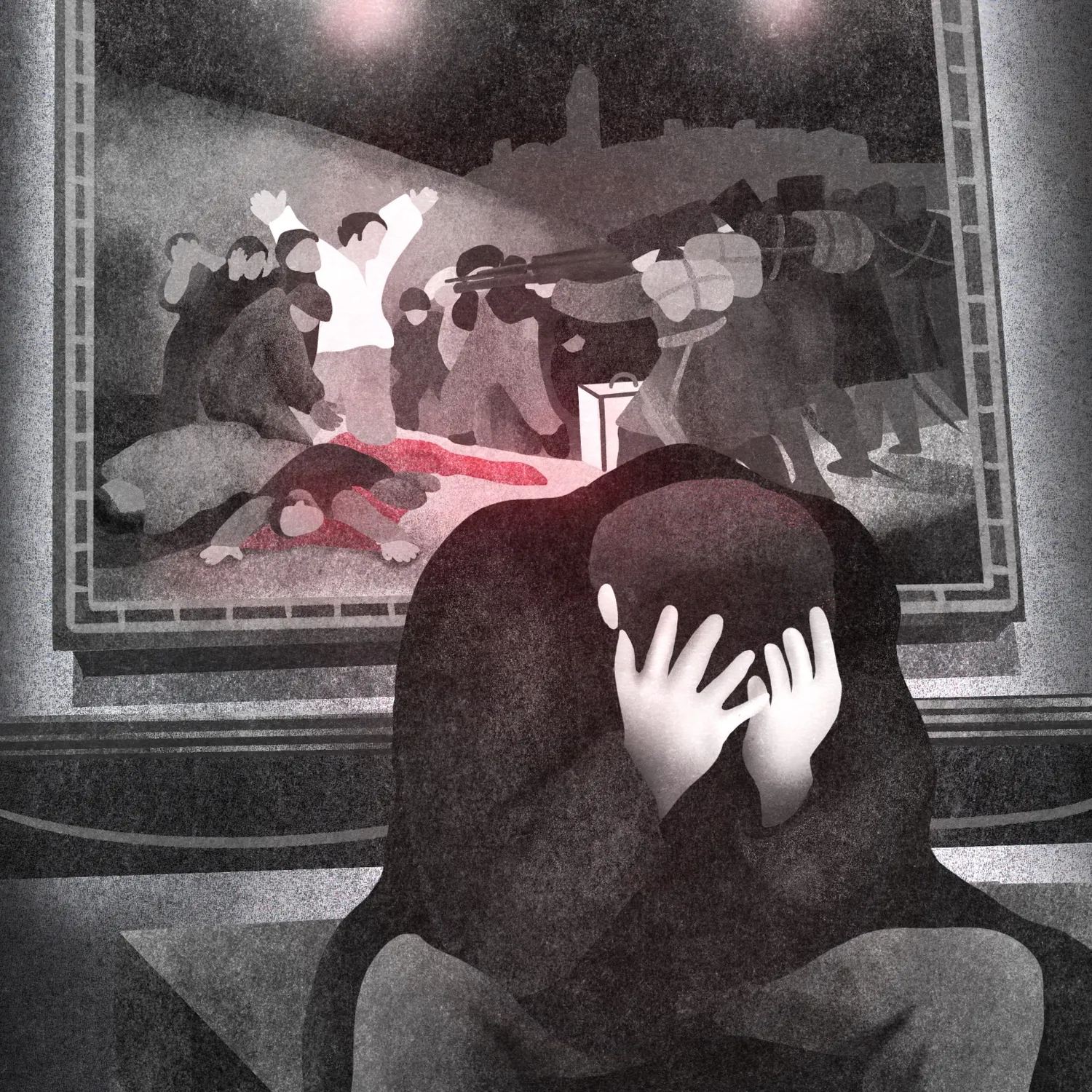
Two months later, Yehuda traveled with his wife to Madrid. One day they visited the Prado Museum; she’s a doctoral student in art, a subject Yehuda says he knows nothing about. He suddenly found himself facing a painting by Goya.
“I wasn’t particularly interested, but suddenly I was standing next to a painting of his that shows a helpless guy holding his hands up in front of soldiers with rifles,” Yehuda says. “I came closer to the painting, and it reminded me exactly of what had happened. The look in his eyes, the fear, the terror.
“I felt I couldn’t stop looking. I began to sweat. It was horrible, and then, out of nowhere, I started to cry. I never cry and I couldn’t understand what was happening to me.
“My wife looked at me and stressed out. She asked, ‘What happened? What happened?’ – and I didn’t know how to answer her. I was shattered. People couldn’t stop looking at me. Try explaining why you break down in tears in the middle of a museum?'”
That night, Yehuda promised his wife that he would seek therapy when they got back to Israel. “I’m trying to learn to accept it, but it’s hard,” he says. “The shame won’t leave me. How did I become somebody who stands by and doesn’t do the right thing?”
Memories from the interrogation room
Some soldiers say their moral injury stems from methods employed in the fighting in Gaza, many of them first reported by Haaretz. Several snipers from the Nahal Brigade, for example, shot Palestinians seeking aid; they had crossed the arbitrary line set by the army.
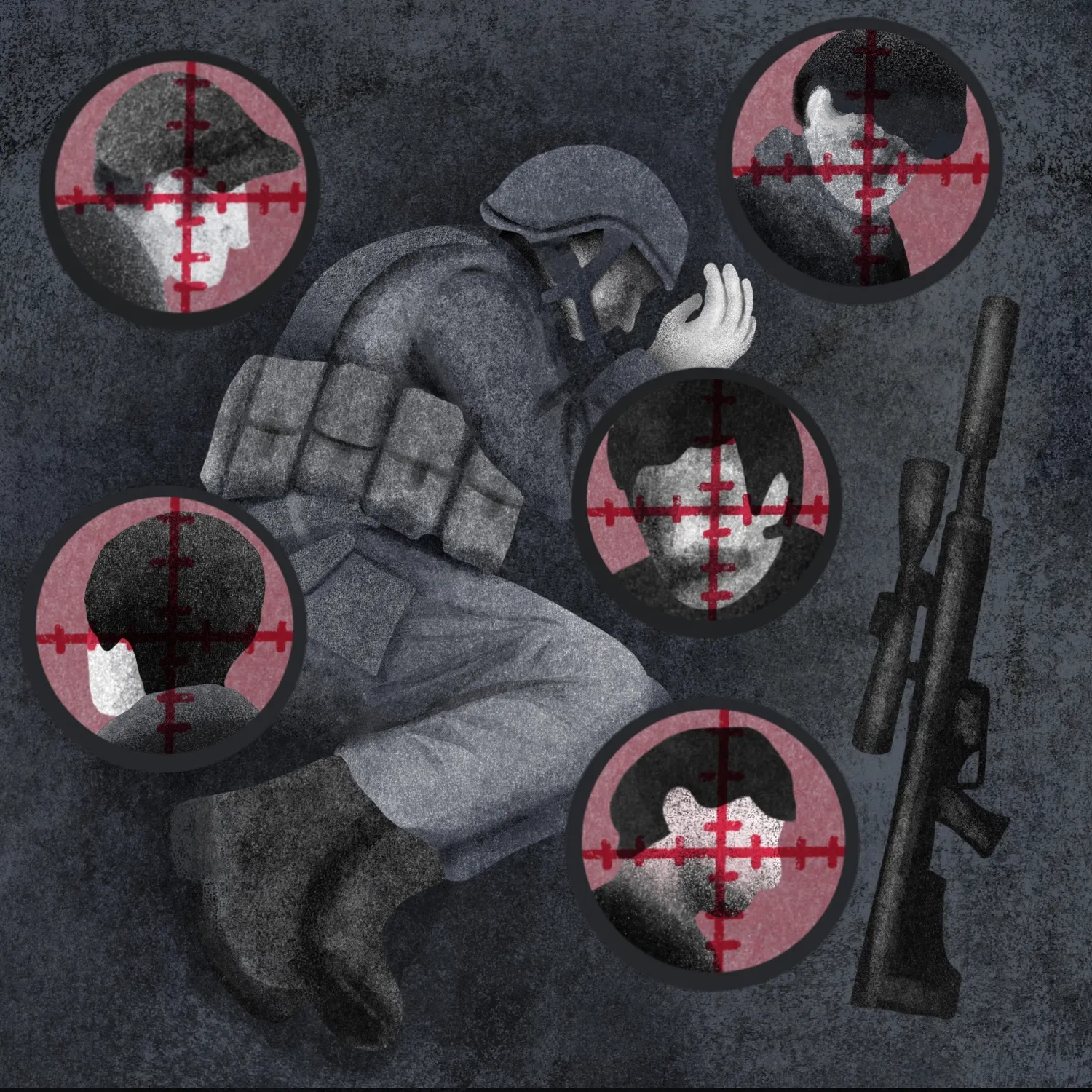
“When you shoot through a sniper’s scope, everything seems close, like in a computer game,” one of them says. “You don’t forget the faces of the people you’ve killed. It stays with you.
“Ever since my discharge, I keep wetting myself at night; I feel like I’ve been left alone, that nobody can help me. I spent a month in the hospital. They tried to explain to me that I had to accept it, that you can’t turn back the clock. Easy for them to say. They aren’t the people who, whenever they close their eyes, see somebody taking a bullet in the forehead.”
Some soldiers speak of mental injuries after seeing Palestinians used as human shields, or after witnessing looting or vandalism. “We would go into Palestinian homes and people would just take pleasure in destruction,” one of them says.
“I’ve seen people taking electric appliances, gold necklaces, cash, everything. Some would say that all Arabs were Nazis and that it’s a blessing to steal from Nazis. I was disgusted, but I didn’t say anything. It particularly pained me when people would burn photos of Palestinians or pee on them. What good is that?
“Once, a soldier noticed that I wasn’t comfortable with it and said, ‘What’s with you? They aren’t coming back here anyway; their story is done.’ I didn’t reply; I just nodded.”
Then there were the operations of Unit 504, one of whose jobs was to interrogate prisoners. “We were in action in northern Gaza and caught a Hamas operative in one of the houses. We got an order to guard him until the 504 interrogator showed up,” Eitan recalls.
“They always move in pairs – an interrogator and a combat soldier. When they arrived, we were standing guard at the entrance to the house, and I could hear and see the entire interrogation.”
Eitan says that, at one point, the interrogator took off the prisoner’s pants and underwear. “He took a couple of cable ties and attached one to his penis and one to his balls. He asked him a question, and when he didn’t answer he pulled the cable ties tighter.
“They repeated it over and over; there was crazy yelling. He never stopped yelling, as if his soul were leaving his body. In the end, he talked; everything came pouring out, and the interrogator removed the cable ties and put him in a truck. They must have taken him to detainment.”
Ever since, Eitan says, the yelling won’t go away. “It shattered everything I thought about the army, everything I thought about us, about me. If we’re capable of doing something so terrible without civilians knowing it, what else is going on in the cellars? What other secrets are we hiding?”
The experts say that such psychological injuries could also happen to people exposed to the fighting from a distance. Ran, for example, didn’t serve a single day in Gaza. He was an air force officer in the reserves at defense headquarters in Tel Aviv, in a unit responsible for planning airstrikes.
“After October 7, everything changed,” he says. “Everything I knew about collateral damage was thrown away. We would plan and get approval for strikes that we knew would involve the death of dozens of civilians, sometimes more. And that made no difference. My cousin was murdered at Nova. I was blinded by revenge and rage, taken over by them.
“What happened was disproportionate. As the days passed, this began to weigh heavily on me. One moment we were planning a strike in which children would die, and the next we were sitting down for a hamburger on Ibn Gabirol [a main street in Tel Aviv]. It’s a dissonance that you can’t restrain, and I felt that a mark was beginning to form on my forehead.”
The moment of crisis, he says, came on March 18 last year, when Israel breached a cease-fire with Hamas and launched a night of airstrikes. Hundreds of people were killed, mostly civilians.
“I couldn’t be part of this anymore, I felt that if I went on serving, I’d be betraying any of the good that was still in me, the person I want to be,” Ran says. And he’s not alone. Several pilots asked to be relieved of their duties after so many civilians were killed that night. The air force agreed but asked the pilots to keep it quiet.
Ran went back home but couldn’t go back to his job. “I developed this kind of obsession to look at the worst pictures of dead and wounded Palestinians,” he says. “I keep trying to reconstruct whether I had something to do with it, if I’m responsible for these images.
“My psychologist has been telling me that it sounds like I’m choosing to torture myself. He asked me to stop, but I can’t. I feel I have this coming.”
Of morals or of identity
Officially, the Defense Ministry doesn’t recognize the diagnosis of a moral injury, which, experts note, hasn’t yet found its way into the American Diagnostic and Statistical Manual of Mental Illness, the DSM. So a soldier suffering from moral injury will approach the ministry’s Rehabilitation Department, go through a medical committee and be recognized as suffering from PTSD. While sometimes these two afflictions overlap, they’re fundamentally different.
The problem with a misdiagnosis is more than a question of semantics. Treatment, says Zalsman of the National Council for the Prevention of Suicide, is also fundamentally different. “PTSD is treated by extensive, gradual exposure to the trauma, with the goal to try to separate the traumatic memory from the emotional response,” he says.
“Moral injury requires goal-oriented work on acceptance and making peace with the deed that caused the crisis. In other words, the person needs to learn to forgive himself.”
But this may soon change. The public committee set up in October to seek solutions for the treatment of disabled soldiers is expected to recommend that the Rehabilitation Department recognize moral injury.
According to a subcommittee, “Treatment protocols must be developed, caregivers and rehabilitation personnel must be trained, and attention must be given to the direct link between moral injury and employment, contribution and a role in the community.”
The army also decided quietly to recognize the phenomenon, however late; the U.S. military, for example, has had treatment protocols for mental injuries for years now. In recent months, and practically in the shadows, Israeli mental health professionals have been crafting an initial intervention protocol for soldiers suffering from moral injury.
The IDF Spokesperson’s Unit hasn’t released a statement on the issue and the entire matter has been kept under wraps, unlike many other steps by the army for soldiers’ mental health during the war. The IDF even refused to call this mental phenomenon “moral injury,” preferring the term “injury of identity.” The military denied that there was any hidden agenda behind the name change.
But sources say something else. “It’s pretty obvious that a sociopolitical statement is being made here,” says a mental health officer in the reserves. “After all, if we recognize that many soldiers are suffering from moral injuries, how does this fit with the cliché about the most moral army in the world? So, instead, they chose a phrase that shifts responsibility to the soldier, as if there were a problem with his identity rather than the actions his leaders sent him to perform.”
Another officer in the military’s mental health system said the decision was “to find an interim solution that would allow these soldiers to get treatment without infuriating politicians. I was present at a meeting where a senior officer said, ‘We can’t call them moral injuries; do we need Channel 14 to hang us from a tree?'” the officer says, referring to the TV station partial to Prime Minister Benjamin Netanyahu. “This is the current mood in the army.”
It’s not just the military that has refused to take a direct look at moral injuries; so do many soldiers. They’re afraid to tell their friends about their feelings, fearing they’ll be branded as traitors, leftists or weaklings. “This used to happen with PTSD, and today it’s moral injuries,” says Levi-Belz of the University of Haifa.
“This isn’t just on the level of the junior commander, brigade commander or even the chief of staff, but throughout society. The government is telling a story that’s a dichotomy: You’re either with us or you’re a leftist traitor, and this has mainly been affecting young guys.
“A soldier may be concerned that, if he says he has doubts about what they did in Gaza, he could be perceived by the team as an outsider who needs to be kicked out. To that soldier, this could be the worst thing that could happen, a sense of complete rejection. So, in many cases, they’ll prefer not to talk about it and not seek help.”
Guy, for example, still refuses to share his feelings with other soldiers. He’s in the Shaldag special forces unit. Since October 7, he has done hundreds of days of reserve duty. In fact, at noon on that terrible Saturday, he was called up and told to head to Be’eri. The things he had failed to prevent there began to haunt him.
“I’m carrying heavy blame, and I think there are a lot like me, but they just decided to channel it somewhere else – to revenge,” Guy says. “Their eyes would shine whenever we went out on an assignment.
“When there was talk about all the terrorists getting killed by the special means the unit used in the tunnels, people were excited, while I was reminded of the Holocaust. This shocked me, but I went on serving. I thought maybe it would pass.”
One operation was at Al-Shifa Hospital in Gaza. “The entire area smelled of death, of bodies,” he says. “Ever since, I can’t bear the smell of burned meat. I became a vegetarian.
“I actually remember the moment when the other shoe dropped, when the smell reminded me of what I smelled at Be’eri. That made me wonder – what have we become? What have I become? To this day, I’m afraid to answer that.”
Tags: Crimes against Humanity, Gaza, IDF, Israel, Military, Palestine, Post-Traumatic Stress Disorder (PTSD), Trauma, War crimes
JOIN THE BDS-BOYCOTT, DIVESTMENT, SANCTIONS CAMPAIGN TO PROTEST THE ISRAELI BARBARIC GENOCIDE OF PALESTINIANS IN GAZA.
DON'T BUY PRODUCTS WHOSE BARCODE STARTS WITH 729, WHICH INDICATES THAT IT IS PRODUCED IN ISRAEL. DO YOUR PART! MAKE A DIFFERENCE!
7 2 9: BOYCOTT FOR JUSTICE!
DISCLAIMER: The statements, views and opinions expressed in pieces republished here are solely those of the authors and do not necessarily represent those of TMS. In accordance with title 17 U.S.C. section 107, this material is distributed without profit to those who have expressed a prior interest in receiving the included information for research and educational purposes. TMS has no affiliation whatsoever with the originator of this article nor is TMS endorsed or sponsored by the originator. “GO TO ORIGINAL” links are provided as a convenience to our readers and allow for verification of authenticity. However, as originating pages are often updated by their originating host sites, the versions posted may not match the versions our readers view when clicking the “GO TO ORIGINAL” links. This site contains copyrighted material the use of which has not always been specifically authorized by the copyright owner. We are making such material available in our efforts to advance understanding of environmental, political, human rights, economic, democracy, scientific, and social justice issues, etc. We believe this constitutes a ‘fair use’ of any such copyrighted material as provided for in section 107 of the US Copyright Law. In accordance with Title 17 U.S.C. Section 107, the material on this site is distributed without profit to those who have expressed a prior interest in receiving the included information for research and educational purposes. For more information go to: http://www.law.cornell.edu/uscode/17/107.shtml. If you wish to use copyrighted material from this site for purposes of your own that go beyond ‘fair use’, you must obtain permission from the copyright owner.
Join the discussion!
We welcome debate and dissent, but personal — ad hominem — attacks (on authors, other users or any individual), abuse and defamatory language will not be tolerated. Nor will we tolerate attempts to deliberately disrupt discussions. We aim to maintain an inviting space to focus on intelligent interactions and debates.
Read more
Click here to go to the current weekly digest or pick another article:
PALESTINE ISRAEL GAZA GENOCIDE: