


Forgeries about World War II in Yugoslavia (III)
BALKANS AND EASTERN EUROPE, 8 Jun 2026
Vladislav B. Sotirovic – TRANSCEND Media Service
The goal of General Dragoljub Draža Mihailović and his royalist Chetniks was the restoration of the pre-war socio-political order and monarchy in Yugoslavia – the status quo ante bellum.
Actual truth:
Basically, this claim, i.e., communist propaganda-psychological platitude, is incorrect, but it was of primary importance for the communists in their psychological-propaganda war against the old regime of the Kingdom of Yugoslavia. This regime was presented in propaganda as socially unjust, economically exploitative, nationally Greater Serbian, and morally rotten, so that all political movements and social forces that would advocate and fight for the restoration of this system ad hoc should be condemned to failure by the majority of the people. On the other hand, in addition to the formal struggle for the liberation of the country from the foreign occupier, the political commissars with their assistants in the partisan units as well as the entire Communist Party of Yugoslavia (CPY) platitudely propagated to the people a paradise on earth in every respect in the event of their coming to power, and as a sine qua non for such general progress a radical change of the old regime was required, i.e., in fact, its comprehensive replacement with a completely new one that would be, above all, supposedly just, progressive, efficient, and prosperous. So, the communists offered the people something new instead of the already tried and tested old one. That the old regime was far from ideal was true, but that the new communist regime would be any better than the old one remained to be seen, i.e., felt.
However, the whole point of the communist propaganda-psychological strategy for coming to power was to win over as many ordinary people as possible during the war, who were the most susceptible to communist propaganda because they essentially wanted changes for the better, that is, to their own benefit. With this mass of people who wanted changes, power would be seized and, of course, a totalitarian dictatorship modeled after the USSR would be introduced, which would never be overthrown. Until then, there had been only one communist country in the world (besides Mongolia) – the USSR, but about which the people knew nothing and which the Yugoslav communists enthusiastically praised, exalting it to the heavens, without even knowing much about it themselves. So, the bet was that ordinary people, especially the poor, and especially those who were left without a home during the war, would logically support communist experiments with the state, economy, and social reorganization because they simply had nothing to lose and they were offered a lot in propaganda. Therefore, it was of utmost importance for the communists to portray themselves, both during and after the war, as fighters for something new, and the Ravna Gora Chetniks (the Yugoslav Army in the Motherland – YAM) for the restoration of the old, under the tactical-psychological assumption that the new always means something that is better and more advanced than the old and that therefore needs to be replaced by the new.[1]
It must be emphasized here that the restoration of the old order of the Kingdom of Yugoslavia was indeed the original motivation of the Ravna Gora movement of General Mihailović for the simple reason that any violent attempt by the occupiers to change that system was considered unacceptable, i.e., undemocratic. However, the Ravna Gora ideologists, together with Draža Mihailović himself, even before the start of the civil war by Broz’s communists (in late summer 1941 in Western Serbia), also sharply criticized that same old regime in political, moral, social, and even national terms. First of all, the act of the leading politicians of Yugoslavia fleeing the country in April 1941 was considered to be extremely immoral[2] and that the structure of the entire state system of pre-war Yugoslavia led to its rapid collapse in the April War, which was based both on (Croatian) betrayal and on the country’s unpreparedness to defend itself for a longer period of time (Greece managed to defend itself for almost a whole month, unlike Yugoslavia, which managed to do so in only ten days). Therefore, unlike communist post-war propaganda, from the very beginning of the war, i.e., the occupation by foreign powers and the fight for the liberation of the country, the political leadership of the Ravna Gora movement was aware that after the war the state-political-economic system of the country must in some way change, i.e., improve, with one indisputable point that post-war Yugoslavia must in any case be a monarchy (kingdom) with the legitimate Karađorđević dynasty on the throne.
The fact is that the political orientation of Draža Mihailović’s Ravna Gora movement evolved, and drastically so, during the war, given that Ravna Gora movement’s awareness of the need for social and political change grew during the war itself, partly thanks to the propaganda and ideological pressure of the communist side, whose aggressive propaganda performance managed to win the sympathy of a certain number of people among the broad masses of the people, but almost exclusively across the Drina river, i.e., in the areas of the Independent State of Croatia. The top representatives and delegates of the Ravna Gora movement publicly presented the final form of the new post-war structure of Yugoslavia at its St. Sava Congress in the village of Ba in Western Serbia in January 1944, which was also a concrete response to the decisions of the communist so-called Second Session of AVNOJ (Anti-Fascist Council of People’s Liberation of Yugoslavia) held on November 28−29, 1943 in the Bosnian town of Jajce on the territory of Nazi Independent State of Croatia, during the night.
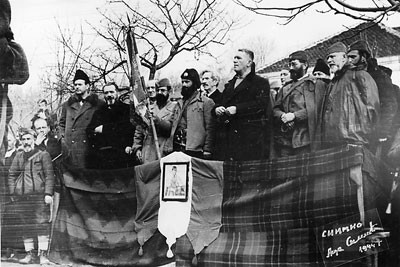
The St. Sava Congress of the Ravna Gora Movement was held in the village of Ba on January 28, 1944 (when decisions were made and adopted), in Suvobor (the entire work of the Congress lasted from January 25 to 28), in the ceremonial hall of the local elementary school during daylight hours, unlike the night and midnight session of the communists in Jajce in November 1943. The Congress, consisting of over 300 delegates, was the most significant political gathering of the Ravna Gora Movement during the entire war, at which the final program on the post-war internal organization of the new Yugoslavia was adopted.[3] The fundamental decision of the Congress in the village of Ba was to reorganize post-war Yugoslavia on a federal basis so that it would be composed of three federal units – Slovenia, Croatia, and Serbia (as opposed to the communist variant of the federalization of Yugoslavia based on six federal republics, three of which would secede from the Serbian ethnolinguistic corpus). Yugoslavia would be a kingdom under the Karađorđević dynasty, as opposed to the communist republican variant under the lifelong presidency of Josip Broz Tito.
This Ravna Gora movement’s federalist orientation of post-war Yugoslavia was, in fact, under the crucial influence of the Yugoslav government in exile in London. Thus, the president of this government, Prof. Slobodan Jovanović of Belgrade University, informed Draža Mihailović as early as December 1942 (i.e., more than a year before the Congress in the village of Ba was held) that post-war Yugoslavia had to be reorganized on federalist principles for, as he explained, two reasons: 1) to please the Croats (and this after the Croatian magnum crimen!)[4] and 2) in order to protect Serbs from new crimes like those of 1941.[5] In principle, socio-economic reforms were also proclaimed to be done after the war, so that the future Yugoslavia, except for the monarchy, would not, in essence, resemble the pre-war Kingdom of Yugoslavia much. Of course, communist agitprop never presented the Yugoslav public with this essence of the post-war reforms proclaimed by the Ravna Gora movement, if for no other reason, and that for one simple reason, because the political system of post-war Yugoslavia of the Ravna Gora movement was based on the principles of multi-party parliamentary democracy, in contrast to the communist option of a one-party anti-parliamentary and anti-democratic dictatorship.
[1] For the first decade of “ideal” life in Tito’s Yugoslavia (Titoslavia), see: Алекс Н. Драгнић, Титова обећана земља Југославија [Tito’s promised land of Yugoslavia], Београд: Задужбина Студеница-Чигоја штампа, 2004.
[2] The case of King Peter II Karađorđević was an exception because he was practically taken from Yugoslavia as a minor in April 1941 against his will.
[3] Коста Николић, Историја Равногорског покрета 1941–1945. Књига друга [History of the Ravna Gora Movement 1941−1945. II vol.], Београд: Српска Реч, 1999, p. 426. It is important to point out here that after the Congress was held, a large number of its delegates were arrested, which practically means that the Congress itself was not held with the tacit approval of the Germans or General Milan Nedić (governor of occupied Serbia), i.e., that it was not collaborationist. Unlike the fate of the delegates of the Ravna Gora Congress in the village of Ba, after the communist AVNOJ congress in Jajce in 1943, not a single delegate was arrested, which points to the conclusion that it was held, as was the First Session of AVNOJ in November 1942 (in Bosnian town of Bihać), with the approval of the Nazi Ustashi regime in Zagreb, and that on the territory controlled by the Ustashi, which the communists unfoundedly declared after the war to be “free” territory, i.e., allegedly liberated by themselves. However, that territory around Bihać (in November 1942) and in the following year around Jajce (November 1943) was simply ceded to Tito’s Partisans for temporary use by the Ustashi.
[4] About Croatian magnum crimen-у see on the website: Бог и Хрвати [God and Croats] (http://bogihrvati.webs.com).
[5] Милан Весовић, Коста Николић, Уједињене српске земље. Равногорски национални програм [United Serbian Lands. National Program of the Ravna Gora Movement], Београд, 1996, p. 68.
__________________________________________

Dr. Vladislav B. Sotirovic is an ex-university professor and a research fellow at the Centre for Geostrategic Studies, Belgrade, Serbia. Email: sotirovic1967@gmail.com – www.geostrategy.rs
Personal disclaimer: The author writes for this publication in a private capacity which is unrepresentative of anyone or any organization except for his own personal views. Nothing written by the author should ever be conflated with the editorial views or official positions of any other media outlet or institution.
Tags: Yugoslavia
This article originally appeared on Transcend Media Service (TMS) on 8 Jun 2026.
Anticopyright: Editorials and articles originated on TMS may be freely reprinted, disseminated, translated and used as background material, provided an acknowledgement and link to the source, TMS: Forgeries about World War II in Yugoslavia (III), is included. Thank you.
If you enjoyed this article, please donate to TMS to join the growing list of TMS Supporters.

This work is licensed under a CC BY-NC 4.0 License.
Join the discussion!
We welcome debate and dissent, but personal — ad hominem — attacks (on authors, other users or any individual), abuse and defamatory language will not be tolerated. Nor will we tolerate attempts to deliberately disrupt discussions. We aim to maintain an inviting space to focus on intelligent interactions and debates.
Read more
Click here to go to the current weekly digest or pick another article:
BALKANS AND EASTERN EUROPE: