
The Man Who Stood Still
AFRICA, 6 Jul 2026
Fabio Vighi | Savage Minds - TRANSCEND Media Service
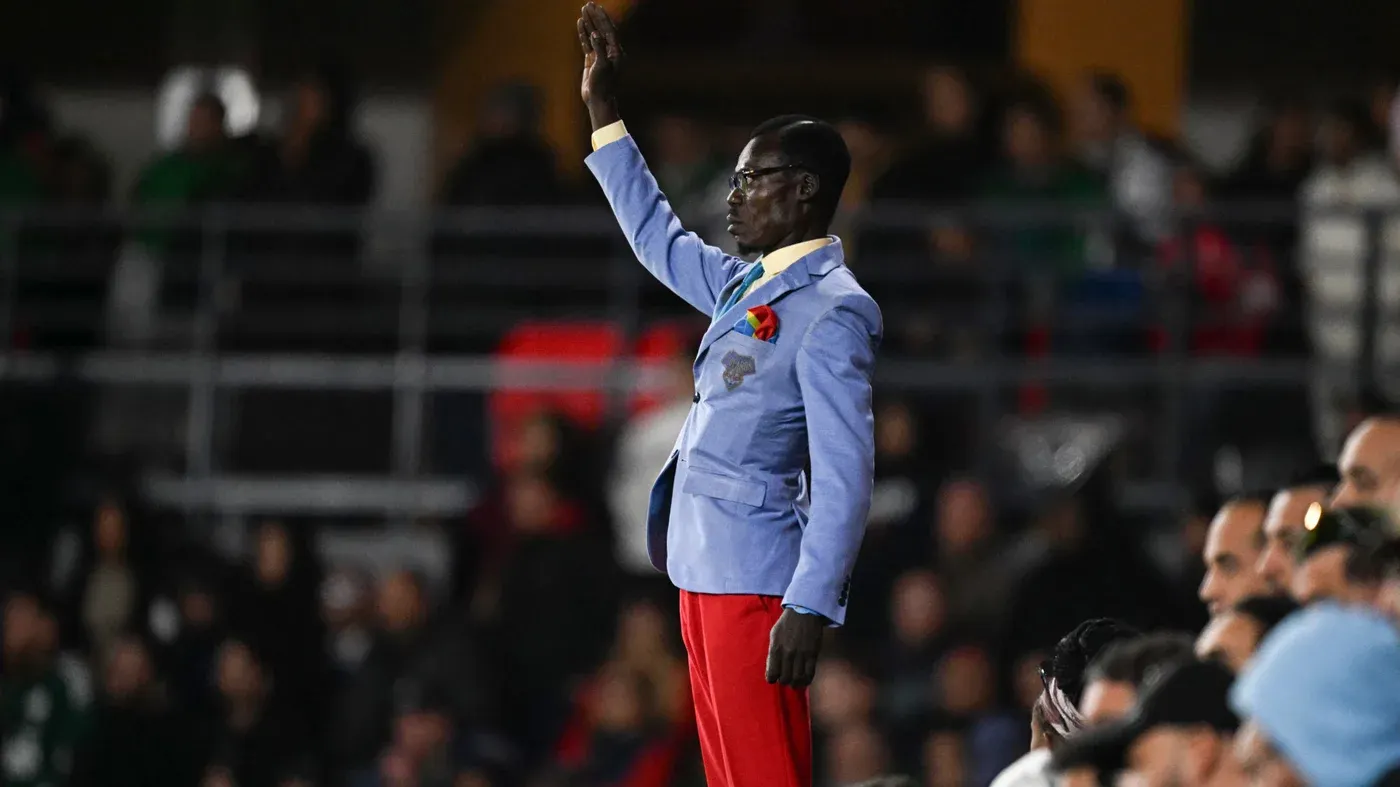
DRC supporter Michel Kuka Mboladinga pays tribute to Patrice Lumumba at the Prince Moulay El Hassan Stadium in Rabat, Morocco, on 6 Jan 2026.
Photo credit: Gabriel Bouys
Lumumba Lives—Congo, Capitalism, and the Violence of Empire
5 Jul 2026 – It is rare to witness stillness during football matches. Football, as a global commodity, belongs to the regime of perpetual movement. Bodies run; cameras pan, zoom, and replay in slow-motion; sponsors advertise; money circulates; attention is endlessly redirected. Everything conspires to keep us inside the flow of spectacle.
At a recent World Cup match, however, one man refused to participate in this moving choreography. As reported widely by the media, he stood completely still for ninety minutes. When the final whistle blew, he covered his mouth and raised two fingers to his temple in the shape of a gun. His name is Michel Kuka Mboladinga, better known as “Lumumba Vea” (“Lumumba Lives”). For more than a decade he has attended every DR Congo match in the same red suit and tie, one arm raised in tribute to Patrice Lumumba, the first Prime Minister of an independent Congo. In a world organised around perpetual circulation, stillness acquires unexpected force. It is meant to suspend the rhythm of spectacle just long enough for history to re-enter the frame.
On 30 June 1960, Lumumba stood before King Baudouin of Belgium and delivered an Independence Day speech that shattered the fiction of Belgian colonial benevolence. Instead of thanking the colonial power, he spoke of forced labour, racial humiliation and systematic violence. Six months later, he was dead.
The Details We Aren’t Supposed to Know
Let us be clear about what happened, because euphemism has become one of history’s preferred instruments of concealment. On 17 January 1961, Lumumba was flown to Elisabethville in the secessionist province of Katanga, and he was badly beaten during the flight. Upon arrival, he and his associates were tortured while Katangan authorities, together with Belgian officers, determined their fate. That evening, between 9:40 and 9:43 p.m., they were driven to an isolated clearing, lined up and executed by a firing squad under Belgian command. But the killing was not enough. The following day, the bodies were exhumed, dismembered and dissolved in concentrated sulfuric acid. The remaining bones were crushed and scattered. Gérard Soete, a Belgian police commissioner who took part in the operation (and died in 2000 without ever being prosecuted), kept at least two of Lumumba’s teeth as, according to his own testimony, “hunting trophies.” More than sixty years later, one of these teeth—the one with a gold crown—was retrieved and returned to his family.
In 2001, a Belgian parliamentary enquiry found that Belgium, the coloniser, was only “morally responsible.” The phrase belongs to the lexicon of liberal legality, where carefully chosen words soften or explicitly obfuscate well documented crimes. The historical record tells a different story. Belgian officials were deeply implicated in Lumumba’s capture, transfer, torture, execution and the subsequent destruction of his body. The CIA’s role was no less decisive. Under President Eisenhower, Lumumba’s “elimination” had already been authorised. Among the plans considered was the poisoning of his toothpaste. Although that plot was never carried out, the CIA station chief in the Congo gave his approval to Lumumba’s transfer into the hands of his executioners.
Why Was Lumumba Killed?
The answer is both simple and structural. Lumumba insisted that Congo’s immense mineral wealth should belong to the Congolese people rather than to foreign corporations and the powers that protected them. That was simply intolerable. Congo possessed—and still does—vast reserves of cobalt, copper, coltan, lithium, uranium and other strategic minerals. The uranium extracted from the Shinkolobwe mine, for example, supplied the Manhattan Project and helped to build the atomic bombs dropped on Hiroshima and Nagasaki. In the emerging Cold War, Western governments had no intention of allowing such resources to slip beyond their geopolitical orbit. Lumumba’s determination to exercise genuine sovereignty over them was enough to seal his fate.
Belgium’s interest was more immediate but no less significant, and part of the same framework: protecting the profits of Union Minière du Haut-Katanga and preserving effective control over Congo’s mineral wealth. The Katangese secession was the mechanism through which those interests were defended. The murder of Lumumba, then, was not an aberration of capitalism but one of its most revealing operations: political sovereignty became intolerable the moment it threatened the free movement of capital and the private appropriation of natural wealth.

The Return of Primitive Accumulation
Colonial plunder was never external to capitalism. Rather, it constituted its historical foundation. What we call “civilisation” was built on enslavement, expropriation, and genocide—a mechanism that, historically, persisted throughout modernity, beneath the surface of capitalist normality, receding only whenever expanded accumulation through wage labour could sustain the system’s reproduction. Today, that condition no longer holds.
What is returning today is not primitive accumulation in its original, historical form, but its elevation from exception to rule—direct expropriation as a systematic feature of “crisis capitalism” rather than a prelude. As capitalism loses its capacity to generate sufficient value through the exploitation of commodity-producing labour, direct expropriation once again becomes indispensable to its reproduction. While the exploitation of labour remains central, it no longer generates sufficient surplus value to support accumulation on the required scale. The gap is bridged through financial expansion, monetary creation, and the relentless extension of debt. Capital survives by multiplying claims on future value that it can no longer produce in the present. The consequence is not only “the financialisation of life” but a renewed dependence on direct appropriation of existing wealth through the systematic deployment of violence. Thus, what once appeared as capitalism’s brutal prehistory returns as one of its increasingly delusional conditions of possibility.
Furthermore, the reach of expropriation now extends well beyond territories, minerals, or labour power, increasingly colonising the very infrastructures of subjectivity itself: attention, desire, memory, behaviour, and data. Spectacle, in this context, is not a distraction from accumulation but one of its contemporary modalities—because before wealth can be extracted from us, our capacity to pause, reflect, and resist must first be stripped away. This is why the “attention economy” is not a cultural side-effect of contemporary capitalism, but one of its foundational infrastructures.
A Flickering Illusion
The “civilised” phase of capitalism—a privilege largely confined to the “Western core”—was always an historical exception. What appeared, especially in the post-war decades, as a stable order founded on welfare, parliamentary democracy and human rights was sustained by conditions that could not last. Social-democratic compromise was wrested from capital by organised labour, but it was also underwritten by the continued extraction of wealth from what came to be known as the “Third World.” The apparent domestication of capitalism never abolished violent expropriation. It merely displaced it geographically and ideologically.
The same was true of capitalism’s mounting monetary contradictions. For decades, the inflationary pressures generated by financial expansion and debt accumulation were largely displaced onto the peripheries of the world economy through unequal exchange, currency hierarchies, structural adjustment and the exorbitant privilege of reserve currencies. The imperial core could preserve the appearance of stability because others absorbed the cost.
That arrangement, too, is now unravelling. Structural inflation, financial instability and fiscal crisis are increasingly returning to the very economies that once externalised them. The geographical separation between prosperity and dispossession is becoming harder to sustain. As these forms of displacement reach their limits, the violence that sustained the system becomes increasingly visible. What once may have appeared exceptional now reveals itself as the ordinary logic of capitalist reproduction.
Gaza is not an exception; it is the paradigm: over a thousand days of genocidal destruction carried out with the diplomatic, military, and ideological support of the self-proclaimed “civilised world.” Lebanon is bombed with the same impunity. Venezuela, Cuba and Iran are subjected to forms of economic warfare designed to destroy societies (while also manipulating financial markets and monetary policy) without formally declaring war.
Meanwhile, in eastern Congo, the killing never stopped. Since 1998, millions have died in conflicts tied to the struggle over strategic minerals. Millions more have been displaced. The humanitarian catastrophe is treated as background noise simply because the extraction continues uninterrupted. Cobalt, coltan and copper leave the country; smartphones, batteries and profits return to the centres of global accumulation. Rather than an isolated crime, then, Lumumba’s murder was the announcement of a political logic that has since become ordinary—the ordinary logic of a collapsing civilisation in denial, barricaded behind its own systemic recourse to violence.
It is a bitter irony, then, that when DR Congo finally reached their first-ever World Cup knockout match—against England in Atlanta—Lumumba Vea could not be there. HisUS visa was denied, a bureaucratic echo of the same borders that have long kept the suffering of his country invisible to the world. A replacement stood in his place, as the original was stranded in Mexico, denied entry to the very country whose political machinery once helped kill the man he memorialises.
But at least he was there once, long enough for cameras to find him. And in that moment, the World Cup, for all its spectacle and commodification, gave us something beyond the flow of capital: a single motionless man whose silence invited us to think—if only for a moment.
_________________________________________________
Fabio Vighi – I am a scholar, writer, and public intellectual working at the intersection of political economy, cultural criticism, and psychoanalytic theory. My current writing focuses on crisis capitalism — its logic, contradictions, and cultural expressions.
Tags: Africa, D.R. Congo, Patrice Lumumba, Soccer, Sports
DISCLAIMER: The statements, views and opinions expressed in pieces republished here are solely those of the authors and do not necessarily represent those of TMS. In accordance with title 17 U.S.C. section 107, this material is distributed without profit to those who have expressed a prior interest in receiving the included information for research and educational purposes. TMS has no affiliation whatsoever with the originator of this article nor is TMS endorsed or sponsored by the originator. “GO TO ORIGINAL” links are provided as a convenience to our readers and allow for verification of authenticity. However, as originating pages are often updated by their originating host sites, the versions posted may not match the versions our readers view when clicking the “GO TO ORIGINAL” links. This site contains copyrighted material the use of which has not always been specifically authorized by the copyright owner. We are making such material available in our efforts to advance understanding of environmental, political, human rights, economic, democracy, scientific, and social justice issues, etc. We believe this constitutes a ‘fair use’ of any such copyrighted material as provided for in section 107 of the US Copyright Law. In accordance with Title 17 U.S.C. Section 107, the material on this site is distributed without profit to those who have expressed a prior interest in receiving the included information for research and educational purposes. For more information go to: http://www.law.cornell.edu/uscode/17/107.shtml. If you wish to use copyrighted material from this site for purposes of your own that go beyond ‘fair use’, you must obtain permission from the copyright owner.
Join the discussion!
We welcome debate and dissent, but personal — ad hominem — attacks (on authors, other users or any individual), abuse and defamatory language will not be tolerated. Nor will we tolerate attempts to deliberately disrupt discussions. We aim to maintain an inviting space to focus on intelligent interactions and debates.