
The Meaning of Tell, Nablus
PALESTINE ISRAEL GAZA GENOCIDE, 10 Aug 2026
Ramzy Baroud | Politics for the People – TRANSCEND Media Service
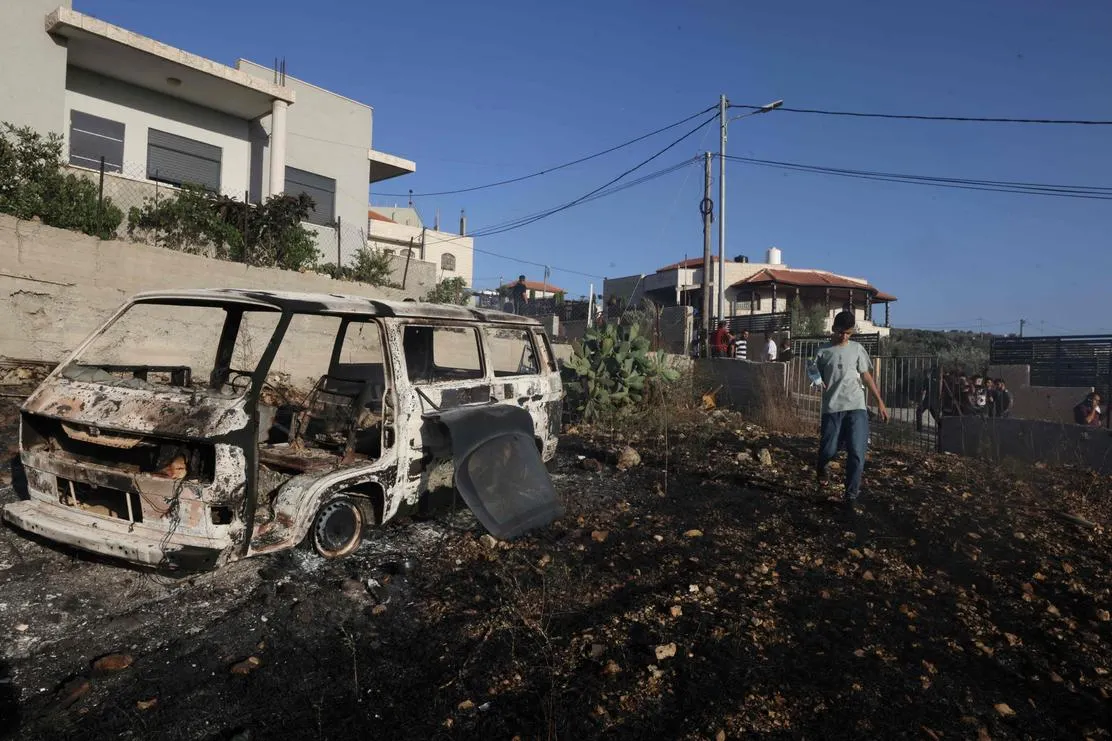
After an attack by Israeli settlers on the Palestinian village of Sarra, outskirts of Nablus, occupied West Bank, on 24 July 2026. Photo credit: Jaafar Ashtiyeh
Why the West Bank May Be Nearing a Breaking Point
6 Aug 2026 – The events in Tell, southwest of Nablus, were not an isolated act of violence. They were a warning.
For years, Israel has treated Palestinian villages in the occupied West Bank as open spaces for military raids, settler invasions, land theft and collective punishment. The expectation was that Palestinians would endure the violence, bury their dead and return to the same unbearable routine.
In Tell, however, that carefully maintained equation was briefly disrupted.
The confrontation began when armed Israeli settlers entered the area near the village, attempting to attack Palestinian homes. Villagers confronted them. Israeli soldiers and armed settlement personnel then intervened, transforming the settler attack into a broader military assault.
During the confrontation, a Palestinian man seized an Israeli weapon and opened fire. Two Israelis were killed, while four Palestinians from the Ramadan family were also killed. What followed was a sweeping campaign of punishment against the entire village.
Israeli forces sealed Tell, stormed many homes and interrogated scores of residents. More than 70 Palestinians were detained in the initial crackdown. The Israeli violence soon spread to surrounding communities, where armed settlers attacked homes, vehicles and set mosques on fire.
The meaning of Tell, therefore, does not lie solely in the number of dead. It lies in the fact that Palestinians, confronted by armed settlers and soldiers, refused to retreat.
Tell may or may not become the immediate spark of a broader uprising. But it revealed that beneath the outward appearance of Israeli control, the West Bank is reaching a breaking point.
Since the beginning of the genocide in Gaza in October 2023, Israel has transformed the West Bank into another major battlefield. More than 1,180 Palestinians have been killed, approximately 13,000 wounded and over 24,600 detained, including hundreds of women and nearly 2,000 children.
The assault is not limited to military raids. It is an integrated system involving the occupation army, armed settlers, military courts, settlement councils, demolition authorities and ministers who openly advocate annexation.
In 2026 alone, thousands of Palestinians have been displaced through settler attacks, demolitions and Israeli restrictions on Palestinian construction. By July, the rate of displacement had reached an average of 17 Palestinians every day—twice the daily average recorded during the previous three years.
Of course, none of this is random violence, but a deliberate policy.
Benjamin Netanyahu has effectively handed the West Bank to the most extreme elements of his coalition. Finance Minister Bezalel Smotrich has used his governmental authority to accelerate illegal settlement construction, legalize illegal outposts and transfer powers over occupied territory from the military administration to Israeli civilian institutions—a fundamental step toward formal annexation.
National Security Minister Itamar Ben-Gvir, meanwhile, has provided political protection to settler movements while repeatedly provoking Palestinians at Al-Aqsa Mosque.
In exchange, Netanyahu receives what he needs most: the continued survival of his government.
With Israel’s general election scheduled for 27 October, the West Bank is likely to become even more central to Netanyahu’s campaign. His political message to the Israeli right is not merely that he can provide “security,” but that he can permanently alter the geography of Palestine.
Palestinians are thus trapped in a brutal equation. If they do not resist, the army and settlers advance. If they fight back, Israel invokes “Palestinian terrorism” to intensify the very policies that produced the resistance in the first place.
Tell exposed that equation, but it also demonstrated its limitations. Indeed, Israel can demolish homes, close roads and arrest entire families. It can empty refugee camps, as it has attempted to do in Jenin, Tulkarem and Nur Shams. It can maintain the illusion that overwhelming violence has pacified the Palestinian people.
But military domination is not real control. Netanyahu and his extremist ministers have so far benefited from what Naomi Klein described as the “shock doctrine”: the exploitation of collective trauma and disorientation to impose political realities that would otherwise face greater resistance.
Gaza was subjected to unprecedented “shock and awe,” while the West Bank was rapidly transformed under the cover of that catastrophe. Shock, however, has a limited lifespan. Eventually, fear gives way to anger, and anger begins searching for a collective political expression.
Palestinian history has repeatedly demonstrated this pattern. Neither Intifada began according to the calculations of political parties or intelligence agencies. Both erupted when accumulated humiliation, economic strangulation and military violence reached a point at which ordinary Palestinians were no longer willing to accept the existing order.
The next uprising, should it occur, may also begin with an event that appears small when viewed in isolation: a village defending itself, a refugee camp refusing another invasion, or a community confronting settlers attempting to seize its land.
Al-Aqsa Mosque and occupied East Jerusalem remain particularly significant. They are among the few places capable of immediately uniting Palestinians across Gaza, the West Bank, Jerusalem and historic Palestine.
On 23 July, thousands of Israeli settlers stormed the Al-Aqsa compound under heavy police protection. Ben-Gvir joined them, while participants waved Israeli flags, sang the Israeli anthem and, once again, openly violated the long-established status quo governing the holy site.
Israel should understand the historical significance of such provocations. Ariel Sharon’s incursion into Al-Aqsa in September 2000 helped ignite the Second Intifada. The attacks on Al-Aqsa and the threatened expulsion of Palestinian families from Sheikh Jarrah contributed to the Palestinian uprising of May 2021.
There is still time for meaningful international action. Palestinians would have no reason to rise if their land were protected, their prisoners freed, their communities allowed to live and their fundamental rights respected.
But if international governments continue to protect Israel from accountability, the question will no longer be whether the West Bank will rise.
It will be when, where—and what single event will finally provide the spark.
____________________________________________

Dr. Ramzy Baroud is a journalist, author, and the editor of The Palestine Chronicle. His latest book, Before the Flood, will be published by Seven Stories Press. His website: www.ramzybaroud.net
Go to Original – savageminds.co
Tags: Anti Zionism, Collective Punishment, Colonialism, Colonization, Crimes against Humanity, Cultural violence, Direct violence, Ethnic Cleansing, Genocide, Israel, Israeli occupation, Palestine, Palestinian Holocaust, Sociocide, State Terrorism, Structural violence, USA, War crimes, West Bank
JOIN THE BDS-BOYCOTT, DIVESTMENT, SANCTIONS CAMPAIGN TO PROTEST THE ISRAELI BARBARIC GENOCIDE OF PALESTINIANS IN GAZA.
DON'T BUY PRODUCTS WHOSE BARCODE STARTS WITH 729, WHICH INDICATES THAT IT IS PRODUCED IN ISRAEL. DO YOUR PART! MAKE A DIFFERENCE!
7 2 9: BOYCOTT FOR JUSTICE!
DISCLAIMER: The statements, views and opinions expressed in pieces republished here are solely those of the authors and do not necessarily represent those of TMS. In accordance with title 17 U.S.C. section 107, this material is distributed without profit to those who have expressed a prior interest in receiving the included information for research and educational purposes. TMS has no affiliation whatsoever with the originator of this article nor is TMS endorsed or sponsored by the originator. “GO TO ORIGINAL” links are provided as a convenience to our readers and allow for verification of authenticity. However, as originating pages are often updated by their originating host sites, the versions posted may not match the versions our readers view when clicking the “GO TO ORIGINAL” links. This site contains copyrighted material the use of which has not always been specifically authorized by the copyright owner. We are making such material available in our efforts to advance understanding of environmental, political, human rights, economic, democracy, scientific, and social justice issues, etc. We believe this constitutes a ‘fair use’ of any such copyrighted material as provided for in section 107 of the US Copyright Law. In accordance with Title 17 U.S.C. Section 107, the material on this site is distributed without profit to those who have expressed a prior interest in receiving the included information for research and educational purposes. For more information go to: http://www.law.cornell.edu/uscode/17/107.shtml. If you wish to use copyrighted material from this site for purposes of your own that go beyond ‘fair use’, you must obtain permission from the copyright owner.
Join the discussion!
We welcome debate and dissent, but personal — ad hominem — attacks (on authors, other users or any individual), abuse and defamatory language will not be tolerated. Nor will we tolerate attempts to deliberately disrupt discussions. We aim to maintain an inviting space to focus on intelligent interactions and debates.
Read more
Click here to go to the current weekly digest or pick another article:
PALESTINE ISRAEL GAZA GENOCIDE: