
Israeli Raids and Settler Attacks Deepen Humanitarian Crisis in West Bank
UNITED NATIONS, 8 Dec 2025
Human Wrongs Watch | UN News - TRANSCEND Media Service
7 Dec 2025 – A spike in Israeli military raids and settler violence across the occupied West Bank is driving new displacement, shutting schools and disrupting essential services for tens of thousands of Palestinians, the UN relief coordination office, OCHA, said in its latest humanitarian update Friday [].
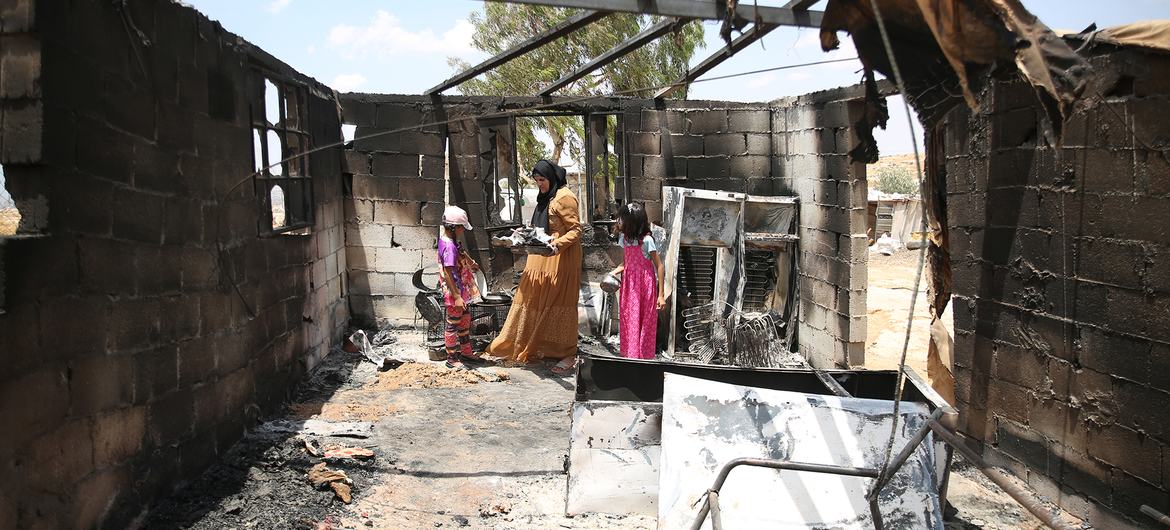
Settler violence has also remained at high levels. So far this year, OCHA documented 1,680 settler attacks across more than 270 communities – an average of five per day – with the current olive harvest season marked by widespread assaults on farmers, trees and agricultural infrastructure.
Situation in Gaza
In Gaza, airstrikes, shelling and daily building detonations continue to be reported near the so-called “Yellow Line,” which cuts across more than half of the territory where Israeli forces remain deployed.
Shifts in the line last week triggered fresh displacement from eastern Gaza City, as winter rains compounded already dire living conditions.
Since the ceasefire took effect in October, more than 774,000 displacement movements have been recorded.
Over the past week alone, more than 20,500 movements were registered, driven largely by flooding and insecurity.
Humanitarians warns that winter conditions, overcrowding and repeated displacement are heightening risks for children, older persons, persons with disabilities and female-headed households.
Food and health services
The health system in Gaza remains on the brink of collapse.
Although 42 health facilities have reopened or partially resumed services since the ceasefire, 61 per cent of all health service points remain non-functional, placing enormous strain on what remains of the system.
According to the UN World Health Organization (WHO), more than 16,500 patients – including around 4,000 children – still require medical evacuation, as the advanced care they need is unavailable inside Gaza.
Food security and nutrition remain critical.
The UN Children’s Fund (UNICEF) reported that two-thirds of children under five consumed just two or fewer food groups in October, placing the entire under-five population at risk of acute malnutrition.
While food assistance has expanded in recent weeks, shortages of fuel, cooking gas and cash continue to limit access to diverse diets.
The scale of physical destruction is immense. More than 80 per cent of buildings in Gaza are damaged or destroyed, and UN estimates indicate that debris clearance alone could take at least seven years, even with stable access and sufficient funding.
Funding and relief supplies
Despite the magnitude of needs, humanitarian funding remains severely constrained. As of 4 December, only 40 per cent of the $4 billion required for the 2025 response in Gaza and the West Bank had been received.
The UN also continues to coordinate humanitarian missions within Gaza.
On Wednesday, six out of seven such attempts were facilitated by Israeli authorities, enabling humanitarian teams to collect fuel, medical supplies, diapers, dignity and hygiene kits, soap, winter clothing, and other essential items from the Kerem Shalom and Zikim crossings.
Tags: Crimes against Humanity, Drones, Genocide, IDF, Israel, Jewish Settlers, Military Industrial Technological Complex, Palestine, Surveillance, USA, War crimes, West Bank
DISCLAIMER: The statements, views and opinions expressed in pieces republished here are solely those of the authors and do not necessarily represent those of TMS. In accordance with title 17 U.S.C. section 107, this material is distributed without profit to those who have expressed a prior interest in receiving the included information for research and educational purposes. TMS has no affiliation whatsoever with the originator of this article nor is TMS endorsed or sponsored by the originator. “GO TO ORIGINAL” links are provided as a convenience to our readers and allow for verification of authenticity. However, as originating pages are often updated by their originating host sites, the versions posted may not match the versions our readers view when clicking the “GO TO ORIGINAL” links. This site contains copyrighted material the use of which has not always been specifically authorized by the copyright owner. We are making such material available in our efforts to advance understanding of environmental, political, human rights, economic, democracy, scientific, and social justice issues, etc. We believe this constitutes a ‘fair use’ of any such copyrighted material as provided for in section 107 of the US Copyright Law. In accordance with Title 17 U.S.C. Section 107, the material on this site is distributed without profit to those who have expressed a prior interest in receiving the included information for research and educational purposes. For more information go to: http://www.law.cornell.edu/uscode/17/107.shtml. If you wish to use copyrighted material from this site for purposes of your own that go beyond ‘fair use’, you must obtain permission from the copyright owner.
Join the discussion!
We welcome debate and dissent, but personal — ad hominem — attacks (on authors, other users or any individual), abuse and defamatory language will not be tolerated. Nor will we tolerate attempts to deliberately disrupt discussions. We aim to maintain an inviting space to focus on intelligent interactions and debates.
Read more
Click here to go to the current weekly digest or pick another article:
UNITED NATIONS:
- Navigating International Humanitarian Law in the Age of Autonomous Weapons
- Genocide Deniers Call Gaza Starvation a ‘Hoax’ by Citing UNICEF—Which Reported Famine
- “The Essence of Childhood Has Been Destroyed”: Israel’s Deliberate Targeting of Children in the Occupied Palestinian Territory since 7 Oct 2023