
Neocolonial Drug Trafficking and the British Empire’s Opium Wars
IN FOCUS, 12 Jan 2026
Michel Chossudovsky | Substack - TRANSCEND Media Service
Today’s “Narco-States” and “The Laundering of Drug Money”
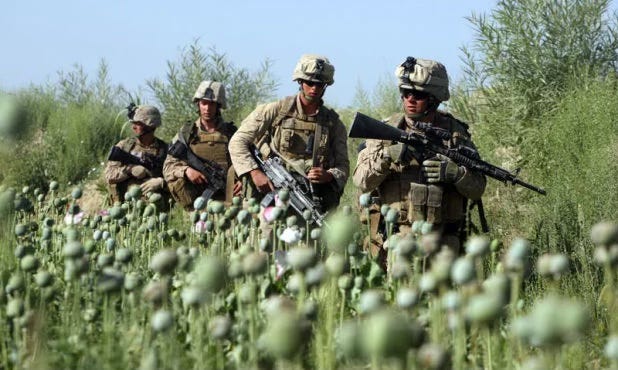
9 Jan 2026 – The tragic events of September 11, 2001 were conducive to the conduct of the October 7, 2001 US-NATO invasion of Afghanistan on the grounds that America had been “attacked by an unnamed foreign power.”
“There is continuity from the colonial style legitimate “drug war” led by the British Empire, to the present drug trafficking structures: Afghanistan under US military occupation, the Narco-State in Latin America.”
Rarely acknowledged by the mainstream media, the “Global War on Terrorism” (GWOT) which was launched on 9/11 coupled with an extensive dollarization of the global economy has a bearing on the global trade in narcotics, which is controlled by powerful financial interests.
The illegal trade in narcotics is conducted in U.S. dollars under a sophisticated money laundering framework.
This article examines briefly the history of narcotics commencing with the British Empire’s Opium Wars.
—Michel Chossudovsky, January 6, 2026
***
Drug Abuse and Illicit Trafficking
In accordance with Resolution 42/112 of 7 December 1987, the UN General Assembly decided to observe 26 June as the International Day against Drug Abuse and Illicit Trafficking as an expression of its determination to strengthen action and cooperation to achieve the goal of an international society free of drug abuse.
Raise Awareness

Money laundering is the processing of criminal proceeds to disguise their illegal origin.
This process is of critical importance, as it enables the criminal to enjoy these profits without jeopardizing their source.

[Image source: United Nations (UNODC)]
Rarely acknowledged, (“legal”) drug trafficking was initiated by the British Empire.
There is continuity. The colonial label has been scrapped. Today the (“illicit”) drug trade is a multibillion “neocolonial” dollar operation.
The two main hubs of production today are:
- Afghanistan which produces approximately 90% of the illegal world supply of opium (transformed into heroin, morphine and opioid related products). There was a successful drug eradication programme in 2000-2001 which was initiated (with UN support) conducted by the Taliban government. It was conducted in the year prior to the US-NATO-led invasion in October 2001.
- Since the invasion and military occupation, according to UNODC, the production of opium has increased 50-fold, reaching 9000 metric tons in 2017.

- The Andean region of South America (Colombia, Peru, Bolivia) which produces cocaine.
- The drug trade is protected by powerful Big Money interests, which in turn control Latin-American politicians.
- The illegal narcotics trade is intimately related to engineered-political chaos and “regime change” (e.g., Peru).
Flashback: The Role of the British Empire
Historically, drug trafficking was an integral part of British colonialism. It was “legal”.
Opium produced in Bengal by the British East India Company (BEIC) was shipped to China’s Southern port of Canton.
The state-sponsored export of opium from British India to China was arguably the largest and most enduring drug operation in history. At its peak in the mid-19th century it accounted for roughly 15% of total colonial revenue in India and 31% of India’s exports. To supply this trade the East India Company (EIC) – and later the British Government – developed a highly regulated cultivation system in which over one million farmers a year were under contract to grow opium poppies. …
The agency system ensured that farmers did not share in the large profits of the opium trade. Given their monopsony power, the opium agencies were able to “keep the price of crude opium just on the economic edge.” (Jonathan Lehne, 2011)

While the share of agricultural land allocated to opium was comparatively small, opium production under colonial rule was nonetheless conducive to impoverishing the Indian population, destabilizing the agriculture system as well as triggering numerous famines.
According to an incisive BBC report:
“The cash crop [opium] occupied between a quarter and half of a peasant’s holding. By the end of the 19th Century poppy farming had an impact on the lives of some 10 million people in what is now the states of Uttar Pradesh and Bihar.
The trade was run by the East India Company, the powerful multinational corporation established for trading with a royal charter that granted it a monopoly over business with Asia.
This state-run trade was achieved largely through two wars, which forced China to open its doors to British Indian opium. …
Stiff production targets fixed by the Opium Agency also meant farmers – the typical poppy cultivator was a small peasant – could not decide whether or not to produce opium. They were forced to submit part of their land and labour to the colonial government’s export strategy”.

[Image: BEIC Opium Factory and Stacking Warehouse, Patna, 1850s]
China and the Opium Wars
When China’s Qing Emperor Daoguang ordered the destruction of opium stocks in the port of Canton (Guangzhou) in 1838, the British Empire declared war on China on the grounds that it was obstructing the “free flow” of commodity trade.
The term “trafficking” applies to Britain. It was condoned and supported throughout the reign of Queen Victoria (1837-1901). In 1838, 1,400 tons of opium per annum were exported from India to China. In the wake of the First Opium war, the volume of these shipments (which extended until 1915) increased dramatically.
The so-called First Opium War (1838-1842), which represented an act of aggression against China was followed by the 1842 Treaty of Nanjing, which not only protected British imports of opium into China, it also granted extraterritorial rights to Britain and other colonial powers leading to the formation of the “Treaty Ports”.
The massive revenues of the opium trade were then used by Britain to finance its colonial conquests. Today it would be called the “laundering of drug money”. The channeling of opium revenues was also used to finance the Hong Kong Shanghai Bank (HKSB) established by the BEIC in 1865 in the wake of the First Opium War.
In 1855, Sir John Bowring on behalf of the British Foreign Office negotiated a treaty with King Mongkut (Rama IV) of Siam, entitled The Anglo-Siamese Treaty of Friendship and Commerce (April 1855) which allowed for the free and unrestricted import of opium into the Kingdom of Siam (Thailand).
While Britain’s trade in opium with China was abolished in 1915, Britain’s drug trafficking monopoly continued until India’s Independence in 1947. Affiliate companies of the BEIC such as Jardine Matheson played an important role in the drug trade.
Of significance, in the aftermath of World War II, US financial interests took possession of the drug trade, which became extensively “dollarised”.
Racism, Narcotics and Colonialism
Historians have focussed on the Atlantic Triangular Slave Trade: slaves from Africa exported by colonial powers to the Americas, followed by commodities produced in plantations using slave labour exported back to Europe.
Britain’s colonial drug trade had a similar triangular structure. Opium produced in colonial plantations by impoverished farmers in Bengal was exported to China, the revenues of which (paid in silver coins) were used largely to finance Britain’s imperial expansion including mining in Australia and South Africa.
No compensation was paid to the victims of the British Empire’s drug trade: The impoverished farmers of Bengal, the people of India and China.
Together with the Atlantic slave trade, colonial drug trafficking constitutes a crime against humanity.
Both the slave trade and drug trafficking were sustained by racism. In 1877, Cecil Rhodes put forth a “secret project” which consisted in integrating the British and US empires into a single “White Supremacist” Anglo-Saxon Empire:
“I contend that we are the finest race in the world … Just fancy those parts that are at present inhabited by the most despicable specimens of human beings… Why should we not form a secret society… for making the Anglo-Saxon race but one Empire…
Africa is still lying ready for us it is our duty to take it. … It is our duty to seize every opportunity of acquiring more territory and we should keep this one idea steadily before our eyes that more territory simply means more of the Anglo-Saxon race, more of the best the most human, most honourable race the world possesses. (emphasis added)
There is continuity from the colonial style legitimate “drug war” led by the British Empire, to the present drug trafficking structures: Afghanistan under US military occupation, the Narco-State in Latin America.
Drug trafficking is a multi-trillion dollar business. The UN office on drugs and crime estimates the laundering of drug money and other criminal activity to be of the order of 2-5 percent of global GDP, $800 billion to $3 trillion. Drug money is laundered through the global banking system. (The date of this estimate is not indicated)
Remember the crack cocaine scandal revealed in 1996 by journalist Gary Webb? Crack was sold to the African-American communities in Los Angeles.
Since 2001, the retail sale of heroin and opioids has become increasingly “weaponized” directed against sustaining racism, poverty and social inequality.
While today’s drug trade is the source of wealth and enrichment, drug addiction including the use of heroin, opioids and synthetic opioids has skyrocketed In 2001, 1,779 Americans were killed as a result of heroin overdose.
By 2016, heroin addiction resulted in 15,446 deaths.
Those lives would have been saved had the US and its NATO allies NOT invaded and occupied Afghanistan in 2001.
Drug-related Mortality. Impacts of the COVID-19 Lockdown (March 2020)
The main drug opioid categories (CDC) are as follows:
- illegal heroin
- synthetic opioids such as fentanyl
- so-called “pain relievers” including oxycodone (OxyContin®), hydrocodone (Vicodin®)
- codeine
- morphine
- etc.
In recent developments, resulting from the Covid-19 lockdown, mortality resulting from cocaine, heroin and opioids has increased dramatically.
The hike starts in February 2020 (coinciding with the financial crash).
Following the mid-March 2020 lockdown, drug overdose deaths go fly high.
In May 2020, the overdose death count was in excess of 3000, i.e., a more than three-fold increase in relation to the drug overdose deaths recorded prior to the corona crisis. (See graph)
In the US, the recorded monthly drug overdose deaths in 2020 have more than tripled.

[Image: Graph based on CDC data, Source PBS]
CDC data confirms that the increase in deaths attributable to drug overdose has continued to increase:
From 71,130 deaths in 2019 (end of December 2019) to 92,478 in 2020 (end of December 2020), namely an increase of 21,348 deaths in the course of 2020 in relation to 2019.
This upward trend has continued in the course of 2021. (See Michel Chossudovsky The Worldwide Corona Crisis. Global Coup d’État Against Humanity.)
In the twelve-month period finishing in June 2021, the number of recorded drug overdose deaths reached almost 100,000 fatalities (end of June 2021: 98,022 (Ibid).
Opioid-related Deaths in Canada
The tendency in Canada is consistent with that observed in the US. A dramatic increase in opioid-related deaths was recorded in Ontario following the March 17, 2020 lockdown emergency which was coupled with unemployment following the closing down of economic activity:
The number of opioid-related deaths increased quickly in the weeks following the state of emergency declaration in Ontario on March 17, 2020. Overall, there was a 38.2% increase in opioid-related deaths in the first 15 weeks of the COVID-19 pandemic (695 deaths; average of 46 deaths weekly) compared to the 15 weeks immediately prior (503 deaths; average of 34 deaths weekly) (ibid).
It is worth noting that in the course of the pandemic, fentanyl (pharmaceutical opioid) accounted for 87% of opioid-related deaths (87.2% [N=538 of 617]) compared to the pre-pandemic cohort (79.2% [N=399 of 504]).22
The following graph provides a clear-cut picture of the dramatic rise in opioid overdose emergency visits in Ottawa starting from January 2020 through December 2020.

[Image source: Public Health Ontario]
_________________________________________
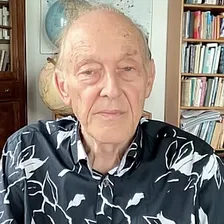 Michel Chossudovsky is an award-winning author, Professor of Economics (emeritus) at the University of Ottawa, Founder and Director of the Centre for Research on Globalization (CRG), Montreal, Editor of Global Research. He has taught as visiting professor in Western Europe, Southeast Asia, the Pacific and Latin America. He has served as economic adviser to governments of developing countries and has acted as a consultant for several international organizations. He is the author of eleven books including The Globalization of Poverty and The New World Order (2003), America’s “War on Terrorism” (2005), The Global Economic Crisis, The Great Depression of the Twenty-first Century (2009) (Editor), Towards a World War III Scenario: The Dangers of Nuclear War (2011), The Globalization of War, America’s Long War against Humanity (2015). He is a contributor to the Encyclopaedia Britannica. His writings have been published in more than twenty languages. In 2014, he was awarded the Gold Medal for Merit of the Republic of Serbia for his writings on NATO’s war of aggression against Yugoslavia. He can be reached at crgeditor@yahoo.com
Go to Original – michelchossudovsky.substack.com
Tags: Afghanistan, China, Drug Dealers, Mafia, Opium, UK, USA, War of Terror, War on Drugs, War on Terror
DISCLAIMER: The statements, views and opinions expressed in pieces republished here are solely those of the authors and do not necessarily represent those of TMS. In accordance with title 17 U.S.C. section 107, this material is distributed without profit to those who have expressed a prior interest in receiving the included information for research and educational purposes. TMS has no affiliation whatsoever with the originator of this article nor is TMS endorsed or sponsored by the originator. “GO TO ORIGINAL” links are provided as a convenience to our readers and allow for verification of authenticity. However, as originating pages are often updated by their originating host sites, the versions posted may not match the versions our readers view when clicking the “GO TO ORIGINAL” links. This site contains copyrighted material the use of which has not always been specifically authorized by the copyright owner. We are making such material available in our efforts to advance understanding of environmental, political, human rights, economic, democracy, scientific, and social justice issues, etc. We believe this constitutes a ‘fair use’ of any such copyrighted material as provided for in section 107 of the US Copyright Law. In accordance with Title 17 U.S.C. Section 107, the material on this site is distributed without profit to those who have expressed a prior interest in receiving the included information for research and educational purposes. For more information go to: http://www.law.cornell.edu/uscode/17/107.shtml. If you wish to use copyrighted material from this site for purposes of your own that go beyond ‘fair use’, you must obtain permission from the copyright owner.
Join the discussion!
We welcome debate and dissent, but personal — ad hominem — attacks (on authors, other users or any individual), abuse and defamatory language will not be tolerated. Nor will we tolerate attempts to deliberately disrupt discussions. We aim to maintain an inviting space to focus on intelligent interactions and debates.