
The Trump Regime’s “Peace Board” Is Another Brick in His Personal Occidental Empire
ANGLO AMERICA, 19 Jan 2026
Jan Oberg, Ph.D. | Transnational Foundation – TRANSCEND Media Service
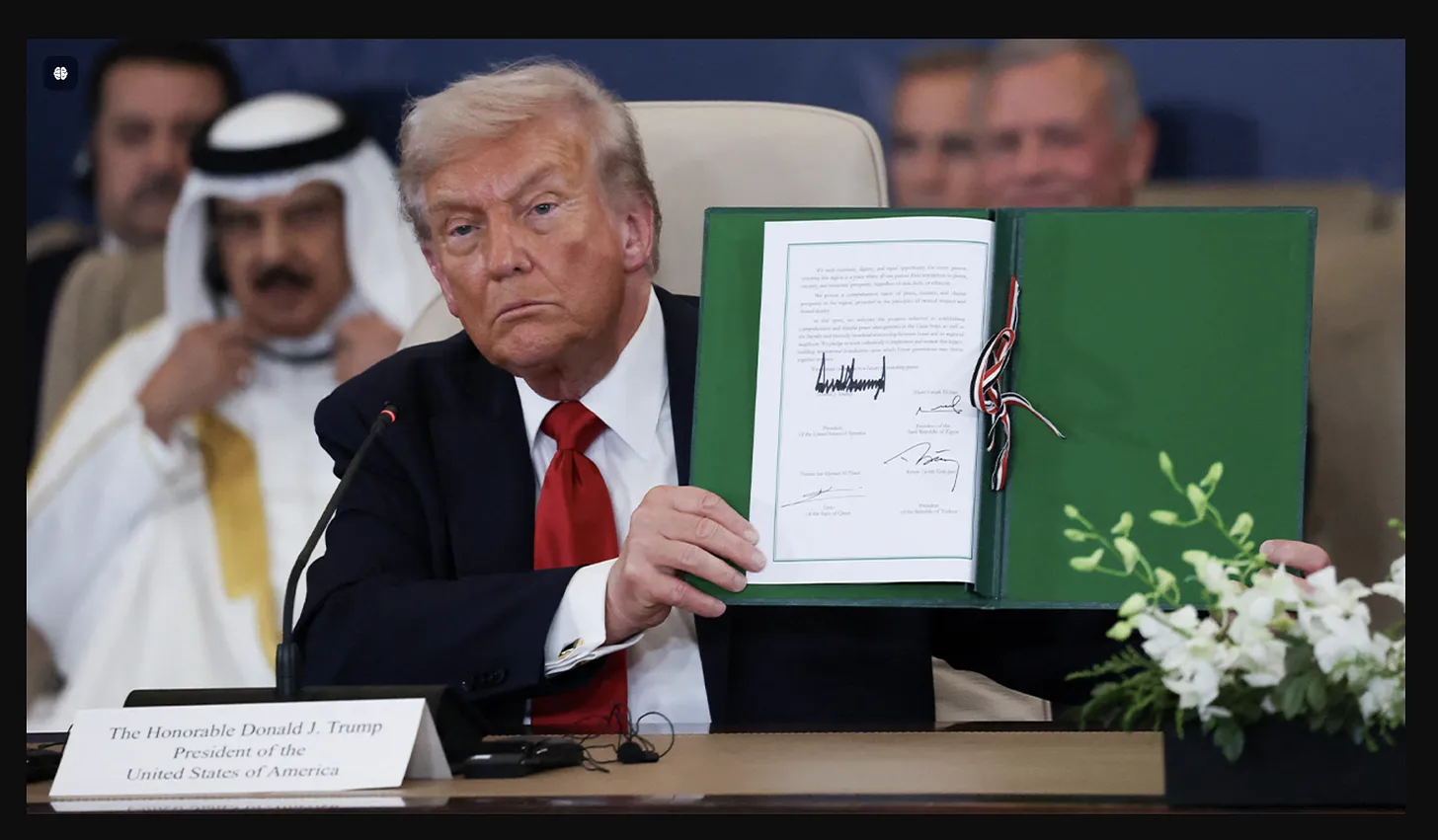
Original photo by FoxNews
His Gaza proposal reveals a far larger and world-threatening project. It’s a bid to replace the UN — and this MAGAlomania must be stopped now. See warning at the end.
18 Jan 2026 – There are moments in political life when the surface events are so loud, so chaotic, so distracting that they obscure the deeper shift taking place beneath them. We focus on the headlines, the personalities, the daily provocations — and miss the architecture being built in the background.
But every once in a while, a document appears, a proposal emerges, or a pattern becomes visible enough that it forces us to stop, step back, and look at the larger design.
Trump’s so‑called Gaza “Board of Peace” is one of those moments.
It is not the outburst of an impulsive leader. It is not a one‑off improvisation. It is a window into a political project that has been unfolding for years — a project that treats institutions as disposable, alliances as leverage, and entire regions as assets in a personal geopolitical domain.
A project that is no longer hiding its contours. A project that now speaks openly in the language of authority, hierarchy, and replacement.
The charter of Donald Trump’s proposed “Board of Peace,” revealed by Haaretz on January 17, 2026, is not a Gaza policy. It is not even a Middle East policy. It is the latest — and clearest — expression of a long‑running project that has defined Trump’s political style for years: the construction of what I describe as a Personal Occidental Empire, a sphere of influence built not on institutions or alliances but on personal (narcissist) authority, loyalty networks, and transactional dependency.
The Gaza initiative is simply the newest brick in that architecture.
According to Haaretz, the charter was quietly sent to around 60 heads of state. Yet the document itself does not mention Gaza at all. Instead, it claims a sweeping mandate to “restore dependable and lawful governance and secure enduring peace in areas affected or threatened by conflict,” and — in a phrase that should alarm every democratic government — to do so “in place of other organizations.”
This is not a reconstruction committee. It is a claim to global jurisdiction, but only over the parts of the world Trump considers within his reach.
This logic is not new. It is the same logic that drove his attempts to buy Greenland, pressure Canada, threaten Mexico with military action, make himself a Viceroy in Venezuela, and reshape NATO into a loyalty‑based protection racket.
These were not random provocations. They were early signals of a worldview in which Western states and territories are not partners but assets — components of a personal geopolitical domain.
Trump’s charter makes the architecture explicit. It opens with a denunciation of existing international structures, calling for “a more nimble and effective international peace‑building body” and urging the world to abandon “institutions that have too often failed.” This is not the language of reform. It is the language of replacement — a hallmark of Trump’s broader governing style, in which established institutions are treated as obstacles to be bypassed, hollowed out, or supplanted by leader‑controlled alternatives.
But the most revealing feature of the charter is its structure of authority.
As Haaretz reports, the chairmanship is not tied to the U.S. presidency, not subject to elections, and not limited by term. It simply states: “Donald J. Trump shall serve as inaugural Chairman of the Board of Peace.” From that point on, the document reads like the constitution of a personal dominion.
Trump alone would invite or expel member states, appoint or dismiss the executive board, veto decisions at will, create or dissolve subsidiary bodies, interpret the charter, and even dissolve the entire organisation. He would also designate his own successor.
This is not multilateralism. It is not even unilateralism. It is personal rule — the defining feature of Trump’s broader political project.
Membership rules reinforce the pattern. While most states would serve three‑year terms, Haaretz notes that countries contributing more than $1 billion in the first year would be exempt from term limits. In other words: pay enough, and you can stay indefinitely — as long as the chairman approves. This is not sovereign equal cooperation; it is a transactional hierarchy, entirely consistent with Trump’s long‑standing preference for loyalty networks and personal dependency.
And crucially: this empire is selective. Trump is not trying to build a universal body. He is not trying to include Russia, China, Iran, or any state that would resist personal subordination. His empire is Western, Atlantic, and strategically convenient — a sphere of influence composed of states he believes he can bend, pressure, or purchase. And regions where he can build his United States of Autarchy if and when the world has turned its back on him and the US
Seen through this lens, the Gaza “peace” board is not an aberration. It is a continuation. It reflects the same logic that shaped his approach to Greenland, Canada, Mexico, Venezuela, NATO, and Europe. The charter simply makes the architecture visible: a system in which institutions are not independent actors but instruments of his personal authority, excercise in 100% defiance of laws, norms and normal respect for others.
What the Gaza “peace” board exposes is not a sudden improvisation but the underlying architecture of a political project that has been unfolding for years.
The pattern is unmistakable: a leader who treats institutions as disposable, alliances as leverage, and entire regions as assets in a personal geopolitical domain. It is the logic of a Personal Occidental Empire — a sphere of influence defined not by shared values or collective security but by proximity to one man’s authority.
This could never become a new United Nations. It is not even an alternative multilateralism. It is an empire without a fixed territory but with all the familiar features: hierarchy, dependency, loyalty, and the steady erosion of institutional constraints.
The Gaza charter simply strips away the last remaining ambiguity. It shows, in black and white, a system in which global authority is concentrated in the hands of a single individual, insulated from elections, oversight, or constitutional limits. It reveals a worldview in which international governance is not a shared responsibility but a personal prerogative. And it demonstrates how easily the language of “peace” can be repurposed to legitimize structures of power that have nothing to do with peace at all.
And here is where most geo-political commentators have understood so little:
The old disciplines can no longer explain what we are living through; only psychology/psychiatry, theology, philosophy — and perhaps the inspiration from (science) fiction and the Theatre of the Absurd — may be able to help.
A warning
We are not reliving the 1930s, and I disagree strongly with geopolitical and other people who predict World War Three to vent their own fears, but do not think of how they deprive their readers of the wish to do something and how they prevent every discussion of solutions and constructive visions for the world.
If this is the direction of the coming years, then the international system is not facing a policy disagreement or a diplomatic rupture. It is facing the emergence of a personalised, extra‑state authority structure that seeks to reorder Western politics around the will of a single leader and tendentially confront everybody else, friends and foes.
We are not reliving the 1930s, and I thoroughly disagree with all the geopolitical experts who predict World War 3. They have no theory behind that claim, but merely vent their own frustrations, deprive people of hope and the will to act, and make it impossible to discuss solutions and visions of a better future for humanity.
That said, some of the structural pressures that once led to global conflict are re‑emerging in new forms – and, no, Trump does not appear yet in military uniform, albeit now with a golden fighter aircraft as a lapel pin. Western militarism is as rampant as it is destructive for the West itself.
The lesson of history is to act before such pressures become irreversible. Or we shall again conclude that the only thing we can learn from history is that we learn nothing from it.
The question is no longer whether this project exists. The question is whether anyone will recognise it in time — and whether the world is prepared to confront the dangers it poses.
__________________________________________
 Prof. Jan Oberg, Ph.D. is director of the independent Transnational Foundation for Peace & Future Research-TFF in Sweden and a member of the TRANSCEND Network for Peace Development Environment. CV: https://transnational.live/jan-oberg
https://transnational.live.
Go to Original – thetransnational.substack.com
Tags: Trump, US empire, USA
DISCLAIMER: The statements, views and opinions expressed in pieces republished here are solely those of the authors and do not necessarily represent those of TMS. In accordance with title 17 U.S.C. section 107, this material is distributed without profit to those who have expressed a prior interest in receiving the included information for research and educational purposes. TMS has no affiliation whatsoever with the originator of this article nor is TMS endorsed or sponsored by the originator. “GO TO ORIGINAL” links are provided as a convenience to our readers and allow for verification of authenticity. However, as originating pages are often updated by their originating host sites, the versions posted may not match the versions our readers view when clicking the “GO TO ORIGINAL” links. This site contains copyrighted material the use of which has not always been specifically authorized by the copyright owner. We are making such material available in our efforts to advance understanding of environmental, political, human rights, economic, democracy, scientific, and social justice issues, etc. We believe this constitutes a ‘fair use’ of any such copyrighted material as provided for in section 107 of the US Copyright Law. In accordance with Title 17 U.S.C. Section 107, the material on this site is distributed without profit to those who have expressed a prior interest in receiving the included information for research and educational purposes. For more information go to: http://www.law.cornell.edu/uscode/17/107.shtml. If you wish to use copyrighted material from this site for purposes of your own that go beyond ‘fair use’, you must obtain permission from the copyright owner.
Join the discussion!
We welcome debate and dissent, but personal — ad hominem — attacks (on authors, other users or any individual), abuse and defamatory language will not be tolerated. Nor will we tolerate attempts to deliberately disrupt discussions. We aim to maintain an inviting space to focus on intelligent interactions and debates.