
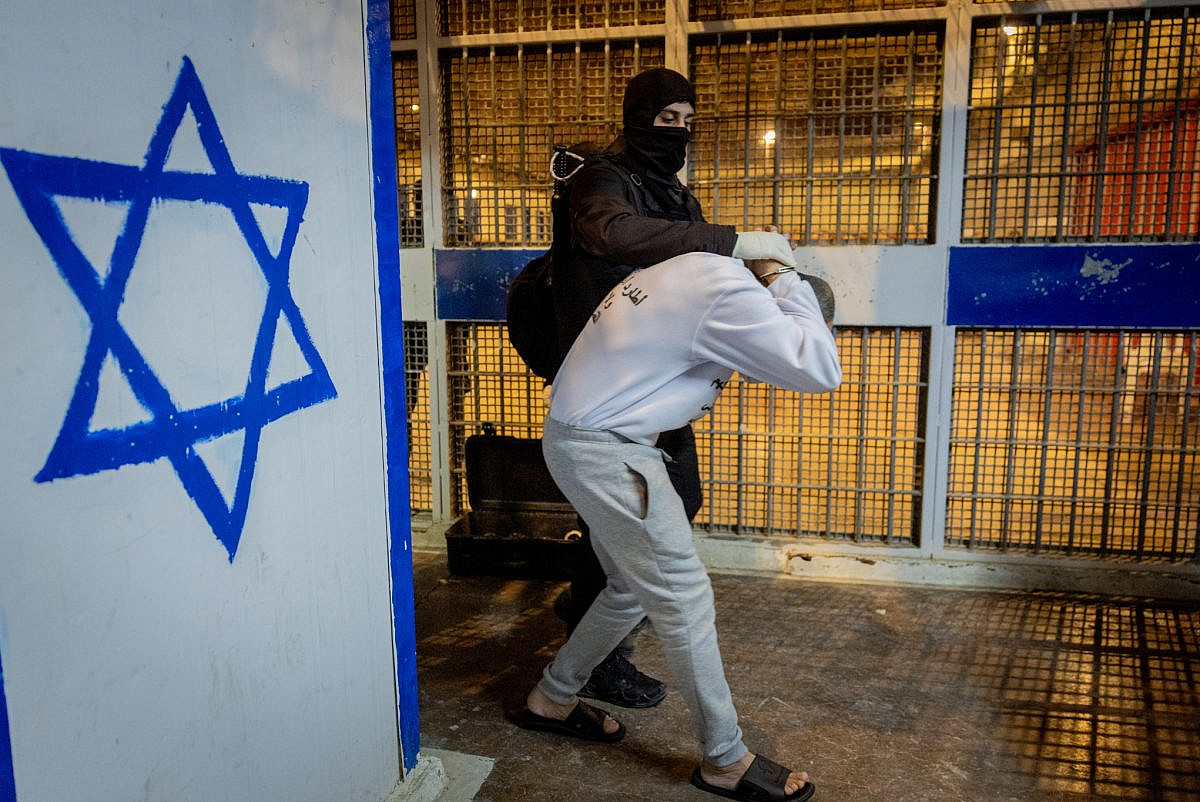
Over the past two years, Palestinian and Israeli human rights organizations have published several reports on the dire condition of Palestinians incarcerated in Israel. The reports describe extreme overcrowding, deprivation of basic necessities, widespread illness, routine violence and torture, and severe restrictions on medical access and care. Between October 2023 and November 2025, nearly 100 Palestinians are known to have died in Israeli custody, which human rights groups describe as likely a significant undercount.
It bears emphasizing that these conditions have not been selectively imposed on Hamas militants captured on October 7 or during the subsequent fighting. Palestinians detained before October 7, workers from Gaza who were in Israel on the day of the attack, and Palestinian citizens of Israel arrested for social media posts have all been subjected to the same regime.
Since spring 2024, when the brutal torture of Palestinian prisoners and the nightmarish conditions at the Sde Teiman detention center were exposed, the core facts of these reports have periodically drawn some attention both abroad and in Israel. However, the conditions that have enabled and normalized such practices across Israeli jails have attracted less scrutiny.
Interviews we conducted with seven attorneys who represent Palestinian detainees point to an aggressive dismantling of monitoring mechanisms, alongside growing obstruction and harassment of legal counsel — developments that, taken together, have allowed the prison system to largely operate with impunity.

‘Sites of institutionalized revenge’
According to lawyers who represented Palestinian detainees both before and after October 7, the changes in Israeli prisons since the start of the war are difficult to overstate. “The situation before the war was very bad, but it is not comparable to what happened in Israeli prisons after October 7,” said Yigal Dotan, an attorney who recently represented a 14-year-old autistic Palestinian citizen of Israel held in detention on suspicion of security offenses. “They have become torture facilities — sites of organized, industrialized revenge. I see it with my own clients and those of other lawyers. Their condition is horrific.”
Structural overcrowding was one of the earliest drivers of this deterioration. One of the first steps the Knesset took after October 7 was to pass emergency legislation circumventing a High Court of Justice ruling and fill cells beyond capacity. According to a 2024 report by Israel’s Public Defender’s Office, the number of prisoners in Israel exceeded 23,300, nearly 9,000 over the legal maximum limit allowing for minimally adequate living conditions. The result, lawyers said, was a rapid descent into inhuman conditions that led to outbreaks of disease.
At the same time, the Israel Prison Service reclassified basic necessities as “luxuries.” Mattresses, pillows, toiletries, and shaving equipment were confiscated overnight, and prisoners were no longer provided with clean clothes.
“They left them only with the clothes on their backs,” said attorney Ben Marmarelli. “Since October 7, my client has been wearing the same pair of underwear. Only now — because of a new petition I filed — there is a chance he will receive another pair.”
During the winter months, prisoners have been exposed to the cold in cells with open windows, without adequate clothing or blankets. Daily yard time was suspended for eight months after October 7, reinstated, and then canceled again following the most recent hostage deal as revenge for the release of Palestinian detainees.
According to attorney Sawsan Zaher, the refusal to allow prisoners to change clothes had predictable consequences. “Those [prisoners] who were released left their winter clothes behind for cellmates so they would have something to wear. These conditions led to scabies outbreaks in all prisons.”

For prisoners with disabilities or serious medical needs, the removal of basic accommodations amounted to total dependence on other detainees, and on lawyers’ ability to intervene in the courts.
“I had a client in a wheelchair, which was confiscated at the start of the war,” said attorney Nadia Daqqa. “He spent nearly a year and a half in prison without it, until he managed to reach a lawyer. He became dependent on other prisoners to get to the bathroom, to shower, or to go outside. He also had no control over his bodily functions and was given only three adult diapers per week. I even had to file a petition about that.”
Nutrition and medical care also deteriorated dramatically. During the first months of the war, daily food rations were reduced to starvation-levels of 800 calories per person, according to testimonies of released prisoners and lawyers, and as revealed by post-mortems of Palestinians who died inside detention facilities. Lawyers who visited clients in April 2024 reported seeing “walking skeletons.” Access to medical treatment, both for worsening pre-existing conditions and for injuries resulting from violence inside the prisons, was severely limited.
Daqqa recounted seeing prisoners whose fractures healed improperly after going untreated. Even when prison doctors formally fulfilled their duties, she explained, “the doctor doesn’t sit in the [prison] wing. He can recommend treatment, but then the prisoner returns to the wing and doesn’t receive it.”
Perhaps the most dramatic transformation in Israeli prison conditions, however, was the fact that by mid-2024, physical violence and torture of Palestinian inmates had become routine. “Before the war, we documented about 10 to 12 cases of torture per year, out of many prison visits,” said Tal Steiner, a lawyer and executive director of Hamoked: Center for the Defence of the Individual, who was until recently the director of the Public Committee Against Torture in Israel. “After the war, every visit resulted in a torture complaint.
“Previously, torture cases were usually linked to Shin Bet interrogations; guard violence was marginal,” Steiner continued. “Now it is the norm: violence during headcounts, violence during transfers between facilities, violence on the way to see a doctor, violence while going to meet our lawyers.”

Isolated from the outside world
What has helped to conceal this brutal reality is the near-total isolation of detainees. After October 7, Israel barred visits by the International Committee of the Red Cross, long one of the few independent monitoring mechanisms, and suspended family visits entirely. For several months, lawyers were also prohibited from prisons, a restriction that was officially eased only in early 2024.
In the absence of the Red Cross and family members, lawyers became the sole channel between prisoners and the outside world. Beyond legal representation, they were tasked with informing families whether detainees were still alive, conveying messages to detainees about their relatives’ condition, and collecting first-hand testimony about prison conditions.
Yet lawyers say their access remains seriously restricted. For detainees from Gaza, lawyers are now required to obtain power of attorney from the prisoner’s family — who are often unreachable — rather than from the detainee during the visit itself, as previously allowed. Lawyers receive appointments to meet their clients months in advance, and can expedite them only through court petitions.
In other cases, prison authorities have barred lawyers from entering facilities altogether, citing shifting or unexplained pretexts such as prison unrest, or guards have independently prevented them from attending detention extension hearings held inside prisons.
As a result of these obstacles, a single prison visit now often costs lawyers around NIS 2,000 (roughly $630), accounting for travel to remote detention centers, hours of waiting, and at most 30 minutes with the client. When visits do occur, lawyers report systematic violations of attorney-client privilege. Guards search their documents, summon translators to review materials in Arabic, and listen in on conversations.
“I had cases where a prisoner was prevented from exposing parts of his body during a visit,” Daqqa said, seemingly to prevent her from documenting recent injuries.

Any message from the outside world — even a greeting from a prisoner’s mother — can trigger punitive measures against lawyers. Through expedited procedures based on secret “evidence,” attorneys can be barred from visiting clients for months, on the grounds that such interactions are allegedly used to coordinate protests among prisoners or serve as communication with terrorist organizations. Around 50 lawyers, most of them Palestinian, have been banned for extended periods since October 7 from visiting their clients for conveying family greetings, recording relatives’ details, or showing photos of prisoners’ children.
Lawyers further reported that clients arrived at meetings beaten and bruised and were sometimes assaulted in front of them. Prisoners testified that before lawyer visits they were held for hours in stress positions, shackled tightly, blindfolded, beaten, and even raped, apparently to deter them from meeting with counsel.
Since visits resumed in early 2024, lawyers say they have repeatedly documented such injuries, to no avail. “I saw the looks from the guards, the shoving, the boot sole marks on my client’s back — full boot prints, more than once,” said Marmarelli. Steiner added: “The sense of impunity was so extreme that the Prison Service allowed itself to beat people until they bled, even knowing that someone from the outside world was about to see them.”
‘The courts are fully complicit’
Already before the war, judicial oversight of prison conditions was minimal. According to data from the Knesset Research and Information Center, of 1,830 cases opened by the National Unit for the Investigation of Prison Guards between 2019 and 2021, 96 percent were closed by July 2023, 93 percent for “lack of criminal offense.” Another 255 cases were passed on from the unit and opened by the State Attorney’s Office between 2019 and 2022 — and similarly, 94 percent of them were closed.
Accordingly, the violence documented since October 7, lawyers argue, reflects a failure not merely of the Israel Prison Service, but of every body responsible for overseeing it: the courts, the Public Defender’s Office, and the Israel Bar Association.
“Violations inside prisons always existed,” said attorney Abeer Baker. “The Bar Association, the Public Defender’s Office, the State Attorney, and the courts have explicit legal authority to knock on the prison gates and say: ‘I’m coming in to inspect.’ None of them did so in time. Everyone knew something horrific was happening inside the prisons, and no one lifted a finger.”
The courts have effectively relinquished judicial oversight. Many detainees are no longer physically brought before a judge, appearing instead via video in detention extension hearings lasting only three to four minutes and conducted entirely in Hebrew without interpretation. Judges routinely approve detention orders and subsequently ignore visible signs of abuse on the bodies of detainees brought before them, as well as complaints of starvation, violence, and medical neglect.

“The judges don’t care what happens to these detainees,” explained Dotan. “In one case, eight detainees were brought to the Tel Aviv District Court looking terrible. During a recess, the court ordered that they be fed. They were forced to kneel, hands cuffed behind their backs, legs shackled. Their meager food trays were thrown on the floor, and they had to bend down and eat like dogs, without hands.” Dotan immediately protested to the court, but the judges merely rolled their eyes, he said. “The courts are fully complicit.”
At the end of October 2023, several human rights organizations petitioned Israel’s High Court over detention conditions, relying on testimonies from released detainees because prison access was denied at that point. The court dismissed the petition as based on “general, unsubstantiated rumors,” ruling that challenges must be brought through individual petitions. Since then, amid evidence of widespread starvation and abuse, civil society organizations have failed to compel the court to address the issue as a systemic one.
According to Steiner, principled petitions were dismissed because “we did not prove the factual claims because the Prison Service denies them,” or because the issue was deemed “resolved” after the Prison Service claimed it had been fixed.
Even when courts issued orders to address specific violations, said Dotan, the Prison Service “blatantly disregards them — more so since October 7.” In the case of the 14-year-old autistic boy, despite a court order requiring his separation from other detainees, the Prison Service failed to comply, and the prisoner was sexually assaulted by his cellmates.
The High Court plays a central role in sustaining the current situation. All seven attorneys emphasized that the High Court has declined to intervene in matters it once treated as urgent, repeatedly granting the state extensions without scrutiny. “It’s a kind of wilful blindness,” Baker said.
In a petition demanding the resumption of Red Cross visits, the High Court has granted the state 20 postponements. A petition concerning food deprivation took over a year and a half to be resolved. “The Court reached a decision only after people had lost tens of kilograms,” Daqqa explained.
More recently, the High Court dismissed a petition seeking to renew family visits, citing failure to exhaust procedures with the Prison Service and requiring proof of a new refusal after the October 2025 ceasefire, necessitating an additional 45-day wait. As in its handling of Israel’s starvation policy in Gaza or the exclusion of foreign media from the Strip, the court effectively adopts the state’s position by postponing review until a specific claim is no longer relevant, while failing to address the underlying issue.

The Public Defender’s Office, charged with ensuring fair criminal process regardless of alleged offense, has been the only state body to acknowledge systematic human rights violations in prisons and voice public concern. It has warned that Israel’s detention powers are “broad and troubling,” and cautioned against the “spillover of extreme counter-terrorism mechanisms into criminal law.”
Nevertheless, in November 2023, the Public Defender announced — without precedent — that it would not represent Hamas operatives, thereby abandoning its fundamental duty toward all Palestinians detained after October 7. “The Public Defender represents people who murdered their children and mutilated their bodies,” said one interviewed lawyer. “The severity of the acts is irrelevant. There is a person who must be guaranteed a fair process, regardless of what they did. That is criminal law.”
The Israel Bar Association, for its part, has failed to defend lawyers barred from prisons or challenge their exclusion. It has uncritically accepted Prison Service claims that lawyers abused their role to coordinate with terrorist organizations and pursued disciplinary proceedings against lawyers based on secret evidence and materials obtained in violation of attorney-client privilege — the legal profession’s most sacred principle.
Even when complaints were eventually dismissed, the reliance on such accusations has created a profound sense of abandonment among lawyers by the professional body meant to protect them. “We [the lawyers defending Palestinians] are completely alone,” Dotan said. “I cannot help my clients. I cannot save them from their fate.”
A wide circle of crime
The treatment of detainees, as described by their lawyers, reflects a broader Israeli policy of dismantling basic human rights norms, compounded by the inability — and often unwillingness — of oversight bodies to intervene.
The harassment of lawyers, who are now de facto the last remaining oversight mechanism, mirrors the broader ongoing assault on human rights organizations. In practice, the state has worked to deny Palestinians even the most basic legal remedies while isolating those who might bear witness to abuse.
The consequences reverberate well beyond prison walls. Thousands of Palestinians who passed through Israeli detention over the past two years have suffered lasting physical and psychological harm, affecting their families and communities for years to come.
On the Israeli side, Steiner noted, “There are many people involved. Many, many Israelis who tortured other human beings in prison, abused them, approved such violence, or covered it up in one way or another.
“This is a crime with very wide circles: dozens of reservists and regular soldiers, hundreds of prison guards,” she concluded. And these individuals and the violence they have normalized will remain part of Israeli society.
In response to +972’s request for comment, the Israel Prison Service spokesperson responded to this article with the following statement: “This is an absolute falsehood. The Israel Prison Service is a security organization operating under the law, and its personnel are responsible for safe custody and safeguarding the rights of all detainees. Any formal complaint submitted by a detainee is examined and handled by the competent authorities in accordance with the law.”
_______________________________________________