
4 Mar 2026 – With global attention fixed on the escalating U.S.-Israeli war with Iran, Israel has imposed a total military closure on the occupied West Bank. Israeli settlers, backed by the army, are seizing the opportunity to try to expel more rural Palestinian communities from their land, as they did in the days immediately following October 7.
Within hours of the war beginning on Saturday morning, the Israeli army shut all checkpoints across the West Bank and blocked roads between cities and villages with iron gates and earth mounds. It also installed new iron gates in locations where none had previously existed. Settlers brought in excavators to seal makeshift passages Palestinians had carved out over the past two and a half years, in areas where the army has kept roads closed since the start of Israel’s genocide in Gaza.
On Sunday, soldiers distributed leaflets to Palestinians in several localities announcing that the army “has imposed a preemptive security cordon around the entire Judea and Samaria area,” banning movement between different West Bank districts “until further notice.”
For residents of Ramallah and its surrounding towns and villages, access to the main roads leading to the rest of the West Bank has been cut off entirely. “It’s impossible to leave,” one resident of the city told +972. “I tried to drive out of one checkpoint in the opposite lane, which is used for entering the city, but soldiers caught me, detained me, and searched my car and body.”
In the village of Duma, east of Ramallah, soldiers and settlers have blocked off the sole exit since Saturday. Residents cannot leave even on foot or transfer between vehicles — a common workaround at other blocked gates across the West Bank.
“The army is preventing entry and exit for laborers, children, and the sick,” said Duma’s mayor, Hussein Dawabsheh. “On Monday, we tried to coordinate the evacuation of an 88-year-old patient, but [the army] refused. The village is surrounded by settlers, so it’s impossible to leave on foot.

“My son is a doctor, and for nearly a week he hasn’t been able to return to the village,” Dawabsheh continued, adding that cooking gas and food supplies have also been barred from entering. “The shops are empty. People buy more during Ramadan, but there is nothing.”
The Israeli army also closed an iron gate at the entrance to the village of At-Tuwani on Saturday, cutting off a key route used by residents of neighboring communities across Masafer Yatta. Anyone in need of medical care must now attempt to evacuate on foot, while transporting cooking gas, food supplies, and fodder for sheep has become nearly impossible.
As Palestinian remain under lockdown, Israeli settlers continue to move freely, escalating their attacks on Palestinian communities across Area C. According to the NGO Yesh Din, at least 50 incidents of settler violence were documented in 37 different Palestinian communities during the first four days of the war alone. In almost every instance, settlers operate with the support of the Israeli army — some of whom are settlers wearing military uniform — to complete whatever mission they are trying to carry out.
In response to +972’s inquiry, the army said it “restricts movement on certain [West Bank] roads for security and operational considerations, in order to maintain the security of the area and public order.”
‘Planned and systematic’
The deadliest attack occurred on Monday in the village of Qaryut, near Nablus. After settlers began uprooting olive trees to pave a new road near Palestinian homes — a route that would serve a nearby outpost — several residents tried to intervene.
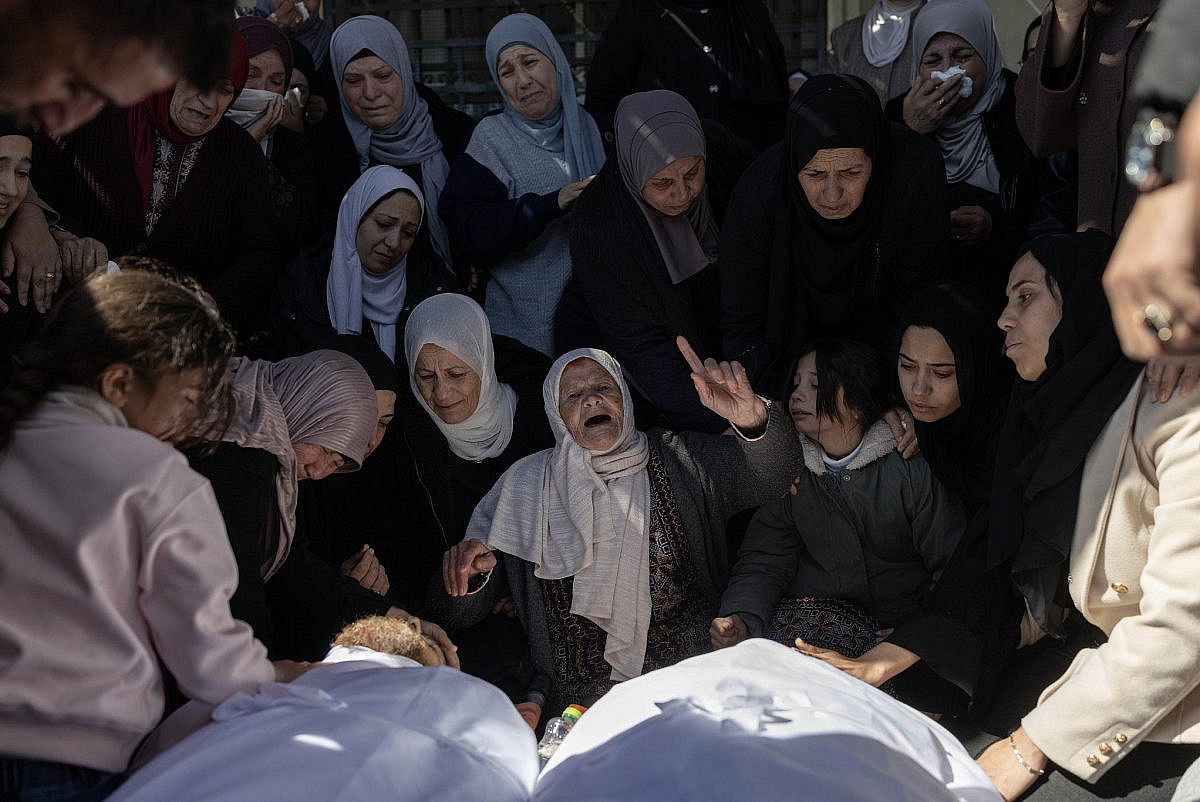
Settlers first threw stones at the residents and then opened fire, killing two brothers, Muhammad and Fahim Muammar, aged 52 and 48. At least one other resident was seriously wounded by live ammunition. Because of army-imposed roadblocks, ambulances were unable to reach the village and evacuate the wounded for more than an hour.
On Tuesday, the army announced that the shooter was an “active reservist in the IDF,” adding that his weapon had been confiscated and that a criminal investigation had been opened. The army would not confirm to +972 whether the soldier belonged to a Regional Defense unit (known in Hebrew as Hagmar) — military battalions composed of settlers who patrol their own communities, which the army established after October 7 due to the transfer of manpower to Gaza.
Bashar Qaryuti, an activist and medic from the village, said soldiers arrived about an hour after the shooting and immediately fired tear gas toward Palestinian homes. “The settlers had full protection from the occupation army, and it provided them with a withdrawal plan,” he recounted. “The army did not intervene until the event ended, and then they detained the [Palestinian] citizens who were there.”
Settlers have since claimed they were attacked by Palestinians throwing stones and that the shooting was an act of self-defense. Qaryuti rejected that account. “The two martyrs were in the garden of their home, defending their children and their family,” he said. “The settlers are the ones who came to this area and attacked the house with stones and then fired live ammunition at every person who was present in this area.”
For Qaryuti, it is clear that the settlers are taking advantage of the new war. “At the same moment that there were missile sirens, that’s when they came and started shooting. This was planned and systematic because there is a complete blackout on what is happening in the West Bank in light of the escalation.”
He added that attacks have also taken place in the [neighboring] towns of Jalud and Talfit and the neighboring village. “We are surrounded by settlements.”
Arresting the victims
In the northern Jordan Valley, settlers have raided the community of Samra almost daily. On Sunday, another group of settlers carried out a pogrom in the hamlet of Al-Hadidiya. Soldiers were present but did nothing to intervene, instead blocking activists from reaching the scene to help.
Amir Perry, an Israeli activist with the Jordan Valley Activists, was already in Al-Hadidiya as part of a “protective presence” effort — a volunteer initiative intended to deter, or at least document, settler attacks on Palestinian villages, at the request of residents. When he got there, Israeli soldiers were arresting a Palestinian accused of throwing stones. After they took him away, settlers entered the village.

“I saw a large group of hilltop youth settlers running toward the other side of the community, some of whom I knew from past incidents,” Perry recounted. “I ran after them. They opened all the water tanks; I closed them. They went down between the houses and into the homes, and I tried to prevent them from entering.
Part of the group, he added, vandalized several houses, damaging electrical systems, smashing a television, tipping over an Iftar meal tray, and scattering blankets and sheets in a bedroom. Then more settlers arrived.
“Suddenly, pickup trucks and ATVs arriving from the outposts in the area flooded the community,” Perry continued. “They began provoking the residents. Chaos and confrontations erupted: stones, sticks, beatings. The army, which had been there the whole time standing aside and doing nothing to prevent it, then stepped in and began arresting nearly all the men from the village.”
As soldiers detained Palestinians, Perry said, settlers attacked one of the handcuffed detainees and beat him. “The army intervened, separated them, and took only the Palestinian. One of the settlers was giving instructions to the army to go search for another [Palestinian] man who was inside one of the houses.”
Around seven Palestinian men were arrested and taken away before being released less than an hour later — an unusually short detention, Perry noted. No settlers were arrested.
10 stitches to the head
A similar scene is playing out in communities east of Ramallah. On Monday, settlers blocked the only entrance to the village of Al-Mughayyir, tore down Palestinian flags, and assaulted a shepherd. Soldiers who arrived at the scene fired tear gas into the village and at residents attempting to push the settlers back.
The following evening, immediately after the breaking of the Ramadan fast, settlers and soldiers set up a checkpoint at the village entrance. A 55-year-old man who was held up at the checkpoint was beaten with a stick by a settler as soldiers stood by. Medics who tried to treat him were also assaulted — it remains unclear whether by soldiers or settlers. The man required 10 stitches to his head.
The army claimed in response to +972’s inquiry that it “was not familiar with reports of the type described.”
In nearby Kafr Malik, settlers attacked shepherds on Monday and tried to steal sheep grazing on land adjacent to the village.
In Duma, the army has declared a month-long closed military zone covering the village and surrounding Bedouin communities, barring all non-residents. Residents and activists say the order is aimed at blocking protective presence activists who have been staying there amid a recent spike in settler attacks. One activist told +972 that soldiers toured the area days earlier, mapping where activists were based.
By Tuesday evening, with activists barred, settlers had already damaged the residential structure where they had been staying. The closed military zone order ostensibly applies to settlers as well, but it is not being enforced against them.
“On Monday, settlers burned electrical wires and destroyed an unused chicken coop in the village,” said Esti Recht, an Israeli activist who had been in the village prior to the closure. When two young men came to assess the damage, she said, settlers arrived on an ATV and tried to attack them. “They sprayed them with pepper spray, hit another young man on the head with a club, and sprayed me as well. They beat one of the Palestinians and stole his phone.”
Recht said a soldier arrived in the middle of the assault and did nothing, “even though they were beating the young man right in front of him.” Settlers later punctured all four of her car tires and smashed a headlight. “They’re always violent,” she said. “But now it feels like they’ve been given an order that everything is allowed. They’re trying to eliminate all the communities. It’s terrifying.”
Of the closed military zone, she added: “For the settlers, everything is allowed. For us, nothing is allowed. The residents will find it hard to survive there without protection.”

First aid by video call
On Saturday morning, as the war began, Yasser Awad was grazing sheep near his village of A-Sfai in Masafer Yatta when four settlers arrived in an ATV. “They immediately began throwing stones at us and attempted to steal the sheep,” he told +972.
Awad and others retreated with the sheep toward the village, but another ATV arrived carrying three more settlers. “They continued attacking us with stones and chased us as we moved toward the houses, trying to push them back with our bodies and prevent them from taking the sheep,” he recounted.
As even more settlers began arriving in the village, one of them pulled out a handgun and fired six consecutive shots toward residents standing beside their houses. “Children and women were screaming in terror and fear,” Awad said. “One of the bullets struck my cousin, Fadel Makhamra, in his hand, and he fell to the ground bleeding.”
Another settler, dressed in military uniform and carrying a rifle, fired directly at a young man standing next to his house, who narrowly avoided the bullet by taking cover behind a wall.
“We called the police, but neither they nor the army came during that entire period,” Awad said. “We also contacted the [Palestinian] Red Crescent, which informed us that all the roads leading out of the nearby city of Yatta [to the village] were closed.”
As a result, paramedics resorted to guiding residents through first aid to Makhamra via video call. An ambulance eventually reached A-Sfai about an hour later, traveling along a rough agricultural road. Settlers blocking the village entrance prevented it from passing until police and soldiers arrived roughly 15 minutes after. Only then was Makhamra transported to a hospital in Yatta.
In the aftermath, the army detained around 20 young Palestinian men, assisted by a settler who pointed out which men to arrest. One of them, Amir Awad, remains in Israeli military detention four days later.
The army said in response to +972’s request that soldiers were dispatched to the area following a report of “violent friction” between Israeli civilians and Palestinians. It added that one Israeli civilian “responded by firing into the air and then shooting toward one of the suspects. As a result, a suspect was wounded and evacuated for medical treatment, [while] another Palestinian suspect was detained by forces at the scene and transferred for police questioning.”
At approximately 2 a.m. on Monday, the army returned, raiding homes and arresting Awad’s brother and uncle. According to Awad, one of the soldiers threatened his mother, saying: “If your son does not come, I will burn your house and send you to Gaza.”
He said his brother was severely beaten by soldiers inside the military vehicle and again inside the army camp before being transferred for interrogation at the police station in the settlement of Kiryat Arba. He and Awad’s uncle were later released, but authorities kept his brother’s ID and phone. The army told +972 it was “not familiar with the allegations regarding the arrest and abuse.”
In the nearby village of Susya, settlers entered privately-owned Palestinian land on Tuesday while 14-year-old Moataz Nawajah was grazing his flock. According to residents, the settlers forced him to kneel. When other Palestinians from the village approached and requested that they let Nawajah go, one of the settlers shot live ammunition at them. The army, which was present in the area, arrested Moataz and four other residents before releasing them hours later. No settlers were arrested.
An army spokesperson told +972 that forces were dispatched to the area following a report that several Palestinians had “approached the settlement and refused to move away,” and that “shots were fired as part of an attempt to disperse them.” It added that the incident is “under review.”
_______________________________________________