


Sustained Indigenous Languages and Peace: The Mandela–Ubuntu–Language Interactivity Part 2
TRANSCEND MEMBERS, 16 Mar 2026
Prof Hoosen Vawda – TRANSCEND Media Service
“South Africa provides a diverse geopolitical ground on which to study the intimate relationship, between Languages and Exogenous Peace. Here, the Nationalist, White dominated, oppressive government of apartheid, weaponised languages, during colonialism and apartheid eras, but later reclaimed as instruments of dignity, unity, and humanisation in the democratic era of Madibaism.”[1]
“Peace speaks many languages, but it is heard most clearly in the mother tongue.”[2]
This publication is suitable for general readership. Parental guidance is recommended for minors who may use this research paper, as a resource material, for projects.
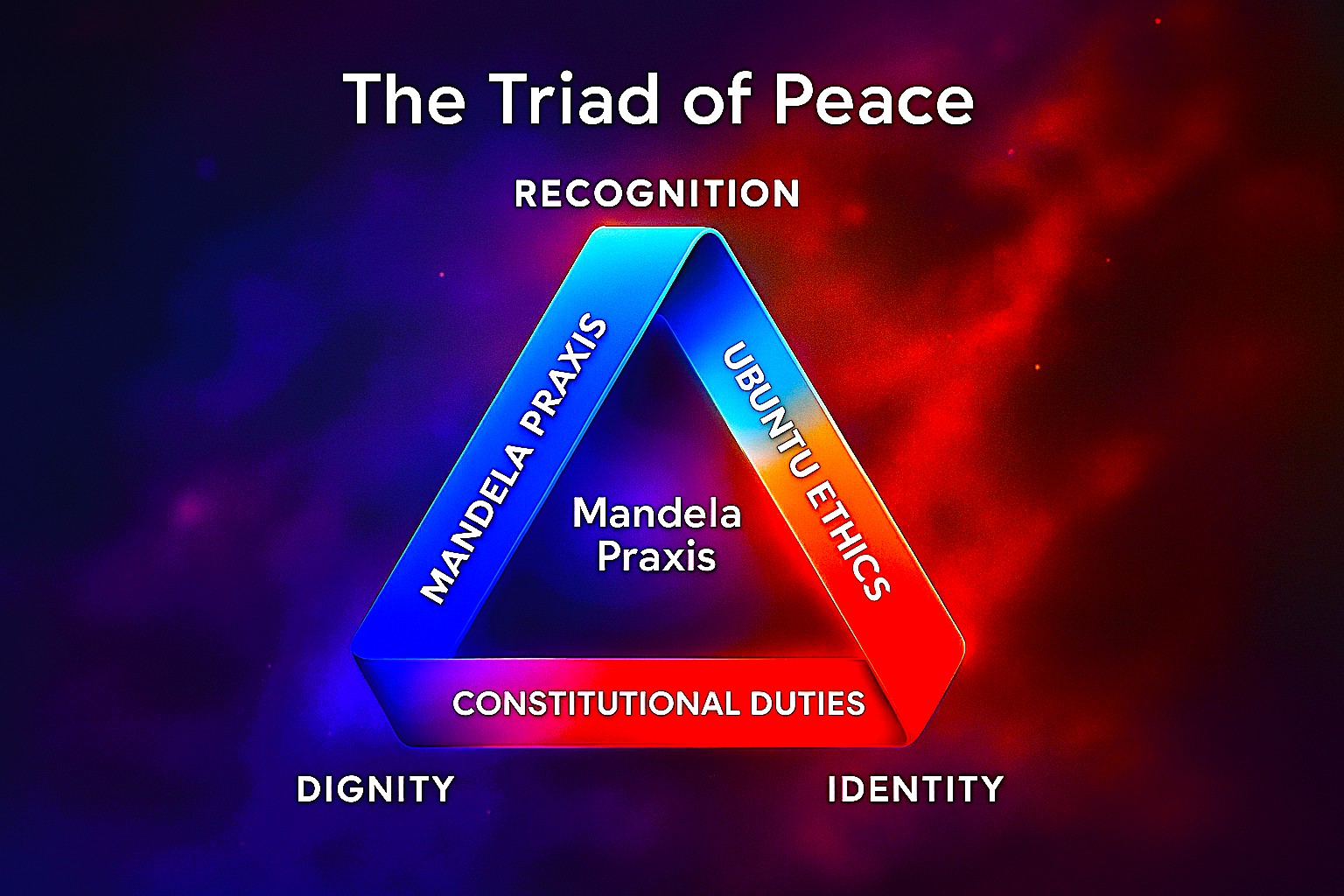
The Triad of Peace: A 3D triangular structure illustrating “Recognition-Dignity- Identity” anchored by Mandela Praxis, Ubuntu Ethics, and Constitutional Duties.
This graphic reflects the philosophical architecture of the foundational elements of Peace, as an Integrated Linguistic-Philosophical Framework
Original Graphic Conceptualised by Mrs V. Vawda, March 2026
Prologue:
This Part 2, in the series on correlation between Peace and indigenous, threatened, rare languages turn to the heart of the matter: the Mandela–Ubuntu–Language hinge, where mother‑tongue recognition becomes the moral grammar of dignity, umuntu ngumuntu ngabantu.[3] As illustrated in the above infographic, which encapsulates the original Vawdaian[4] proposal of the Triad of Peace, a conceptual model, in which Recognition, Dignity, and Identity operate as interdependent pillars of linguistic peace-building. The triangular form symbolises structural reciprocity: each side reinforces and is reinforced by the others, reflecting the relational logic central to African humanism. The upper axis, Recognition, foregrounds the ethical imperative to affirm the presence, worth, and cultural world of the Other, an imperative exemplified in Mandela’s commitment to multilingual engagement as a means of humanising political adversaries and dissolving historical hostilities. The lower-left axis, Dignity, highlights the socio‑moral significance of enabling individuals and communities to express themselves in their heritage languages; dignity here is inseparable from linguistic agency and constitutional protections that guarantee equitable language rights. The lower-right axis, Identity, anchors the affective and epistemic dimensions of language, acknowledging that heritage languages are repositories of memory, worldview, and selfhood.
The interior dimensions of the triangle illustrate how Mandela’s Praxis[5], Ubuntu Ethics[6], and Constitutional Duties[7] interact to sustain the Triad. Mandela’s praxis represents the strategic and moral use of language to restore trust and social cohesion. Ubuntu ethics situate personhood as inherently relational, umuntu ngumuntu ngabantu, thereby positioning language as a medium through which communal bonds are articulated, renewed, and ethically maintained. Constitutional duties provide institutional grounding by mandating parity of esteem among languages and safeguarding the linguistic rights that enable recognition and dignity to be materially realised.
Together, these elements form an integrated peace architecture in which language is not merely communicative but constitutive of ethical relations, national healing, and collective flourishing. The triangular geometric configuration conveys stability, balance, and interdependence, symbolising that sustainable peace arises only when recognition, dignity, and identity are all simultaneously upheld.
Language is not a neutral conduit of information; it is a moral technology that confers recognition, dignity, and identity. This paper argues that linguistic choice and preservation are central to peacebuilding. It examines Mandela’s pragmatic language ethos, the Ubuntu ethic of relational personhood encapsulated by umuntu ngumuntu ngabantu, and neurocognitive evidence showing that native languages evoke stronger emotional engagement than foreign languages. The analysis situates language as the connective tissue between memory (Part 1: heritage/identity) and humanistic praxis (Part 3: Ubuntu peace) and concludes with a Call to Action for revitalising endangered languages under a structured SPERL agenda (Saving, Protecting, Empowering, Reviving Languages). Policy anchors include South Africa’s constitutional language provisions and UNESCO’s 2022–2032 International Decade of Indigenous Languages.[8]
- Introduction: Language as Humanity’s First Peace Treaty[9]
Before laws and institutions, peace begins in language, in the possibility of mutual intelligibility and recognition. Each language encodes a lived cosmology; losing a language is losing a way of feeling and knowing the world. Ubuntu philosophies emphasise that a person becomes a person through others, a view rendered linguistically in Nguni as umuntu ngumuntu ngabantu (“a person is a person through other persons”), which frames language not merely as description but as relation-creating action[10].
South Africa’s historical arc, languages weaponised under apartheid and re-humanised in the democratic dispensation, offers a unique testbed. The Constitution recognises 11 official languages, mandates equitable treatment, and tasks the state with elevating the status and advancing the use of indigenous languages, principles made operational by instruments like the Official Use of Languages Act (2012) and departmental language policies.
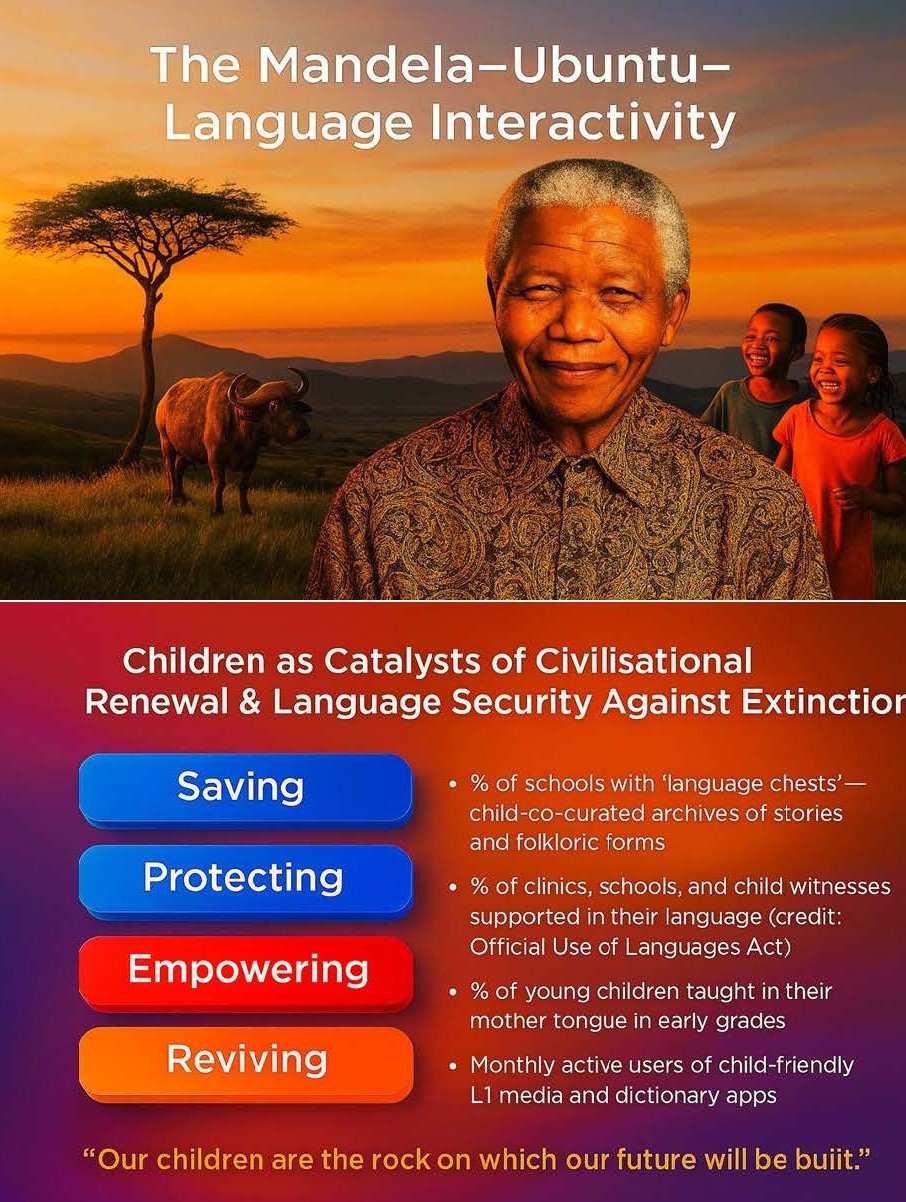
Languages, Mandela Peace Philosophy and nurturing Children
Photo Top: The Vawdaian concept of Language and Peace inter-connectedness, as illustrated by the first democratically elected President Mandela and the uniquely South African philosophy of Ubuntu encapsulating the dictum, if you are desirous of a change, start with the children, the future of a country.
Photo Bottom: Children worldwide are the Catalyst for ant transformative change, especially in preservation of Indegenous and Rare Languages, Globally
Original Graphics Conceptualised by Mrs V. Vawda, March 2026
Children as Catalysts of Civilisational Renewal and Language Security Against Extinction.[11]
1) Executive Thesis
Children are the decisive leverage point for reversing language loss and catalysing civilisational renewal. A child‑first strategy aligns with:
- Global commitments to safeguard indigenous/heritage languages (UNESCO’s International Decade of Indigenous Languages 2022–2032 [12]and the World Atlas of Languages), both calling for documentation, revitalisation, and digital inclusion.
- National duties (e.g., South Africa’s Official Use of Languages Act and constitutional parity of esteem) that can be operationalised through child‑centred service, schooling, and media.
- Statespersonship that frames children as a nation’s future (e.g., Nehru’s insistence that the way we raise children “will determine the future of the country,” and Mandela’s vision of children as the “rock on which our future will be built”).
The synthesis below translates this vision into SPERL (Saving • Protecting • Empowering • Reviving • Languages), with children at the centre.
2) Why children? The scientific and policy case
- Affective, cognitive anchoring in the mother tongue
Studies show that native languages carry stronger emotional resonance than later‑learned languages, with higher autonomic arousal to emotionally laden words and reprimands in L1. This “emotional depth” supports identity formation, empathy, and moral socialisation, key goals of basic education.
- Decision‑making and moral reasoning
Research on the Foreign‑Language Effect indicates that processing in a foreign language increases cognitive distance and can dampen affect; vital affective–ethical learning therefore benefits from early, sustained L1 exposure in school and at home.
- Global risk of language extinction
International assessments warn that a large share of the world’s ~7,000 languages is endangered, prompting a decade‑long mobilisation (IDIL 2022–2032) and a data infrastructure (World Atlas of Languages) to track vitality and guide interventions, both emphasising intergenerational transmission as the decisive variable.
- Policy levers exist
In multilingual democracies, constitutional and statutory frameworks mandate equitable use and development of official languages; child‑facing services (schooling, clinics, courts’ child‑witness support) are the most scalable pathways to make those rights lived realities.
3) The SPERL Framework, Child‑Centred Version
S , Saving (document and seed)
Goal: Create durable, child‑friendly records and learning seeds for threatened languages.
- Community kid‑corpora: Record children’s songs, playground chants, riddles, folktales with grandparents; index in the UNESCO World Atlas of Languages–compatible format.
- School‑based micro‑archives: Every primary school hosts a class‑curated digital “language chest” (audio, drawings, sub‑titles), linked to district repositories; aligns with IDIL’s call for community‑owned documentation.
- Child health touchpoints: During vaccination/growth‑monitoring visits, clinics invite caregivers to contribute a lullaby/proverb in L1 to the local archive, normalising language pride outside
Child‑impact metric: Number of schools with active “language chests”; hours of child‑generated L1 audio/video archived and reused in class.
P , Protecting (rights and safe use)
Goal: Guarantee environments in which children can safely use heritage languages without discrimination.
- Rights in service delivery: Implement the Official Use of Languages Act in child‑facing offices (birth registration, child grants, clinics); provide signage and forms in the dominant local languages.
- Anti‑stigma school codes: Explicitly prohibit shaming or punitive measures for speaking L1 on campus; integrate language‑respect modules in life orientation curricula. (Reinforces constitutional parity and dignity.)
- Child witness support: In juvenile justice and social services, guarantee certified interpreters so that a child’s testimony and needs are heard in L1, improving accuracy and safeguarding rights.
Child‑impact metric: Share of child‑facing facilities operating in ≥3 official languages; complaints on language discrimination resolved within 30 days.
E , Empowering (learners and teachers)
Goal: Equip children and the adults around them to use and create in L1 (with strong bridges to lingua francas).
- Mother‑tongue‑based multilingual education [13](MTB‑MLE): Early grades taught in L1 with additive bilingualism to English/other lingua francas; this aligns with global guidance and improves literacy transfer.
- Teacher upskilling: Fund in‑service credentials for L1 reading science, oral‑language pedagogy, and emotionally rich vocabulary work, leveraging evidence that affectively loaded L1 contexts deepen learning.
- Parents as co‑educators: “10‑minute L1 read‑aloud” daily pledge with guided tip‑sheets; distribute dual‑language decodable readers so children see L1 and L2 as both/and rather than either/or.
Child‑impact metric: Grade‑3 reading comprehension in L1 and transfer to L2 by Grade‑4; time‑on‑task in L1 literacy blocks.
R , Reviving (culture, media and tech)
Goal: Make L1 the language of joy, aspiration, and modernity for children.
- Kid‑first media ecology: Commission animated shorts, audiobooks, and STEM explainer videos in L1; embed local idioms and proverbs so children experience cultural pride in contemporary formats. (IDIL emphasises digital inclusion.)
- Gamified lexicons[14]: Co‑create child‑friendly dictionaries with emojis, audio, and etymology trails; host spelling bees and proverb slams at district festivals to make prestige visible.
- Makers’ labs: After‑school clubs that script, film, and subtitle community stories; outputs archived to the school “language chest,” then syndicated to local radio.
Child‑impact metric: Monthly active users of L1 kid‑content platforms; number of youth productions broadcast/streamed.
L , Languages (mainstreaming and governance)
Goal: Position languages as cross‑cutting assets in education, health, justice, and economic development.
- Whole‑of‑government plan: Annual Language Equity Scorecard tracking each department’s child‑impact indicators (services, content, training); aligns national reporting with IDIL dashboards.
- Budget‑tagging: Earmark a small percentage of child‑facing programme budgets to L1 content and translation, recorded in the Estimates of National Expenditure; this converts rights into resourced delivery.
- Public mobilisation: National Children and Languages Week, libraries, museums, and sports codes partner to normalise L1 usage in elite spaces (courts, stadiums, science centres).
Child‑impact metric: % of departmental child‑facing outputs meeting language‑access standards; IDIL‑aligned annual progress report published.
4) Programmatic Blueprint (24‑month starter roadmap)
Quarter 1–2
- Establish a Child‑Language Task Team (Education, Arts and Culture, Health, Justice, civil society, youth creators).
- Select pilot districts (multilingual with one endangered or under‑served language).
- Design language chest templates and consent protocols.
Quarter 3–4
- Launch MTB‑MLE booster in Grade R–3; roll out dual‑language readers.
- Train clinic and social services staff on L1 intake and interpretation pathways.
Year 2
- Commission kid‑first media (animated folktales, science explainers).
- Host district proverb slams and radio storytelling seasons; archive outputs to the World Atlas–compatible formats.
- Publish the first Language Equity Scorecard and budget‑tagging report.
5) Guardrails and Ethics
- Child safeguarding and consent in all recordings and broadcasts; align with IDIL’s community‑ownership ethos and privacy norms.
- Non‑extractive documentation: Communities retain IP; schools/archives hold use licences, not ownership.
- Additive bilingualism: L1 foundations enriched with high‑quality bridges to L2/L3, preservation and (Avoid subtractive shifts that accelerate L1 loss.)
6) Success Signals (what “civilisational renewal”[15] looks like for children)
- Identity and dignity: Children confidently present, debate, and create in L1 and L2; measurable declines in reported L1 stigma in schools.
- Vitality curve bending upward: More child speakers, more child‑produced content, and routine L1 use in public services; improved atlas vitality descriptors for target languages.
- Cognitive–affective outcomes: Richer vocabulary and narrative skills in L1 feeding stronger L2 performance and social–emotional learning, a pattern consistent with the affective depth of L1 usage.
7) A universal call, anchored in leaders’ words
- “Children of today will make the … tomorrow.” The way we raise and educate them charts a nation’s future.
- “Our children are the rock on which our future will be built.” A child‑first language policy is, therefore, a nation‑building policy.
- The Mandela–Ubuntu–Language Interactivity
2.1 Mandela’s Linguistic Praxis: From Head to Heart
A widely circulated aphorism attributes to Nelson Mandela the maxim: “If you talk to a man in a language he understands, that goes to his head. If you talk to him in his own language, that goes to his heart.” While the spirit is faithful to his practice, scholars have noted that the exact phrasing is likely a later paraphrase of Mandela’s 1992 discussion with Richard Stengel [16]about speaking Afrikaans to Afrikaner warders: “when you speak Afrikaans, you go straight to their hearts.” The ethos, speaking an interlocutor’s language as moral persuasion and psychological disarmament, remains historically grounded.
Mandela’s multilingual outreach softened adversarial postures, acknowledged personhood, and repositioned negotiation from confrontation to conversation. In praxis terms, multilingualism became a peace strategy, not a performance: address guards in Afrikaans; affirm Black South Africans in isiXhosa/isiZulu/Sesotho/Setswana; and model a dignity-first approach to reconciliation.
2.2 Ubuntu as Linguistic Ethic[17]
Ubuntu is a relational ethic and a linguistic worldview. The proverb umuntu ngumuntu ngabantu captures that personhood is co-authored. Ubuntu orients speakers toward courtesy, mutuality, and restorative intent, transforming speech into a moral act that seeks harmony and reintegration rather than alienation or punishment. Linguistic and philosophical treatments trace the term and its cognates across Bantu languages, showing historical depth and semantic evolution from Proto-Bantu roots, reinforcing that Ubuntu is not a slogan but a civilisational grammar of being.
- Philosophical Grounding: Recognition, Dignity, Identity
- Recognition: To address a person in their languageis to say “I see you”, to acknowledge their symbolic world. This is the first condition of peace, because invisibility breeds grievance. Ubuntu codifies recognition as a shared moral.
- Dignity: The right to speak, learn, and be served in one’s language is bound to material dignityin South African constitutional thought, parity of esteem and equitable treatment, and to global cultural rights discourses.
- Identity: Languages store ancestry, metaphors, moral archetypes, prayer, and grief. The loss of a languageis a loss of identity infrastructure, hence UNESCO’s global decade for indigenous languages.
These pillars, recognition → dignity → identity, comprise a triadic architecture of peace that is interculturally resonant yet locally actionable.
- Sociolinguistic and Neurocognitive Validation
4.1 Emotional Resonance: Native vs. Foreign Languages
A robust literature demonstrates that native (L1) languages elicit stronger emotional reactivity than foreign (L2) languages:
- Psychophysiology: Turkish–English bilinguals show greater skin-conductance responsesto taboo words and childhood reprimands in L1 than L2, objective evidence that L1 is more affectively charged.
- Survey and usage data: Across >1,000 multilinguals, the emotional force of taboo wordsis rated highest in L1 and decreases with later‑learned languages; naturalistic acquisition amplifies emotionality relative to classroom learning.
- Reviews and applications: Reviews synthesize that affective processing is typically weaker in L2, with implications for decision‑making, forensic interviewing, and persuasion.
4.2 Moral Judgment and Decision‑Making: The Foreign‑Language Effect (FLE)
- Seminal finding: Using a foreign language reduces framing biasesand loss aversion, consistent with emotional distancing that promotes more analytic processing.
- Meta‑analysis: Aggregated evidence shows that foreign‑language contexts increase utilitarian choicesin moral dilemmas and reduce risk aversion; similarity between L1–L2 moderates effect sizes.
- Recent clarifications: Newer studies nuance FLE by highlighting impacts on metacognition(lower “feeling‑of‑rightness,” longer decision times) even when headline moral choices don’t always shift, useful for designing deliberative peace dialogues.
Implication for peace processes: Negotiations only in a colonial or third language may attenuate emotional authenticity and trust formation; strategically including heritage languages can heighten empathic engagement, confession, and reconciliation, precisely the “heart” Mandela targeted in practice.
- Mandela’s Language Ethos Revisited
Mandela’s method had four synergistic layers:
- Healing(address trauma with linguistic acknowledgement).
- Fear‑dismantling(use the out‑group’s language to neutralise threat perception).
- Power realignment(shift from adversarial distance → dialogic proximity).
- Peace diplomacy(language as credible signal of respect and intent).
The underlying principle is multilingualism as moral action, not mere technique, an ethos consistent with Ubuntu’s relational grammar.
- Policy and Rights Framework: From Ethos to Institutions
- Constitutional anchors: Section 6 recognises 11 official languages and imposes duties on the state to elevate indigenous languages; subsequent policy instruments operationalise parity and equitable access across departments.gov+1
- Jurisprudence and practice: Scholarly analyses document tensions between ideal and implementation, noting drift toward English in higher domains and the need for positive state actionto achieve substantive equality for linguistic communities.
- Global mandate: The International Decade of Indigenous Languages (2022–2032)mobilises states and civil society to preserve, revitalise, and promote linguistic diversity; the UNESCO World Atlas of Languages provides a living infrastructure for data and monitoring.
- Ubuntu as Linguistic Praxis in Diverse Societies
Ubuntu reframes speech acts as co‑creation of social harmony. In plural polities, this yields practical commitments:
- Service delivery: Provide frontline servicesin dominant local languages and accessible translation, reducing institutional alienation.gov
- Education: Strengthen mother‑tongue instructionin early grades with bridges to additional lingua francas; this aligns with dignity, identity, and learning outcomes argued in local and comparative policy reviews.
- Justice and reconciliation: Embed language rightsin restorative processes, honouring the affective truth that victims and perpetrators can express more fully in L1.
- Epigraph / Epilogue
“Languages are the rivers of human memory; when a river dries, a civilisation forgets how to feel.”
This trilogy honours language as the lifeblood of recognition, dignity, and identity, and thus as the architecture of peace.
- Call to Action: Preventing Further Degradation and Advancing SPERL
SPERL , Saving, Protecting, Empowering, Reviving Languages
9.1 Saving
- Documentendangered languages (audio corpora, dictionaries, grammars) and deposit open collections (e.g., ELDP/ELAR, UNESCO WAL).
9.2 Protecting
- Enforce constitutional parity and equitable treatmentin public communications; audit departmental compliance with the Official Use of Languages Act.gov
9.3 Empowering
- Fund community media, mother‑tongue literacy, and intergenerational storytellingprojects; harness Ubuntu proverbs as civic pedagogy.
9.4 Reviving
- Align with the UN International Decade of Indigenous Languages (2022–2032)to access global guidance, partnerships, and reporting frameworks; address the sobering projections that 50–90% of languages risk endangerment by 2100 without concerted action.
- Take‑Home Message
The Philosophical and Sociolinguistic Exploration
Language as Recognition
To speak someone’s language is to say:
- “I see you.”
- “Your culture has value.”
- “Your identity deserves space.”
Recognition is the first prerequisite for peace.
Language as Dignity
Dignity arises from:
- being heard,
- being understood,
- being allowed to express oneself in one’s authentic voice.
Stripping language is stripping dignity; restoring language is restoring humanity.
Language as Identity
Every language encodes:
- metaphors of moral behaviour,
- cosmologies,
- kinship structures,
- spiritual interpretations of life and death.
Thus, language is identity in audible form.
Language is peace.
To preserve language is to preserve dignity; to respect language is to respect identity; to revive language is to revive humanity. Ubuntu and Mandela’s praxis converge on this truth.
- Conclusion: The Intellectual Hinge
Part 2 demonstrates that language is the hinge of your Trilogy: the bridge from heritage and identity (Part 1) to applied peace and African humanism (Part 3). Empirically (psychophysiology, decision science), normatively (Constitution/rights), and philosophically (Ubuntu), linguistic choice is a peace intervention. The next movement (Part 3) should convert this architecture into operational guidelines, dialogue protocols, and training for peace practitioners, with languages as core design variables, not afterthoughts.
- The Bottom Line (for Diverse Communities, Nationally and Globally)
- Multilingual equityis human rights in action.gov
- Heritage languagesare public goods; their loss is a societal harm.
- Ubuntu‑guided speechoperationalises recognition → dignity → identity, the triad of peace.
The protection of endangered languages is an odyssey toward a multilingual future in which rights, resources, and rituals move in concert, and where communities are held together by the most human of bonds: language that speaks to the heart without forsaking the mind.
The author has written extensively about Peace Propagation and formulated the concept of Endogenous[18] and Exogenous Peace[19] as well as proposed new theories about propagative peace.[20],[21],[22], [23], [24]. He has also incorporated the uniquely South African concept of Ubuntu Peace philosophy, the Vawdaian peace theory and the Emeritus, late Professor Johan Galtung’s peace presentations to counteract global belligerism [25] across continents, by peace disrupting governments, in recent months. The author has concertedly attempted to embark on this project as a Peace Protagonists,[26] Human aggression comes from biophotonic[27] disruption and reptilian-brain dominance. The Human Proclivity towards Peace, underlines the neuro-psychological evolution of the human consciousness itself.[28]
Mandela’s Language Ethos[29]
Mandela understood that language is:
- An instrument of healing
- Speaking Afrikaans to Afrikaner guards softened hardened attitudes.
- An instrument of dismantling fear
- Using isiXhosa, isiZulu, Sesotho, or Setswana affirmed the worth of Black South Africans.
- An instrument of psychological realignment
- Language shifts power dynamics from confrontation → conversation.
- An instrument of peace diplomacy
- Mandela used language to turn adversaries into partners.
Mandela’s Legacy Approach:
- Multilingualism as moral action.
- Language as humanisation.
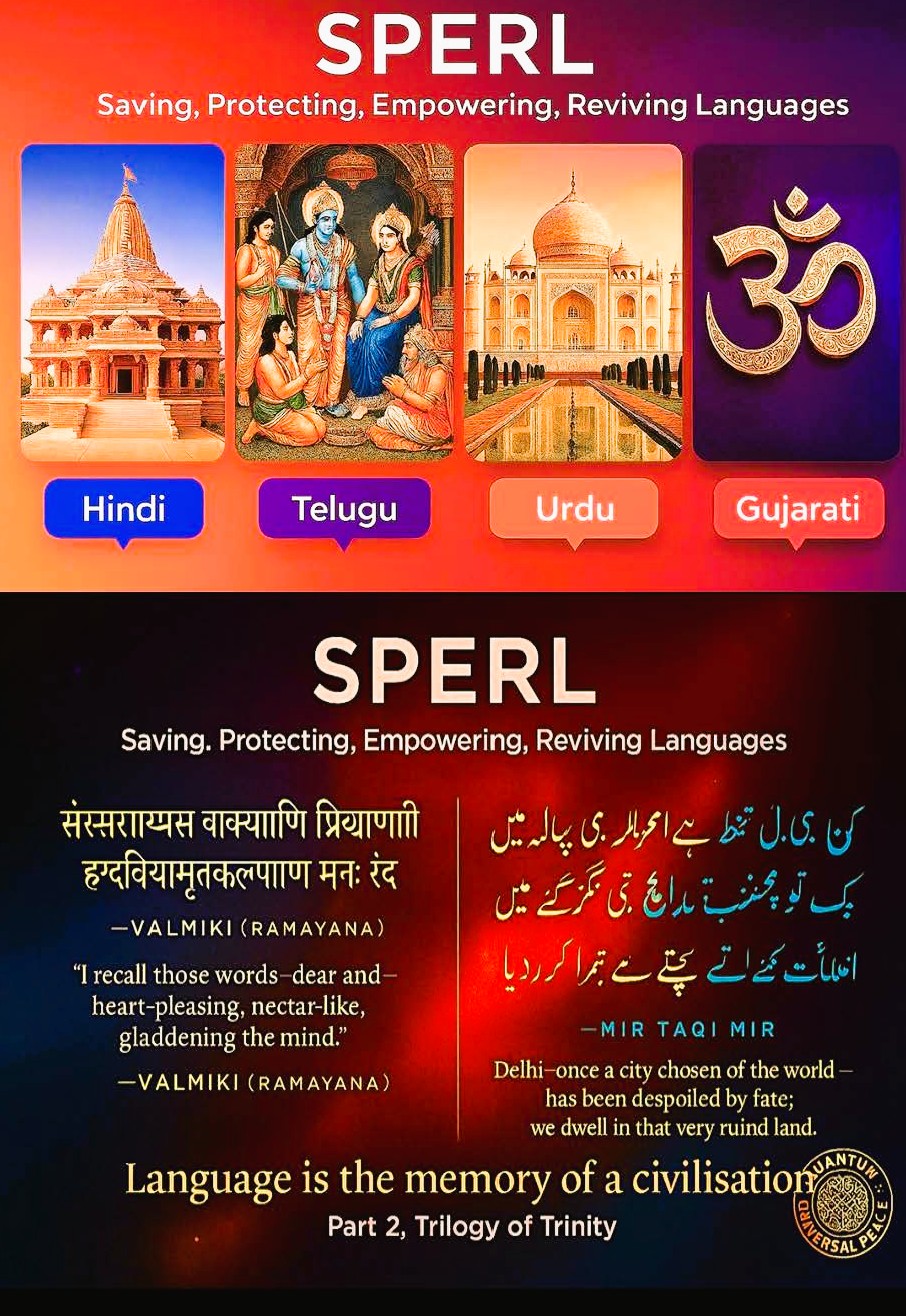
The Society for the Preservation of Extinct and Rare Languages ensuring sustained peace
Photo Top: A graphic highlighting the Preservation of Rare, Indian Languages from extinction, to enhance, Social Cohesion and Peace Propagation, at the level of diverse multi-traditional and multi-religious societies, as evident in Motherland, India and in the global diaspora, including South Africa.
SPERL encapsulation featuring:
Hindi , Vedantic/Hindu temple architecture motif
Telugu , a Ramayana panel to represent classical narrative heritage
Urdu , the Taj Mahal as an emblem of Indo‑Islamic art and poetry
Gujarati , a bold Āum (Om) glyph and ornate patterning inspired by Gujarati design traditions
Photo Bottom: Quotes from authors and Poets in Indigenous language under threat of extinction.
Original Photographs Conceptualised by Mrs V. Vawda, March 2026
1) On the heart‑healing power of remembered words
Sanskrit[34] (Devanāgarī):
संस्मराम्यस्य वाक्यानि प्रियाणि मधुराणि च ।
हृद्यान्यमृतकल्पानि मनः प्रह्लादानि च ॥ ३–१६–३९ ॥
IAST: saṃsmarāmy asya vākyāni priyāṇi madhurāṇi ca | hṛdyāny amṛta‑kalpāni manaḥ prahlādāni ca || 3.16.39 ||
Sense: “I recall those words, dear and sweet, heart‑pleasing, nectar‑like, gladdening the mind.” [35]
2) On ethical speech (soft vs. truthful yet ‘unwelcome’ counsel)
Sanskrit (Devanāgarī):
सुलभाः पुरुषा राजन् सततं प्रियवादिनः ।
अप्रियस्य तु पथ्यस्य वक्ता श्रोता च दुर्लभः ॥
IAST: sulabhāḥ puruṣā rājan satataṃ priyavādinaḥ | apriyasya tu pathyasya vaktā śrotā ca durlabhaḥ ||
Sense: “O King, speakers of pleasing words are common; but rare are those who speak and those who hear the beneficial truth that may be unwelcome.” [36]
- B) Bahadur Shah Zafar (1775–1862)[37], Exile, Loss, and Cultural Memory (Urdu)
Opening couplet (matlaʿ) from the celebrated ghazal:
Urdu (Nastaʿlīq):
لگتا نہیں ہے دل مرا اُجڑے دیار میں
کس کی بنی ہے عالمِ ناپائیدار میں
Transliteration: lagtā nahīn hai dil merā ujṛe diyār meñ / kis kī banī hai ʿālam‑e nā‑pāydār meñ
Sense: “My heart finds no rest in this ravaged homeland; who has ever found permanence in a transient world?”[38]
Closing couplet (maqtaʿ):
Urdu (Nastaʿlīq):
کتنا ہے بد نصیب ‘ظفر’ دفن کے لئے
دو گز زمین بھی نہ ملی کوئے یار میں
Transliteration: kitnā hai bad‑nasīb ‘Zafar’, dafn ke liye / do gaz zamīn bhī na milī kū‑e‑yār meñ
Sense: “How ill‑fated is ‘Zafar’: not even two yards of earth to be buried in the beloved’s lane.” [39]
- C) Mīr Taqī Mīr (1723–1810), [40] Delhi as Language–Civilisation
Elegy for a ruined city:
Urdu (Nastaʿlīq):
دہلی جو ایک شہر تھا عالم میں انتخاب
رہتے تھے منتخب ہی جہاں روزگار کے
اس کو فلک نے لُوٹ کے ویراں کر دیا
ہم رہنے والے ہیں اسی اُجڑے دیار کے
Transliteration: dillī jo ek shahr thā ʿālam meñ intikhāb / rehte the muntaḳhab hī jahāñ rozgār ke / us ko falak ne lūṭ ke vīrān kar diyā / ham rahne vāle haiñ usī ujṛe diyār ke
Sense: “Delhi, once a city chosen of the world, home to the most select livelihoods, has been despoiled by fate; we dwell in that very ruined land.” [41]
On Delhi’s streets as living art:
Urdu (Nastaʿlīq):
دلّی کے نہ تھے کوچے اوراقِ مصور تھے
جو شکل نظر آئی تصویر نظر آئی
Transliteration: dillī ke na the kūche aurāq‑e muṣavvir the / jo shakal nazar āʾī taṣvīr nazar āʾī
[42]Sense: “The lanes of Delhi were pages from an illuminated album; every visage appeared a portrait.”
- D) Ghalib, 1797–1869), [43]Plural Voices, Distinct Styles
Urdu (Nastaʿlīq):
ہیں اور بھی دنیا میں سخن ور بہت اچھّے
کہتے ہیں کہ ‘غالب’ کا ہے اندازِ بیاں اور
Transliteration: haiñ aur bhī duniyā meñ suḳhan‑var bahut achchhe / kahte haiñ ki ‘Ghālib’ kā hai andāz‑e bayān aur[44]
Sense: “There are many fine poets in the world; they say Ghalib’s manner of expression is yet another kind.”
To celebrate plurality of voices and styles in preservation work.)
Emotional Resonance Curve illustrating differential affective, cognitive, and autonomic responses to native (L1) versus later‑learned (L2+) languages.[45]
This figure below, models the well‑documented decline in emotional resonance as linguistic processing shifts from an individual’s first language (L1) to foreign or later‑acquired languages (L2+). Experimental research across psycholinguistics and affective neuroscience demonstrates that L1 is associated with stronger physiological arousal, including elevated skin‑conductance responses to emotionally salient words, reprimands, or moral dilemmas compared with L2+ processing. Large multilingual surveys similarly reveal that the subjective emotional intensity of lexical items decreases systematically as one moves farther from the native language, particularly for languages acquired through formal instruction rather than immersion.
On the rightward slope, the curve reflects the Foreign‑Language Effect, in which processing information in a non‑native language increases psychological distance, reduces emotional reactivity, and promotes more utilitarian or analytically driven judgments. Meta‑analytic findings confirm that reduced emotional embodiment in L2+ contexts is robust across domains, including moral reasoning and risk‑based decision‑making. Consequently, the horizontal axis (“Cognitive Distance”) captures the widening gap between conceptual processing and embodied affect as speakers move from L1 to L2+, while the vertical axis (“Emotional Responses”) represents the composite of autonomic reactivity, emotional vividness, and affective engagement.
The curve has direct implications for language revitalisation, pedagogy, and peace‑building. Because L1 processing engages deeper emotional circuitry and autobiographical memory, communication in native and heritage languages strengthens interpersonal trust, moral salience, cultural identity, and community cohesion. Conversely, reliance on L2+ alone can unintentionally attenuate the emotional force of communication, with consequences for counselling, mediation, early‑childhood instruction, and intergenerational transmission. The Emotional Resonance Curve therefore underscores the need to protect and revitalise L1 environments to preserve not only linguistic diversity but also the affective architecture of human cognition.
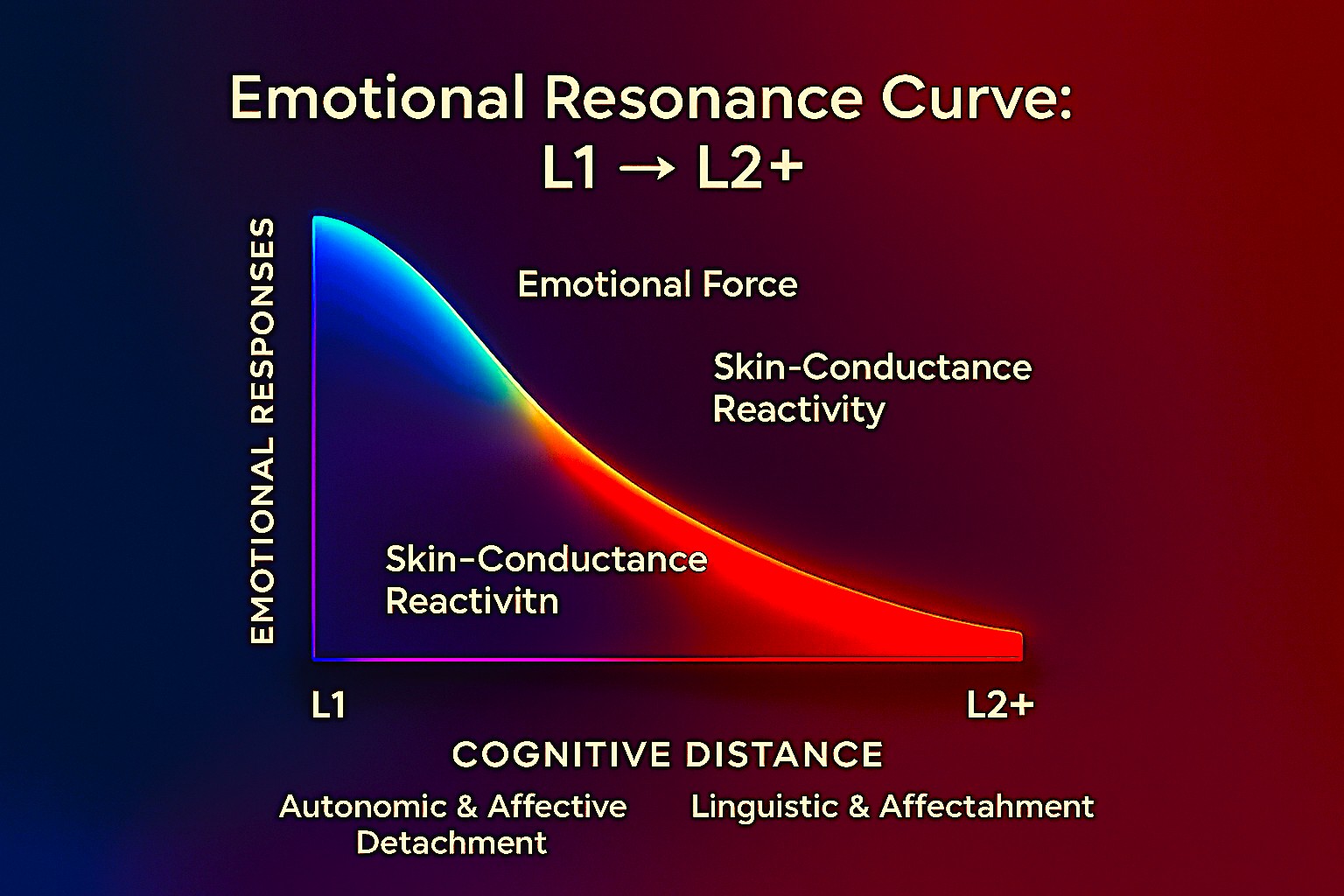
The Emotional Resonance Curve.
A scientific confirmation of addressing a person in L1 (mother tongue)or L2 (Foreign or secondarily learnt) languages, based on autonomic neuro-physio-psychology.
Original Graphic Conceptualised by Mrs V. Vawda March 2026
Policy Levers for Linguistic Equity and the SPERL Framework: An Integrated Model for Strengthening Linguistic Justice and Supporting Endangered Languages
This synthesises the multi‑layered policy architecture required to advance linguistic equity in South Africa by aligning constitutional mandates, departmental implementation mechanisms, and the SPERL[46] framework, Saving, Protecting, Empowering, Reviving Languages. At the upper tier, the figure highlights two overarching imperatives: Strengthening Linguistic Justice, which arises directly from constitutional commitments to promote and elevate historically marginalised indigenous languages, and Supporting Endangered Languages, reflecting the global urgency articulated through UNESCO’s International Decade of Indigenous Languages (2022–2032). These principles are grounded in statutory obligations such as the Official Use of Languages Act (2012), which requires government departments to adopt language policies, establish language units, and ensure equitable multilingual communication. [gov.za]
The second-tier foregrounds Constitutional and Statutory Mandates, encompassing foundational duties under Section 6 of the South African Constitution,[47] including parity of esteem, proactive development of indigenous languages, and non‑discrimination in language use. These mandates also extend to the protection of cultural rights, as language constitutes a core element of cultural heritage and identity within constitutional jurisprudence. [justice.gov.za], [pmg.org.za]
The third tier presents Departmental Implementation Levers, representing the operational machinery through which national and provincial entities fulfil constitutional obligations. These include multilingual service delivery, translation and interpretation in public services, and compliance monitoring by departmental language units. Academic and policy analyses underline persistent gaps between legal provisions and real‑world implementation, particularly the gradual privileging of English at the expense of indigenous languages, underscoring the need for systematic institutional enforcement. [uwcscholar.uwc.ac.za]
The fourth tier highlights Educational Policy Levers, emphasising the constitutional right to education in one’s language of choice where practicable, the pedagogical value of mother‑tongue instruction, and the need to prevent unjustified removal of indigenous-language tuition. Constitutional Court rulings and linguistic‑rights research note that while policies support multilingual education, institutional drift toward English medium instruction continues to undermine substantive linguistic equality. [zenodo.org]
At the foundation lies the SPERL Framework, which systematises language preservation into four interlocking domains: Saving (documentation and archiving of languages, aligned with UNESCO’s World Atlas of Languages), Protecting (legal safeguards and oversight mechanisms), Empowering (community-led revitalisation, teacher training, and public-language access), and Reviving (revalorisation of languages through curricula, arts, and digital inclusion). These categories map directly onto global strategies for revitalising endangered languages and resonate with UNESCO’s call for international coordination, capacity building, and digital infrastructure development. [unesco.org], [unesdoc.unesco.org]
Overall, the infographic visually articulates a coherent, multi‑scalar policy ecosystem, illustrating how constitutional principles cascade into departmental responsibilities and community-level action. By integrating national legal frameworks with international preservation standards, the model provides a robust foundation for strengthening linguistic justice and ensuring the survival, dignity, and flourishing of South Africa’s indigenous languages.
Table 1: Policy Levers: From Constitutional Mandates to Departmental Policies, with SPERL Alignment
| Policy Lever | Description / Requirements | Constitutional or Institutional Basis | SPERL Alignment |
| 1. Constitutional Recognition of 11 Official Languages | The Constitution recognises 11 official languages and requires the state to take practical and positive measures to elevate and advance the use of historically marginalised indigenous languages. | South African Constitution, s.6; Official Use of Languages Act 2012 [gov.za] | Protecting / Reviving, ensures foundational legal recognition and prevents symbolic erasure. |
| 2. Duty to Communicate in Languages of Choice (Where Practicable) | Government departments must communicate in at least three official languages and provide access to additional languages where feasible. | Official Use of Languages Act; CBE Language Policy; Constitutional language‑rights provisions [gov.za], [justice.gov.za] | Empowering / Protecting, enables linguistic dignity in state–citizen encounters. |
| 3. Creation and Enforcement of Departmental Language Policies | Each national department must adopt a language policy and establish a Language Unit to monitor compliance, promote multilingualism, and ensure equitable language use. | Official Use of Languages Act (2012); Departmental policy instruments (e.g., CBE Policy) [gov.za] | Saving / Protecting, institutionalises practices that safeguard language use. |
| 4. Parity of Esteem and Equitable Treatment | All official languages must enjoy equal status; the state may not privilege English at the expense of indigenous languages. | Constitutional obligations under s.6; jurisprudence emphasising substantive equality for minority languages [uwcscholar.uwc.ac.za] | Protecting / Reviving, combats linguistic marginalisation and hierarchical erosion. |
| 5. Mother‑Tongue Education and Language of Learning and Teaching (LoLT) | Policies encourage access to education in one’s mother tongue where practicable, with supportive transitions to additional languages. Court rulings emphasize the need for fairness, balancing access with constitutional rights. | Education provisions under s.29; Constitutional Court jurisprudence; language‑policy analyses [uwcscholar.uwc.ac.za], [zenodo.org] | Empowering / Reviving, strengthens intergenerational transfer of endangered languages. |
| 6. Promotion of Indigenous Languages as Cultural Heritage | Language is recognised as cultural property; communities have rights to maintain and develop their languages without discrimination. | Cultural‑rights discussions in constitutional frameworks; Afrikanerbond analysis [pmg.org.za] | Saving / Reviving, preserves languages as repositories of memory and identity. |
| 7. Mechanisms for Translation and Interpretation in Public Services | State institutions must provide access to translation/interpretation in courts, public hearings, and administrative processes to ensure fairness and inclusion. | Constitutional language‑rights architecture, judicial‑administrative provisions [justice.gov.za] | Protecting / Empowering, supports equitable access to justice and governance. |
| 8. National Archives and Documentation Mandate | Calls for systematic documentation of languages, especially endangered ones, through archives, corpora, dictionaries, and recordings. | UNESCO World Atlas of Languages; IDIL 2022–2032 Global Action Plan [unesco.org], [unesdoc.unesco.org] | Saving, preventing linguistic extinction through durable documentation. |
| 9. Support for Community‑Based Revitalisation Initiatives | Encourages funding and capacity building for community language programmes, local media, and intergenerational storytelling. | UNESCO International Decade of Indigenous Languages; global revitalisation frameworks [social.desa.un.org] | Empowering / Reviving, strengthens community ownership and transmission. |
| 10. Digital Inclusion and Language Technologies | Promote development of digital tools (keyboards, corpora, machine translation, online learning) to expand the presence of indigenous languages in the digital sphere. | UNESCO Global Roadmap for Multilingualism and World Atlas of Languages (digitization agenda) [unesdoc.unesco.org] | Reviving / Empowering, brings endangered languages into modern information ecosystems. |
| 11. Accountability and Monitoring Mechanisms | Departments must monitor implementation of language policies, report progress, and address non-compliance, ensuring linguistic equity is a measurable outcome. | Official Use of Languages Act implementation obligations; departmental oversight mechanisms [gov.za] | Protecting, ensures that legal provisions translate to lived linguistic rights. |
| 12. International Cooperation and Normative Alignment | Engagement with global partners to share best practices, access funding, and align national strategies with international conventions and decadal frameworks. | UN Permanent Forum on Indigenous Issues; IDIL 2022–2032 recommendations [social.desa.un.org] | Saving / Reviving, situates local efforts within global linguistic‑preservation movements. |
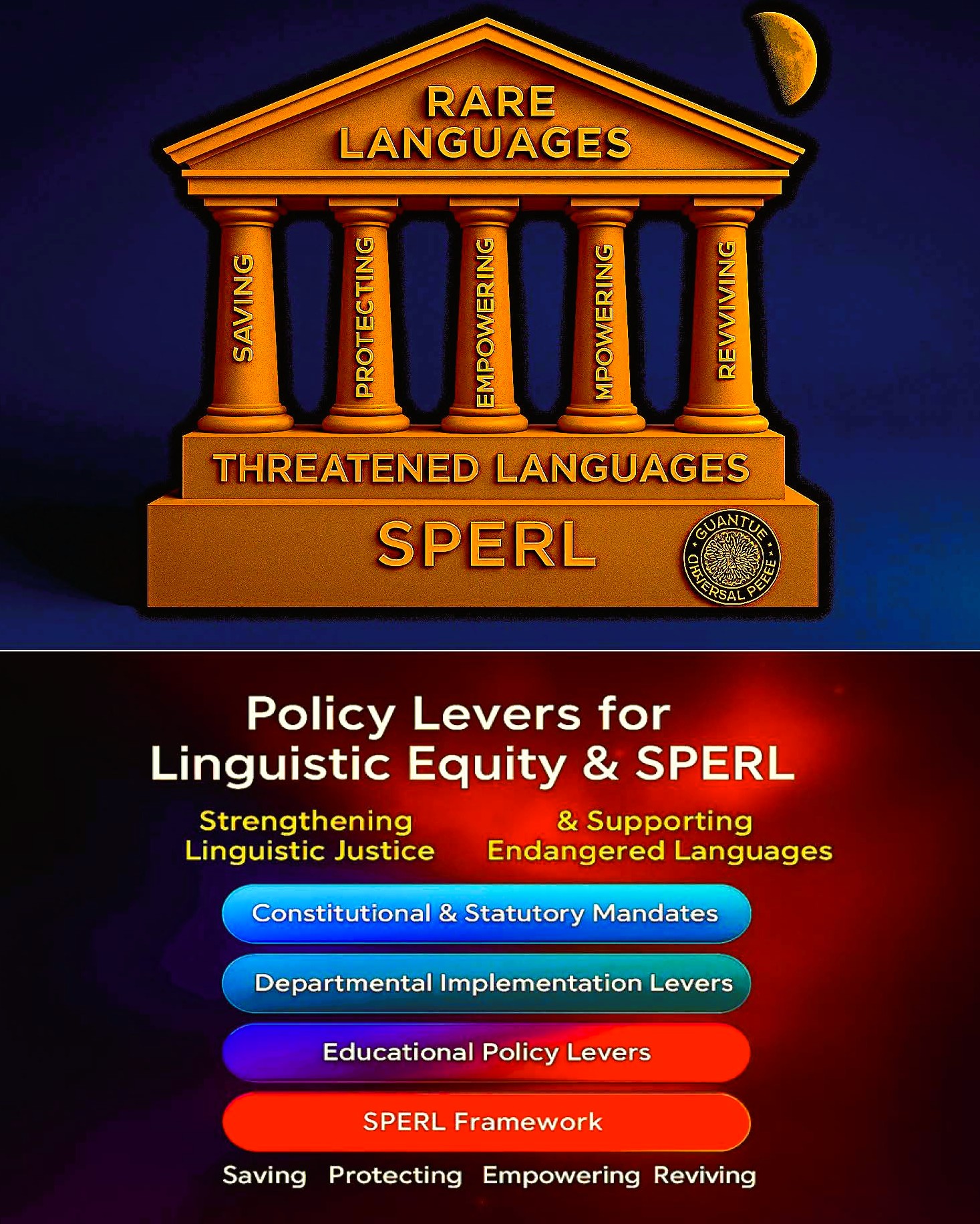
Countermeasures to prevent extinction of Rare Languages to ensure sustained Peace
Photo Top: The Pillars of SPERL upholding Rare Languages
Photo Bottom: A Graphic summarising the different tiers of Linguistic Equity as a Policy Initiative to augment the objectives of SPERL
Original Graphic Conceptualised by Mrs V. Vawda, March 2026
Comments and discussion are invited by e-mail: vawda@ukzn.ac.za
Global: + 27 82 291 4546
References:
[1] https://www.transcend.org/tms/2025/11/valmiki-the-silent-seer-of-resonant-endogenous-and-global-peace/
[2] Personal Quote by author, February 2026
[3] https://www.bing.com/ck/a?!&&p=dbc1b1da5740365466cf8d20ec211ab0735d314a3b4d4df6a116b5f41073a38dJmltdHM9MTc3MzEwMDgwMA&ptn=3&ver=2&hsh=4&fclid=37940f5c-820f-62a2-14ab-19c283916323&psq=umuntu+ngumuntu+ngabantu+meaning&u=a1aHR0cHM6Ly93d3cuc3R1ZG9jdS5jb20vZW4temEvbWVzc2FnZXMvcXVlc3Rpb24vMTI1NzE3MjkvdW1udHUtbmd1bW50dS1uZ2FiYW50dQ
[4] https://www.bing.com/ck/a?!&&p=1b67dd99a6911f6a4b1d8564d5a7f9e8bd91bdedece0e2fbb60010ab4af4a9fdJmltdHM9MTc3MzEwMDgwMA&ptn=3&ver=2&hsh=4&fclid=37940f5c-820f-62a2-14ab-19c283916323&u=a1aHR0cHM6Ly93d3cudHJhbnNjZW5kLm9yZy90bXMvYXV0aG9yLz9hPUhvb3NlbiUyMFZhd2Rh&ntb=1
[5] https://www.bing.com/ck/a?!&&p=32fa5369211a831407e6e2191db59288515952cb7b1c41c33af5e4520846237aJmltdHM9MTc3MzEwMDgwMA&ptn=3&ver=2&hsh=4&fclid=37940f5c-820f-62a2-14ab-19c283916323&u=a1aHR0cHM6Ly9lbi53aWtpcGVkaWEub3JnL3dpa2kvUHJheGlzXyhwcm9jZXNzKQ&ntb=1
[6] https://www.bing.com/ck/a?!&&p=447b72692ebc5ac34a3412f1ae2ecaa17080dc62742adbcb9b774fbc45706be4JmltdHM9MTc3MzEwMDgwMA&ptn=3&ver=2&hsh=4&fclid=37940f5c-820f-62a2-14ab-19c283916323&psq=ubuntu+ethics&u=a1aHR0cHM6Ly9saW5rLnNwcmluZ2VyLmNvbS9yd2UvMTAuMTAwNy85NzgtMy0zMTktMDk0ODMtMF80Mjg
[7] https://www.bing.com/ck/a?!&&p=928a884466a9163e2bf1cb127deb408c6f774f041fc49cd6e67b98ad2d586539JmltdHM9MTc3MzEwMDgwMA&ptn=3&ver=2&hsh=4&fclid=37940f5c-820f-62a2-14ab-19c283916323&psq=constitutional+duties&u=a1aHR0cHM6Ly9hY2FkZW1pYy5vdXAuY29tL2FqY2wvYXJ0aWNsZS83Mi8zLzY4NS84MDYzNjU1
[8] https://www.bing.com/ck/a?!&&p=92dd8bb8791ec657ce00a913cdc434d5fd2b83775070b9ed71add551c50b1fcdJmltdHM9MTc3MzEwMDgwMA&ptn=3&ver=2&hsh=4&fclid=37940f5c-820f-62a2-14ab-19c283916323&u=a1aHR0cHM6Ly93d3cudW5lc2NvLm9yZy9lbi9kZWNhZGVzL2luZGlnZW5vdXMtbGFuZ3VhZ2Vz&ntb=1
[9] https://www.bing.com/ck/a?!&&p=87c7cb028e3a4162fc9fb8660547c21ff71a35b72e7eb08264c2478ae41560dbJmltdHM9MTc3MzEwMDgwMA&ptn=3&ver=2&hsh=4&fclid=37940f5c-820f-62a2-14ab-19c283916323&psq=language+as+humanity%e2%80%99s+first+peace+treaty+pdf&u=a1aHR0cHM6Ly9saW5rLnNwcmluZ2VyLmNvbS9jb250ZW50L3BkZi8xMC4xMDU3L2lwLjIwMTAuMzQucGRm
[10] https://www.bing.com/ck/a?!&&p=fa35f0c24f16a35e76c0ee3a8542c173ee89039839210b23b320c0a782e0a2d1JmltdHM9MTc3MzEwMDgwMA&ptn=3&ver=2&hsh=4&fclid=37940f5c-820f-62a2-14ab-19c283916323&u=a1aHR0cHM6Ly93d3cuYmVoYXZpb3VyYW5kdGVjaG5vbG9neS5jb20vcG9zdC9yZWxhdGlvbmFsLWZyYW1lLXRoZW9yeS1sYW5ndWFnZS1jb2duaXRpb24tYW5kLXRoZS1pbmZsdWVuY2Utb2YtdGVjaG5vbG9neQ&ntb=1
[11] https://www.bing.com/ck/a?!&&p=1c633d0249f60315ea53fdf75a63262f37824a5f1498b5f48648206a67936849JmltdHM9MTc3MzEwMDgwMA&ptn=3&ver=2&hsh=4&fclid=37940f5c-820f-62a2-14ab-19c283916323&u=a1aHR0cHM6Ly9lYWpvdXJuYWxzLm9yZy93cC1jb250ZW50L3VwbG9hZHMvTGFuZ3VhZ2UtUmV2aXZhbC1TaWduaWZpY2FuY2UtU3RyYXRlZ2llcy1NZXRob2RzLWFuZC1Jc3N1ZXMucGRm&ntb=1
[12] https://www.bing.com/ck/a?!&&p=92dd8bb8791ec657ce00a913cdc434d5fd2b83775070b9ed71add551c50b1fcdJmltdHM9MTc3MzEwMDgwMA&ptn=3&ver=2&hsh=4&fclid=37940f5c-820f-62a2-14ab-19c283916323&u=a1aHR0cHM6Ly93d3cudW5lc2NvLm9yZy9lbi9kZWNhZGVzL2luZGlnZW5vdXMtbGFuZ3VhZ2Vz&ntb=1
[13] https://www.bing.com/ck/a?!&&p=766b322779325b213a52baba95f71f8eb681aa858e12e7f89a2cfafc0366998eJmltdHM9MTc3MzEwMDgwMA&ptn=3&ver=2&hsh=4&fclid=37940f5c-820f-62a2-14ab-19c283916323&psq=%e2%80%a2%09Mother+tongue+based+multilingual+education+&u=a1aHR0cHM6Ly91bmVzZG9jLnVuZXNjby5vcmcvYXJrOi80ODIyMy9wZjAwMDAyMzE4NjU
[14] https://www.bing.com/ck/a?!&&p=2b2d093c8c107b486dc41f1d337bb445dc38cfd916d0ebeb9357f1ebabe74281JmltdHM9MTc3MzEwMDgwMA&ptn=3&ver=2&hsh=4&fclid=37940f5c-820f-62a2-14ab-19c283916323&psq=%e2%80%a2%09gamified+lexicons+meaning&u=a1aHR0cHM6Ly9lZHVjYXRpb25hbHRlY2hub2xvZ3kubmV0L2dhbWlmaWNhdGlvbi13aGF0LWl0LWlzLWhvdy1pdC13b3Jrcy1leGFtcGxlcy8
[15] https://www.bing.com/ck/a?!&&p=06eb24b8ce03071a3c412b1ce45f3c7d175a17a45608583bd20cf06258cf4c0eJmltdHM9MTc3MzEwMDgwMA&ptn=3&ver=2&hsh=4&fclid=37940f5c-820f-62a2-14ab-19c283916323&u=a1aHR0cHM6Ly9pY3Jqb3VybmFsLm9yZy9pbmRleC5waHAvaWNyL2lzc3VlL2Rvd25sb2FkLzI3LzIy&ntb=1
[16] https://www.bing.com/ck/a?!&&p=ae078d3a23c24712a3f5b9900be451836bc5b63d3c20aad78717acc65eb9a359JmltdHM9MTc3MzEwMDgwMA&ptn=3&ver=2&hsh=4&fclid=37940f5c-820f-62a2-14ab-19c283916323&u=a1aHR0cHM6Ly90cHkubmVsc29ubWFuZGVsYS5vcmcvZm9vdG5vdGVzLzM2Mi1ubS1pbi1jb252ZXJzYXRpb24td2l0aC1yaWNoYXJkLXN0ZW5nZWwtam9oYW5uZXNidXJnLWNpcmNhLTI2LWFwcmlsLWFuZC0zLW1heS0xOTkzLWNkLTYxLW5tZi1qb2hhbm5lc2J1cmc&ntb=1
[17] https://www.bing.com/ck/a?!&&p=13035b3097ebfb56f3b65cd7d2ebb38af87562a27f106be7cab3ed3925a2b225JmltdHM9MTc3MzEwMDgwMA&ptn=3&ver=2&hsh=4&fclid=37940f5c-820f-62a2-14ab-19c283916323&psq=Ubuntu+as+Lingui
stic+Ethic&u=a1aHR0cHM6Ly9waGlsb3BlZGlhLm9yZy90cmFkaXRpb25zL3VidW50dS1waGlsb3NvcGh5Lw
[18] TRANSCEND MEDIA SERVICE » The Attainment of Sustained, Endogenous Peace: Sacred Postures for a Fractured World
[19] https://www.bing.com/ck/a?!andandp=9f95cdaa204fea30ad3af679f1ab7b313b2ebb746c5aa1c08d3c8cbfb7972831JmltdHM9MTc3MTAyNzIwMAandptn=3andver=2andhsh=4andfclid=37940f5c-820f-62a2-14ab-19c283916323andpsq=Exogenous+Peace+vawdaandu=a1aHR0cHM6Ly93d3cudHJhbnNjZW5kLm9yZy90bXMvMjAyNS8wOC90aGUtYXR0YWlubWVudC1vZi1wZWFjZS1hLW11bHRpZGltZW5zaW9uYWwtcGVyc3BlY3RpdmUv
[20] https://www.bing.com/ck/a?!andandp=034fe75ec36f056696e725d9b4ea3087c4af0fd5f0ddc4f1d0bdf6962d90e2baJmltdHM9MTc3MTAyNzIwMAandptn=3andver=2andhsh=4andfclid=37940f5c-820f-62a2-14ab-19c283916323andpsq=Peace+Protagonists%2c+hoosen+vawdaandu=a1aHR0cHM6Ly93d3cudHJhbnNjZW5kLm9yZy90bXMvMjAyNC8wMy9wZWFjZS1wcm9wYWdhdGlvbi1odW1hbi1yaWdodHMtZGF5LXBvc3QtbGliZXJhdGlvbi0xOTk0LXNvdXRoLWFmcmljYS1wYXJ0LTEv
[21] https://www.bing.com/ck/a?!andandp=6c5b0459700ca20bc6eb6bae97ab2f646b024e95bec3fde1de985dd245591412JmltdHM9MTc3MTAyNzIwMAandptn=3andver=2andhsh=4andfclid=37940f5c-820f-62a2-14ab-19c283916323andpsq=Peace+Protagonists%2c+hoosen+vawdaandu=a1aHR0cHM6Ly93d3cudHJhbnNjZW5kLm9yZy90bXMvMjAyNC8wMS9nbG9iYWwtd2ViaW5hci1zZXJpZXMtb3BwcmVzc29ycy1hbmQtcGVhY2UtZGlzcnVwdG9ycy8
[22]https://www.bing.com/ck/a?!andandp=aa0956c0af4996fbf6d678010420158779bb6262010036c2d54366c25ccf0e3eJmltdHM9MTc3MTAyNzIwMAandptn=3andver=2andhsh=4andfclid=37940f5c-820f-62a2-14ab-19c283916323andpsq=Peace+Protagonists%2c+hoosen+vawdaandu=a1aHR0cHM6Ly93d3cudHJhbnNjZW5kLm9yZy90bXMvdGFnL2FwYXJ0aGVpZC1tYXJ0eXJzLw
[23] https://www.bing.com/ck/a?!andandp=a8abb7e9791d7d6db751a036519a953d09cfbf6acccee42d5f41af52cb22e89bJmltdHM9MTc3MTAyNzIwMAandptn=3andver=2andhsh=4andfclid=37940f5c-820f-62a2-14ab-19c283916323andpsq=Peace+Protagonists%2c+hoosen+vawdaandu=a1aHR0cHM6Ly93d3cuZmFjZWJvb2suY29tL3RyYW5zY2VuZGludGVybmF0aW9uYWwvcG9zdHMvdGhlLWFjcmltb25pb3VzLWFuZC10YXJnZXRlZC1kZXN0cnVjdGlvbi1vZi1ob3VzZXMtb2YtZ29kLWNsaW1heC1vZi1yZWxpZ2lvcGhvYmkvNTgxMjQzMzUwODEyOTc0Lw
[24] https://www.bing.com/ck/a?!andandp=f5fa6cf0c30fedf6280c2077cc79a61a319559181440d3bd4b2ef9cbaf9b9b6bJmltdHM9MTc3MTAyNzIwMAandptn=3andver=2andhsh=4andfclid=37940f5c-820f-62a2-14ab-19c283916323andpsq=Peace+Protagonists%2c+hoosen+vawdaandu=a1aHR0cHM6Ly90aGVtYWpsaXMuY28uemEvYXJ0aWNsZXMvYWwtaGFxL3BhbGVzdGluZS10aGUtYXRoYWFiLW9mLWFsbGFoLXRhYWxhLw
[25] https://www.bing.com/ck/a?!andandp=2a93b8d170338938a01924b2afa33109c40a607366470f76f94c737806bee774JmltdHM9MTc3MTAyNzIwMAandptn=3andver=2andhsh=4andfclid=37940f5c-820f-62a2-14ab-19c283916323andpsq=belligerism+vawdaandu=a1aHR0cHM6Ly93d3cudHJhbnNjZW5kLm9yZy90bXMvMjAyNi8wMS91YnVudHUtcmlzaW5nLWEtcGVhY2UtZm9yY2UtYWdhaW5zdC1nbG9iYWwtYmVsbGlnZXJpc20v
[26] https://www.bing.com/ck/a?!andandp=bfa48f1dff587216ab251a4e4a7460075fca00e706b246ceac9fbd919cf3584aJmltdHM9MTc3MTAyNzIwMAandptn=3andver=2andhsh=4andfclid=37940f5c-820f-62a2-14ab-19c283916323andpsq=Peace+Protagonists%2c+hoosen+vawdaandu=a1aHR0cHM6Ly91bmJvdW5kZWRhY2FkZW15Lm9yZy90cmFuc2NlbmQtbWVkaWEtc2VydmljZS8
[27] https://www.bing.com/ck/a?!&&p=22a112b3f585ff365fc51e10d42a2ef3c9521de9bbe6a428113366d368e5e530JmltdHM9MTc3MzEwMDgwMA&ptn=3&ver=2&hsh=4&fclid=37940f5c-820f-62a2-14ab-19c283916323&psq=biophotonic+tms+vawdas&u=a1aHR0cHM6Ly93d3cudHJhbnNjZW5kLm9yZy90bXMvMjAyNi8wMy90aGUtZm91bmRhdGlvbnMtb2YtY29tbXVuYWwtcGVhY2Utc3VzdGFpbmluZy10aHJlYXRlbmVkLWxhbmd1YWdlcy1hcy1wZWFjZS1pbmZyYXN0cnVjdHVyZS1wYXJ0LTEv
[28] Personal Quote by author, February 2026
[29] https://www.bing.com/ck/a?!&&p=ac7e95837c7413c69b5284a1d7ee83bf2d57395e1e8fd46306c4a94ff16ce54eJmltdHM9MTc3MzEwMDgwMA&ptn=3&ver=2&hsh=4&fclid=37940f5c-820f-62a2-14ab-19c283916323&psq=MANDELA%e2%80%99S+LANGUAGE+ETHOS+Mandela+understood+that+language+is%3a+An+instrument+of+healing+Speaking+Afrikaans+to+Afrikaner+guards+softened+hardened+attitudes.+An+instrument+of+dismantling+fear+Using+isiXhosa%2c+isiZulu%2c+Sesotho%2c+or+Setswana+affirmed+the+worth+of+Black+South+Africans.+An+instrument+of+psychological+realignment+Language+shifts+power+dynamics+from+confrontation+%e2%86%92+conversation.+An+instrument+of+peace+diplomacy+Mandela+used+language+to+turn+adversaries+into+partners.+His+approach%3a+Multilingualism+as+moral+action.+Language+as+humanisation.&u=a1aHR0cHM6Ly93d3cucmVzZWFyY2hnYXRlLm5ldC9wdWJsaWNhdGlvbi8zNzE2MzIwNzBfQ3JpdGljYWxfRGlzY291cnNlX0FuYWx5c2lzX29mX05lbHNvbl9NYW5kZWxhJTI3c19TcGVlY2hfSV9BbV9QcmVwYXJlZF90b19EaWU
[30] https://www.transcend.org/tms/2025/11/valmiki-the-silent-seer-of-resonant-endogenous-and-global-peace/
[31] https://www.transcend.org/tms/2025/10/the-ramayana-as-a-treatise-on-peace-and-social-harmony/
[32] https://www.transcend.org/tms/2025/11/philosophy-of-peace-in-the-life-of-maharishi-valmiki-the-sage-from-the-anthill-to-spiritual-metamorphosis/
[33] https://www.transcend.org/tms/2025/10/the-inner-lamp-deepavalis-philosophy-of-peace-in-a-world-of-conflict-and-belligerence/
[34] https://www.bing.com/ck/a?!&&p=1cc31e72763230ed8b641df058447b2ae46a9cea863b456e816784acdde94a34JmltdHM9MTc3MzEwMDgwMA&ptn=3&ver=2&hsh=4&fclid=37940f5c-820f-62a2-14ab-19c283916323&psq=Sanskrit&u=a1aHR0cHM6Ly93d3cuYnJpdGFubmljYS5jb20vdG9waWMvU2Fuc2tyaXQtbGFuZ3VhZ2U
[35]https://www.bing.com/ck/a?!&&p=9d5a435bc7cfe86e90421d4ba8bd02411dc0545787bbeb217577b29f4ba2ae62JmltdHM9MTc3MzEwMDgwMA&ptn=3&ver=2&hsh=4&fclid=37940f5c-820f-62a2-14ab-19c283916323&psq=%5bdharmasutra.org%5d&u=a1aHR0cHM6Ly93d3cuZGhhcm1hc3V0cmEub3JnL2Jsb2c
[36] https://www.bing.com/ck/a?!&&p=77464d302d3e02c79ce51de143736199ee5994b61889a75b3346943576f389c4JmltdHM9MTc3MzEwMDgwMA&ptn=3&ver=2&hsh=4&fclid=37940f5c-820f-62a2-14ab-19c283916323&u=a1aHR0cHM6Ly9iaWJsZWh1Yi5jb20vZXBoZXNpYW5zLzQtMjkuaHRt&ntb=1
[37] https://www.bing.com/ck/a?!&&p=9dc0a54424b5a059556bd5750fed26eca16b346ab6f686275539bd540eda7789JmltdHM9MTc3MzEwMDgwMA&ptn=3&ver=2&hsh=4&fclid=37940f5c-820f-62a2-14ab-19c283916323&psq=Bahadur+Shah+Zafar+(1775%e2%80%931862)&u=a1aHR0cHM6Ly9lbi53aWtpcGVkaWEub3JnL3dpa2kvQmFoYWR1cl9TaGFoX1phZmFy
[38] https://www.bing.com/ck/a?!&&p=83e87baa94b3680deae4b22351c6cd7658aa321c58a22a026d5d75af0d3ac3e6JmltdHM9MTc3MzEwMDgwMA&ptn=3&ver=2&hsh=4&fclid=37940f5c-820f-62a2-14ab-19c283916323&u=a1aHR0cHM6Ly9lbi53aWtpcXVvdGUub3JnL3dpa2kvQ3J5LF90aGVfYmVsb3ZlZF9Db3VudHJ5&ntb=1
[39] https://www.bing.com/ck/a?!&&p=4d4469c00deebb00fd6bd9c2d03c402481651773e1f3312deb549e1beb8c0065JmltdHM9MTc3MzEwMDgwMA&ptn=3&ver=2&hsh=4&fclid=37940f5c-820f-62a2-14ab-19c283916323&psq=%e2%80%9cHow+ill+fated+is+%e2%80%98Zafar%e2%80%99%3a+not+even+two+yards+of+earth+to+be+buried+in+the+beloved%e2%80%99s+lane.%e2%80%9d&u=a1aHR0cHM6Ly93d3cucmVkZGl0LmNvbS9yL3VuaXRlZHN0YXRlc29maW5kaWEvY29tbWVudHMvdGczcm5kL2hvd191bmx1Y2t5X3phZmFyX2lzX2Zvcl9oaXNfYnVyaWFsX2V2ZW5fdHdvLw
[40] https://www.bing.com/ck/a?!&&p=c6f3effbded80af69cc19ff2b5cfb829c36d407316eefd3a33e9f1cd82c68713JmltdHM9MTc3MzEwMDgwMA&ptn=3&ver=2&hsh=4&fclid=37940f5c-820f-62a2-14ab-19c283916323&psq=mir+taqi+mir+rekhta&u=a1aHR0cHM6Ly9lbi53aWtpcGVkaWEub3JnL3dpa2kvTWlyX1RhcWlfTWly
[41] https://www.bing.com/ck/a?!&&p=720c2a68360b4f1e6f6089307655dd27aec139778395bd909d2835722dec7c84JmltdHM9MTc3MzEwMDgwMA&ptn=3&ver=2&hsh=4&fclid=37940f5c-820f-62a2-14ab-19c283916323&psq=dill%c4%ab+jo+ek+shahr+th%c4%81+%ca%bf%c4%81lam+me%c3%b1+intikh%c4%81b+%2f+rehte+the+munta%e1%b8%b3hab+h%c4%ab+jah%c4%81%c3%b1+rozg%c4%81r+ke+%2f+us+ko+falak+ne+l%c5%ab%e1%b9%ad+ke+v%c4%abr%c4%81n+kar+diy%c4%81+%2f+ham+rahne+v%c4%81le+hai%c3%b1+us%c4%ab+uj%e1%b9%9be+diy%c4%81r+ke&u=a1aHR0cHM6Ly93d3cucmVraHRhLm9yZy9xaXRhL2t5YWEtYnV1ZC1vLWJhYXNoLXB1dWNoaG8taG8tcHV1cmFiLWtlLXNhYWtpbm8tdW5rbm93bi1xaXRh
[42] https://www.bing.com/ck/a?!&&p=91a76c6ef590101639e267971ae49210ac29082352f8a03dbfe61e0ee6c09d40JmltdHM9MTc3MzEwMDgwMA&ptn=3&ver=2&hsh=4&fclid=37940f5c-820f-62a2-14ab-19c283916323&u=a1aHR0cHM6Ly93d3cucmVraHRhLm9yZy9jb3VwbGV0cy9kaWxsaWkta2UtbmEtdGhlLWt1dWNoZS1hdXJhYXEtZS1tdXNhdnZhci10aGUtbWlyLXRhcWktbWlyLWNvdXBsZXRz&ntb=1
[43] https://www.bing.com/ck/a?!&&p=f38f2db939be67d2b420b55bdb9859876f27ab346bfd35df72086765dd4f0599JmltdHM9MTc3MzEwMDgwMA&ptn=3&ver=2&hsh=4&fclid=37940f5c-820f-62a2-14ab-19c283916323&psq=Ghalib%2c+1797%e2%80%931869)%2c++&u=a1aHR0cHM6Ly9lbi53aWtpcGVkaWEub3JnL3dpa2kvR2hhbGli
[44] https://www.bing.com/ck/a?!&&p=1fee4d9011a96bf71941bb7bf94c35f60540f788ce934c5442456b60eb5444d4JmltdHM9MTc3MzEwMDgwMA&ptn=3&ver=2&hsh=4&fclid=37940f5c-820f-62a2-14ab-19c283916323&u=a1aHR0cHM6Ly93d3cucmVraHRhLm9yZy9jb3VwbGV0cy9oYWluLWF1ci1iaGlpLWR1bml5YWEtbWVuLXN1a2hhbi12YXItYmFodXQtYWNoY2hoZS1taXJ6YS1naGFsaWItY291cGxldHM&ntb=1
[45] https://www.bing.com/ck/a?!&&p=8ff5fe0f03dac9b0435cbcdecdd39b9b3625a182db03103648144afd3005abe6JmltdHM9MTc3MzEwMDgwMA&ptn=3&ver=2&hsh=4&fclid=37940f5c-820f-62a2-14ab-19c283916323&u=a1aHR0cHM6Ly93d3cudGhvbWFzd2llcmluZ2EuY29tL3Bvc3QvaW50cm9kdWNpbmctdGhlLWV4cGVyaWVudGlhbC1pbnRpbWFjeS1jdXJ2ZS11bmxvY2tpbmctZW1vdGlvbmFsLXZhbHVl&ntb=1
[46] https://www.bing.com/ck/a?!&&p=6b1853707871cbba9b37bf330b2128c14fe3a9c92212fa9f5f00d1564a0c58a2JmltdHM9MTc3MzEwMDgwMA&ptn=3&ver=2&hsh=4&fclid=37940f5c-820f-62a2-14ab-19c283916323&u=a1L3ZpZGVvcy9zZWFyY2g_cT1Tb2NpZXR5K2Zvcit0aGUrcHJldmVudGlvbitvZitFeHRpbmN0aW9uK29mK1JhcmUrTGFuZ3VhZ2VzJnFwdnQ9U29jaWV0eStmb3IrdGhlK3ByZXZlbnRpb24rb2YrRXh0aW5jdGlvbitvZitSYXJlK0xhbmd1YWdlcyZGT1JNPVZEUkU
[47] https://www.bing.com/ck/a?!&&p=0f6ff1dfc2c3214e56454b28fac5788a1742e6f1e71a78fa9ed1aba9198a1f3fJmltdHM9MTc3MzEwMDgwMA&ptn=3&ver=2&hsh=4&fclid=37940f5c-820f-62a2-14ab-19c283916323&psq=Constitutional+and+Statutory+Mandates%2c+encompassing+foundational+duties+under+Section+6+of+the+South+African+Constitution%2c&u=a1aHR0cHM6Ly93d3cuZ292LnphL2RvY3VtZW50cy9jb25zdGl0dXRpb24vY29uc3RpdHV0aW9uLXJlcHVibGljLXNvdXRoLWFmcmljYS0wNC1mZWItMTk5Nw
______________________________________________
Professor G. Hoosen M. Vawda (Bsc; MBChB; PhD.Wits) is a member of the TRANSCEND Network for Peace Development Environment.
Director: Glastonbury Medical Research Centre; Community Health and Indigent Programme Services; Body Donor Foundation SA.
Principal Investigator: Multinational Clinical Trials
Consultant: Medical and General Research Ethics; Internal Medicine and Clinical Psychiatry:UKZN, Nelson R. Mandela School of Medicine
Executive Member: Inter Religious Council KZN SA
Public Liaison: Medical Misadventures
Activism: Justice for All
Email: vawda@ukzn.ac.za
Tags: Biophoton, Emotional Resonance Curve, Global belligerism, Harmonism, Nelson Mandela, Neuroharmonics, Nguni, Peace Crusade, Peace Mandala, Peace Propagation, Peace Propagators, Ubuntu, Urdu, cyber-harmonics
This article originally appeared on Transcend Media Service (TMS) on 16 Mar 2026.
Anticopyright: Editorials and articles originated on TMS may be freely reprinted, disseminated, translated and used as background material, provided an acknowledgement and link to the source, TMS: Sustained Indigenous Languages and Peace: The Mandela–Ubuntu–Language Interactivity Part 2, is included. Thank you.
If you enjoyed this article, please donate to TMS to join the growing list of TMS Supporters.

This work is licensed under a CC BY-NC 4.0 License.
Join the discussion!
We welcome debate and dissent, but personal — ad hominem — attacks (on authors, other users or any individual), abuse and defamatory language will not be tolerated. Nor will we tolerate attempts to deliberately disrupt discussions. We aim to maintain an inviting space to focus on intelligent interactions and debates.