
The Security Council Has Allowed Unchecked Power and Brutality–to Protect Peace, We Must Reform the UN
UNITED NATIONS, 6 Apr 2026
Luiz Inácio Lula da Silva | The Guardian - TRANSCEND Media Service
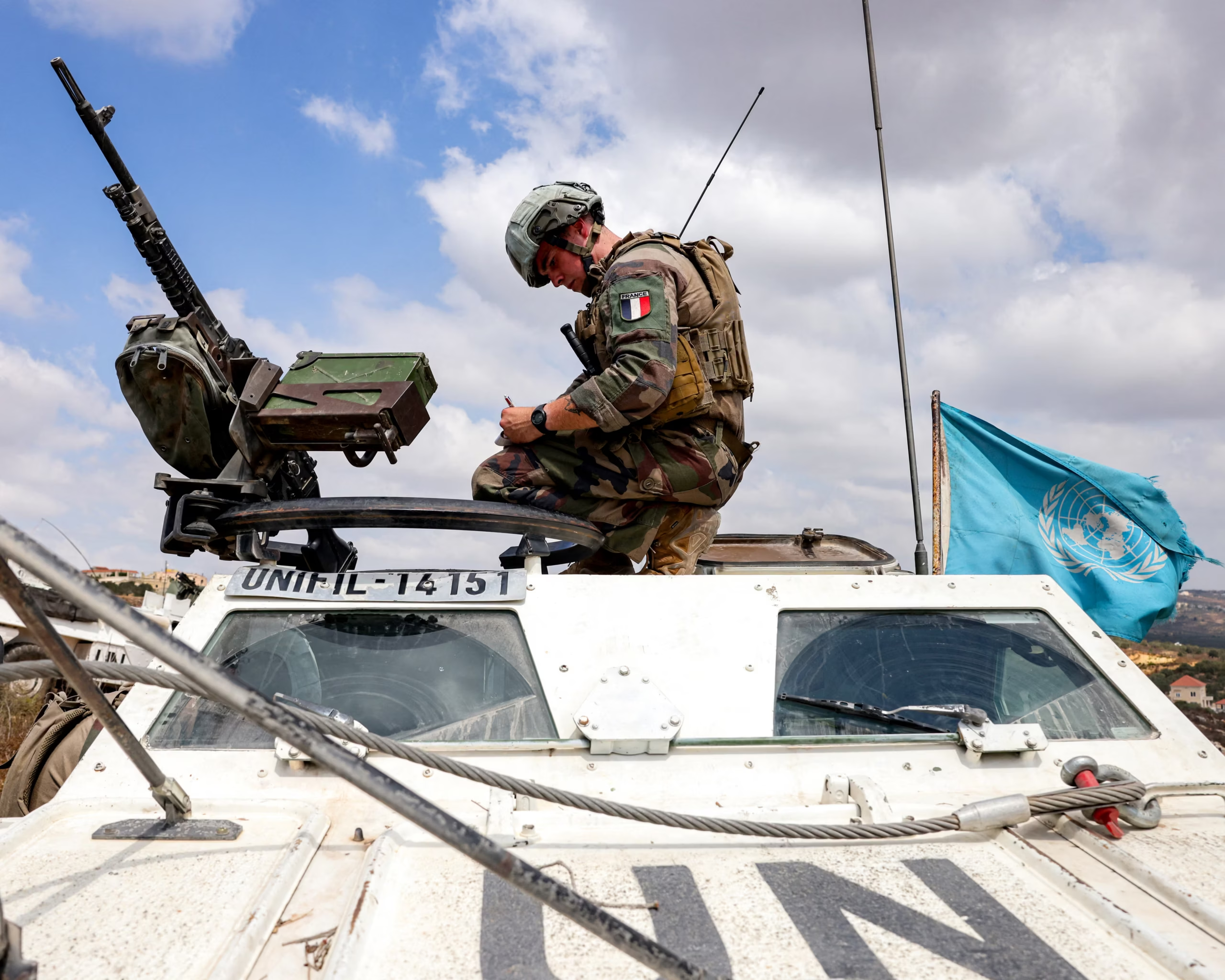
A French peacekeeper with the UN interim force in Lebanon (Unifil), August 2025. Photograph: Anwar Amro/AFP/Getty Images
A world without rules is an insecure world. It’s time for multilateralism that truly reflects the global order.
30 Mar 2026 – Every violation of international law invites the next. From Afghanistan to Iran, and across Iraq, Libya, Syria, Ukraine, Gaza and Venezuela, the line between what is permitted and what is prohibited has been steadily blurred by the complicit inaction of the UN security council. Wielding the veto as both a shield and a weapon, its permanent members too often act without grounding in the UN charter. They play with the fate of millions, leaving a trail of death and destruction.
Until recent years, there was at least an attempt to give interventions a veneer of legitimacy through UN endorsement. Today, the open exercise of power no longer even tries to keep up appearances. The guardrails of multilateral institutions are becoming too narrow to contain hegemonic rivalries. Without multilateralism, we risk replacing an imperfect system of collective security with the brutal reality of widespread insecurity. When all constraints on the use of force are removed, chaos prevails.
The world is witnessing the highest number of armed conflicts since the second world war. It is no coincidence that this is happening at a moment when democracy stands at a crossroads. Extremism is both the starting point and the end point of a vicious cycle. When governments allow themselves to be drawn into war by intolerance or the arrogance of power, they plant the seeds of resentment that yield more hatred and violence.
Technological advances with both civilian and military applications confront us with ethical questions. The selection of military targets is already being carried out by artificial intelligence, without legal or moral parameters in place. The principles of international humanitarian law – in particular the distinction between civilians and combatants – are under serious threat. Women and children are the primary victims of this collective tragedy.
We are living through an arms race that is pushing countries to devote ever larger shares of their budgets to armaments. Military spending globally, now about $2.7tn, absorbs valuable resources that could instead be used to fight hunger and poverty, confront the climate crisis, ensure universal access to education and promote digital inclusion. Even more egregious is the recurring use of hunger as a weapon of war, and the impunity with which forced displacement is carried out.
No bombs, drones or missiles can shield economies from the impact of armed conflict. Fluctuations in oil prices mean more expensive – or even inaccessible – energy and transport for businesses and consumers. Blockades constrain trade. Fertiliser shortages push up food prices and fuel inflation. Central banks raise interest rates, increasing public and private debt. Investment opportunities and jobs are lost.
Unilateral actions, arbitrary measures, violations of sovereignty and summary executions are becoming the rule. A study published in the Lancet shows that sanctions imposed without UN backing – particularly economic ones – affect mortality rates in targeted countries, and have, on average, been responsible for about half a million deaths each year since the 1970s.
Excessive power and instability go hand in hand. A world without rules is an insecure world, where anyone can be the next victim. Violence cannot replace dialogue, nor can force prevail over diplomacy. The prerogatives of the permanent members of the security council are already unjustifiable in an international order grounded in the sovereign equality of nations. When exercised irresponsibly, they become intolerable. It is time to respond with resolve by restoring the capacity of a reformed United Nations to act, so that it no longer remains a mere spectator to events that affect us all.
_________________________________________________
Luiz Inácio Lula da Silva is the President of Brazil.
Go to Original – theguardian.com
Tags: Anti-hegemony, Anti-imperialism, BRICS, Brazil, Lula da Silva, Multipolar World Order, UNSC, United Nations, Warfare
DISCLAIMER: The statements, views and opinions expressed in pieces republished here are solely those of the authors and do not necessarily represent those of TMS. In accordance with title 17 U.S.C. section 107, this material is distributed without profit to those who have expressed a prior interest in receiving the included information for research and educational purposes. TMS has no affiliation whatsoever with the originator of this article nor is TMS endorsed or sponsored by the originator. “GO TO ORIGINAL” links are provided as a convenience to our readers and allow for verification of authenticity. However, as originating pages are often updated by their originating host sites, the versions posted may not match the versions our readers view when clicking the “GO TO ORIGINAL” links. This site contains copyrighted material the use of which has not always been specifically authorized by the copyright owner. We are making such material available in our efforts to advance understanding of environmental, political, human rights, economic, democracy, scientific, and social justice issues, etc. We believe this constitutes a ‘fair use’ of any such copyrighted material as provided for in section 107 of the US Copyright Law. In accordance with Title 17 U.S.C. Section 107, the material on this site is distributed without profit to those who have expressed a prior interest in receiving the included information for research and educational purposes. For more information go to: http://www.law.cornell.edu/uscode/17/107.shtml. If you wish to use copyrighted material from this site for purposes of your own that go beyond ‘fair use’, you must obtain permission from the copyright owner.
Join the discussion!
We welcome debate and dissent, but personal — ad hominem — attacks (on authors, other users or any individual), abuse and defamatory language will not be tolerated. Nor will we tolerate attempts to deliberately disrupt discussions. We aim to maintain an inviting space to focus on intelligent interactions and debates.
Read more
Click here to go to the current weekly digest or pick another article:
UNITED NATIONS:
- Navigating International Humanitarian Law in the Age of Autonomous Weapons
- Genocide Deniers Call Gaza Starvation a ‘Hoax’ by Citing UNICEF—Which Reported Famine
- “The Essence of Childhood Has Been Destroyed”: Israel’s Deliberate Targeting of Children in the Occupied Palestinian Territory since 7 Oct 2023