
Trump and Lula at the White House: A Relationship Built on Pragmatism and a Broader Regional Calculus
LATIN AMERICA AND THE CARIBBEAN, 11 May 2026
Guilherme Casarões | The Conversation - TRANSCEND Media Service
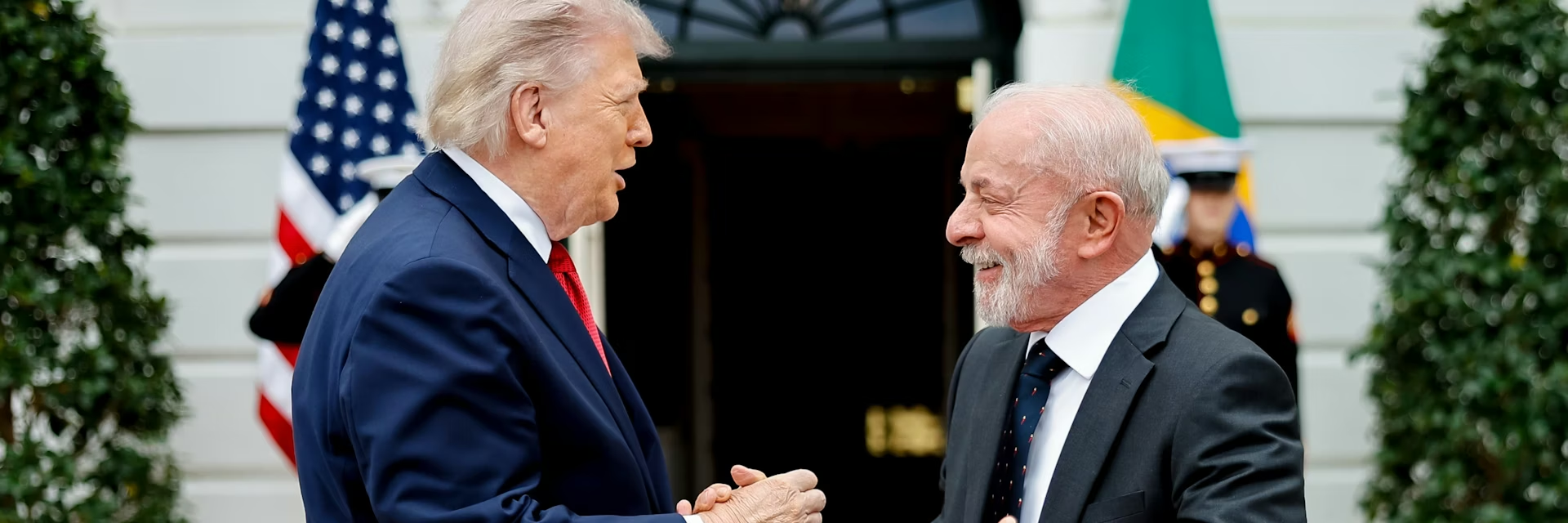
Brazilian President Lula da Silva greets US President Donald Trump upon his arrival at the White House: the trip also serves a second, equally important function for Lula, as each item on the bilateral agenda maps directly onto a domestic electoral fault line. Ricardo Stuckert/PR, CC BY
8 May 2026 – For about three hours of closed-door talks between Brazilian President Luiz Inácio Lula da Silva and US President Donald Trump at the White House on May 7, 2026, many observers in the two countries held their breath. Since there was no official joint statement or press conference, they did not know what to expect. Despite the reported “chemistry” between both presidents at the United Nations General Assembly last September, bilateral tensions were far from resolved.
The meeting between both presidents could have gone many ways: on the surface, Brazil and the US currently stand more as geopolitical rivals than allies. Over the last few months, Lula has made several criticisms to what he saw as a renewed US unilateralism. The Trump administration, in turn, seems to be responsive to the former President Jair Bolsonaro family’s demands regarding free speech or organized crime.
But Lula wanted the conversation to succeed, not so much because of diplomatic concerns, but because he faces an uphill battle ahead of the October elections. His trip to Washington was, above all, a domestic political operation. Even if the meeting lacked specific results, the positive atmosphere reported by both presidents was a victory for Lula in the context of a presidential race that is already shaping up to be one of the most consequential in Brazil’s recent history.
Flávio Bolsonaro, the eldest son of the jailed former President Jair Bolsonaro, has mounted a formidable electoral challenge. Polls now show him in a statistical tie with Lula in a hypothetical runoff, which is a remarkable position for a candidate whose political inheritance includes a father convicted of attempting a coup d’état.
The far-right senator has made several trips to the United States over recent months, including an appearance at the conservative CPAC summit, projecting himself as the candidate who can restore Brazil’s relationship with Washington after years of what he characterizes as Lula’s anti-American drift. His pitch to Brazilian voters is simple and powerful: only a Bolsonaro can work with Trump.
That narrative has found purchase in a Brazilian electorate that is increasingly attentive to geopolitical alignments. This is not the Brazil of previous electoral cycles, where foreign policy was a footnote.
Trump as a lifeline
Since Trump’s return to the White House, the Bolsonarist movement has portrayed the U.S. president as a lifeline, not only capable of keeping Jair Bolsonaro out of jail but also helping his movement’s political comeback. Flávio has reportedly pledged significant concessions to Washington on rare earth minerals, narcoterrorism designations, and trade, presenting these as proof of loyalty to an administration that the Bolsonaro family views as friendly and like-minded.
Whether or not Trump reciprocates that loyalty in any meaningful way is almost beside the point. The image of members of the Bolsonaro dynasty in Washington, welcomed by the MAGA establishment, is itself an electoral asset.
This is precisely the vulnerability that Lula traveled to Washington to neutralize. By securing a White House meeting, the Brazilian president sent a clear signal to his domestic audience: the relationship with Washington is not broken, and it does not require a Bolsonaro to fix it. The Brazilian-only press conference that followed the meeting only served to reinforce this point.
But the trip serves a second, equally important function. Each item on the bilateral agenda maps directly onto a domestic electoral fault line for Lula. On trade and tariffs, Lula returns home able to claim that he is fighting to protect Brazilian exporters and consumers from the inflationary pressures of a trade war. On organized crime – specifically the potential US designation of drug gangs PCC and Comando Vermelho as foreign terrorist organizations – the president can portray himself as a defender of Brazilian sovereignty and judicial autonomy, resisting external interference in domestic security policy. On rare earth minerals and strategic resources, Lula can reframe what is, in essence, a negotiation over economic dependency as a story of Brazil’s rising geopolitical clout.
And on democracy itself, the contrast with the Bolsonaro family could not be starker: while the father languishes under house arrest for plotting a coup, they were not able to prevent Lula from being welcomed in Washington as a legitimate (and friendly) head of state.
Political pragmatism
It would be a mistake, however, to reduce Trump’s willingness to meet Lula to a mere diplomatic courtesy. The Trump administration has shown a consistent pragmatism beneath its ideological posturing. Its management of relations with Claudia Sheinbaum’s Mexico, its intermittent engagement with Venezuela, and now its reception of Lula all suggest that the White House can work with ideological opponents when strategic interests demand it.
Brazil, the largest economy in South America and a country with substantial reserves of the critical minerals that Washington covets for its industrial and defense supply chains, is too significant to be held hostage to electoral sympathies for the Bolsonaro family. There is also a broader regional calculus: as the United States asserts primacy across Latin America through what has become known as the “Trump Corollary”, having a cooperative Brazilian government is considerably more useful than a destabilized one.
None of this means that Lula’s Washington gambit will succeed electorally. Flávio Bolsonaro has proven to be a more disciplined and adaptable candidate than his father, and the transnational networks that animate the Bolsonarist movement extend well beyond Washington. A single White House photo-op carries only so much weight.
What the trip does illustrate, however, is the degree to which Brazilian electoral politics has become inseparable from the global contest over alignment, sovereignty, and great-power patronage. In that contest, Lula has made his move. It will hardly change the minds of those who, left or right, have already made up their minds about their candidates. But it shows to the centrist voter, if anything, that a pragmatic defense of Brazilian sovereignty can be much more efficient than ideological submission to foreign interests.
_________________________________________________
an Associate Professor of Brazilian Studies at Florida International University.
Go to Original – theconversation.com
Tags: Brazil, Latin America Caribbean, Lula da Silva, North America, Trump, USA, White house
DISCLAIMER: The statements, views and opinions expressed in pieces republished here are solely those of the authors and do not necessarily represent those of TMS. In accordance with title 17 U.S.C. section 107, this material is distributed without profit to those who have expressed a prior interest in receiving the included information for research and educational purposes. TMS has no affiliation whatsoever with the originator of this article nor is TMS endorsed or sponsored by the originator. “GO TO ORIGINAL” links are provided as a convenience to our readers and allow for verification of authenticity. However, as originating pages are often updated by their originating host sites, the versions posted may not match the versions our readers view when clicking the “GO TO ORIGINAL” links. This site contains copyrighted material the use of which has not always been specifically authorized by the copyright owner. We are making such material available in our efforts to advance understanding of environmental, political, human rights, economic, democracy, scientific, and social justice issues, etc. We believe this constitutes a ‘fair use’ of any such copyrighted material as provided for in section 107 of the US Copyright Law. In accordance with Title 17 U.S.C. Section 107, the material on this site is distributed without profit to those who have expressed a prior interest in receiving the included information for research and educational purposes. For more information go to: http://www.law.cornell.edu/uscode/17/107.shtml. If you wish to use copyrighted material from this site for purposes of your own that go beyond ‘fair use’, you must obtain permission from the copyright owner.
Join the discussion!
We welcome debate and dissent, but personal — ad hominem — attacks (on authors, other users or any individual), abuse and defamatory language will not be tolerated. Nor will we tolerate attempts to deliberately disrupt discussions. We aim to maintain an inviting space to focus on intelligent interactions and debates.
Read more
Click here to go to the current weekly digest or pick another article:
LATIN AMERICA AND THE CARIBBEAN: