
Advocates Renew Call for End to US Sanctions after Devastating Venezuela Earthquakes
LATIN AMERICA AND THE CARIBBEAN, 29 Jun 2026
Brett Wilkins | Common Dreams - TRANSCEND Media Service
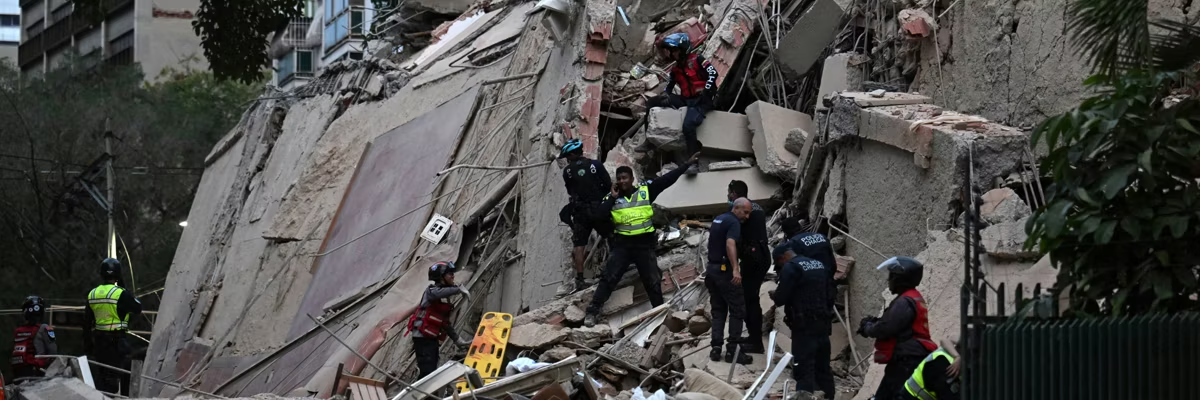
Rescuers search for victims in a collapsed building in Caracas following two massive earthquakes that rocked Venezuela on 24 Jun 2026. (Photo by Juan Barreto/AFP via Getty Images)
Despite Earthquake, Trump Keeps Sanctions on Venezuela
25 Jun 2026 – Human rights groups on Thursday implored the United States and allied countries to lift all sanctions against Venezuela—which experts say have already killed tens of thousands of people—as the beleaguered South American country reels from Wednesday’s devastating earthquakes.
At least 188 people are dead and over 1,500 others injured, with those figures almost certain to rise, following a 7.2-magnitude temblor centered in San Felipe, Yaracuy—about 100 miles west of Caracas—and a 7.5-magnitude quake that struck less than a minute later, also in centered in Yaracuy.
US President Donald Trump, who authorized the illegal invasion of Venezuela and adbuction of President Nicolás Maduro earlier this year, wrote on social media after the earthquakes that his administration “stands ready, willing, and able to help.”
“We will be there for our new and great friends,” Trump claimed.
Delcy Rodríguez, Maduro’s vice president and acting president since his ouster, thanked the Trump administration for “offering support and solidarity to the people of Venezuela in the face of this tragedy that has plunged us into mourning.”
However, US sanctions—first imposed during then-President George W. Bush’s second term while Hugo Chávez was leading Venezuela and ramped up under the Obama, Trump, and Biden administrations—remain in place, complicating relief efforts after one of the country’s worst-ever natural disasters.
While the Trump administration has issued narrow exemptions from sanctions to companies looking to profit from Venezuela’s crisis and copious natural resources, primarily oil, these waivers have not delivered broad relief to the people who need it most.
“Today’s catastrophe makes clear what we have long argued: When a country is deliberately weakened through economic warfare, its ability to prepare for, respond to, and recover from disasters is also weakened,” the US-based peace group CodePink said in a statement. “The United States has a responsibility to help address the humanitarian consequences of the policies it has imposed.”
🇻🇪 CODEPINK extends our deepest condolences to the people of Venezuela following the devastating earthquakes that have taken hundreds of lives, injured thousands, and left entire communities in urgent need of assistance.Our full statement: buff.ly/QzYcQ3p
CodePink continued:
Too often, we’ve seen the US and other Western countries exploit natural disasters like this in order to deepen foreign control. In Haiti, the US and its allies have repeatedly pushed militarization and politically conditioned aid instead of genuine recovery led by the country itself. In this moment, the world must refuse to allow Venezuela to be forced down the same path.
We also call on the administration to immediately lift all US sanctions on Venezuela and release Venezuelan funds under US jurisdiction so they can be used for emergency relief, reconstruction, and recovery.
“This is the time for cooperation, compassion, and respect for Venezuela’s sovereignty,” CodePink added. “We urge the international community to support relief efforts and stand with the Venezuelan people as they rebuild their homes, their communities, and their future.”
The Center for Economic and Policy Research (CEPR), a Washington, DC-based think tank, said Thursday that “while the Trump administration has issued a series of general licenses to allow foreign businesses and banks to operate in Venezuela in spite of US sanctions, the continued existence of these sanctions significantly discourages international economic and financial actors from expanding operations there.”
CEPR co-director Mark Weisbrot said that “we must remember that Venezuela suffered the worst depression in the history of the world, without a war, due to illegal US economic sanctions.”
“This deadly destruction was not a mistake, but an expected result that would happen to any country that was cut off by sanctions from the international financial system, and also from the vast majority of its foreign exchange earnings from exports,” he continued.
According to a 2019 CEPR report, as many as 40,000 Venezuelans died due to sanctions during the previous two years. The sanctions ostensibly targeted Maduro’s government, but made it much more difficult for millions of people to obtain food, medicine, and other necessities.
“Tens of thousands, and more likely hundreds of thousands, of Venezuelans died as a result of those sanctions,” Weisbrot said Thursday. “The United States is therefore obligated to help prevent further loss of life in Venezuela.”
______________________________________________

Brett Wilkins is a staff writer for Common Dreams. Full Bio >
Go to Original – commondreams.org
Tags: Collective Punishment, Inhuman Punishment, Latin America Caribbean, Sanctions, Trump, USA, Venezuela
DISCLAIMER: The statements, views and opinions expressed in pieces republished here are solely those of the authors and do not necessarily represent those of TMS. In accordance with title 17 U.S.C. section 107, this material is distributed without profit to those who have expressed a prior interest in receiving the included information for research and educational purposes. TMS has no affiliation whatsoever with the originator of this article nor is TMS endorsed or sponsored by the originator. “GO TO ORIGINAL” links are provided as a convenience to our readers and allow for verification of authenticity. However, as originating pages are often updated by their originating host sites, the versions posted may not match the versions our readers view when clicking the “GO TO ORIGINAL” links. This site contains copyrighted material the use of which has not always been specifically authorized by the copyright owner. We are making such material available in our efforts to advance understanding of environmental, political, human rights, economic, democracy, scientific, and social justice issues, etc. We believe this constitutes a ‘fair use’ of any such copyrighted material as provided for in section 107 of the US Copyright Law. In accordance with Title 17 U.S.C. Section 107, the material on this site is distributed without profit to those who have expressed a prior interest in receiving the included information for research and educational purposes. For more information go to: http://www.law.cornell.edu/uscode/17/107.shtml. If you wish to use copyrighted material from this site for purposes of your own that go beyond ‘fair use’, you must obtain permission from the copyright owner.
Join the discussion!
We welcome debate and dissent, but personal — ad hominem — attacks (on authors, other users or any individual), abuse and defamatory language will not be tolerated. Nor will we tolerate attempts to deliberately disrupt discussions. We aim to maintain an inviting space to focus on intelligent interactions and debates.
Read more
Click here to go to the current weekly digest or pick another article:
LATIN AMERICA AND THE CARIBBEAN: