
30 June 1960: Congo Received a Flag, a National Anthem—and a Booby-Trapped State
TRANSCEND MEMBERS, 6 Jul 2026
Raïs Neza Boneza – TRANSCEND Media Service
29 Jun 2026 – On 30 June 1960, Congo became independent. Or, more precisely, Belgium handed Congo a flag, a few speeches, a timetable, a constitutional manual written elsewhere, and an administrative machine whose steering wheel was still suspiciously connected to Brussels. It was independence, certainly. But it was independence in the colonial style: congratulations on your new house; apologies about the missing roof, the locked basement, and the previous owner still keeping the keys. The road to that day had already revealed the central truth of Congo’s postcolonial tragedy: the Congolese people had voted, but the colonial establishment was still trying to edit the result.
May 1960: The People Vote. Brussels Checks the Fine Print.
The elections of May 1960 produced a fragmented parliament, as elections in vast, newly politicized countries often do. Congo was not a neat little European municipality where three parties argue about parking spaces and then form a coalition over coffee. More than a dozen significant political forces entered the arena. Regional interests collided with national ambitions. Personal rivalries wore ideological clothes. Old colonial hierarchies met new nationalist impatience. Yet one fact was clear enough to make Brussels uncomfortable: Patrice Émery Lumumba’s Mouvement National Congolais and its allies had emerged as the central political force. Lumumba was not merely asking for a flag and a ceremonial handshake. He represented a more dangerous idea: that independence should mean Congolese control over Congo. That was the problem. Belgium had accepted independence with the enthusiasm of a landlord signing a lease while quietly removing the plumbing. The colonial authorities had hoped for a transition managed by politicians more predictable, more regional, more cautious, and preferably less interested in asking inconvenient questions about mines, banks, army command, land, foreign capital, and who exactly had benefited from seventy-five years of “civilizing mission.” Lumumba had the irritating habit of treating independence as something more than a change of uniforms at government offices.
17–18 June: The First Attempt to Outvote the Voters
The first manoeuvre came quickly. Joseph Kasa-Vubu, leader of ABAKO and one of Lumumba’s major rivals, was designated to form a government. The logic was elegant in the way colonial logic often is: the election had produced an inconvenient winner, so perhaps another man could be asked to govern instead. Democracy, apparently, was welcome—as long as it arrived wearing acceptable shoes. On 18 June, Kasa-Vubu presented a proposed government designed to push Lumumba aside. It was an attempt to construct an alternative centre of power before independence, one more reassuring to Belgian interests and less likely to demand that sovereignty actually become sovereign. But the arrangement collapsed almost immediately. Jason Sendwe of BALUBAKAT, Antoine Gizenga of the Parti Solidaire Africain, Anicet Kashamura of CEREA and other key forces withdrew their support. The proposed government was exposed for what it was: not a national coalition, but a political emergency exit built by people who did not like the election result. It had ministers, names, titles, and perhaps even a future seating chart. What it did not have was a parliamentary majority. A government without a majority is not a government. It is a press release with furnishings.
21 June: Brussels Discovers Arithmetic
By 21 June, the manoeuvre had failed. The Belgian authorities had to retreat from the fantasy that the Congo could be shepherded into independence through a government deliberately detached from the country’s electoral reality. Lumumba, whom Brussels had worked to keep away from power, was finally asked to form a government. This was not a gift. It was not an act of colonial enlightenment. It was political arithmetic. Lumumba had won the central battle because the electoral verdict could be delayed, manipulated, softened, decorated, and discussed in very serious administrative language—but not entirely erased. At thirty-five, Lumumba had become the man Belgium had hoped to avoid and Congo could no longer avoid. He now faced an almost absurd task: to build a viable national government in a matter of days, from a parliament fractured by regional loyalties, ideological tensions, colonial distortions and personalities large enough to require their own provinces. The Congo was expected to become a functioning state by the end of the month. Belgium had spent decades making sure that few Congolese had access to senior administration, military command, financial management or the machinery of national power. Then, suddenly, everyone was shocked that the handover looked rushed. It was rather like throwing someone into the Congo River after confiscating their boat, their map and their swimming lessons, then publishing an editorial about their poor technique.
23 June: The Marriage Nobody Trusted
Lumumba’s solution was political compromise. On 23 June, he assembled a broad coalition and reached an agreement with Kasa-Vubu. Kasa-Vubu would become President of the Republic; Lumumba would become Prime Minister. It was a marriage arranged not by affection but by necessity. The two men represented different political traditions, different regional constituencies and different visions of the new Congo. Lumumba wanted a strong central state capable of holding together a country the size of Western Europe. Kasa-Vubu was more cautious, more rooted in regional balances, and surrounded by networks that did not necessarily share Lumumba’s appetite for a forceful national transformation. But neither man could afford open war before independence. So, they made peace in the traditional manner of politicians everywhere: publicly, temporarily, and with one hand already near the drawer where the knives were kept. Under the Fundamental Law imposed for the transition, the Prime Minister held the central responsibilities of government. The President represented the state and performed an important constitutional role, but the government was answerable through the parliamentary structure. Lumumba accepted the presidency for Kasa-Vubu because he understood the machinery of power. He ceded prestige in order to retain the engine. It was a clever calculation. It was also the beginning of an unstable arrangement in which both men would later claim to be defending the constitutional order against the other.
The Bolikango Question: In Politics, Everyone Remembers the Betrayal They Did Not Start
Jean Bolikango, another major political figure, believed he had an understanding with Lumumba concerning the presidency. When Kasa-Vubu was elected instead, Bolikango and his supporters saw betrayal. But the story is more complicated than the legend. Before Lumumba’s final deal with Kasa-Vubu, Bolikango had participated in efforts connected to the alternative government project intended to keep Lumumba from power. In other words, the alliance had already been damaged before Lumumbamade his own calculation. This does not make Lumumba innocent. Politics rarely offers innocence. It offers timing, leverage, disappointment, and speeches pretending that nobody ever had lunch with the enemy. Lumumba’s decision helped secure the parliamentary arrangement needed for independence. But it also alienated Bolikango and sections of the Equateur political network, including influential figures within the inherited colonial administration and security apparatus. The new state had not yet raised its flag, and already its coalition was developing cracks. Congo was being born with a national anthem in one hand and a resignation letter in the other.
30 June: The Ceremony
Then came Independence Day. King Baudouin arrived in Léopoldville in full ceremonial splendor, surrounded by the visual language of monarchy, medals, military authority and imperial confidence. His speech praised the role of Belgium and invoked Leopold II, as though the Congo’s history had been a charitable internship supervised by a man whose name had become synonymous with colonial atrocity. It was a remarkable performance. Imagine arriving at the funeral of a man you robbed, praising his work ethic, and then asking his children to be grateful for the coffin. Kasa-Vubu spoke with presidential restraint. He gave the ceremony the diplomatic tone expected from a new head of state trying to ensure that the republic entered the world without immediately setting fire to the reception hall. Then Lumumba spoke. He had not been expected to deliver the speech that he delivered. History has never lacked guests who, once invited to the table, refuse to sit quietly and look decorative. Lumumba did not accept the colonial script. He reminded the world that Congo’s independence had not been granted as a polite favor. It had been conquered through struggle. He named the humiliation, discrimination, violence, dispossession and exploitation behind the pageantry. He refused to turn the end of colonial rule into a retirement party for colonialism. For the first time in that ceremony, the people whose country was supposedly being liberated were not being asked to applaud their former masters. They were being told the truth. And that truth was considered terribly impolite. Colonialism has always had a special talent for committing violence and then becoming offended by the tone of the survivor.
A Flag Without Full Power
Lumumba had won an extraordinary political victory. He had defeated the attempt to bypass the electoral verdict. He had forged a coalition. He had taken the office of Prime Minister. He had placed Congo on the world stage as a country refusing to apologize for becoming free. But he did not inherit a state capable of carrying the weight of that freedom. The treasury was fragile. The monetary and financial systems remained deeply entangled with foreign interests. The administration was largely shaped by colonial personnel and colonial habits. The army remained under Belgian command structures. The economy was still organized around extraction, not national development. Congo possessed uranium, copper, cobalt, diamonds, gold, forests, rivers and immense human potential. What it did not possess was control over the mechanisms that transformed wealth into sovereignty. That was the poisoned gift. Belgium had not merely left Congo underprepared. It had built the colonial system precisely to prevent Congolese political, administrative and economic autonomy. Then it departed at speed, leaving behind an institutionally fragile country and acting surprised when the structure began to shake.
The Regional Dimension: A Country Built on Fault Lines
Congo’s fragility was not only a problem of empty offices, missing civil servants and ministers discovering that independence came without an instruction manual. It was also a problem of geography. Not ordinary geography: colonial geography. The kind designed by accountants, concession companies and men in Brussels who looked at a continent and saw a spreadsheet with rivers. Congo’s provinces had not been developed as parts of one national economy. They had been developed as extraction zones with different flags, different railway lines and the same final destination: Europe. Katanga, in the southeast, was the industrial jewel: copper, cobalt, uranium, and enough underground wealth to make foreign shareholders suddenly develop a deep spiritual attachment to “regional autonomy.” Kasai possessed diamond fields so rich that even the soil seemed to have a Swiss bank account. Together, Katanga and Kasai produced much of the colony’s export wealth. But that wealth was not built to feed Congo. It was built to travel outward—by rail, by contract, by ship, by bank transfer, and eventually by champagne glass in Brussels. The mines were connected to European capital, European ports and European buyers. They were not connected to a national economic vision because colonialism does not build nations. It builds pipelines. Belgium had effectively created regional economic kingdoms. Provincial budgets, mining concessions and labor systems had been designed separately, with little concern for whether Congo itself might one day need to function as a country rather than a warehouse with human beings inside it. Then independence arrived. Suddenly, everyone was expected to act surprised that the warehouse had no national loading plan.
Moïse Tshombe and CONAKAT in Katanga argued for autonomy. But let us be generous: “autonomy” is a beautiful word. It sounds like a song. It sounds like dignity. It sounds much better than: Please do not let Léopoldville touch the copper. Katanga’s political elite feared a nationalist government led by Lumumba. They feared nationalization. They feared redistribution. They feared the horrifying possibility that Katanga‘s wealth might be used to build schools, roads and hospitals beyond Katanga. A scandal, obviously. Within days of independence, Tshombe declared Katanga‘s secession. Belgian troops remained in the province, officially to protect European civilians—because nothing says “we respect your sovereignty” quite like sending soldiers into someone else’s country without asking them first. Belgian officers helped command the Katangese gendarmerie. Union Minière continued paying taxes to the secessionist regime. Katanga was not simply a rebellion. It was a corporate board meeting with a flag. Copper financed it. Brussels blessed it. Foreign capital applauded discreetly from behind the curtains. Kasaï soon developed its own separatist logic. The diamond barons had apparently read the Katanga manual and reached the obvious conclusion: if Katanga could keep its copper, Kasaï could keep its diamonds. Meanwhile, the government in Léopoldville had barely finished deciding who got which office before the country began falling apart like a suitcase packed by a colonial administration in a hurry.
Lumumba was not merely fighting Belgian colonialism. He was fighting an economy deliberately designed to make national unity look unreasonable. Every wealthy province had a financial reason to leave. Every poorer province had a political reason to fear abandonment. The central state was asked to hold together a country whose economic architecture had been designed, brick by brick, railway by railway, mine by mine, to pull it apart. Congo had inherited a map. The problem was that the map had been drawn by people who never intended it to become a nation.
The Church: Moral Authority, Carefully Parked
The Belgian colonial system was not only economic and administrative. It was also religious. The Catholic Church was not a minor actor standing politely in the background with a Bible and a worried expression. It was one of the principal architects of the colonial “civilizing mission”—that famous project in which people were beaten, dispossessed and governed without consent, but occasionally taught hymns. The Church controlled schools, hospitals, printing presses, radio broadcasting and much of the social infrastructure. By 1960, it had educated many of the Congolese political elite, including Lumumba, Kasa-Vubu and numerous parliamentarians. In other words: the Church had helped train the people who would eventually demand freedom from the system it had helped administer. That is called irony. In Congo, it came with a cassock.
As independence approached, the Catholic hierarchy faced an awkward question: would it transfer its moral blessing from Belgian colonial authority to the new Congolese state? Or would it wait and see whether the new African government promised not to disturb Church property, Church influence, Church schools or the sacred mystery of European privilege? The answer was cautious ambiguity. Archbishop Félix Scalais and the hierarchy spoke of “order,” “stability,” and “respect for property.” In normal circumstances, these sound harmless. In a country emerging from colonial exploitation, however, they sounded rather different. “Order” often meant: do not disturb the old hierarchy. “Stability” often meant: do not frighten the investors. “Respect for property” often meant: please do not ask who acquired all this property, how, and with whose labor.
When Katanga seceded, the Church’s silence became even more eloquent. Many Catholic missionaries in Katanga sympathized with Tshombe’s regime. Lumumba‘s anti-colonial rhetoric, socialist language and suspicion toward clerical power made him deeply unpopular among sections of the missionary establishment. Some missionaries treated Katanga‘s secession as a defense of “Christian civilization” against “communist barbarism.” Which is a remarkable sentence when one remembers that the so-called civilization in question had spent decades treating Congolese people as labor reserves with baptism certificates. The Church possessed moral authority that could have defended national unity, condemned Belgian intervention, or challenged the destruction of Congo’s sovereignty. Instead, much of the hierarchy watched. It did not excommunicate Tshombe. It did not place secession on the same moral level as colonial injustice. It did not loudly declare that a country cannot become free while its richest province is protected by foreign troops and mining corporations. Silence, however, is never neutral when one side has guns, copper and Belgian officers. It was a political choice dressed in ecclesiastical robes.
The Belgian Exception: How to decolonize by leaving the Building on Fire
Was Congo’s case exceptional? Yes and no. Britain had its own empire, its own greed, its own tricks, and its own talent for leaving behind borders drawn with a ruler and a hangover. But in places such as Ghana, the colonial state at least transferred more administrative capacity before independence. Kwame Nkrumah inherited a civil service that had been progressively Africanized, a university, a growing African officer corps, and a treasury that some Ghanaian officials actually understood. It was not paradise. Britain did not leave Ghana with a handwritten apology and the Crown jewels. But compared with Congo, Ghana received something close to a state. Nigeria, independent in October 1960, had also undergone a longer political transition. Nigerianization of the civil service had been underway for years. Regional governments already existed. The federal structure was complicated, fragile and later catastrophic—but it was not invented five minutes before the opening ceremony.
France, meanwhile, preferred a different model: independence with strings attached, military bases nearby, the French franc in the pocket, French advisers in the office, and Paris still sitting quietly in the room like a former spouse who refuses to move out. Guinea’s Sékou Touré rejected de Gaulle’sarrangement and paid dearly. French officials departed with astonishing speed, taking files, equipment, typewriters and even telephones. The message was clear: independence is free, but the furniture is ours.
Congo received the worst combination. Belgium offered the abrupt abandonment of Guinea without even Guinea’s political preparation. Yet it retained the economic grip of the French model: Union Minière, banking interests, monetary structures and commercial networks remained deeply tied to Belgian power. Unlike Britain, Belgium had barely Africanised the administration. Unlike France, Belgium did not even bother to make dependency look like partnership. It simply left the Congo’s political house while keeping the deeds, the bank account and the electricity switch. This was not negligence. It was structural sabotage with excellent manners.
The United Nations: Arriving as a Fire Brigade, Leaving Like an Undertaker
Then came the mutiny. Within days of independence, soldiers in the Force Publique rose up against Belgian officers and the slow pace of Africanization. The army had been designed as a colonial force: Congolese soldiers, Belgian commanders, discipline through humiliation, and promotion ceilings low enough to cause neck pain. Independence arrived. The uniforms remained. The officers remained. The hierarchy remained. The soldiers noticed. Belgium responded by sending paratroopers into Congo without consulting the new government. Officially, this was to protect European civilians. Unofficially, it was another reminder that Congo’s sovereignty came with terms and conditions.
Lumumba and Kasa-Vubu appealed to the United Nations. On 14 July 1960, the Security Council authorized the UN Operation in the Congo, ONUC. In theory, the international community had arrived to restore order and protect Congo’s territorial integrity. In practice, the UN arrived with a mandate so cautious that it often resembled diplomatic yoga. Secretary-General Dag Hammarskjöld insisted that the UN could not take sides in Congo’s internal disputes. That sounded noble. Neutrality always sounds noble when written in a communiqué. But Katanga’s secession was not simply an internal political disagreement about municipal zoning. It was backed by Belgian troops, Belgian officers, foreign mining interests and enormous mineral wealth. To refuse to act against that intervention was not neutrality. It was neutrality with a strong preference for the people already winning.
The UN refused to help Lumumba deploy troops to Katanga. It resisted direct action against the secession. It told the Congolese government to act legally and peacefully while its enemies received weapons, money, international protection and the practical assistance of people who had never confused “law” with “what benefits us.” When Lumumba turned toward the Soviet Union for assistance, Washington suddenly discovered that Congo had become a major Cold War emergency. The United States, already suspicious of Lumumba, began seeing him less as an African nationalist and more as a possible Soviet proxy. The CIA moved from concern to plotting. The Cold War, as usual, had found another country to use as a chessboard. In September 1960, Kasa-Vubu dismissed Lumumba in a constitutional crisis. Joseph Mobutu later seized power with foreign support. Lumumba was arrested, transferred to Katanga and murdered in January 1961 by Katangese forces and Belgian officers. The UN did not kill Lumumba. But it helped create the political space in which his enemies could. It refused to crush the Katanga secession while Lumumba still had a chance to preserve the country’s unity. It treated foreign-backed fragmentation as a domestic inconvenience. It failed to protect the elected Prime Minister from forces openly working to remove him. The United Nations had been invited to Congo as a savior. It became an undertaker with a blue helmet.
The Republic Was Born Half-Invited
There is another silence in this founding story. The first Congolese government contained no women.The Republic spoke the language of liberation while leaving women outside the cabinet rooms where liberation was being converted into institutions, offices, and law.
But women were not absent from Congo’s struggle for freedom. They organised meetings, mobilised communities, carried messages across dangerous political terrain, built networks between towns and villages, protected activists, raised support, and sustained the daily work of resistance under colonial rule. They helped create the political ground on which independence became possible.
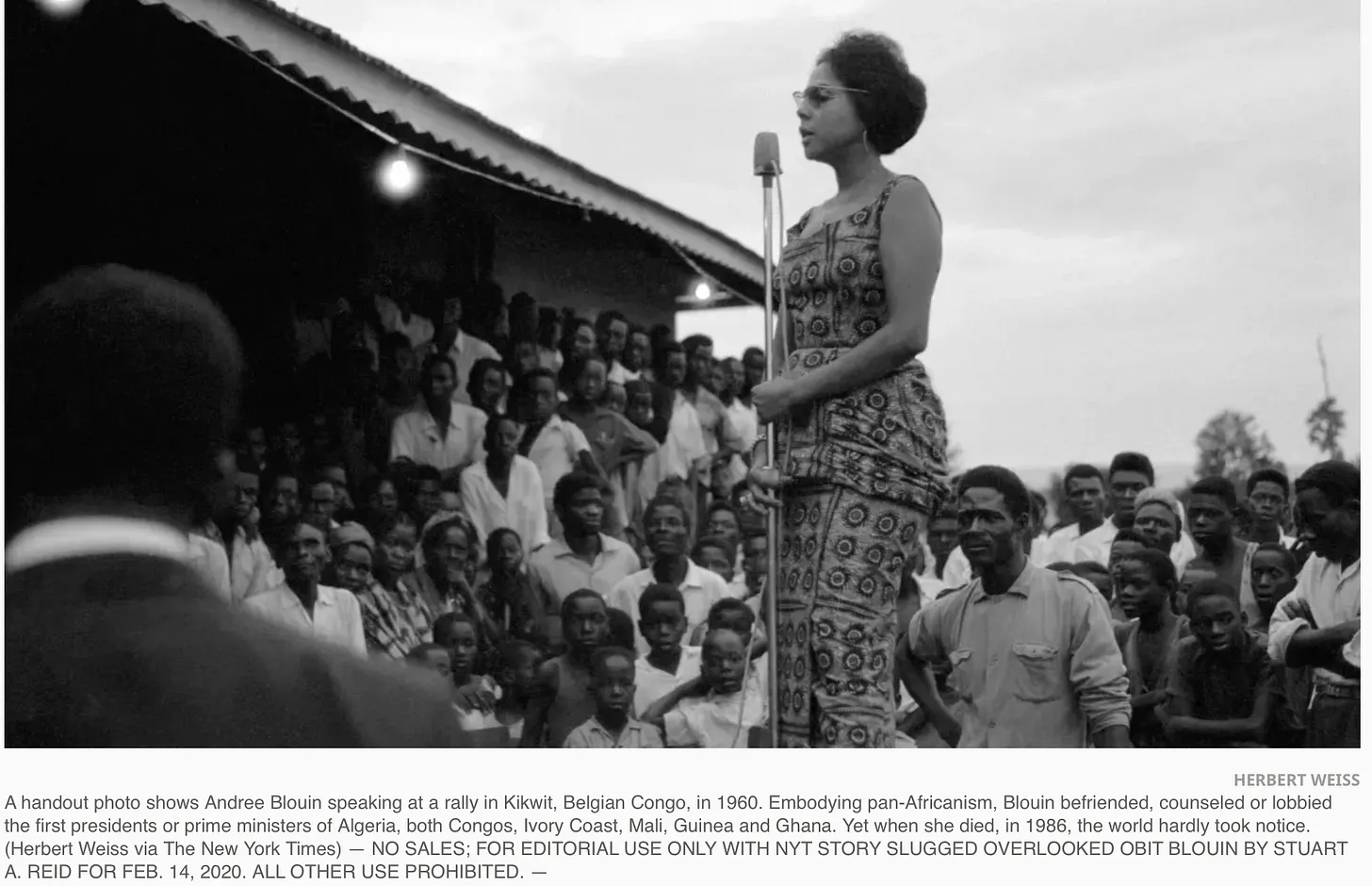
Andrée Blouin was one of them. Pan-Africanist, feminist, organiser, and writer, she entered the Congolese independence struggle not as a spectator but as a political worker with experience from anti-colonial movements across Africa. During the 1960 campaign, she worked alongside Antoine Gizenga, Pierre Mulele, and Lumumba’s allies, helping mobilise large numbers of women for the Parti Solidaire Africain and the wider nationalist cause. Her organising was practical, political, and strategic: travelling, speaking, recruiting, building local structures, and turning women’s anger at colonial rule into collective action.
After independence, Lumumba appointed her Chief of his Chief of Protocol and speechwriter. The title could sound ceremonial, but her role was not decorative on that time. Blouin helped manage diplomatic contacts, receive foreign delegations, prepare speeches, and navigate the international pressures surrounding the new government. She was part of the political machinery of a republic under siege. She understood that protocol was not merely about ceremony; it was about who could speak for Congo, who could enter its political space, and who could shape the message carried beyond its borders.
Her importance also made her a target. A politically active woman close to Lumumba was treated by sections of the press and political establishment as suspicious, improper, or dangerous. Rather than recognising her as an organiser and adviser, many preferred to reduce her to gossip, insinuation, or the familiar colonial fantasy that an influential woman must be someone’s accessory rather than an actor in her own right.
That distinction matters. Women were present in the movement, essential to its organisation, and active in its political imagination. Yet they remained excluded from the official architecture of the Republic. Their labour was needed; their authority was not equally recognised. Congo entered independence proclaiming freedom while denying women formal access to the rooms where the meaning of that freedom was being decided.
Congo could not fully reclaim its future while treating the political intelligence, labour, courage, and leadership of half its people as secondary.
The Independence That Was Still Waiting to Arrive
The lesson of 30 June 1960 is not that Lumumba failed. Nor is it that Congo was doomed. The lesson is that political independence without military, financial, economic and institutional sovereignty is an extremely expensive costume party. You may have a flag. You may have an anthem. You may have a parliament, a presidential palace, ceremonial cars, imported pens, polished shoes and enough speeches about “national destiny” to keep radio stations busy for a decade. But if someone else controls the mines, the money, the credit, the army, the contracts, the banks and the international emergency phone line, then sovereignty is mostly theatre. Beautiful theatre. Very expensive theatre. But theatre.
That is why Congo’s constitutional debates, from 1964 to 1967, from Mobutu’s republic to the 2006 Constitution and beyond, often risk missing the central question. They argue about who occupies the chair. Who gets the microphone. Who extends the mandate. Who appoints whom. Who changes which article. Meanwhile, the real question sits quietly in the corner, drinking mineral water and waiting to be invited: Who owns the machine? On 30 June 1960, Lumumba and Kasa-Vubu received the keys to Congo. But many of the locks remained in Belgian, foreign and corporate hands. Katanga’s barons had keys forged from copper and cobalt. Kasaï’s elites had keys cut from diamonds. The Church held keys to schools, hospitals and moral influence. The United Nations held keys to international legitimacy—and frequently used them to lock Lumumba out.
And now, today; Congo did not enter independence empty-handed. It entered handcuffed to an economic order designed before the flag existed—and to a regional order in which its minerals were never simply minerals, but invitations to foreign armies, neighboring ambitions, multinational appetites and diplomatic sermons.
Sixty-six years later, the names have changed, the suits are better tailored, and the speeches are now streamed in high definition. But eastern Congo is still at war. A president governs from Kinshasa while the Republic’s authority remains contested in parts of its own territory. Constitutional debates return like a seasonal illness, always presented as a cure for the nation and somehow always arriving with a political thermometer already in someone’s pocket.
Meanwhile, peace agreements are signed in Washington, photographed under chandeliers and praised as historic before the gunfire has had the courtesy to read the press release. The latest American-sponsored diplomacy promises peace, security and investment—three words that Congolese people have heard before, often in precisely the order that makes the minerals disappear first. The agreement may matter; peace must always be tried. But a peace whose map is drawn around cobalt, copper and strategic corridors must answer a blunt question: peace for whom, and prosperity for who exactly?
The tragedy of Congo is not that it lacks leaders, constitutions, summits or foreign partners. It has had all of them—sometimes in industrial quantities. The tragedy is that sovereignty is still too often negotiated as though the country were a prize to be stabilized, a mine to be secured, or a humanitarian emergency with excellent geological potential.
Lumumba’s question has therefore not disappeared. It has merely changed its clothes. Who controls the land beneath the people’s feet? Who decides the terms of peace? Who writes the constitution—and for whose future? Who profits when Congo is declared stable enough to invest in, but never safe enough for its own people to live in peace?
That is why 30 June 1960 is not a museum date, nor merely an annual parade of flags and old speeches. It is a receipt Congo keeps carrying while others deny having made the purchase.
And it is still addressed to power.
 ____________________________________________
 Raïs Neza Boneza is the author of fiction as well as non-fiction, poetry books and articles. He was born in the Katanga province of the Democratic Republic of Congo (Former Zaïre). He is also an activist and peace practitioner. Raïs is a member of the TRANSCEND Media Service Editorial Committee and a convener of the TRANSCEND Network for Peace Development Environment for Central and African Great Lakes. He uses his work to promote artistic expressions as a means to deal with conflicts and maintaining mental wellbeing, spiritual growth and healing. Raïs has travelled extensively in Africa and around the world as a lecturer, educator and consultant for various NGOs and institutions. His work is premised on art, healing, solidarity, peace, conflict transformation and human dignity issues and works also as freelance journalist. You can reach him at rais.boneza@gmail.com – http://www.raisnezaboneza.no
Tags: Africa, Belgium, Colonialism, Colonization, D.R. Congo, Europe, Imperialism, Independence, Resources, Tribalism
DISCLAIMER: The statements, views and opinions expressed in pieces republished here are solely those of the authors and do not necessarily represent those of TMS. In accordance with title 17 U.S.C. section 107, this material is distributed without profit to those who have expressed a prior interest in receiving the included information for research and educational purposes. TMS has no affiliation whatsoever with the originator of this article nor is TMS endorsed or sponsored by the originator. “GO TO ORIGINAL” links are provided as a convenience to our readers and allow for verification of authenticity. However, as originating pages are often updated by their originating host sites, the versions posted may not match the versions our readers view when clicking the “GO TO ORIGINAL” links. This site contains copyrighted material the use of which has not always been specifically authorized by the copyright owner. We are making such material available in our efforts to advance understanding of environmental, political, human rights, economic, democracy, scientific, and social justice issues, etc. We believe this constitutes a ‘fair use’ of any such copyrighted material as provided for in section 107 of the US Copyright Law. In accordance with Title 17 U.S.C. Section 107, the material on this site is distributed without profit to those who have expressed a prior interest in receiving the included information for research and educational purposes. For more information go to: http://www.law.cornell.edu/uscode/17/107.shtml. If you wish to use copyrighted material from this site for purposes of your own that go beyond ‘fair use’, you must obtain permission from the copyright owner.
Join the discussion!
We welcome debate and dissent, but personal — ad hominem — attacks (on authors, other users or any individual), abuse and defamatory language will not be tolerated. Nor will we tolerate attempts to deliberately disrupt discussions. We aim to maintain an inviting space to focus on intelligent interactions and debates.